Generative engine optimization (GEO) is the practice of editing and structuring content so that generative AI search engines cite it and show it in their answers. The term comes from a 2023 research paper, “GEO: Generative Engine Optimization”, which appeared at KDD 2024 and tested nine ways to rewrite a source.
Search demand for generative engine optimization is measurable. On October 5, 2026, Ahrefs estimated about 7,200 monthly US searches and 26,000 worldwide for “generative engine optimization”, with a keyword difficulty of 1. Related terms are smaller. “AI search optimization” draws about 3,500 US and 7,100 global searches, and “geo seo” about 3,000 and 16,000.
Most pages on this topic repeat one headline number. This guide covers the full method table, where the results hold and where they run out, and what Google said in July 2026.
Where the term generative engine optimization comes from
Generative engine optimization traces back to a paper by six researchers: Pranjal Aggarwal, Vishvak Murahari, Tanmay Rajpurohit, Ashwin Kalyan, Karthik Narasimhan and Ameet Deshpande. The paper first appeared on arXiv on November 16, 2023. Its final version ran in the proceedings of KDD 2024, held in Barcelona in August 2024.
That final version lists the authors at IIT Delhi and Princeton University, with two co-authors as independent researchers. The paper describes generative engines as systems like BingChat, Google’s SGE and perplexity.ai. They retrieve documents and use large neural models to write an answer grounded in those sources. GEO is the authors’ answer for content creators: a black-box framework for improving visibility in those answers.
How GEO-bench works
To test the idea, the authors built GEO-bench, a set of 10,000 queries drawn from nine sources, including MS MARCO, Natural Questions, ELI5 and Perplexity.ai Discover. About 80% of the queries are informational, with 10% each transactional and navigational. They span 25 domains such as Arts, Health and Games, and the test split holds 1,000 queries.
The engine was a simulation. For each query it fetched the top 5 Google results and had gpt-3.5-turbo write an answer. It sampled 5 responses at temperature 0.7 and averaged over 5 random seeds.
The researchers picked one source per query at random and had a language model rewrite it with each method. They then measured how much of the answer that source earned.
How the paper measures visibility
The paper uses two metrics. Position-adjusted word count (PAWC) is the share of answer words in sentences that cite a source, weighted so that earlier citations count more. Subjective impression asks GPT-3.5 to rate seven facets, such as relevance, influence and click likelihood. The result is then scaled to match PAWC.
What the GEO research found
Adding quotations and statistics raised a source’s visibility the most, with fluency edits and source citations close behind, while keyword stuffing lowered it. On the test set, an unoptimized source scored 19.3 on position-adjusted word count, and the same source with quotations added scored 27.2.
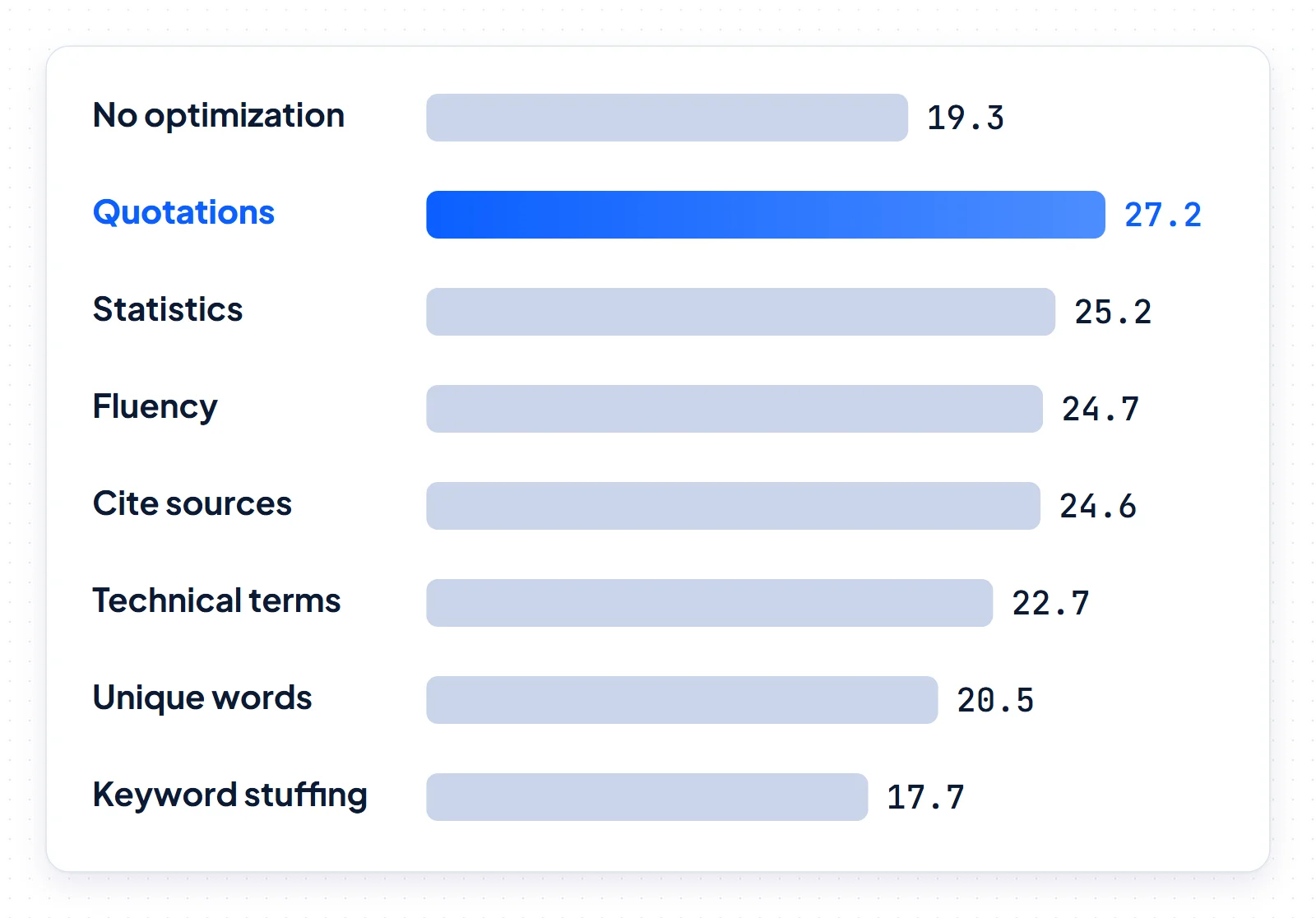
The table shows all nine methods from Table 1 of the final paper. The paper reports absolute scores and gives ranges in its text, so the percentage column is our own calculation from those scores, not a figure the authors published.
| Method | What it means | PAWC score (Table 1) | Change vs baseline (our calculation) |
|---|---|---|---|
| No optimization | Source left as published (baseline) | 19.3 | Baseline |
| Quotation addition | Adds quotations from credible sources | 27.2 | +40.9% |
| Statistics addition | Swaps qualitative statements for quantitative statistics where possible | 25.2 | +30.6% |
| Fluency optimization | Improves the fluency of the text | 24.7 | +28.0% |
| Cite sources | Adds citations to credible sources | 24.6 | +27.5% |
| Technical terms | Adds technical terms where possible | 22.7 | +17.6% |
| Easy-to-understand | Simplifies the language | 22.0 | +14.0% |
| Authoritative | Rewrites in a more persuasive, authoritative tone | 21.3 | +10.4% |
| Unique words | Adds unusual or distinctive words | 20.5 | +6.2% |
| Keyword stuffing | Adds more of the query’s keywords | 17.7 | −8.3% |
The authors write that keyword stuffing and similar methods offer “little to no improvement” in generative engine responses. That is the clearest break from old SEO habits. An authoritative tone scored higher on subjective impression (22.9) than on word count, but the authors found no significant improvement from it.
The gains were also uneven by rank. Sources that sat lower in Google’s results gained the most, while top-ranked sources lost share when every source was optimized at once.
Results vary by domain
No single method won everywhere. Table 3 of the paper lists the domains where each method helped most.
- Quotation addition: People and Society, Explanation, History.
- Statistics addition: Law and Government, Debate, Opinion.
- Cite sources: Statement, Facts, Law and Government.
- Fluency optimization: Business, Science, Health.
- Authoritative tone: Debate, History, Science.
The practical reading is to match the edit to the content. A page about regulation fits statistics and citations, while a history page fits quotations.
The best combination
The authors also tested pairs of methods on a 200-example subset. Fluency optimization combined with statistics addition did best, outperforming any single method by more than 5.5%. In short, readable text with concrete numbers beat any one trick.
The Perplexity.ai check
To test a real product, the authors ran a 200-sample subset of the test set on Perplexity.ai. They uploaded source text as files, because Perplexity did not accept source URLs. Against a baseline PAWC of 24.1, quotation addition scored 29.1, cite sources 26.8 and statistics addition 26.2, while keyword stuffing fell to 21.9 (Table 7).
The subjective metric told a mixed story. Cite sources dropped from 24.7 to 19.0 on subjective impression in that test, so even a winning method did not win on every measure.
What Google says about GEO
Google treats GEO as part of SEO, not as a separate discipline. Its guide to optimizing your website for generative AI features on Google Search was last updated on July 10, 2026. “From Google Search’s perspective, optimizing for generative AI search is optimizing for the search experience, and thus still SEO,” the guide says.
The same guide expands AEO as answer engine optimization and GEO as generative engine optimization. It also lists several things you do not need to do.
- “Structured data isn’t required for generative AI search, and there’s no special schema.org markup you need to add.”
- You don’t need new machine-readable files, AI text files, markup or Markdown to appear in Google Search. Google says it ignores them.
- “There’s no requirement to break your content into tiny pieces.”
Google’s broader advice is to create content people find “unique, compelling, and useful”, which it says will likely matter more over the long run than any other suggestion. A separate Google page, AI features and your website, says there are “no additional requirements” to appear in AI Overviews or AI Mode. A page must be indexed and eligible to show in Google Search with a snippet.
GEO vs SEO vs AEO vs LLMO
GEO, AEO, SEO and LLMO are four labels for overlapping work. SEO gets pages found and ranked, and AEO makes content the direct answer to a question. GEO gets content cited inside AI-generated answers, while LLMO shapes how language models describe a brand. Google’s July 10, 2026 guide files both GEO and AEO under SEO.
| Term | Stands for | Main goal | Where to read more |
|---|---|---|---|
| SEO | Search engine optimization | Get pages found and ranked in search results | Google Search Central documentation |
| AEO | Answer engine optimization | Make content the direct answer to a question | Google names it in its July 2026 guide |
| GEO | Generative engine optimization | Get content cited and shown inside AI-generated answers | Aggarwal et al., KDD 2024 |
| LLMO | Large language model optimization | Shape how language models describe and recommend a brand | Our LLMO guide |
In practice the differences are small. A page that is indexed, answers the question clearly and backs its claims with sources serves all four. LLMO adds work beyond your own pages, such as how your brand appears as an entity, which our LLMO explainer covers in depth.
How to apply generative engine optimization
Start with SEO basics, then add the edits that the GEO paper measured as useful. Each step below maps to a tested method or to an official statement.
- Make sure the page can be found. Google says a page must be indexed and snippet-eligible to appear in its AI features. OpenAI’s crawler documentation says sites that opt out of OAI-SearchBot will not be shown in ChatGPT search answers, though they can still appear as navigational links. Perplexity says its PerplexityBot crawler is designed to surface and link websites in Perplexity’s search results.
- Add quotations from credible sources. Quotation addition was the strongest single method on GEO-bench, especially for people, society and history topics.
- Add statistics with their sources. Replace vague claims with numbers, and name where each number comes from.
- Cite your sources. Link to primary documents, studies and official pages. Citing sources helped most for factual and legal queries.
- Write fluently and plainly. Fluency and easy-to-understand rewrites both helped, and fluency plus statistics was the best pair tested.
- Keep a clear structure. Descriptive headings and direct answers help readers find each claim. Google says you do not need to chop content into tiny pieces, so structure for people.
- Skip keyword stuffing. It lowered position-adjusted word count both in the simulated engine and on Perplexity.
None of these steps replaces SEO. In Google’s words, optimizing for generative AI search is “still SEO”, so the same quality work serves both.
How to measure GEO
Measuring generative engine optimization means tracking whether AI answers mention and cite your pages over time, alongside normal search metrics. No AI engine publishes a citation score, so teams sample a fixed set of prompts on a schedule and record mentions, citations and position. In Google Search Console, the Performance report includes traffic from AI Overviews and AI Mode under the Web search type. Google’s July 2026 guide also points site owners to a Generative AI performance report in Search Console.
For other engines, that prompt log is the main tool. Our guide to AI visibility sets out five metrics: mention rate, citation rate, share of voice, position and sentiment. Treat any single answer as a sample: the GEO paper itself averaged 5 responses per query across 5 random seeds.
Limits and myths of GEO
The GEO paper is a useful starting point, not proof that rewriting a page will earn citations. Its results come from a simulated engine, vary by domain and have been challenged by later research.
The engine was simulated
The main experiments used gpt-3.5-turbo over the top 5 Google results, not the AI search products people use in 2026. The real-engine check covered only 200 samples on Perplexity. The authors note that their methods may need to adapt as generative engines evolve, and they did not test how GEO edits affect search rankings.
Results depend on the domain
The paper’s own abstract says the efficacy of these strategies varies across domains. A method that helped history pages may do little for a product page, so test on your own content before rolling an edit out site-wide.
Later research found smaller effects
C-SEO Bench is a 2025 benchmark by Puerto, Gubri, Green, Oh and Yun, accepted to the NeurIPS 2025 Datasets and Benchmarks track. It tested conversational SEO methods on GPT-4o-mini, Claude 3.5 Haiku, o3 and o4-mini. The authors found that most existing methods “do not achieve significant gains for unilateral adopters”.
In the same benchmark, placing the target document first in the model’s context window produced far greater citation gains than any rewriting method. Gains also shrank as more publishers adopted the same methods.
No method guarantees a citation
AI search tools also make citation mistakes. In March 2025, the Tow Center for Digital Journalism, writing in Columbia Journalism Review, ran 1,600 queries built from excerpts of 200 news articles across 8 AI search tools. Collectively, the tools gave incorrect answers to more than 60% of the queries. None of the studies covered here shows a way to guarantee that an AI engine will cite a page.
SEO is not dead
Google and the research point the same way. Google calls generative AI optimization still SEO, while C-SEO Bench found that a document’s position in the model’s context mattered more than rewriting it. In search-based AI engines, that position starts with retrieval, which is still a search problem.
What to do next
Treat generative engine optimization as an editing layer on top of SEO. For most sites, start by auditing the pages that already rank. Add the missing sources, numbers and quotations, then measure before and after.
Content teams should first pick the pages where AI answers already appear for their topics. Agencies should sell measured editing and tracking, not guaranteed citations, because neither the paper nor Google offers such a guarantee.
Teams that build GEO and LLMO services also face a naming question, because the category labels are still new. A short descriptive name such as llmo.si or aivisibility.si says what the service does. .si is Slovenia’s country-code domain. For AI companies it reads as SuperIntelligence. Our guide to AI domains covers naming options for AI businesses.