AI visibility is the share of relevant AI answers that mention or cite a brand, measured per engine, such as ChatGPT, Google’s AI Overviews and AI Mode, Perplexity and Claude. It covers whether an answer names you, cites you as a source, places you early and describes you accurately. No official definition exists yet, so we give a working one.
Interest in the term has grown fast. US searches for “ai visibility” went from 39 a month in January 2025 to 11,173 in July 2026 (Ahrefs, October 2026). This guide covers the definition, the difference from SEO, the crawlers that matter and a method to measure and improve it without a paid tool.
What is AI visibility?
AI visibility is the share of relevant AI answers that mention or cite your brand, measured separately for each AI engine. That is our working definition. We found no definition from Google, OpenAI, Anthropic, Perplexity, academic research or a standards body.
The term comes from vendors and agencies that sell tracking and audits. The closest academic idea is “visibility in generative engine responses” from the GEO paper by Aggarwal and colleagues, presented at KDD 2024. The authors measure it by how much of an answer draws on a source, weighted by where its citation appears, plus a subjective impression score.
In practice, AI visibility has four parts:
- Mentions: the answer names your brand, product or domain.
- Citations: the answer links to a page on your site as a source.
- Position: you appear early in the answer, not only in a closing list.
- Sentiment and accuracy: the answer describes you correctly and fairly.
A brand can be mentioned without being cited, or cited without being mentioned. Track the two separately, because the fixes differ.
Why AI visibility matters now
Google says AI Overviews has over 2.5 billion monthly active users. In a Pew Research Center study of March 2025, US users clicked a traditional result in 8% of visits when an AI summary appeared, against 15% without one. A brand missing from the answer may never be seen by that user.
The 2.5 billion figure comes from Sundar Pichai at Google I/O on May 19, 2026, where he also said AI Mode has surpassed 1 billion. OpenAI put ChatGPT at about 1.2 billion weekly users in its DevDay 2026 recap of September 29, 2026.
The click figures come from independent research. The Pew Research Center study covered 68,879 Google searches by 900 US adults in March 2025. The 8% and 15% rates are clicks on a traditional result, and users clicked a link inside the summary in only 1% of visits. The study predates AI Mode’s global rollout, so treat it as a signal, not a 2026 measurement.
Search interest in “ai visibility”
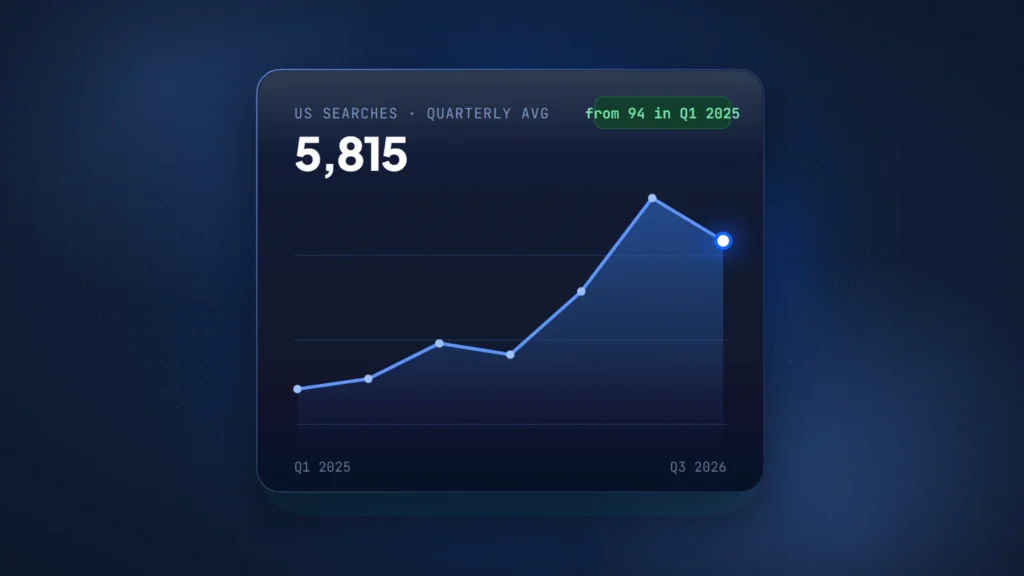
US monthly searches for “ai visibility” rose from 39 in January 2025 to 2,840 in September 2025, reached 9,330 in April 2026 and peaked at 11,173 in July 2026 (Ahrefs, October 2026).
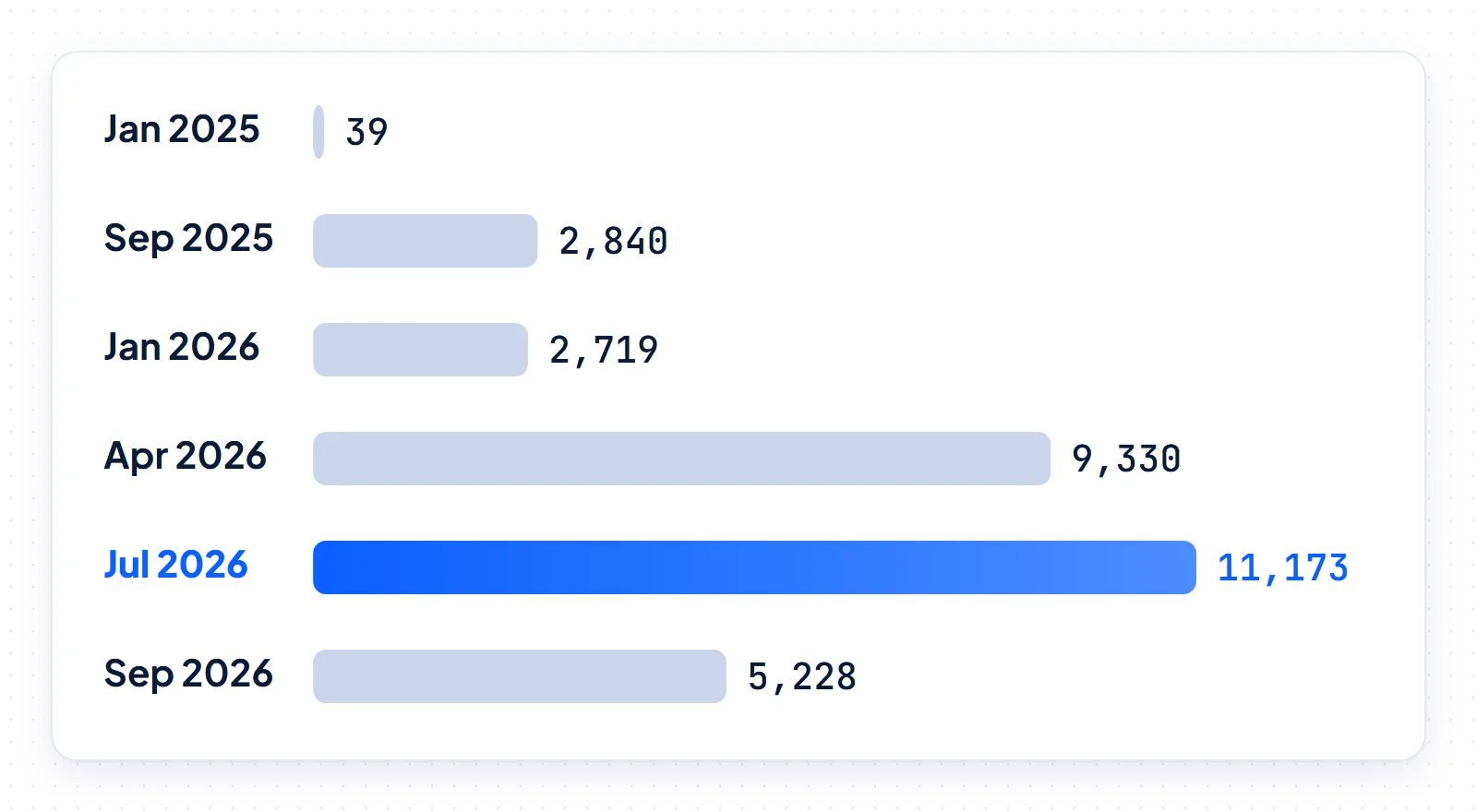
Interest has cooled since the peak, with 5,228 searches in September 2026. By quarter, the average monthly volume went from 94 in Q1 2025 to 7,463 in Q2 2026, then fell to 5,815 in Q3 2026. Demand is still far above early 2025 levels.
AI visibility vs SEO visibility
SEO visibility measures where your pages rank in a list of links. AI visibility measures whether a generated answer names or cites you. The two overlap, because AI search features retrieve web pages.
| Aspect | SEO visibility | AI visibility |
|---|---|---|
| What the user sees | A ranked list of links | A generated answer with mentions and source links |
| Where you win | A high position on the results page | A named mention or a cited link inside the answer |
| Main metrics | Rankings, impressions, clicks | Mention rate, citation rate, share of voice, sentiment |
| Role of the click | The click is the main goal | Many users read the answer and stop (1% clicked a summary link in Pew’s March 2025 study) |
| Crawler access | Search engine crawlers such as Googlebot | Each engine’s search crawler, such as Googlebot, OAI-SearchBot, PerplexityBot or Claude-SearchBot |
| Measurement | Search Console, rank tracking | Prompt sets run per engine, plus referral tags such as utm_source=chatgpt.com |
Google visibility is not the same as AI visibility, but it is the foundation for appearing in Google’s AI features. In its guide to AI features and your website, Google says: “There are no additional requirements to appear in AI Overviews or AI Mode, nor other special optimizations necessary.” The usual SEO basics still apply.
How AI systems choose which sources to cite
AI search features look up web pages for each question and cite some of the pages they use. A page can only be cited if the engine’s search crawler can reach it and the page sits in that engine’s index.
Google is explicit about the bar. A page must be “indexed and eligible to be shown in Google Search with a snippet” to appear as a supporting link in AI Overviews or AI Mode. Both features “may use a ‘query fan-out’ technique”: they run several related searches across subtopics and data sources.
OpenAI’s publishers and developers FAQ says “Any public website can appear in ChatGPT search,” and asks sites not to block OAI-SearchBot. Perplexity says PerplexityBot exists to surface and link websites in its search results. In each case, the search crawler, not the training crawler, decides whether you can be cited.
Content then shapes which reachable pages get used. The GEO paper found that “GEO can boost visibility by up to 40% in generative engine responses,” measured on GEO-bench, the authors’ own benchmark.
How to measure AI visibility
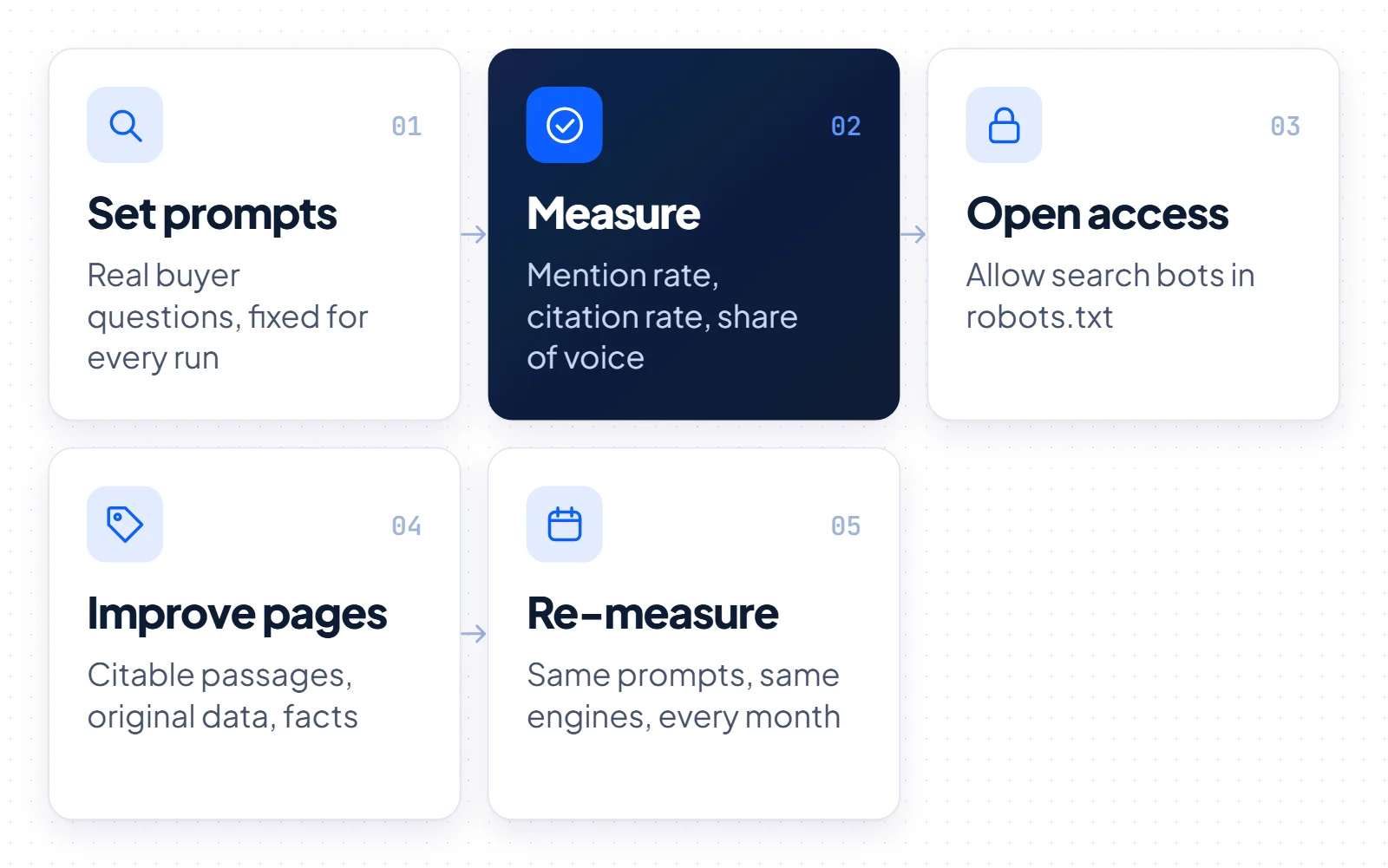
Measure AI visibility by running a fixed set of real customer questions through each AI engine on a schedule, then recording who gets mentioned, who gets cited and how. Keep a separate score for each engine, because a blended number hides the differences.
- Build a prompt set. Write the questions buyers ask before choosing a provider, plus questions that name your brand.
- Pick the engines your audience uses, for example ChatGPT, Google AI Mode, Perplexity and Claude.
- Run each prompt in a clean session, more than once, and log the answer, every brand named and every cited URL.
- Repeat each month with the same prompts, so changes reflect your work and not a new question set.
Then calculate five metrics:
- Mention rate: answers that name your brand, divided by all answers in the set.
- Citation rate: answers that link to your domain, divided by all answers.
- Share of voice: your mentions, divided by all brand mentions for you and your competitors.
- Position: whether you appear first, in the middle or only in a closing list.
- Sentiment: whether the description is positive, neutral, negative or simply wrong.
Analytics fill in the traffic side. ChatGPT adds utm_source=chatgpt.com to referral links, so those visits appear as their own source. Google counts AI feature traffic in the overall Search Console Performance report. Since June 2026, a separate generative AI performance report shows impressions in AI Overviews and AI Mode by page, country, device and date, without clicks or queries. Server logs show which AI crawlers fetch your pages.
A spreadsheet is enough to start. Paid AI visibility tools fall into three groups: prompt monitoring at scale, crawler log analysis and prompt research. Define your metrics before you compare tools.
How to improve AI visibility
Improve AI visibility in two steps: first let each engine’s search crawler reach your pages, then publish passages, data and facts that an answer can quote. No content work helps a page an engine cannot fetch.
Skip the shortcuts. Google says “You don’t need to create new machine readable files, AI text files, or markup to appear in these features.”
Allow the right AI crawlers
AI companies run separate crawlers for model training and for search answers. Blocking a training crawler such as GPTBot or ClaudeBot keeps your content out of future models but does not remove you from search answers. Blocking a search crawler does. Google-Extended is a special case: it also covers grounding in Gemini, but it does not affect Google Search.
| Bot | Company | Purpose | robots.txt token |
|---|---|---|---|
| GPTBot | OpenAI | Training: generative AI foundation models | GPTBot |
| OAI-SearchBot | OpenAI | Answers: surfaces websites in ChatGPT search | OAI-SearchBot |
| ChatGPT-User | OpenAI | Answers: user-initiated visits; robots.txt may not apply | ChatGPT-User |
| Googlebot | Search, including AI Overviews and AI Mode | Googlebot | |
| Google-Extended | Training and grounding for Gemini; does not affect inclusion or ranking in Google Search | Google-Extended | |
| PerplexityBot | Perplexity | Answers: Perplexity search results; not for training | PerplexityBot |
| Perplexity-User | Perplexity | Answers: user-requested fetches; generally ignores robots.txt | Perplexity-User |
| ClaudeBot | Anthropic | Training | ClaudeBot |
| Claude-SearchBot | Anthropic | Answers: search result quality | Claude-SearchBot |
| Claude-User | Anthropic | Answers: fetches pages for user questions | Claude-User |
OpenAI’s crawler overview says sites that block OAI-SearchBot “will not be shown in ChatGPT search answers,” though they can still appear as navigational links, while GPTBot covers training. OpenAI says search changes take about 24 hours to apply after a robots.txt update. Google’s crawler documentation says Google-Extended “does not impact a site’s inclusion in Google Search,” so it is not an AI Overviews opt-out. Perplexity’s crawler docs say PerplexityBot is not used to train foundation models.
Write passages an AI answer can cite
Open each section with a one- or two-sentence answer that makes sense on its own, then add the detail. Name the subject in full instead of “it” or “they”, and attach a source and date to every number.
The GEO paper supports this approach. Of nine methods tested, adding quotations, adding statistics and citing sources worked best. They gave “a relative improvement of 30-40% on the Position-Adjusted Word Count metric and 15-30% on the Subjective Impression metric.” Keyword stuffing gave little to no improvement. Lower-ranked sources gained most: citing sources lifted the visibility of rank-5 pages by 115.1% and cut that of rank-1 pages by 30.3%.
These are controlled benchmark results. A smaller test on Perplexity.ai, run with uploaded source files, showed gains of up to 37%, and real-world results are not guaranteed.
Publish original data
A number that exists only on your site gives an engine a reason to cite you instead of a summary of others. Survey results, pricing data, usage statistics or a dated trend series all qualify, as long as you state the method and the date.
Keep entity facts consistent
State your company name, what you do, where you operate and your product names the same way on your site, your profiles and directory listings. AI answers draw on many sources, and conflicting facts make an accurate description less likely.
Earn mentions on other sites
AI answers also draw on third-party sources, not only on your own pages. In Pew’s March 2025 study, Wikipedia, YouTube and Reddit made up 15% of the sources in Google’s AI summaries. Press coverage, reviews, community answers and expert roundups all add to what an engine can find about you.
AI visibility, GEO, AEO and LLMO
Generative engine optimization (GEO), answer engine optimization (AEO) and large language model optimization (LLMO) are names for the work of improving AI visibility, which is the result you measure. They are overlapping practices, not rival disciplines.
Generative engine optimization (GEO) takes its name from the 2023 paper cited above. Answer engine optimization (AEO) focuses on direct answers in search and assistants. LLMO, large language model optimization, describes the same effort aimed at chat assistants. Our guide to LLMO tactics covers it in more detail.
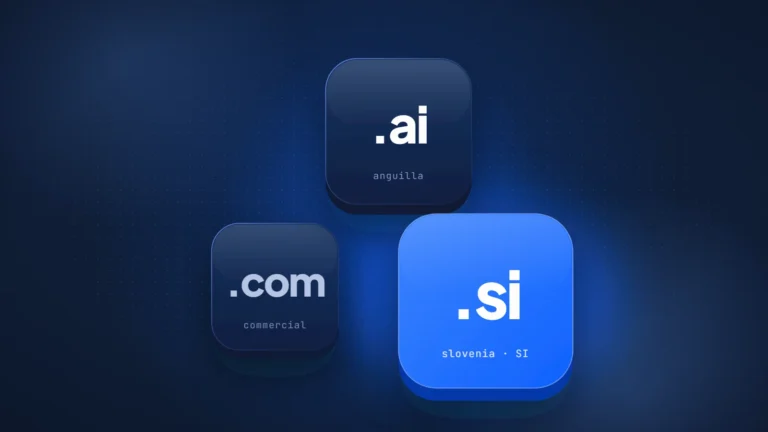
.si is Slovenia’s country-code domain. For AI companies it reads as SuperIntelligence. That is our framing, not an official meaning. Names such as aivisibility.si and llmo.si are examples of addresses that state the service directly. For the wider choice of extensions for an AI brand, see our guide to .ai domains.
What to do next
Start with a baseline measurement this month, then fix crawler access before you change content.
If you are a founder
Write 20 questions your buyers ask, run them through two or three engines and note whether you appear. Check that robots.txt allows OAI-SearchBot, PerplexityBot and Googlebot, and decide on training crawlers separately. Then align your About page and product facts so every source says the same thing. If you are still choosing a name, our guide to premium domain names covers what makes a name worth paying for.
If you are a marketer or agency
Agree on a fixed prompt set and per-engine metrics with the client before you report anything. Report mention rate, citation rate and share of voice for each engine, with the date of each run. Tie content work to citable passages and original data. Avoid promising placement in AI answers, because the engine, not you, picks the sources.