Superintelligence is a hypothetical intellect that would far exceed the best human minds in nearly every field, from scientific creativity to social skills. That is the short answer to “what is superintelligence”, and it comes with two caveats: no such system exists today, and researchers have not agreed on a single formal definition or a test for it.
The term has moved from philosophy papers into company names. Ilya Sutskever co-founded Safe Superintelligence Inc. in June 2024, and Mark Zuckerberg announced Meta Superintelligence Labs in June 2025. That same month, OpenAI CEO Sam Altman called OpenAI a superintelligence research company. In October 2025, the Future of Life Institute called for a prohibition on developing superintelligence. It set two conditions for lifting it: broad scientific consensus that it can be done safely, and strong public buy-in. This explainer sets out what the term means, where it came from, who uses it, and where experts agree and disagree.
What is superintelligence?
Superintelligence, also called artificial superintelligence (ASI) when it refers to machines, is a hypothetical intellect that greatly exceeds human cognitive performance in virtually all domains, not just in one task such as chess. Philosopher Nick Bostrom gave the most widely quoted definitions in 1998 and 2014. Google DeepMind researchers placed artificial superintelligence at the top of their 2023 “Levels of AGI” scale. They describe it as a system that “outperforms 100% of humans” and mark it as “not yet achieved”.
Bostrom’s two definitions differ slightly, so it helps to keep them apart. In his 1998 paper “How long before superintelligence?”, he described “an intellect that is much smarter than the best human brains in practically every field”. He named scientific creativity, general wisdom and social skills as examples. His 2014 book, Superintelligence: Paths, Dangers, Strategies, uses a broader phrase: “any intellect that greatly exceeds the cognitive performance of humans in virtually all domains of interest”.
The first version compares an intellect with the best human brains. The second compares it with humans in general. IBM uses a similar idea and calls artificial superintelligence (ASI) “a hypothetical software-based artificial intelligence (AI) system with an intellectual scope beyond human intelligence”. None of these definitions comes with a test that would show when a system has crossed the line.
The DeepMind “Levels of AGI” paper by Morris and colleagues, first posted in November 2023, adds a useful distinction. It sorts AI systems by two things: how well they perform and how general they are. Level 4 covers systems at “at least 99th percentile of skilled adults”. Level 5, “Superhuman”, covers systems that outperform every human.
The paper lists AlphaFold, AlphaZero and Stockfish as narrow systems that already reach superhuman level. Each beats every human in its own task. None of them counts as superintelligence, because each works in a single domain. The word “general” is what separates these tools from the systems that labs now say they want to build.
AGI vs superintelligence vs narrow AI
AGI (artificial general intelligence) usually means a system that matches skilled humans across most cognitive tasks, while superintelligence would greatly exceed the best humans in virtually all of them. Narrow AI, by contrast, performs one task or a small set of tasks. The difference between AGI and superintelligence is one of degree: both are general, but only superintelligence goes far beyond human level. Google DeepMind’s 2023 “Levels of AGI” framework lists the superhuman general level as “not yet achieved”.
| Feature | Narrow AI | AGI | Superintelligence |
|---|---|---|---|
| Scope | One task or a small set of tasks | Most cognitive tasks across domains | Virtually all domains of interest |
| Compared with humans | From below human to superhuman, in one task | Roughly matches skilled adults | Greatly exceeds the best humans |
| Exists today | Yes | Contested, with no agreed test | No (“not yet achieved”, DeepMind) |
| Example | AlphaFold, AlphaZero, Stockfish | Stated goal of labs such as OpenAI | None; stated goal of OpenAI, SSI and Meta |
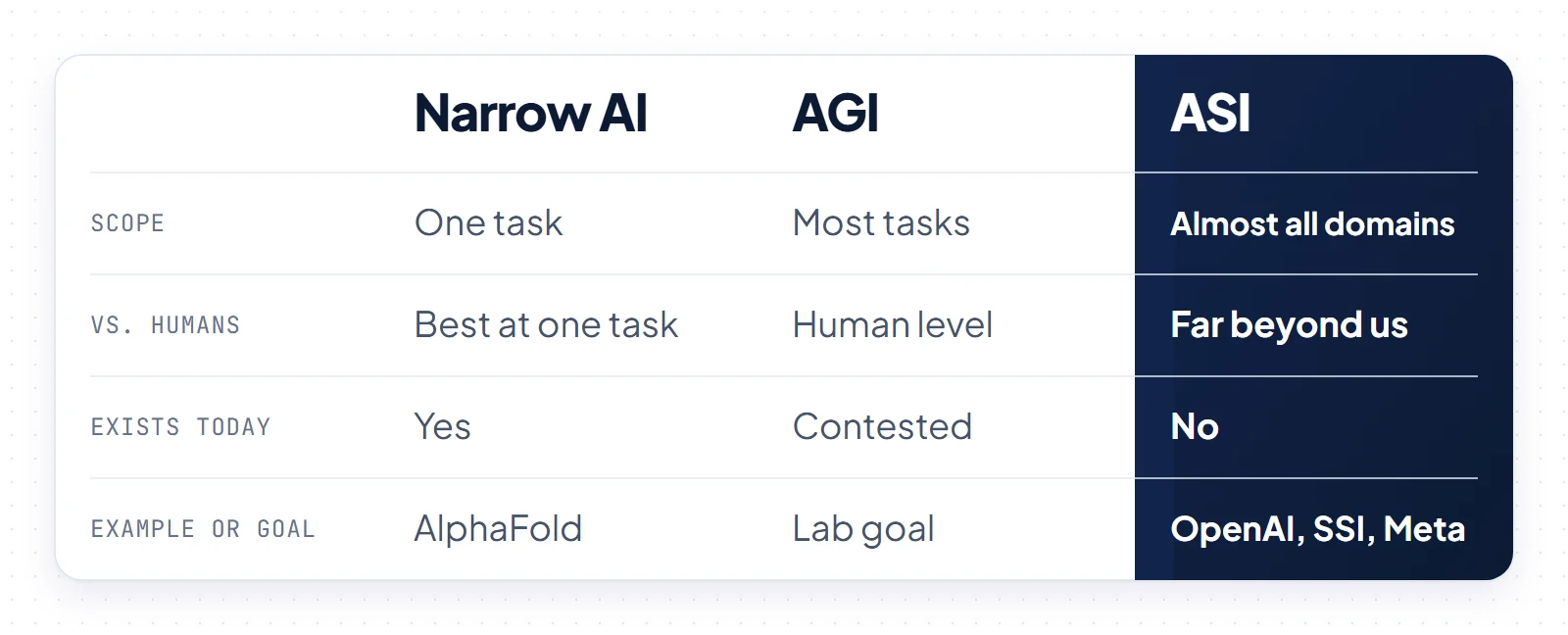
The labels are not fixed. There is no single agreed definition of AGI or of superintelligence, and companies use both words in their own ways. That makes it useful to check which meaning a speaker has in mind.
OpenAI’s CEO treats the two as steps on one path. In his January 2025 post “Reflections”, Sam Altman wrote: “We are now confident we know how to build AGI as we have traditionally understood it”. He added: “We are beginning to turn our aim beyond that, to superintelligence in the true sense of the word”.
Those lines describe AGI as a near-term target and superintelligence as the next one. They state one company leader’s intent, and other researchers dispute both the timing and the framing.
Where the idea comes from
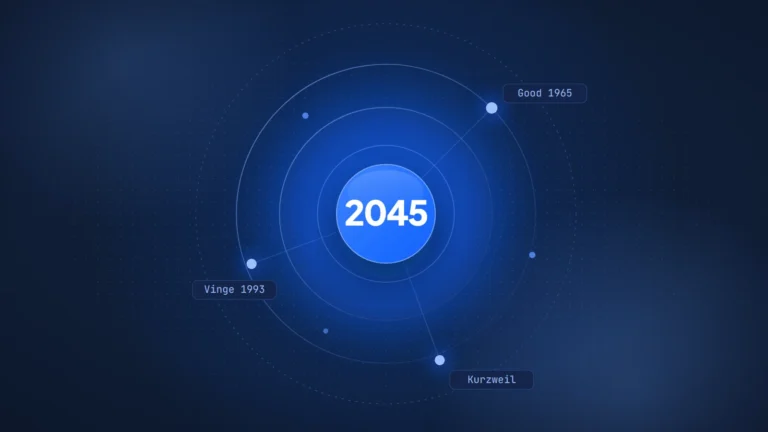
The idea of a machine smarter than any person dates back at least to 1965, when I. J. Good described an “intelligence explosion”. Vernor Vinge wrote about a coming technological singularity in 1993, and Nick Bostrom gave the concept the definitions most writers still quote.
Good’s 1965 paper, “Speculations Concerning the First Ultraintelligent Machine”, defined a machine that “can far surpass all the intellectual activities of any man however clever”. His argument was short. Designing machines is itself an intellectual activity, so such a machine “could design even better machines”. Good wrote that there would then be an “intelligence explosion”, and “the intelligence of man would be left far behind”.
He called the first such machine “the last invention that man need ever make”. He attached a condition to that claim, which the section on risks covers below.
Vinge took the idea further in March 1993. He wrote “The Coming Technological Singularity” for the VISION-21 Symposium of NASA Lewis Research Center and the Ohio Aerospace Institute. In it he wrote: “Within thirty years, we will have the technological means to create superhuman intelligence”. The next sentence read: “Shortly after, the human era will be ended”. He also gave a window: “I’ll be surprised if this event occurs before 2005 or after 2030”.
Bostrom then turned the idea into a defined research topic. His 1998 paper fixed the term “superintelligence” to a clear meaning. His 2014 book asked three questions in turn: which paths might lead there, what forms superintelligence could take, and why it could be hard to control. Later definitions, such as IBM’s and Google DeepMind’s, use their own wording, but they share his core idea of performance beyond humans across almost all domains.
The three forms of superintelligence
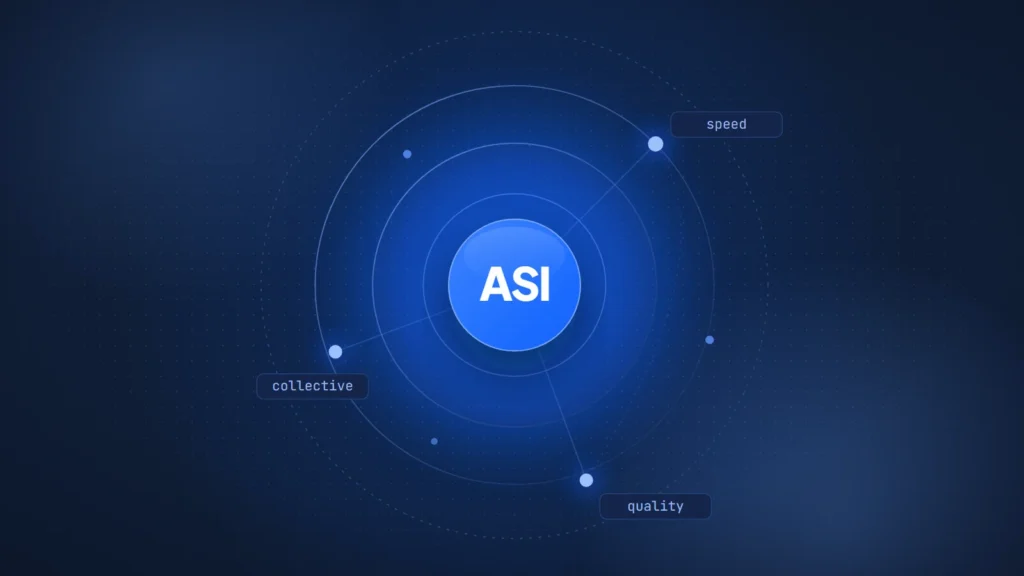
Nick Bostrom’s 2014 book describes three forms of superintelligence. Speed superintelligence could do everything a human mind can do, but much faster. Collective superintelligence would come from many smaller minds working together, and would be strongest on tasks that split into parallel parts. Quality superintelligence would be at least as fast as a human mind and far smarter in kind.
Speed superintelligence
Speed superintelligence needs no new kind of thought. It thinks the same thoughts a person can, at a much higher rate. Work that takes a human expert months could, in principle, take such a system a small fraction of that time. The gain comes from speed alone.
Collective superintelligence
Human institutions already show a weak version of this effect. A research lab or a company can solve problems that no single member could solve alone. Bostrom’s collective form applies the same principle at a scale and level of coordination far beyond any team of people.
Quality superintelligence
Quality superintelligence is the hardest form to picture. It describes a mind that is not just faster or larger, but better at reasoning in ways humans might not follow.
Possible paths
Bostrom’s book also discusses several routes that could, in theory, lead to superintelligence:
- Artificial intelligence: software systems that reach and then pass human ability.
- Whole brain emulation: scanning a human brain and running a copy of it in software.
- Biological cognition: raising human intelligence through biological means.
- Brain-computer interfaces: linking human brains directly to machines.
- Networks and organizations: making groups of people and machines think better together.
Most public debate now focuses on the first path, because the largest AI labs say it is the route they are taking.
Who is trying to build superintelligence
Several companies now say openly that superintelligence is their goal. The most prominent are OpenAI, Safe Superintelligence Inc. and Meta. Microsoft AI also formed its own superintelligence team in November 2025. Their statements describe ambitions and expectations, not systems that exist today.
OpenAI began to write about the topic in 2023. In “Governance of superintelligence” (May 22, 2023), Sam Altman, Greg Brockman and Ilya Sutskever wrote that “it’s conceivable that within the next ten years, AI systems will exceed expert skill level in most domains”. They called for “something like an IAEA for superintelligence efforts”.
On July 5, 2023, OpenAI announced a Superalignment team co-led by Sutskever and Jan Leike. The Superalignment announcement stated: “While superintelligence seems far off now, we believe it could arrive this decade”. OpenAI set aside “20% of the compute we’ve secured to date” for the effort and gave it a four-year goal. OpenAI dissolved the team in May 2024, after both of its leaders left the company.
Altman has since gone further in his personal posts. In “The Gentle Singularity” (June 10, 2025), he wrote that “Humanity is close to building digital superintelligence”. He also wrote: “before anything else, we are a superintelligence research company”. These are claims about direction and nearness, not evidence that anyone has built such a system.
Ilya Sutskever, Daniel Gross and Daniel Levy announced Safe Superintelligence Inc. (SSI) on June 19, 2024. The company’s website at ssi.inc calls it “the world’s first straight-shot SSI lab, with one goal and one product: a safe superintelligence”. It also states: “Superintelligence is within reach”. TechCrunch, citing the Financial Times, reported in April 2025 that SSI had raised $2 billion at a valuation of $32 billion.
Meta joined the field in 2025. In an internal memo on June 30, 2025, Mark Zuckerberg announced Meta Superintelligence Labs. Alexandr Wang became Chief AI Officer, with Nat Friedman as co-lead. The memo said: “As the pace of AI progress accelerates, developing superintelligence is coming into sight”.
A month later, on July 30, 2025, Zuckerberg published a letter titled “Personal Superintelligence”. In it he wrote: “Meta’s vision is to bring personal superintelligence to everyone”. He also wrote: “Over the last few months we have begun to see glimpses of our AI systems improving themselves”.
In these company names, the word works as a mission label. A lab can call itself a superintelligence lab without having built, or defined in testable terms, the thing in its name.
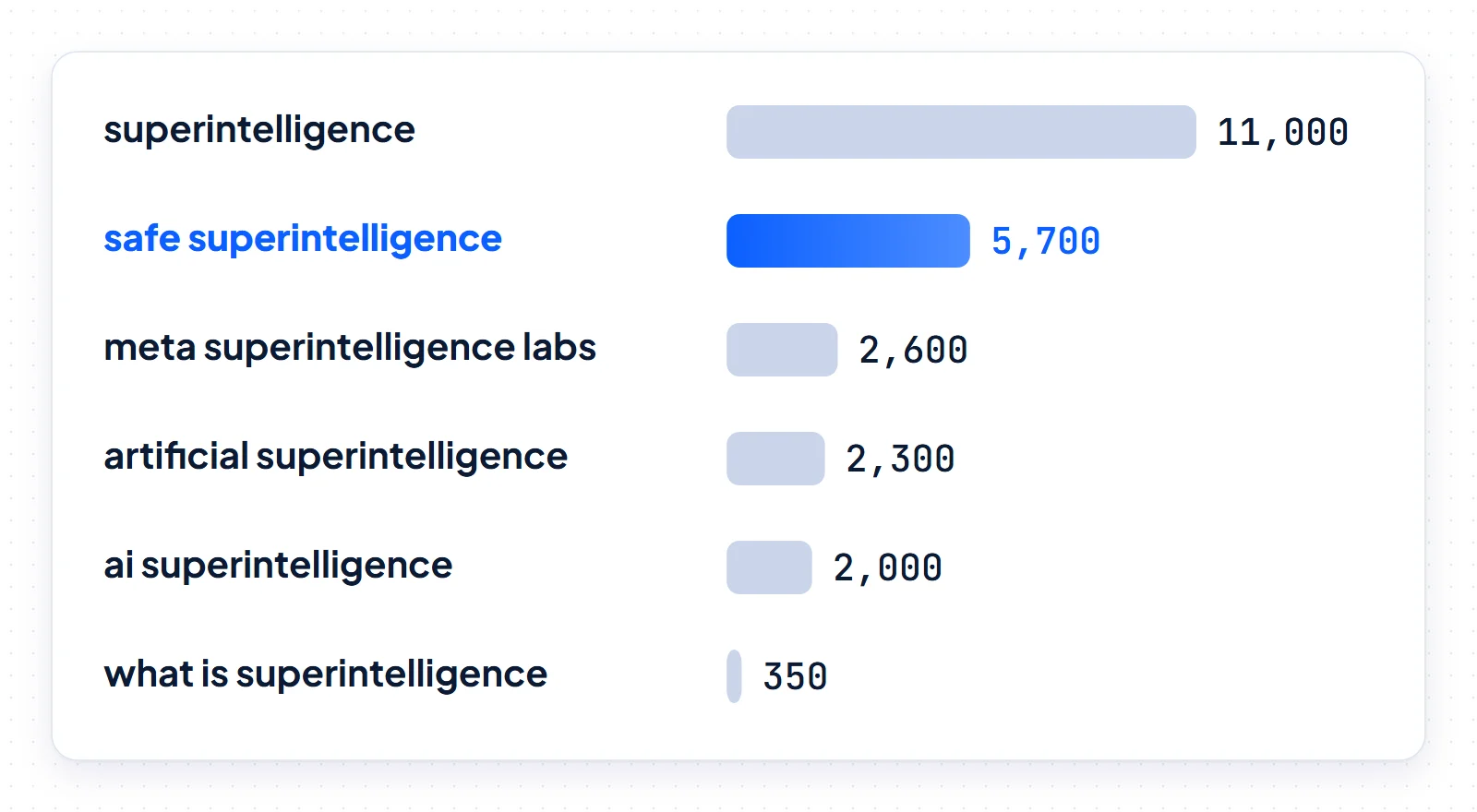
Search data shows how much these companies shape public interest. In Ahrefs Keywords Explorer (October 5, 2026), “superintelligence” gets about 11,000 monthly searches worldwide. The company-linked phrases “safe superintelligence” (5,700) and “meta superintelligence labs” (2,600) both exceed the generic phrases “artificial superintelligence” (2,300) and “ai superintelligence” (2,000). The question “what is superintelligence” gets about 350. In the US, “safe superintelligence” (3,000) comes close to the single word (3,800).
How far are we from superintelligence?
Nobody knows how close superintelligence is, and there is no expert consensus. The evidence comes in three kinds: a 2023 survey of 2,778 AI researchers about human-level AI, dated statements from lab leaders, and skeptical replies. Each measures something different.
The largest survey of its kind did not ask about superintelligence directly. Grace and colleagues surveyed 2,778 researchers who had published in top AI venues and released the results on January 5, 2024. Respondents put a 50% chance on unaided machines outperforming humans in every possible task by 2047, and a 10% chance by 2027. The 2047 estimate came 13 years earlier than in the same team’s survey one year before.
The “Thousands of AI Authors on the Future of AI” survey also asked about full automation of occupations. Respondents gave a 10% chance by 2037 and a 50% chance by 2116, compared with 2164 in the 2022 survey. These numbers describe human-level performance, which sits a step below superintelligence in most definitions. They are pooled estimates from experts, not measurements.
Lab leaders have given shorter timelines, and stated them with more confidence. OpenAI wrote in July 2023 that superintelligence “could arrive this decade”. Altman wrote in June 2025 that humanity is “close to building digital superintelligence”. Zuckerberg’s June 2025 memo said it is “coming into sight”. Each of these comes from a company that is trying to build the technology, or from its leader.
Others doubt the whole premise. Yann LeCun, then Meta’s chief AI scientist, called fears of AI threatening humanity “complete B.S.” when speaking to the Wall Street Journal in October 2024. Earlier that year, in a post on X, he had addressed how to control AI systems much smarter than us. Before working that out, he argued, “we need to have the beginning of a hint of a design for a system smarter than a house cat”.
History adds a caution of its own. Vinge’s 1993 paper placed the event between 2005 and 2030. The survey estimates have moved too: the 2047 figure shifted by 13 years between two surveys held a year apart. Dated claims are best read as snapshots of what one person or group thought at one time.
Risks and the safety debate
The central concern is control: a system far smarter than its makers might pursue goals they cannot correct. Many prominent researchers treat this as a serious risk, while others, such as LeCun, reject the worry.
The concern is as old as the idea itself. Good’s sentence about the last invention continued with a condition: “provided that the machine is docile enough to tell us how to keep it under control”. Bostrom’s 2014 book discusses this as the control problem. In short, it asks how humans could make sure that a far more capable system acts in line with human intentions.
On May 30, 2023, the Center for AI Safety published a one-sentence Statement on AI Risk: “Mitigating the risk of extinction from AI should be a global priority alongside other societal-scale risks such as pandemics and nuclear war”. That statement covers AI in general, not superintelligence alone. In the Grace survey, between 38% and 51% of respondents gave at least a 10% chance to advanced AI leading to outcomes as bad as human extinction.
Positions on superintelligence now range from building it to banning it. OpenAI wrote in July 2023 that superintelligence “will be the most impactful technology humanity has ever invented”. The Future of Life Institute’s Statement on Superintelligence of October 22, 2025 calls for “a prohibition on the development of superintelligence”. The prohibition would hold until there is broad scientific consensus that it can be done safely and controllably, plus strong public buy-in. Signatories include Geoffrey Hinton, Yoshua Bengio and Steve Wozniak.
What experts broadly agree on
- No system today meets the definitions of superintelligence used by Bostrom, IBM or Google DeepMind.
- The term has no single formal definition and no agreed test.
- Narrow systems such as AlphaFold and AlphaZero already outperform every human at specific tasks.
- Surveyed researchers moved their estimates for human-level AI earlier between the 2022 and 2023 surveys.
What remains contested
- When superintelligence could arrive. Lab statements speak of this decade; LeCun doubts that today’s systems are anywhere near it.
- How dangerous it would be. LeCun dismisses existential risk, while many signatories of the CAIS and FLI statements treat it as serious.
- Whether it should be built at all. SSI, Meta and OpenAI are pursuing it; the FLI statement calls for a prohibition until it can be done safely and with public support.
For anyone reading news about superintelligence, three checks help. First, note who is speaking and whether they run a lab. Second, check the date, because positions shift quickly. Third, ask which meaning is in play: human-level AI, AGI, or an intellect far beyond human level.
Why the letters SI now matter for names
ASI has become common shorthand for artificial superintelligence: IBM and Google DeepMind both use it. Safe Superintelligence Inc. goes further, using SSI as its name and calling itself an “SSI lab”.
That shorthand gives some domain names a second reading. .si is Slovenia’s country-code domain. For AI companies it reads as SuperIntelligence. This is an informal reading with no official status: the extension belongs to Slovenia and follows the rules of its registry. Our guide to the .si domain explains how the extension works.
Some names use both meanings. One example is essai.si: “essai” is French for an attempt or an essay, and the name contains both AI and SI. Similar names appear in our list of premium .si domains.
For founders, the practical test is simple. A name should work on its own first, for people who never notice the SI reading. The extra meaning is a bonus for an AI audience, not a promise about the product.