Reflection AI is a New York AI lab founded in March 2024 by former Google DeepMind researchers Misha Laskin and Ioannis Antonoglou. It set out to build “superintelligent autonomous systems” and in 2025 repositioned as an American open frontier lab. It was valued at $25 billion pre-money in April 2026 and has not yet released an open frontier model.
Interest is high for a company with one shipped product. In our Ahrefs check on October 5, 2026, the term “reflection ai” drew about 8,300 monthly searches in the US and 13,000 worldwide. The query “misha laskin” drew about 600 and 700, and “reflection ai valuation” about 350 and 450. This profile separates what Reflection says about itself from what the press has reported, with dates.
The table below collects the core facts as of October 5, 2026.
| Item | Detail |
|---|---|
| Founded | March 2024 |
| Founders | Misha Laskin and Ioannis Antonoglou, both formerly at Google DeepMind |
| CEO | Misha Laskin |
| Headquarters | New York |
| Products | Asimov, a code-comprehension agent (July 2025) |
| Models released | No open-weight model as of October 4, 2026 |
| Latest valuation | $25 billion pre-money (April 2026, confirmed by the CEO on CNBC) |
| Key partners | Nvidia (lead investor, October 2025), SpaceX, Nebius, Shinsegae, US Department of Energy |
| Website | reflection.ai |
Who founded Reflection AI
Misha Laskin and Ioannis Antonoglou, two researchers from Google DeepMind, founded Reflection AI in March 2024. Laskin, the CEO, led reward modeling for DeepMind’s Gemini project, according to TechCrunch.
Antonoglou co-created AlphaGo. The company’s own blog says he joined DeepMind as a founding engineer and helped create the system. TechCrunch put the headcount at about 60 people in October 2025, and no primary source has confirmed a later figure.
Reflection AI’s mission, then and now
Reflection AI began with a superintelligence mission and, in October 2025, reframed itself around open models. Both statements come from the company’s own blog, seven months apart.
On March 7, 2025, the company published Reflection: A Path to Superintelligence. It stated “At Reflection, we are building superintelligent autonomous systems” and defined superintelligence as “An autonomous system that will do most cognitive work on a computer”. The post also argued that “solving autonomous coding will enable superintelligence more broadly”.
That definition ties the term to computer-based work. It is narrower than the broader definitions covered in our explainer on what superintelligence means, which compares how researchers use the word.
On October 9, 2025, the day its $2 billion round became public, Reflection published Building Frontier Open Intelligence Accessible to All. It stated “We’re building frontier open intelligence accessible to all”. It also said the company must build open models “so capable that they become the obvious choice for users and developers worldwide”.
The two posts stress different things. The March 2025 post centered on autonomous coding as a path to superintelligence. The October 2025 post centers on open weights and on the risk that a few closed labs will control frontier AI. The national angle came in a TechCrunch interview that month. Laskin called DeepSeek and Qwen “our wake-up call” and argued that otherwise the global standard of intelligence would be set outside America.
Products and models: what Reflection AI has shipped
Reflection AI’s only shipped product is Asimov, a code research agent launched on July 16, 2025. Reflection AI had not released an open-weight model as of October 4, 2026, although Axios reported that day that the first one was set to be released soon.
Asimov is built to explain code, not to generate it. SiliconANGLE reported that it reads a codebase alongside emails, Slack messages, project notes and documentation to explain how a software system works.
The open model is still a plan. In October 2025, TechCrunch reported that Reflection intended to release a frontier model trained on “tens of trillions of tokens” in 2026. The weights would be public, but the datasets and training pipelines would stay proprietary. TechCrunch also reported that revenue would come from enterprises and from governments building “sovereign AI” systems.
Reflection has published no model name, size, license or benchmark. Axios reported on October 4, 2026, that this first open-weight model is “set to be released soon”. According to the report, the model is expected to trail top US frontier models but compete with the best Chinese open-weight models. Reflection declined to comment.
Reflection AI funding and valuation
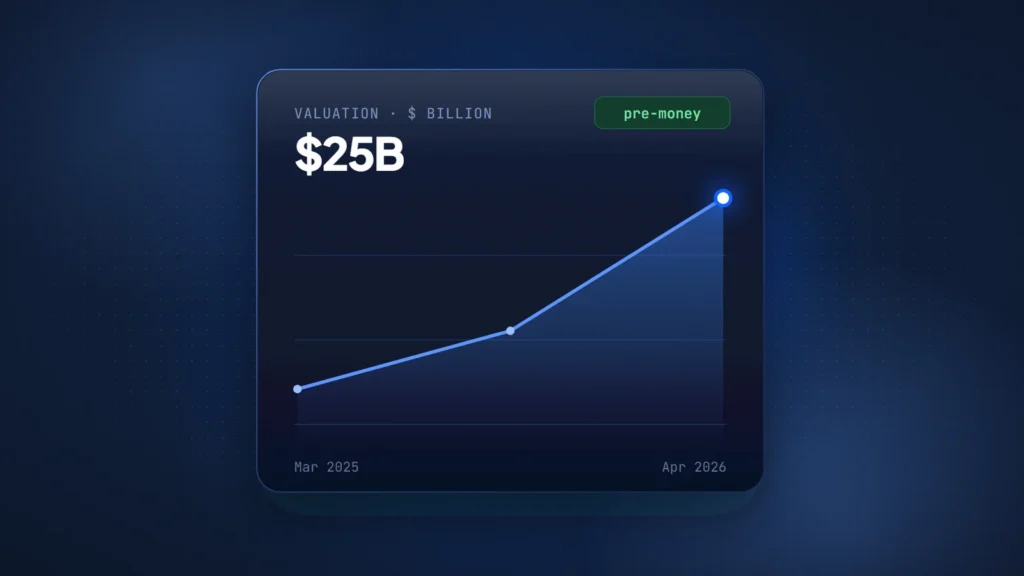
Reflection AI’s reported valuation rose from about $545 million in March 2025 to $8 billion in October 2025 and $25 billion pre-money in April 2026. On those reported figures, that is roughly a 46-fold increase in 13 months.
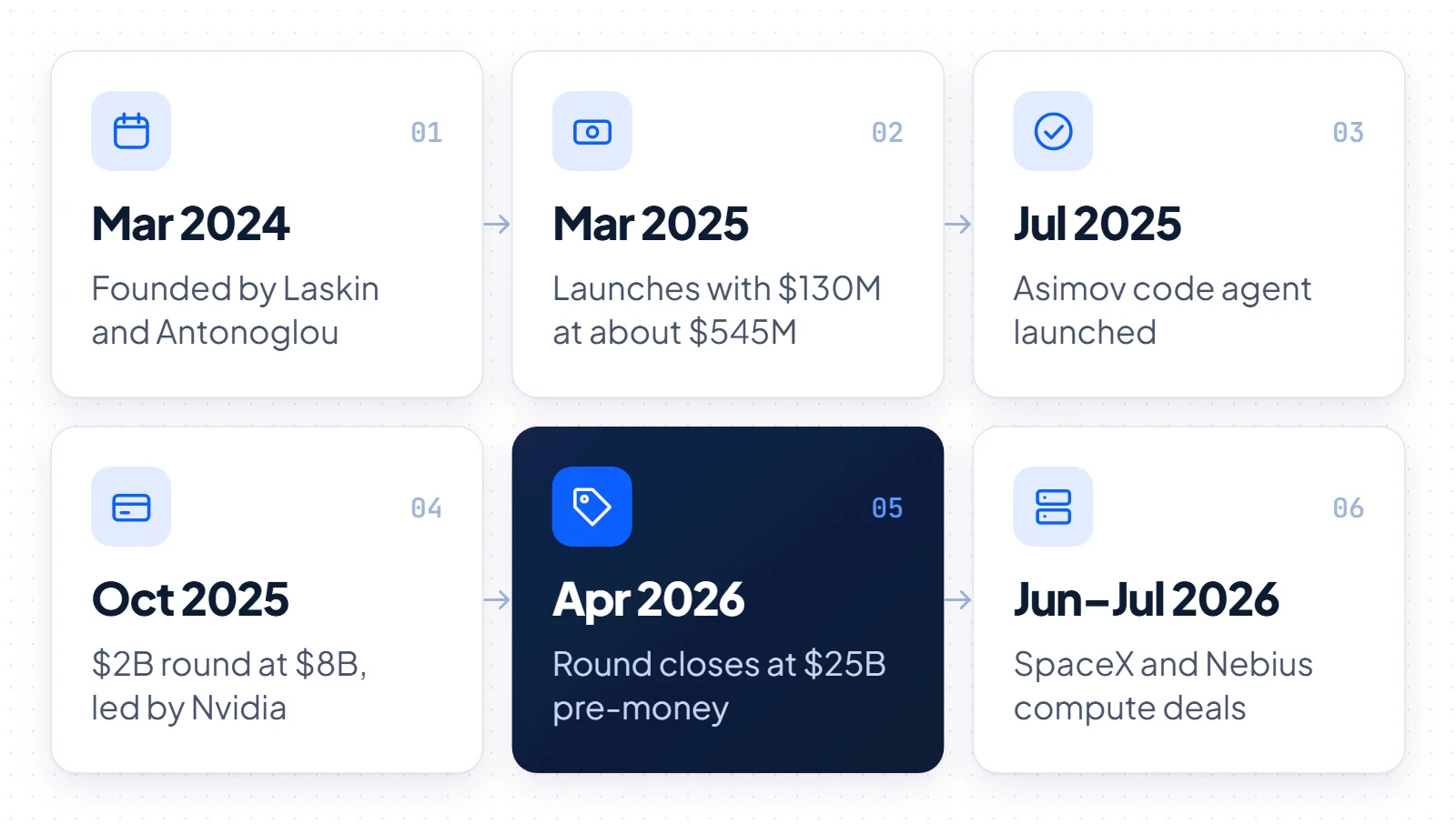
The company emerged from stealth on March 7, 2025, with $130 million. That total combined a $25 million seed round led by Sequoia and CRV with a $105 million Series A co-led by CRV and Lightspeed. TechCrunch put the valuation at that point at $545 million. In October 2025, Reflection raised $2 billion at an $8 billion valuation in a round led by Nvidia, SiliconANGLE reported. TechCrunch described that jump as a “15x leap” in seven months.
The Financial Times reported on March 2, 2026, that Reflection was courting investors at a valuation of more than $20 billion. Later that month, the Wall Street Journal reported talks to raise $2.5 billion at $25 billion pre-money and said the company had no meaningful revenue. On April 23, 2026, Laskin confirmed on CNBC that the round had closed at a $25 billion pre-money valuation. No primary source has confirmed the final amount raised.
| Date | Round | Amount | Valuation | Lead and investors | Source and status |
|---|---|---|---|---|---|
| March 7, 2025 | Seed and Series A | $130 million ($25 million seed, $105 million Series A) | About $545 million | Sequoia and CRV (seed); CRV and Lightspeed (Series A); Nvidia’s venture arm, Reid Hoffman, Alexandr Wang | SiliconANGLE; TechCrunch (valuation). Reported |
| October 9, 2025 | Series B | $2 billion | $8 billion | Nvidia (lead; about $800 million per the WSJ), B Capital, Citi, CRV, DST, Eric Schmidt, Lightspeed, Sequoia, 1789 and others | Reflection AI blog (amount); TechCrunch (valuation); SiliconANGLE (Nvidia lead); WSJ via Tech Startups (Nvidia stake) |
| March 2026 | Talks | $2.5 billion (WSJ) | More than $20 billion (FT), then $25 billion pre-money (WSJ) | JPMorgan reported to be considering | Reported, not closed at the time |
| April 23, 2026 | Round closed | Not confirmed ($2.5 billion was the reported target) | $25 billion pre-money | Not disclosed | CNBC; confirmed by the CEO |
Compute deals and partners
Reflection AI signed two compute contracts in 2026 for Nvidia GB300 systems: SpaceX, worth up to about $6.3 billion, and Nebius, worth more than $1 billion through 2029. The company also signed memoranda with Shinsegae Group in South Korea on March 16, 2026, and with the US Department of Energy on May 22, 2026.
| Partner | Date | What | Value |
|---|---|---|---|
| Shinsegae Group | March 16, 2026 | MOU for a data center of up to 250 MW in South Korea | Not disclosed |
| US Department of Energy | May 22, 2026 | Genesis Mission MOU: open-source AI platform for 17 national laboratories | Not disclosed |
| SpaceX | June 22, 2026 | Nvidia GB300 capacity at Colossus 2, Memphis | $150 million a month through 2029; up to about $6.3 billion |
| Nebius | July 14, 2026 | Nvidia GB300 capacity through 2029 | More than $1 billion |
The SpaceX deal, reported by CNBC on June 22, 2026, runs at $150 million a month from July 1, 2026, through 2029. That adds up to about $6.3 billion if it runs to term. The contract allows termination on 90 days’ notice after the first three months, so the full value is not guaranteed.
Nebius agreed to sell Reflection more than $1 billion of computing power on Nvidia GB300 chips through 2029, Bloomberg reported on July 14, 2026. TechCrunch covered the deal the same day.
Under the Shinsegae memorandum, Reflection supplies Nvidia GPUs, open-weight models and engineering, while Shinsegae handles the site, power, permits and financing. DatacenterDynamics described it as the first deal under the American AI Exports Program.
Government work grew in May 2026. Under the Genesis Mission agreement announced on May 22, Reflection will provide an open-source AI platform for the Department of Energy’s 17 national laboratories, MeriTalk reported. Four days later, the Washington Post ran a brief headlined “Reflection AI arrives in Washington”.
How Reflection AI compares with other frontier labs
Reflection AI is the only lab in this group that has promised open weights for a frontier model but not yet shipped one. Thinking Machines Lab and Meta Superintelligence Labs have released models, while Safe Superintelligence has released no public product.
| Lab | Founded | Led by | Open weights | Public models as of October 2026 | Latest reported valuation |
|---|---|---|---|---|---|
| Reflection AI | March 2024 | Misha Laskin (CEO) | Promised; datasets and pipelines to stay proprietary | None | $25 billion pre-money (April 2026) |
| Thinking Machines Lab | Launched February 2025 | Mira Murati (CEO) | Yes, Inkling under Apache 2.0 | Inkling (July 2026), Inkling-Small | $12 billion (July 2025); talks at a pre-money valuation of at least $40 billion reported (September 2026) |
| Safe Superintelligence | June 2024 | Ilya Sutskever (co-founder and CEO since July 2025) | Not disclosed | None | $32 billion (April 2025, reported) |
| Meta Superintelligence Labs | June 2025 | Alexandr Wang (Chief AI Officer) | Partly, Muse Glimmer (August 2026) | Muse Spark (April 2026), Muse Glimmer | Not applicable (unit of Meta) |
The contrast with Safe Superintelligence is the clearest. SSI also names superintelligence as its goal, but it had published no model, product or API as of October 5, 2026. Meta Superintelligence Labs is a unit inside Meta rather than a startup, so it has no separate valuation.
On strategy, Reflection’s closest match is Thinking Machines Lab, which released its Inkling open-weights model on July 15, 2026. Reflection’s pitch differs in emphasis: it presents open models as an American answer to DeepSeek and Qwen.
Can you invest in Reflection AI, and is it legit?
You cannot buy Reflection AI shares on a public stock exchange, because it is a private, venture-backed company. Its named backers include Nvidia, Sequoia, Lightspeed and CRV.
We do not give investment advice. The valuations in this article are dated, reported figures, not estimates of what shares are worth.
Reflection AI is a real company with named founders, named investors and public agreements with SpaceX, Nebius and the Department of Energy. Confusion often comes from Reflection 70B, a 2024 model from HyperWrite’s Matt Shumer that drew fraud allegations, as Tom’s Guide reported in September 2024. That model and the dispute around it are unrelated to Reflection AI.
The open question is delivery, not legitimacy. As of October 4, 2026, Reflection had raised more than $2 billion in disclosed rounds and signed large compute contracts. It had still not released the open frontier model at the center of its pitch.
What to watch next
The next test for Reflection AI is its first open-weight model. When it arrives, check three things: the license, the parameter count and independent benchmark results.
Then compare them with the goal Axios described, which is to compete with the best Chinese open-weight models. Until a model ships, the public record consists of Asimov, the funding rounds and the compute contracts.
Reflection runs its website on reflection.ai, a .ai domain. Labs that brand around superintelligence have another option. .si is Slovenia’s country-code domain. For AI companies it reads as SuperIntelligence. Our guide to superintelligence domains compares the extensions AI companies choose.