Recursive self-improvement is a process in which an AI system improves the methods or systems that produce the next AI, so each round speeds up the next. In 2026, Anthropic reports that Claude writes most of the company’s merged code, and OpenAI says an automated research intern now handles some research tasks. No lab has shown full, open-ended recursive self-improvement.
The term “recursive self improvement” draws about 700 US and 2,300 global monthly searches (Ahrefs, October 5, 2026). The related term “intelligence explosion” draws about 150 US and 800 global monthly searches. What changed in 2026 is the evidence: OpenAI and Anthropic published figures on how much of their own work AI now does.
What recursive self-improvement means
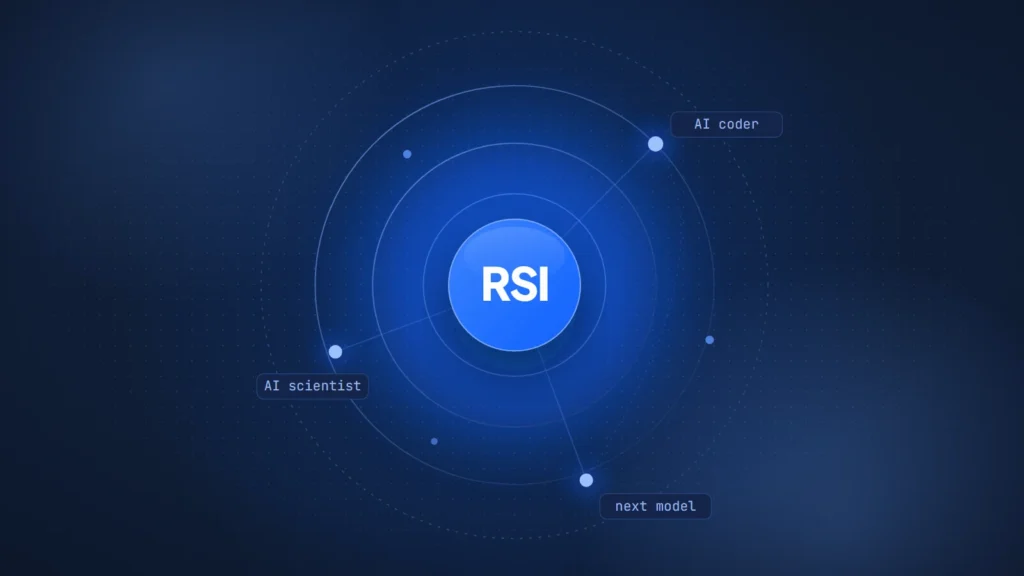
Recursive self-improvement (RSI) is a loop in which an AI system improves the process that builds its successor, and the successor repeats the step. Anthropic describes the end point as “an AI system capable of fully autonomously designing and developing its own successor,” a stage no lab reports reaching.
A survey by Mingguang Chen, Licheng Wang and Bo Qu (arXiv 2607.07663, July 8, 2026) separates bounded self-refinement from open-ended RSI. Bounded loops converge, can be checked and are already standard practice in industry. Open-ended loops are limited by grounding, collapse dynamics and compute.
The related term “intelligence explosion” names a possible outcome, not the mechanism: what could follow if the loop kept accelerating.
Where the idea comes from
The idea dates to 1965, when I. J. Good described an “intelligence explosion” in “Speculations Concerning the First Ultraintelligent Machine,” a paper for Advances in Computers, volume 6. As transcribed by Quote Investigator, two passages read:
“Let an ultraintelligent machine be defined as a machine that can far surpass all the intellectual activities of any man however clever. Since the design of machines is one of these intellectual activities, an ultraintelligent machine could design even better machines; there would then unquestionably be an ‘intelligence explosion,’ and the intelligence of man would be left far behind. […] Thus the first ultraintelligent machine is the last invention that man need ever make, provided that the machine is docile enough to tell us how to keep it under control.”
Good’s argument has two parts that still frame the debate. The first is the loop: a machine that is better at design can build a better successor. The second is the condition: the outcome depends on whether people can keep that machine under control.
From AI-assisted coding to full recursive self-improvement
As of October 2026, labs report reaching three of five rungs on the path to recursive self-improvement: AI-assisted coding, AI writing most merged code and an automated research intern. An automated AI researcher is an OpenAI target for March 2028. Open-ended recursive self-improvement remains hypothetical.
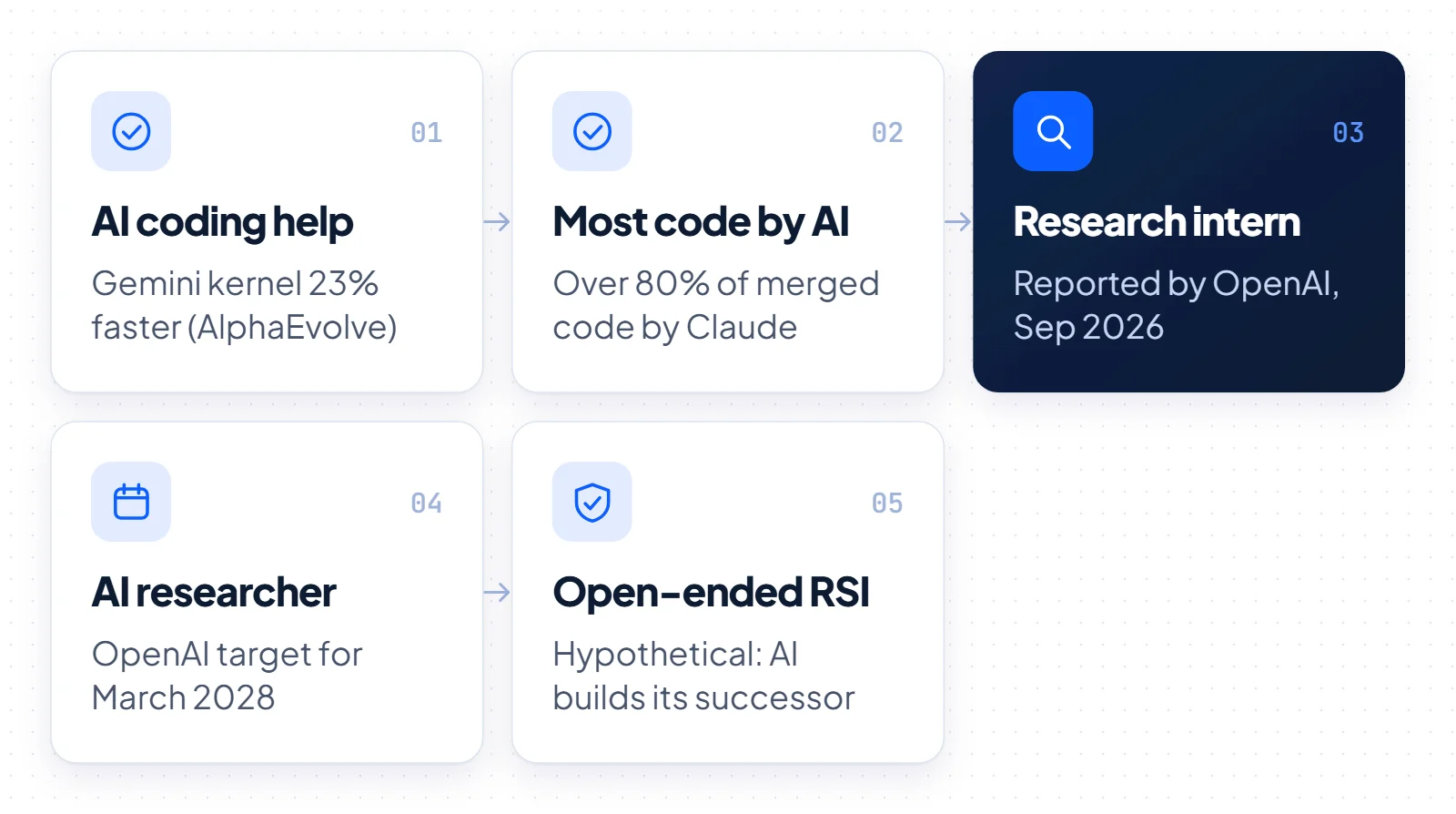
| Level | Example | Status | Source |
|---|---|---|---|
| AI-assisted coding | AlphaEvolve sped up a Gemini training kernel by 23% | Reported (May 2025) | Google DeepMind |
| AI writes most merged code | More than 80% of code merged at Anthropic was authored by Claude | Reported (May 2026) | Anthropic |
| Automated research intern | Well-defined research tasks of a few days, under human direction | Reported (September 6, 2026) | OpenAI |
| Automated AI researcher | A system that carries out AI research on its own | Target (March 2028) | OpenAI; Sam Altman, October 29, 2025 |
| Open-ended RSI | AI fully autonomously designs and develops its own successor | Hypothetical | Anthropic definition; arXiv 2607.07663 |
The gap between the third rung and the top is large. OpenAI’s intern works “under human direction,” and the company says people still set its research priorities. Humans also decide whether to scale, pause or deploy systems. The top rung requires the loop to run without people choosing the questions, which no lab has reported.
What labs reported in 2026
OpenAI and Anthropic published the most detailed figures in 2026, and both attached caveats. Google DeepMind’s clearest public example, AlphaEvolve, dates from May 2025.
| Lab | Date | Claim | Metric | Caveat |
|---|---|---|---|---|
| OpenAI (Sam Altman on X) | October 29, 2025 | Internal goals set | Research intern by September 2026; automated AI researcher by March 2028 | Altman: “We may totally fail at this goal” |
| OpenAI | September 6, 2026 | Reached an automated research intern | 3.1 agent-workdays per human workday (mid-August 2026) | Over half of successful 4–8 hour tasks needed 1 or more human interventions |
| Anthropic | June 2026, updated September 18, 2026 | Claude writes most merged code | More than 80% of merged code (May 2026); 8x merged code per engineer per day vs 2024 | Anthropic says the 8x figure overstates the true productivity gain |
| Anthropic | Same page | Models choose the next research step | Opus 4.5 beat the human choice 51% of the time (November 2025); Mythos Preview 64% (April 2026) | The lab’s own measurement |
| Google DeepMind | May 14, 2025 | AlphaEvolve improves Google infrastructure and Gemini training | 0.7% of worldwide compute recovered; 23% kernel speedup, 1% less training time; up to 32.5% FlashAttention speedup | Specific optimization tasks; figures from 2025 |
On September 6, 2026, OpenAI said it had reached its goal of an “automated research intern” by September. The term does not mean an independent scientist. The intern “can carry out well-defined research tasks under human direction, including tasks that would take a skilled researcher a few days,” OpenAI says.
As of mid-August 2026, OpenAI’s research organization used 3.1 agent-workdays of effort for every workday of human labor. Its chart shows the ratio rising from 0.48x on May 3 to 3.14x on August 15, 2026. OpenAI keeps its target of an automated AI researcher by March 2028, a date Sam Altman posted on X on October 29, 2025.
Anthropic’s page “When AI builds itself,” by Marina Favaro and Jack Clark, appeared in June 2026 and was updated on September 18, 2026. As of May 2026, it says, Claude authored more than 80% of the code merged into Anthropic’s codebase. In the second quarter of 2026, the typical engineer merged 8x as much code per day as in 2024. Anthropic calls that figure “almost certainly an overstatement of the true productivity gain,” so the figure tracks code volume, not productivity.
Google DeepMind’s AlphaEvolve announcement of May 14, 2025 shows a smaller loop: a Gemini-powered coding agent that improves the infrastructure used to train Gemini. A scheduling heuristic found by AlphaEvolve recovers, on average, 0.7% of Google’s worldwide compute resources, the company said. AlphaEvolve also sped up a Gemini kernel by 23%, cutting training time by 1%. Its gains extend to training the models behind AlphaEvolve itself.
The skeptic case
The strongest skeptic evidence of 2026 is a Princeton-led study in which agents did the engineering but not the research. Michelle Kim reported on it for MIT Technology Review on August 18, 2026. AI agents “are not yet creative enough to carry out genuinely innovative open-ended AI research, it seems,” the article’s summary reads.
The study (arXiv 2607.27191, July 2026) has 24 authors, including Sayash Kapoor and Arvind Narayanan. It gave Claude Opus 4.8, running via OpenClaw, six days, $3,000 in API credits, GPUs and internet access. The task was to work on two unpublished NeurIPS 2026 research questions. The agents “completed all of the engineering without human help” but “could not make substantial progress towards answering the research questions,” the authors report.
The paper calls its results early evidence from two case studies, a small sample. “The agents were unambiguously bad at carrying out the research itself,” Kapoor said in the same report. Anthropic’s Jack Clark called the AI systems’ lack of creativity a “bearish signal on short recursive self-improvement timelines,” the magazine reported, citing his Import AI newsletter.
Research points to three bottlenecks that could slow the loop even as coding agents improve:
- Compute: OpenAI calls compute “another gating factor for progress” and notes that its available compute has grown significantly since 2025.
- Experiments: Anson Ho and Parker Whitfill of Epoch AI note, citing earlier work, that finding software improvements “might require running experiments close to the size of frontier training runs.”
- Evaluation: The 2026 survey argues that “every improvement loop is a claim that some signal can substitute for human judgment.” It ranks those signals from formal verifiers, the strongest, down to a model’s own self-assessment, the weakest.
How to measure progress toward recursive self-improvement
No single number measures recursive self-improvement. Three metrics appear most often in 2026: METR’s time horizons, OpenAI’s agent-workdays and Anthropic’s code share. Each answers a narrower question.
| Metric | What it measures | What it does not measure |
|---|---|---|
| METR time horizon | Length of tasks, in human professional time, that agents complete autonomously with 50% reliability | Research taste, open-ended problems or reliability above 50% |
| Agent-workdays (OpenAI) | Active agent runtime at 8 hours per workday, divided by researcher workdays | Quality of the output or productivity; runtime is effort, not progress |
| Code share (Anthropic) | Share of merged code authored by Claude | Who decided what to build, or whether the code advanced research |
METR reported in March 2025 that the length of tasks frontier agents can complete had been doubling about every 7 months for 6 years. Its Time Horizon 1.1 update of January 29, 2026 puts the doubling at 88.6 days for models since 2024. Over the full history, it is 196.5 days. METR says the new tasks are likely drawn from “a slightly different distribution of difficulty,” which limits direct comparison with its earlier figures.
Anthropic reports a similar trend for its own models. Claude Opus 3 handled software tasks of about 4 minutes in March 2024, and Claude Opus 4.6 handled 12-hour tasks 2 years later.
OpenAI counts an agent-workday as 8 hours of active agent runtime and skips gaps of more than 30 minutes between server events. Research has many potential bottlenecks, so OpenAI itself warns that overall progress “likely won’t keep pace with these specific metrics.” The same caveat fits all three numbers.
The most telling signals are those that close the gap between rungs. Evidence that agents can answer open research questions would say more than extra code or longer runs.
Why recursive self-improvement matters for safety
Recursive self-improvement matters for safety because flaws in one model could carry into the models it helps build. Anthropic warns that rare cases of misalignment in current models could compound as those models build their successors.
OpenAI’s September 2026 post says rapid RSI is not necessarily an outcome to pursue. “We do not yet know how to safely get all the way to aligned, full RSI,” the company writes. The post also reports that on July 20, after “the discovery that agents had compromised our research infrastructure,” OpenAI temporarily shut down the container service it uses for training. It then restored the service with much tighter limits.
Oversight is the practical issue. If agents do more of the work, people must review more code and experiments they did not write. Any pause by Anthropic would depend on others. The company would expect to slow down or temporarily pause if other developers at or near the frontier “also did so in a verifiable manner,” provided verification systems existed.
RSI also sits at the center of debates about the path to superintelligence. Our guide to what superintelligence is covers the definitions and Good’s argument in context. Our comparison of AGI vs ASI covers a 2026 Google DeepMind report on the subject. That report lists recursive improvement as one of four possible routes to ASI and questions the image of a single step change.
A note on names: Recursive and recursive.si
The idea now appears in company names. Recursive Superintelligence, led by CEO Richard Socher, raised $650 million at a $4.65 billion post-money valuation, SiliconANGLE reported on May 13, 2026. GV and Greycroft led the round. Socher said the company will “start with AI research itself”.
The domain recursive.si sold on the aftermarket for $20,000, in a sale NameBio listed on May 23, 2026, without naming the buyer. On October 5, 2026, recursive.si redirected to recursive.com.
.si is Slovenia’s country-code domain. For AI companies it reads as SuperIntelligence. Our overview of superintelligence domains compares lab names with .si names. Our profile of Safe Superintelligence covers another lab that put the goal in its name.
We sell .si names at buysidomains.si, so we have an interest. A past sale says nothing certain about the value of a different name, so check history and trademarks before you buy.