AGI vs ASI comes down to one threshold. Artificial general intelligence (AGI) would match skilled humans across most cognitive tasks. Artificial superintelligence (ASI) would far exceed the best humans in virtually all of them. Google DeepMind’s Levels of AGI framework marks every general level above “Emerging” as not yet achieved, ASI included.
Ahrefs data from October 5, 2026 shows about 2,500 global monthly searches for “agi vs asi” and about 48,000 for “what is agi”. The terms have also moved from papers into company plans. In June 2026, Google DeepMind researchers wrote that human-level AGI has become “a concrete next-decade target for many of the largest AI organisations” (From AGI to ASI). This guide lines up the definitions, the levels and the forecasts, each with its source.
AGI vs ASI: what is the difference?
The difference between AGI and ASI is the bar a system is measured against. AGI is general ability at roughly the level of skilled humans, while ASI is general ability well beyond the best humans.
OpenAI’s Charter, published in 2018, defines AGI as “highly autonomous systems that outperform humans at most economically valuable work” in its mission statement. The benchmark is economic, and the scope is most work, not all of it. OpenAI CEO Sam Altman called AGI “a weakly defined term” in a February 2025 blog post. By it, he said, OpenAI generally means a system that can tackle increasingly complex problems at human level in many fields.
For superintelligence, the standard reference is philosopher Nick Bostrom. His 2014 book Superintelligence defines it as “any intellect that greatly exceeds the cognitive performance of humans in virtually all domains of interest” (chapter 2). His 1998 paper “How Long Before Superintelligence?” set a similar bar. It describes an intellect “much smarter than the best human brains in practically every field, including scientific creativity, general wisdom and social skills.”
Google DeepMind adds a collective benchmark. Its June 2026 report From AGI to ASI sets the bar at systems “more intelligent and cognitively capable than large organisations of humans” rather than individual experts. AGI is measured against skilled individuals, while ASI is measured against the best individuals and, in DeepMind’s framing, against whole organizations.
ANI vs AGI vs ASI: a side-by-side comparison
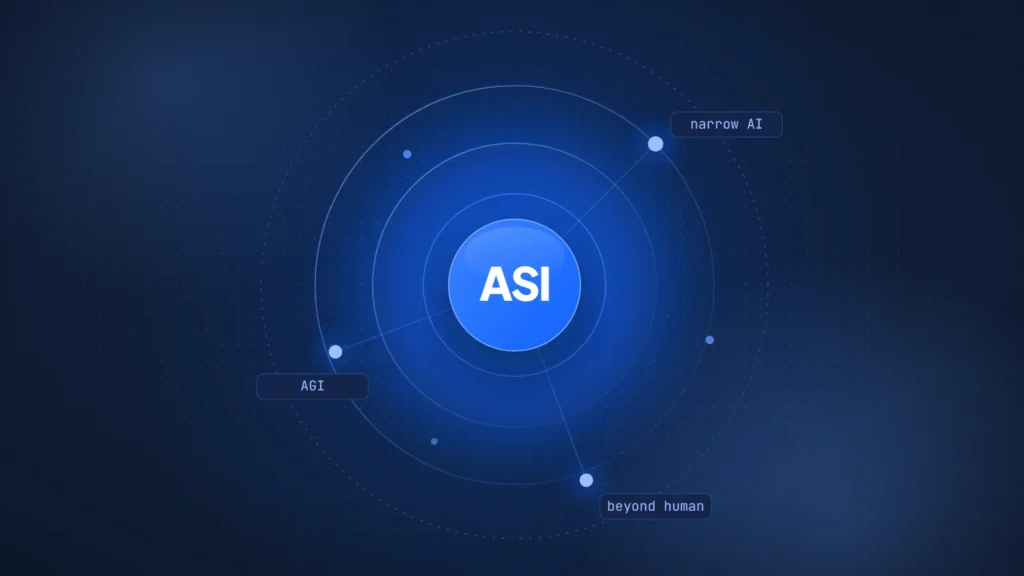
ANI, AGI and ASI are three points on one scale of generality and performance. Artificial narrow intelligence (ANI) handles one task or a narrow set of tasks. AGI handles most cognitive tasks at a human level, and ASI exceeds humans across almost all of them.
| Aspect | ANI (narrow AI) | AGI (general AI) | ASI (superintelligence) |
|---|---|---|---|
| Definition | AI built for one task or a narrow set of tasks | “Highly autonomous systems that outperform humans at most economically valuable work” | “Any intellect that greatly exceeds the cognitive performance of humans in virtually all domains of interest” |
| Scope | A single domain | Most cognitive tasks | Virtually all domains |
| Benchmark | Task-specific performance | Skilled humans | The best humans, or large organizations of humans |
| Status today, per named sources | Widely deployed | ChatGPT-class models rated Level 1 “Emerging AGI” as of September 2023; Levels 2–5 not yet achieved (Morris et al., 2025 revision) | Not yet achieved; Level 5 general AI in Morris et al. |
| Who defines it (example) | Narrow column of the Levels of AGI paper (Google DeepMind) | OpenAI Charter (2018) | Nick Bostrom (2014); Google DeepMind (2026) |
The table shows why most of the debate is about AGI. Narrow AI is in everyday use, and every source above treats ASI as something not yet built. AGI sits in the contested middle, where the chosen definition decides whether a system counts.
Where ASI sits in Google DeepMind’s Levels of AGI
In Google DeepMind’s Levels of AGI framework, ASI is Level 5 general AI: a system that outperforms 100% of humans across a wide range of tasks. The paper treats AGI and ASI as rungs on the same ladder, not as separate technologies.
The framework comes from “Levels of AGI for Operationalizing Progress on the Path to AGI” by Morris, Legg and colleagues at Google DeepMind. First posted in November 2023 and revised in September 2025, it rates systems on performance and generality, with autonomy as a separate dimension. It also splits each level into a narrow and a general column.
The performance levels run from Level 0, No AI, to Level 5, Superhuman. Emerging means performance “equal to or somewhat better than an unskilled human” on a task. Competent, Expert and Exceptional mean at least the 50th, 90th and 99th percentile of skilled adults. Exceptional was originally called “Virtuoso” in the first version of the paper.
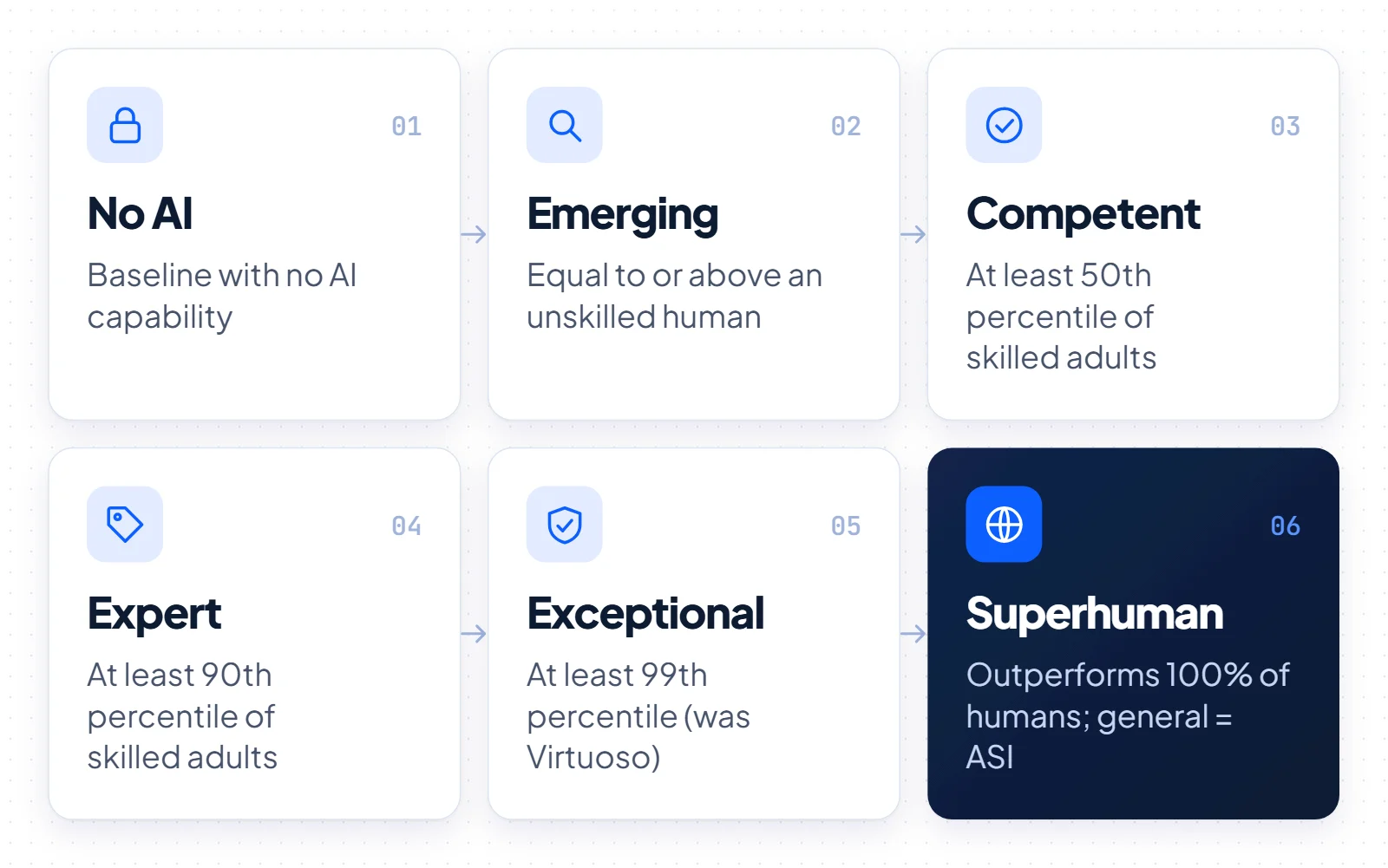
The authors label Level 5 General AI systems ASI. These systems “will be able to do a wide range of tasks at a level that no human can match,” in the paper’s words. In the general column, Levels 2 to 5 are all listed as not yet achieved.
Is ChatGPT AGI?
Google DeepMind’s Levels of AGI paper (Morris et al.) placed ChatGPT at Level 1 “Emerging AGI” as of September 2023, an early stage of AGI rather than human level. The paper lists ChatGPT, Bard, Llama 2 and Gemini at that level, and the authors kept that rating in the September 2025 revision.
The authors note that frontier language models reach Competent performance on some tasks, such as short essay writing and simple coding. Yet the models stay at Level 1 “until the performance level increases for a broader set of tasks,” the paper says. In their scheme, a system reaches a general level only when it performs at that level across a broad set of tasks.
Microsoft researchers took a stronger position in their 2023 “Sparks of Artificial General Intelligence” paper. An early version of GPT-4, they wrote, “could reasonably be viewed as an early (yet still incomplete) version of an artificial general intelligence (AGI) system” (Bubeck et al.).
OpenAI has not formally declared ChatGPT or any other product to be AGI, and its CEO’s public statements have shifted. In January 2025, Altman wrote on his blog that OpenAI is “now confident we know how to build AGI as we have traditionally understood it” (Reflections). He said “we basically have built AGI, or very close to it,” then called that “a spiritual statement, not a literal one,” in a February 2026 Forbes profile.
In an August 2026 interview with TIME, Altman said OpenAI had “not quite yet” reached AGI. He added that OpenAI expected to have an internal system he would call AGI by the end of 2026.
How AGI could lead to ASI
The classic argument for a fast path from AGI to ASI is I. J. Good’s “intelligence explosion” from 1965. A machine that is better than humans at designing machines could, in principle, design successors smarter than itself.
In “Speculations Concerning the First Ultraintelligent Machine,” Good argued that such a machine “could design even better machines,” producing an “intelligence explosion” that would leave human intelligence far behind. He called the first ultraintelligent machine “the last invention that man need ever make,” with one condition attached. It had to be “docile enough to tell us how to keep it under control,” which links the idea to the safety questions covered below.
Google DeepMind’s 2026 report From AGI to ASI, by Tim Genewein, Shane Legg and colleagues, sees more than one route. It names four possible pathways to ASI:
- scaling up AGI systems;
- shifts to new AI paradigms;
- recursive improvement, in which AI improves AI;
- ASI emerging from large-scale multi-agent systems.
The authors also question the image of a single step change. They suggest society may instead see a series of large changes driven by AI-enabled progress. They describe preparing for that as “a massively interdisciplinary endeavour of global scope and interest.” Recursive improvement is only one of the four.
How far away is AGI? What the surveys say
The 2023 AI Impacts survey of 2,778 AI researchers (Grace et al.) is the largest survey of its kind. Its aggregate forecast gave a 50% chance by 2047 that unaided machines outperform humans at every possible task, if science continues undisrupted. That forecast concerns “high-level machine intelligence,” which covers every task, not the “most economically valuable work” in OpenAI’s AGI definition.
AI Impacts ran the study, “Thousands of AI Authors on the Future of AI”, in October 2023. It surveyed researchers who had published in top-tier AI venues. Respondents’ aggregate forecast put a 10% chance on high-level machine intelligence by 2027 and a 50% chance by 2047. That 50% date is 13 years earlier than in the 2022 survey.
Full automation of all occupations came much later in the same survey: 10% by 2037 and 50% by 2116, compared with 2164 in 2022. The gap shows how much the wording of a question moves the answer.
AI companies speak in shorter horizons. Human-level AGI is now “a concrete next-decade target for many of the largest AI organisations,” the DeepMind report says. The Future of Life Institute adds that “many leading AI companies have the stated goal of building superintelligence in the coming decade” on its statement page. One lab, Safe Superintelligence, even carries that goal in its name. A stated goal is not a forecast, so the two kinds of numbers should be read separately.
The safety debate around superintelligence
Two public statements anchor the safety debate: a 2023 CAIS statement on extinction risk and a 2025 FLI call to prohibit superintelligence until it can be built safely.
In May 2023, the Center for AI Safety published a one-sentence statement on extinction risk. Its signatories included Geoffrey Hinton, Yoshua Bengio, Demis Hassabis of Google DeepMind, Sam Altman of OpenAI and Dario Amodei of Anthropic. The full text reads: “Mitigating the risk of extinction from AI should be a global priority alongside other societal-scale risks such as pandemics and nuclear war” (CAIS).
In October 2025, the Future of Life Institute launched its Statement on Superintelligence. It calls for “a prohibition on the development of superintelligence” until two conditions are met. The first is “broad scientific consensus that it will be done safely and controllably,” and the second is strong public buy-in. The statement had more than 76,000 signatures as of October 2026, with Hinton, Bengio and Stuart Russell among the named signers.
Researchers in the Grace et al. survey were divided too. Of the respondents, 68.3% thought good outcomes from superhuman AI were more likely than bad ones. Yet between 38% and 51% gave at least a 10% chance to outcomes as bad as human extinction, depending on how the question was framed.
How to read AGI and ASI claims
Read any AGI or ASI claim by asking which definition it uses, which level it means and who is making it. Without a stated definition, a claim about AGI or ASI cannot be checked.
- Check the definition. “Most economically valuable work” (OpenAI) is not “every possible task” (the AI Impacts survey) or “virtually all domains” (Bostrom).
- Check the level. Level 1 “Emerging AGI” in DeepMind’s framework is four levels below ASI, and the paper marks every general level above Level 1 as not yet achieved.
- Check the source type. A company goal, a researcher survey and a published framework are different kinds of evidence.
- Separate consensus from speculation. The definitions and levels are published and citable; dates for AGI or ASI are forecasts with wide uncertainty.
For a fuller look at the end point of the scale, read our explainer on what superintelligence is. It covers the concept, its history and the main arguments in more depth.
.si is Slovenia’s country-code domain. For AI companies it reads as SuperIntelligence. That reading is our framing, not an official meaning. For what makes a name worth paying for, see our guide to premium domain names. Our guides to the .si domain and to .ai domains cover the registration rules for each extension.