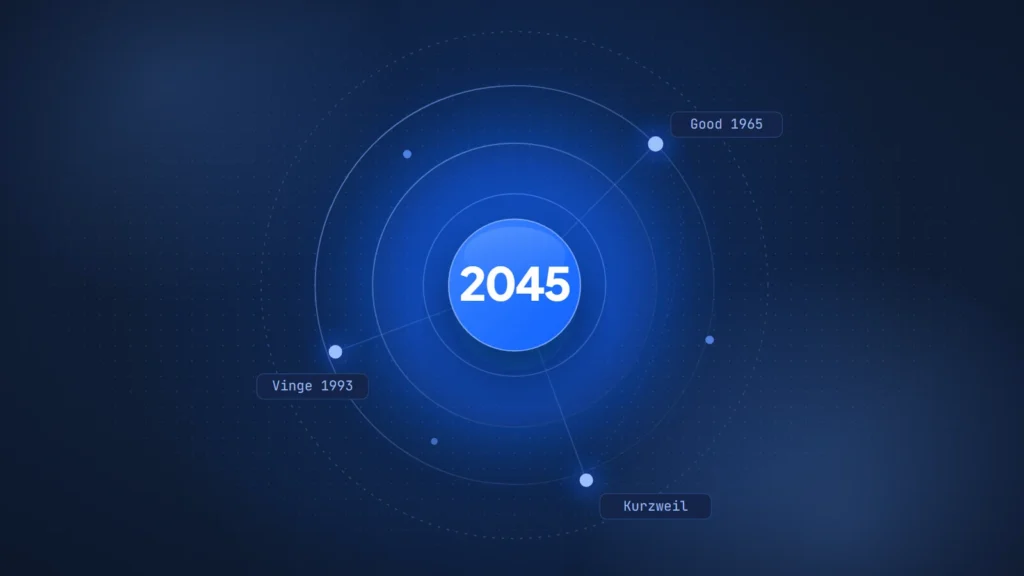
The technological singularity is a hypothetical point where technological progress, usually driven by self-improving AI, becomes so fast that it changes civilization beyond prediction. The idea traces back to Stanislaw Ulam’s 1958 account of a talk with John von Neumann. It runs through I. J. Good’s 1965 “intelligence explosion” and Vernor Vinge (1993) to Ray Kurzweil’s date of 2045.
“Technological singularity” draws about 3,500 US and 6,400 global searches a month (Ahrefs, October 5, 2026). “What is the singularity” adds about 4,100 US and 5,000 global searches, and “singularity meaning” about 1,500 US and 5,000 global. The term has also moved from essays into executive statements. Between February 2025 and July 2026, Elon Musk, Sam Altman and Demis Hassabis each said the singularity had begun or was close.
Where the technological singularity idea comes from
The technological singularity idea comes from three texts: Ulam’s 1958 tribute to von Neumann, Good’s 1965 paper on ultraintelligent machines and Vinge’s 1993 essay for a NASA symposium. Kurzweil later gave it a date.
The first recorded use of “singularity” in this sense is secondhand. In a tribute in the Bulletin of the American Mathematical Society in May 1958, Ulam recalled talks with von Neumann, who died in 1957. The words are Ulam’s paraphrase, not a direct quote from von Neumann. Ulam wrote that one conversation “centered on the ever accelerating progress of technology and changes in the mode of human life, which gives the appearance of approaching some essential singularity in the history of the race beyond which human affairs, as we know them, could not continue”.
Good made the mechanism explicit in 1965. His paper “Speculations Concerning the First Ultraintelligent Machine” defined a machine that “can far surpass all the intellectual activities of any man however clever”. Such a machine “could design even better machines” in turn. The result would be an “intelligence explosion”. Good called the first such machine “the last invention that man need ever make, provided that the machine is docile enough to tell us how to keep it under control”.
Vinge gave the idea its modern definition in March 1993. He wrote “The Coming Technological Singularity” for the VISION-21 Symposium of NASA Lewis Research Center and the Ohio Aerospace Institute. The NASA Technical Reports Server archives the paper (record 19940022856). In it he wrote: “Within thirty years, we will have the technological means to create superhuman intelligence”, and then: “Shortly after, the human era will be ended”.
Vinge described the singularity as “a point where our models must be discarded and a new reality rules”, a limit on forecasting itself. He also gave a window: “I’ll be surprised if this event occurs before 2005 or after 2030”.
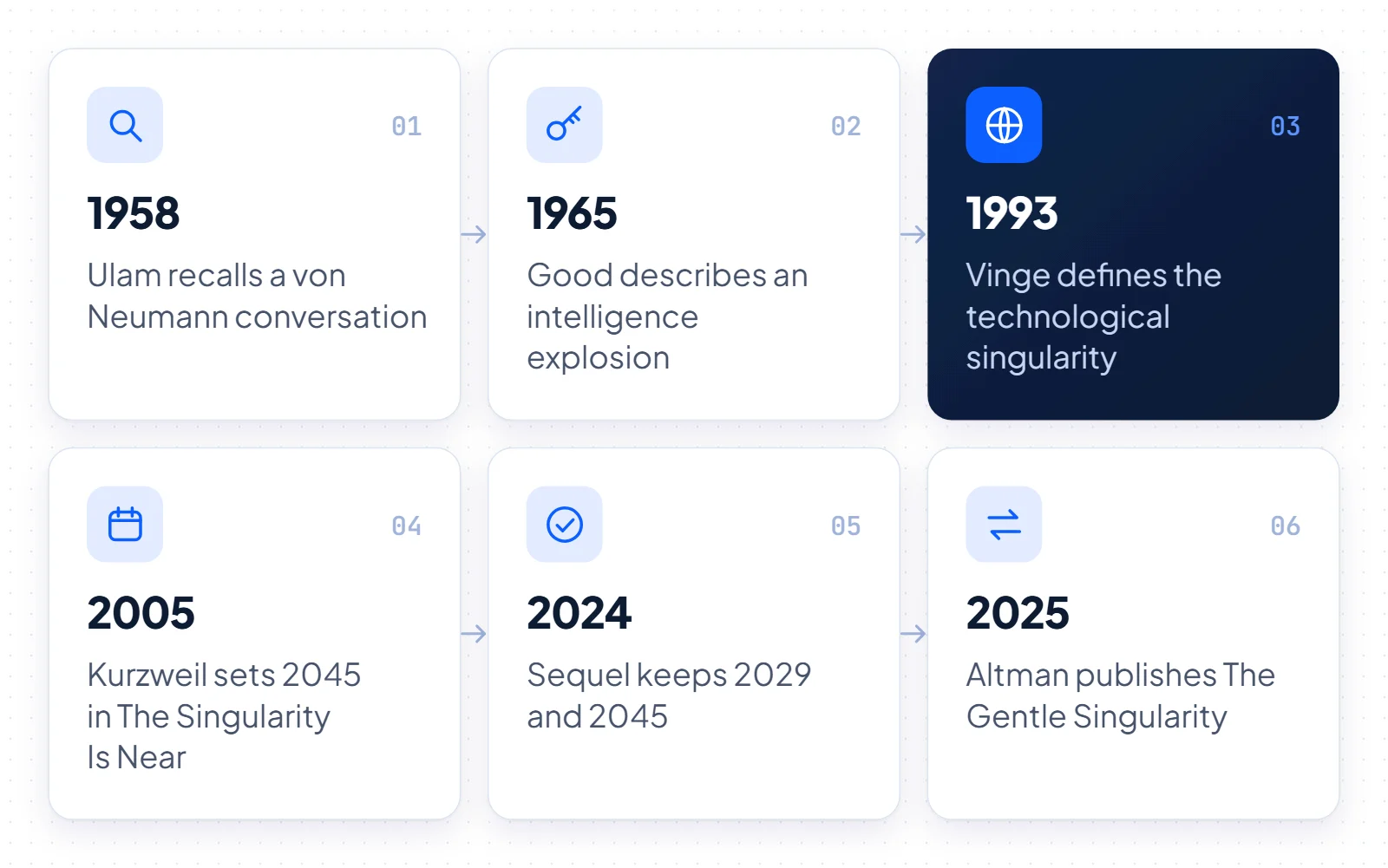
The milestones, in order:
- 1958: Ulam recalls von Neumann’s “essential singularity”.
- 1965: Good describes an “intelligence explosion”.
- 1993: Vinge’s NASA symposium essay defines the singularity.
- 2005: Kurzweil’s The Singularity Is Near sets 2045.
- 2024: The Singularity Is Nearer (June 25) keeps 2029 and 2045.
- 2025: Sam Altman publishes “The Gentle Singularity” (June 10).
Three meanings of the singularity
The word “singularity” carries three overlapping meanings: accelerating change, an intelligence explosion and an event horizon beyond which prediction fails. Many arguments about the singularity are really arguments about which meaning a speaker has in mind.
| Meaning | Core idea | Associated with |
|---|---|---|
| Accelerating change | Technology speeds up until human life changes beyond recognition | Ulam’s account of von Neumann (1958); Kurzweil (2005, 2024) |
| Intelligence explosion | A machine smarter than any human designs better machines, which design better ones again | I. J. Good (1965) |
| Event horizon | A point past which our models fail and the future cannot be forecast | Vernor Vinge (1993) |
The meanings often travel together. Vinge’s 1993 essay quotes both Ulam and Good, and the subtitle of Kurzweil’s 2024 book, When We Merge with AI, names a merger of humans and AI. Still, they lead to different tests. Accelerating change shows up in technical and economic data, while an intelligence explosion needs AI that speeds up AI research itself.
Recent statements by tech leaders use the word more loosely, as an era already underway rather than a single moment. When Altman wrote in June 2025 that “we are past the event horizon”, he borrowed Vinge’s image and applied it to the present.
Ray Kurzweil’s 2029 and 2045 predictions
Ray Kurzweil predicts human-level AI by 2029 and the singularity by 2045. He first forecast 2029 in 1999, gave both dates in The Singularity Is Near (2005) and repeated them in The Singularity Is Nearer, published on June 25, 2024.
In the 2005 book, Kurzweil described the Singularity as “a profound and disruptive transformation in human capability” and set its date as 2045. He also expected computers to pass the Turing test “by the end of the 2020s”, and in 2024 he again put that milestone at 2029. The sequel keeps 2045 for the Singularity.
Kurzweil restated both dates in an interview with Zoë Corbyn for The Observer, published by the Guardian on June 29, 2024. He defined human-level intelligence as AI that reaches the ability of the most skilled humans in a given domain. By 2029, he said, AI will reach that level in most respects. The interview’s headline quoted him: “We are going to expand intelligence a millionfold by 2045”.
Specific dates make Kurzweil’s forecast easy to test, and they drew a well-known rebuttal. In October 2011, Microsoft co-founder Paul Allen and Mark Greaves called the 2045 date “quite far-fetched”, and Kurzweil replied in the same magazine on October 20, 2011.
What supporters and skeptics say
Supporters of the singularity idea now include the heads of several large AI companies. Skeptics include scientists who doubt that progress will compound as fast as forecast. Each statement below carries a date and a source, and none is a consensus view.
| Who | Position | When | Source |
|---|---|---|---|
| Ray Kurzweil | Human-level AI by 2029, Singularity by 2045 | 2005; repeated June 2024 | The Singularity Is Near; The Singularity Is Nearer |
| Steven Pinker | “There is not the slightest reason to believe in a coming singularity.” | June 1, 2008 | IEEE Spectrum |
| Gordon Moore | “I am a skeptic.” | June 1, 2008 | IEEE Spectrum |
| Paul Allen and Mark Greaves | “we don’t think it is near” | October 12, 2011 | MIT Technology Review |
| Stephen Hawking | Full AI “could spell the end of the human race” | December 2, 2014 | BBC interview |
| Elon Musk | “We are on the event horizon of the singularity” | February 2025 | X post |
| Sam Altman | “We are past the event horizon” | June 10, 2025 | “The Gentle Singularity” blog post |
| Elon Musk | “We have entered the Singularity” | January 4, 2026 | X posts, reported by Benzinga |
| Demis Hassabis | “foothills of the singularity” | May 19, 2026 | Google I/O, reported by Semafor |
| Sam Altman | “We’re now, like, in the singularity.” | July 2026 | Relentless podcast, reported by Al Jazeera |
| Seán Ó hÉigeartaigh | “We aren’t there yet.” | July 2026 | Al Jazeera |
Supporters and warnings
Stephen Hawking warned about advanced AI several times. In a BBC interview on December 2, 2014, he said full AI “could spell the end of the human race” because it would redesign itself ever faster. In October 2016, launching Cambridge’s Leverhulme Centre for the Future of Intelligence, he called powerful AI “either the best, or the worst thing, ever to happen to humanity”.
Elon Musk has made the strongest present-tense claims, all on X. His post of February 2025 read “We are on the event horizon of the singularity”, and on January 4, 2026, he went further. That day he wrote “We have entered the Singularity” and “2026 is the year of the Singularity”, according to Benzinga.
Sam Altman published his essay “The Gentle Singularity” on June 10, 2025. It says “We are past the event horizon; the takeoff has started” and names 2026 as the likely arrival of “systems that can figure out novel insights”.
Demis Hassabis, CEO of Google DeepMind, closed the Google I/O keynote on May 19, 2026. People would look back, he said, and realize “we were standing in the foothills of the singularity”. Hassabis later told Semafor that, in his interpretation, the singularity “means the era that we’re in”. In July 2026, Al Jazeera reported Altman saying on the Relentless podcast that “We’re now, like, in the singularity”.
Skeptics
Steven Pinker saw “not the slightest reason to believe in a coming singularity”, according to IEEE Spectrum’s 2008 special report. In the same report, Intel co-founder Gordon Moore said: “I am a skeptic. I don’t believe this kind of thing is likely to happen, at least for a long time”.
In “The Singularity Isn’t Near” (October 12, 2011), Allen and Greaves argued that a “complexity brake” slows progress. Their verdict was measured: “While we suppose this kind of singularity might one day occur, we don’t think it is near”.
The 2026 claims drew skeptics too. In the July 2026 Al Jazeera report on Altman’s remarks, Cambridge research professor Seán Ó hÉigeartaigh said: “We aren’t there yet”.
Singularity vs AGI vs ASI
The singularity is not the same as AGI or ASI. AGI (artificial general intelligence) is AI that matches humans across most tasks, and ASI (artificial superintelligence) far exceeds them. The singularity is the period of runaway change that ASI might trigger.
In Good’s and Vinge’s versions, the steps form a chain. An AI reaches human level in AI research, improves its own successors and pulls far ahead of humans. The pace of change then outruns human forecasting. Each step is a separate assumption, and the “complexity brake” argument targets the speed of that loop.
Kurzweil’s own dates keep the first and last steps apart: 2029 for human-level AI and 2045 for the Singularity. Our guide to AGI vs ASI explains where the line between the two sits. Our explainer on what superintelligence is covers Good’s argument and its risks in more depth.
How close are we to the singularity?
Nobody knows how close the singularity is, and researcher surveys measure it only indirectly. In AI Impacts’ 2024 survey of 1,580 researchers, the mean aggregate forecast gave high-level machine intelligence (HLMI) a 50% chance by 2042.
That survey is the newest in AI Impacts’ series: the 2024 Expert Survey on Progress in AI, run in December 2024 and published in September 2026. In its mean aggregate forecast, HLMI reaches a 10% chance by 2027. The survey defines HLMI as the point “when unaided machines can accomplish every task better and more cheaply than human workers”.
That 50% year has moved earlier with each survey: 2061 in 2016, 2059 in 2022, 2047 in 2023 and 2042 in 2024. The 2023 survey, with 2,778 respondents, gave the 2047 date. Forecasts of this kind measure expert opinion, not technical progress.
The 2024 survey also asked about the singularity’s core mechanism. Assuming HLMI exists, the median respondent gave a 10% chance of vastly superhuman AI within 2 years and 60% within 30 years. For a roughly tenfold speedup in technological progress, the medians were 20% within 2 years and 80% within 30 years. Both medians matched the 2023 survey.
Only 4% of the 189 researchers asked rated the intelligence-explosion argument “quite likely” (81 to 100%) to be broadly correct. That share was down from 12%, 7% and 9% in the 2016, 2022 and 2023 surveys.
The evidence therefore splits two ways. Several AI leaders said in 2025 and 2026 that the singularity had begun. The median surveyed researcher saw a fast takeoff as possible but unlikely soon after human-level AI.
How to read a singularity claim
Read any singularity claim against three checks: which meaning the speaker uses, what dated source stands behind it, and how it compares with researcher surveys. In AI Impacts’ 2024 survey, only 4% of the researchers asked rated the intelligence-explosion argument “quite likely”.
- Meaning: an “event horizon” claim about today treats the singularity as an era, not as self-improving AI that outpaces people.
- Source: prefer a dated paper, blog post or recorded talk over a screenshot or summary.
- Evidence: compare an executive’s claim with the latest researcher survey, and note the survey year.
For teams naming AI products, the vocabulary matters too. Our note on what SI stands for covers how the abbreviation is used for superintelligence and in other fields. .si is Slovenia’s country-code domain. For AI companies it reads as SuperIntelligence. Our comparison of superintelligence domains shows how AI labs name themselves.