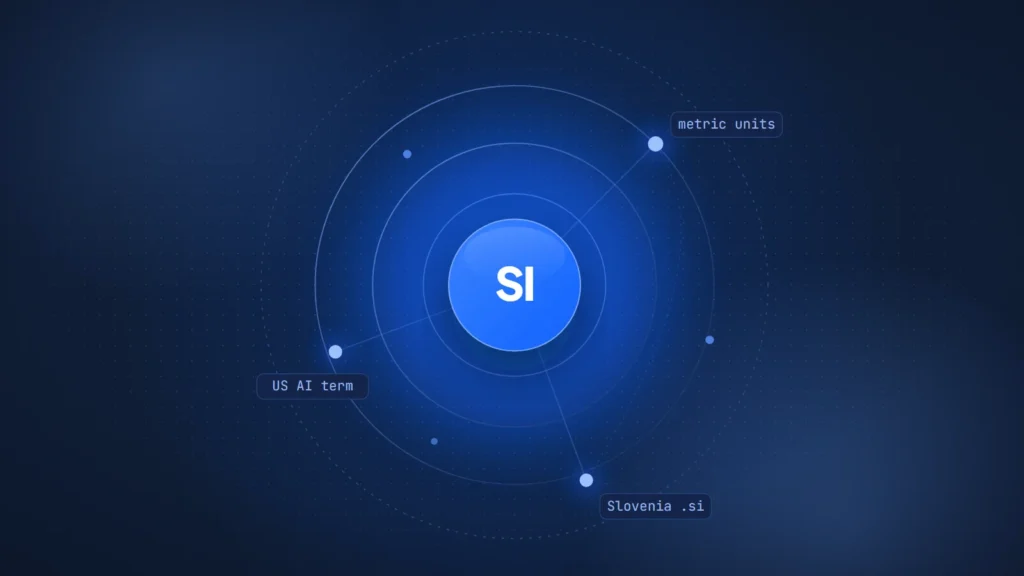
What does SI stand for? Most often, SI is the International System of Units (Système international d’unités), the modern metric system. Since September 29, 2026, the US executive branch also uses SI for “Super Intelligence” under Executive Order 14434. SI is also Slovenia’s ISO country code, which gives the country its .si domain.
The question draws about 900 searches a month in the US and 1,100 worldwide, according to Ahrefs data from October 5, 2026. Most top results still cover only the units meaning. This guide explains the three meanings that matter in 2026. It also covers other common uses of SI, each with a primary source.
What does SI stand for in physics?
In physics, SI stands for the International System of Units, the shared system for measurement used around the world. The International Bureau of Weights and Measures (BIPM) calls the SI “the internationally agreed system for measurement”. It also keeps the official definition.
The letters come from the French name, Système international d’unités. That is why they do not match the English words. The BIPM publishes the rules in the SI Brochure, a 9th edition first issued in 2019 and updated in 2026. For US readers, NIST’s guide to SI units says the SI is commonly known as the metric system.
The SI rests on seven base units. All other SI units are built from these seven. NIST counts 22 derived units with special names and symbols.
| Base unit | Symbol | Quantity measured |
|---|---|---|
| second | s | time |
| meter | m | length |
| kilogram | kg | mass |
| ampere | A | electric current |
| kelvin | K | thermodynamic temperature |
| mole | mol | amount of substance |
| candela | cd | luminous intensity |
The BIPM spells the length unit metre; the table uses the US spelling.
The 2019 redefinition
Since May 20, 2019, every SI unit has been defined by fixing the numerical values of seven defining constants. NIST says the world’s measurement experts all voted for this change in November 2018. The change took effect on World Metrology Day, May 20, 2019.
The BIPM lists the seven constants by symbol: ΔνCs, c, h, e, k, NA and Kcd. They include the speed of light (c) and the Planck constant (h). NIST describes the result as a measurement system based entirely on physical constants of nature.
Other meanings of SI
Outside measurement, SI and its variants have several common meanings. Capital letters often tell you which one is meant. The table lists only meanings we could confirm with a primary or authoritative source.
| Meaning | Field | Source |
|---|---|---|
| SI: Super Intelligence, the US executive branch’s term for AI since September 29, 2026 | US government | Executive Order 14434, whitehouse.gov |
| SI: Slovenia (ISO 3166-1 alpha-2; alpha-3 SVN, numeric 705) | Country codes | ISO 3166 Online Browsing Platform, iso.org |
| .si: Slovenia’s country-code top-level domain | Internet domains | IANA Root Zone Database |
| Si: Sport Injection, the badge on the Honda Civic Si | Cars | Honda News |
| Si: silicon, atomic number 14 | Chemistry | PubChem |
| sí: yes; si: if or whether | Spanish | Cambridge Dictionary |
| si: older name of ti, the seventh note of the sol-fa scale | Music | Cambridge Dictionary |
| SI: Sports Illustrated, first issue dated August 16, 1954 | Sports media | SI Vault, si.com |
On a Honda, the badge reads Si with a lowercase i. Honda says the initials stand for “Sport Injection”, and the original Civic CRX Si debuted for the 1985 model year. In music, Cambridge notes that the sol-fa scale first had six notes, with si added later.
Spanish shows how much one accent matters. The Cambridge Spanish–English dictionary gives sí with an accent as yes and si without one as if or whether. Spanish also uses si for the seventh note of the scale, the note English calls ti or B. Online acronym lists give many more meanings. The ones above are those with a source we can cite.
SI in AI: Super Intelligence under Executive Order 14434
In AI, SI now stands for Super Intelligence in US executive-branch usage. Executive Order 14434 is titled “Inaugurating The Era Of Super Intelligence” and was signed on September 29, 2026. It tells executive-branch agencies to write “Super Intelligence” and “SI” where they used to write “Artificial Intelligence” and “AI” in official documents.
How the term arrived
On September 19, 2026, President Donald Trump floated several other names for AI on social media, including “Superior Intelligence (SI)”, according to a Register.si notice. In a September 22 speech at the UN General Assembly, he said the US government would use the term super intelligence instead of artificial intelligence. Reuters and Deseret News reported the remarks. The order followed on September 29. The Federal Register published it on October 2, 2026, at 91 FR 63129.
What the order changes
Section 2(a) applies to executive-branch agencies and their non-statutory documents. Agencies must use the new terms in official correspondence, public communications, websites, reports, policy documents and other non-statutory documents within the executive branch. Section 1 sets the policy to the maximum extent permitted by law.
What the order does not change
Section 2(b) says the order does not require changes to earlier regulations, Presidential actions, contracts, grants or other historical documents. Section 4(c) adds that the order creates no right or benefit enforceable at law or in equity. In practice, older rules, contracts and grants that say AI do not have to be rewritten.
What SI means in the order
Section 3(a) defines Super Intelligence and SI as the technologies and systems covered by the statutory definition of artificial intelligence in 15 U.S.C. 9401(3). In other words, the order’s definition covers the same systems as the existing statutory definition of AI and does not create a new technical category. Section 3(b) asks for draft legislative language, within 60 days, that would give SI a federal definition. The draft should say whether the new definition would modify, expand or supersede the existing statutory one.
SI vs AI vs ASI
SI under Executive Order 14434 is the US executive branch’s name for the AI systems that 15 U.S.C. 9401(3) already covers. Artificial superintelligence (ASI) is a research term for hypothetical systems that would outperform humans at nearly all cognitive tasks. Federal SI describes existing technology, while ASI describes a hypothetical one.
- AI: the established term, and still the wording of the statutory definition in 15 U.S.C. 9401(3).
- SI (federal): the executive branch’s name for those same AI systems since September 29, 2026.
- ASI (research): a hypothetical future system that would exceed human ability in nearly all cognitive work.
Searchers do confuse the two terms. On October 5, 2026, Ahrefs showed about 20 monthly US searches and about 100 worldwide for the query si vs ai. The term superior intelligence drew about 60 US searches. For the research meaning, how it differs from AGI and who is working on it, read our explainer on what superintelligence is.
SI and .si: Slovenia’s country code
The .si domain is Slovenia’s country-code top-level domain, based on the ISO 3166-1 code SI. The IANA Root Zone Database lists ARNES as manager and April 1, 1992 as the registration date. Register.si reported in a September 24, 2026 notice that .si had passed 200,000 domains.
.si is Slovenia’s country-code domain. For AI companies it reads as SuperIntelligence. That reading is our framing, not an official meaning of the domain. Our guide to superintelligence domains compares the names AI labs use with .si names.
Demand rose with the news. Register.si’s notice also said every registrar pays the same registry price of €10. Each registrar then sets its own final price. It added that media claims of Slovenia earning millions have “no real basis” (our translation from Slovene). You register names through about 90 registrars, not directly at Register.si.
The Register.si homepage counter showed 301,826 .si domains at 16:29 UTC on October 5, 2026. The figure changes daily. For rules, prices and registration steps, see our complete guide to the .si domain. For how country codes become domains, read our guide to ccTLDs.
How to tell which SI is meant
Context and capital letters tell you which SI a text means. Measurements point to the units. US executive-branch documents from September 29, 2026 onward point to Super Intelligence. A lowercase .si in an address points to Slovenia’s domain.
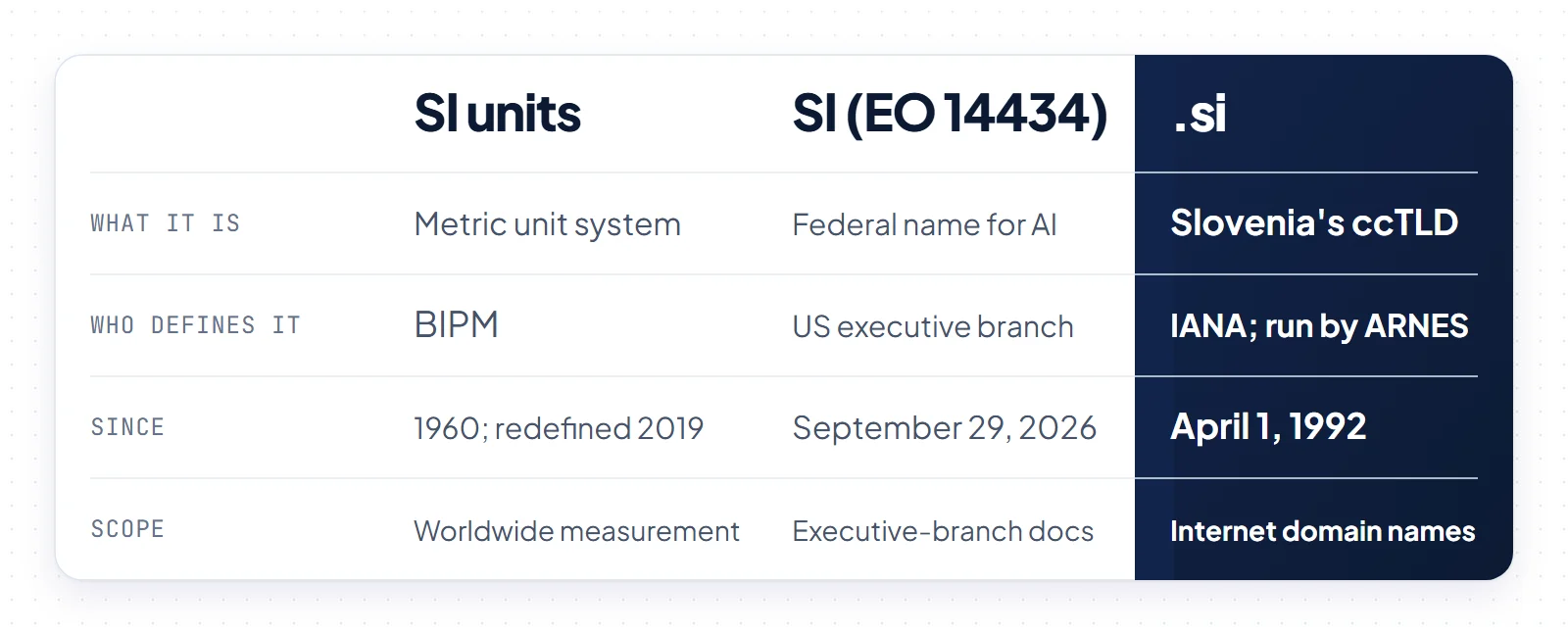
- Next to a number or a unit symbol, as in a lab report, SI means the International System of Units.
- In a US executive-branch document from September 29, 2026 onward, SI means Super Intelligence, which the order defines as today’s AI.
- In a web or email address, .si is Slovenia’s country-code domain.
- Si with a lowercase i is silicon in chemistry, or the Sport Injection badge on a Honda Civic.
- Sí with an accent is Spanish for yes, and si without it means if.
If you write for a mixed audience, spell out the meaning at first use, as in International System of Units (SI) or Super Intelligence (SI). The order covers only executive-branch documents, so other writers can keep using AI. The legal definition in federal law also still uses the term AI. Founders weighing a .si name for an AI company should treat the SuperIntelligence reading as a brand choice. To compare it with .ai, see our guide to .ai domains.