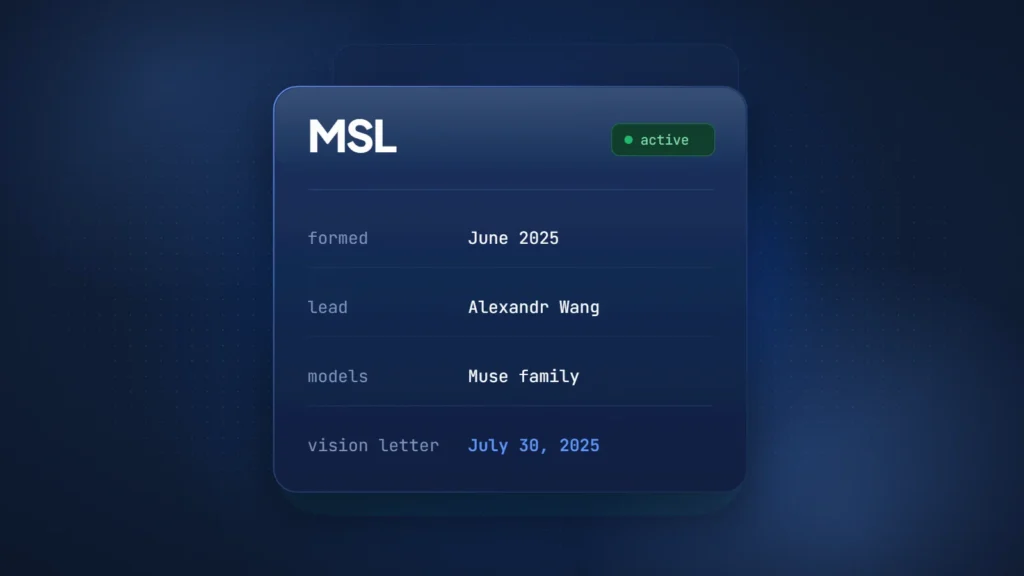
Meta Superintelligence Labs (MSL) is Meta’s umbrella AI organization, announced in an internal Mark Zuckerberg memo on June 30, 2025. Chief AI Officer Alexandr Wang, the former CEO of Scale AI, leads it. MSL’s first model, Muse Spark, launched on April 8, 2026, and the Muse family kept growing through September 2026.
Interest in the lab is steady. The term “meta superintelligence labs” draws about 1,300 searches a month in the US and 2,600 worldwide. The shorter “meta superintelligence” draws about 900 in the US and 1,100 worldwide (Ahrefs, October 5, 2026). Meta also named the lab in its first 2026 spending guidance, in January.
Meta Superintelligence Labs timeline, June 2025 to October 2026
MSL went from a memo to a shipping model family in just over nine months. Meta’s own posts confirm the model launches and spending guidance. The founding memo, the August 2025 reorganization and the October 2025 job cuts come from press reports.
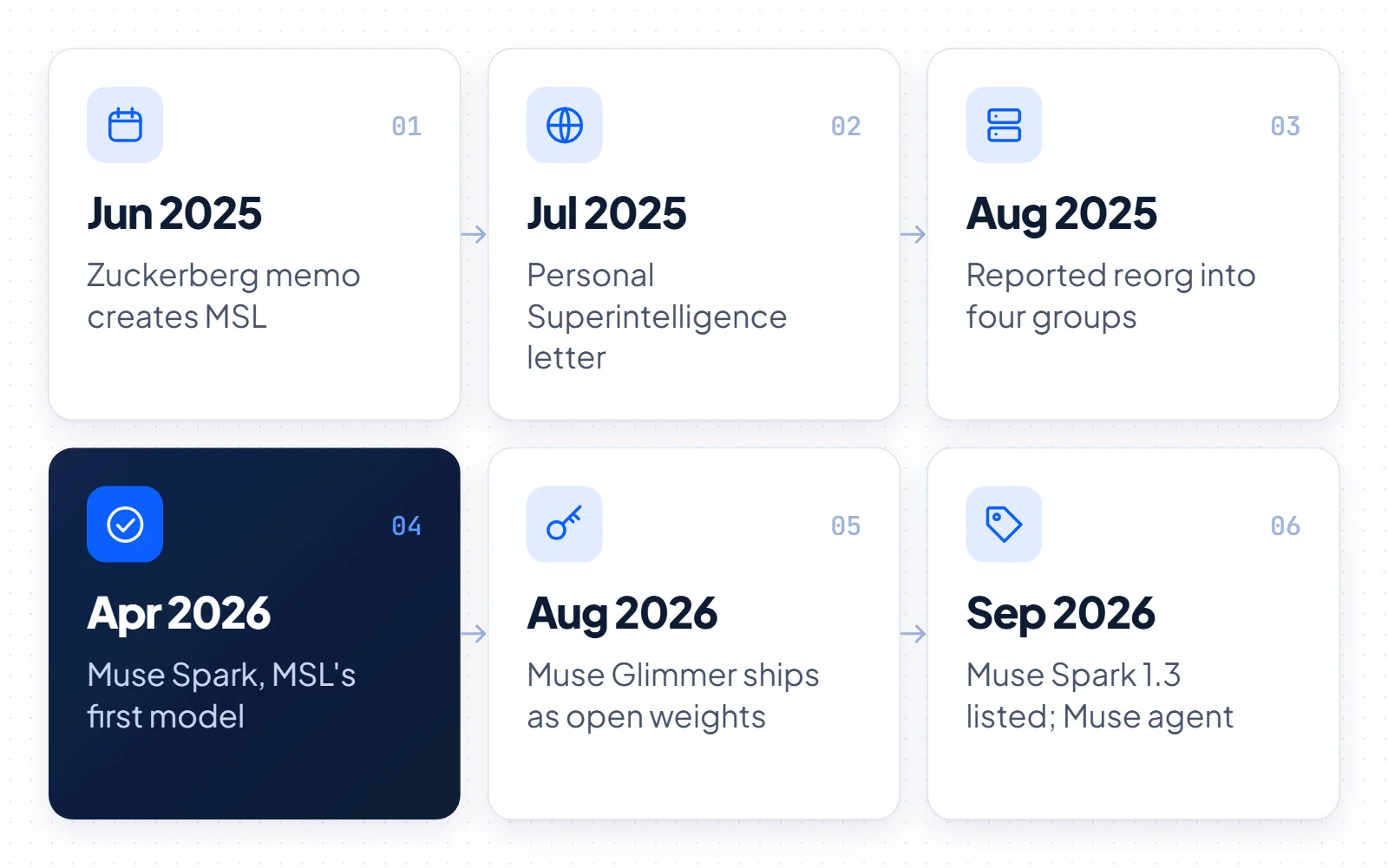
| Date | Event | Source type |
|---|---|---|
| June 12, 2025 | Scale AI announces a Meta investment valuing Scale at over $29 billion; Wang joins Meta | Primary (Scale AI) |
| June 30, 2025 | Zuckerberg memo creates MSL, with Wang as Chief AI Officer and Nat Friedman on products | Reported (CNBC) |
| July 25, 2025 | Shengjia Zhao named Chief Scientist of MSL | Primary (Zuckerberg on Threads) |
| July 30, 2025 | Zuckerberg publishes the “Personal Superintelligence” letter | Primary (Meta) |
| August 19, 2025 | MSL split into four groups | Reported (Bloomberg) |
| October 21, 2025 | Hyperion data center joint venture with Blue Owl Capital | Primary (Meta) |
| October 22, 2025 | About 600 MSL roles cut; TBD Lab spared | Reported (CNBC, Bloomberg) |
| November 19, 2025 | Yann LeCun says he will leave Meta at the end of 2025 | Reported (CNBC) |
| January 28, 2026 | 2026 capex guidance of $115–135 billion names MSL as a driver | Primary (Meta) |
| April 8, 2026 | Muse Spark, MSL’s first model | Primary (Meta) |
| July 7, 2026 | Muse Image and Muse Video | Primary (Meta) |
| August 10, 2026 | Muse Glimmer, an open-weights model | Primary (Meta) |
| September 2, 2026 | Muse Spark 1.3 listed on ai.meta.com | Primary (listing) |
| September 8, 2026 | Muse personal AI agent | Primary (Meta) |
Who leads Meta Superintelligence Labs and how it is structured
Alexandr Wang leads Meta Superintelligence Labs (MSL). Bloomberg reported that MSL was split into four groups on August 19, 2025: TBD Lab, FAIR, Products and Applied Research, and MSL Infra. Wang “leads Meta Superintelligence Labs (MSL),” according to his Meta executive biography. The structure below him rests mostly on press reports.
Bloomberg based that report on a memo from Wang. Meta has not published its own post on the change. The table lists a lead only where a Meta statement or the founding memo names one.
| Unit | Focus (as reported) | Lead |
|---|---|---|
| TBD Lab | Frontier models | Alexandr Wang (Meta spokesperson, March 2026) |
| FAIR | Long-term research | Not disclosed by Meta |
| Products and Applied Research | AI products and applied research | Nat Friedman (founding memo, June 2025) |
| MSL Infra | Infrastructure | Not disclosed by Meta |
Zuckerberg also named a chief scientist. “I’m excited to share that Shengjia Zhao will be the Chief Scientist of Meta Superintelligence Labs,” he wrote on Threads on July 25, 2025. We found no later Meta statement on Zhao’s role. Meta has not disclosed MSL’s total headcount.
Hiring at Meta Superintelligence Labs: what is confirmed
The confirmed hiring record at Meta Superintelligence Labs is short. Alexandr Wang moved from Scale AI in June 2025, and the founding memo named a list of recruits. Reports on October 22, 2025 put role cuts at about 600, and Yann LeCun said on November 19, 2025 that he would leave. Meta has not disclosed what MSL pays its staff.
Wang arrived through a deal with Scale AI. On June 12, 2025, Scale AI announced “a significant new investment from Meta” that valued Scale at “over $29 billion,” with Meta holding a minority of its equity. Wang joined Meta and stayed on Scale’s board, and Jason Droege became interim CEO. CNBC reported that Meta paid $14.3 billion for a 49% stake with no voting power, so the deal was an investment, not an acquisition.
The founding memo, as published by CNBC, named 11 new hires. On October 22, 2025, CNBC and Bloomberg reported that Meta cut roughly 600 roles across FAIR, product AI and AI infrastructure. TBD Lab was spared. With a smaller team, “each person will be more load-bearing and have more scope and impact,” Wang wrote in a memo quoted by CNBC.
Yann LeCun announced on November 19, 2025 that he would leave Meta at the end of the year, CNBC reported. He said he would found a startup for Advanced Machine Intelligence, with Meta as a partner.
In March 2026, Meta rejected reports that Wang had been sidelined. Wang “still runs MSL and TBD” and has “growing not waning influence,” spokesperson Andy Stone said.
Pay is not disclosed. We found no official figure for Wang, Friedman, Zhao or MSL researchers in Meta’s releases or filings. Press estimates of individual offers are unconfirmed.
Meta’s wider workforce also changed. The second-quarter 2026 results record $1.18 billion of severance tied to a company-wide May 2026 headcount cut, and 75,472 employees at June 30, 2026.
What “personal superintelligence” means in Meta’s words
Personal superintelligence is the goal Meta attaches to its AI work, including MSL’s models. It means AI that helps each person reach their own goals, delivered largely through personal devices. Zuckerberg set it out in a letter dated July 30, 2025, published at meta.com/superintelligence.
The letter opens with a claim about progress. “Over the last few months we have begun to see glimpses of our AI systems improving themselves,” Zuckerberg wrote. “Developing superintelligence is now in sight,” he added.
The letter frames the goal around individuals. “Meta’s vision is to bring personal superintelligence to everyone,” the letter states. It describes “a personal superintelligence that helps you achieve your goals” for each user. “Personal devices like glasses … will become our primary computing devices,” Zuckerberg wrote.
The letter also draws a line on openness. “We’ll need to be rigorous about mitigating these risks and careful about what we choose to open source,” it says.
Meta still uses the phrase with investors. “We’re on track to deliver personal superintelligence to billions of people,” Zuckerberg said in Meta’s first-quarter 2026 results on April 29, 2026.
Money and compute behind MSL
Meta guided 2026 capital expenditures to $130–145 billion on July 29, 2026, up from $72.22 billion in 2025, including principal payments on finance leases. Meta does not report a separate budget for Meta Superintelligence Labs, but its January 28, 2026 release named MSL as a driver of the spending increase.
The January 28, 2026 release expected year-over-year growth “driven by increased investment to support our Meta Superintelligence Labs efforts and core business,” Meta said. That wording covers the whole company. Since then, the guidance has changed twice.
| Release date | 2026 capex guidance | Change |
|---|---|---|
| January 28, 2026 | $115–135 billion | First guidance; MSL named as a driver |
| April 29, 2026 | $125–145 billion | Raised |
| July 29, 2026 | $130–145 billion | Narrowed |
The second-quarter 2026 results also report $31.08 billion of capex for that quarter alone. Two AI clusters anchor the build-out. In July 2025, Zuckerberg said Prometheus in New Albany, Ohio, was expected online in 2026, TechCrunch reported. Prometheus “will deliver 1-gigawatt of capacity” once complete, Meta’s engineering team wrote on February 9, 2026.
Zuckerberg also said Hyperion in Louisiana would scale to 5 gigawatts over several years. It has outside money: under a joint venture announced on October 21, 2025, Blue Owl Capital funds hold 80% and Meta 20%. Total development costs for the Richland Parish, Louisiana site are about $27 billion. The release puts Blue Owl’s cash contribution at about $7 billion and Meta’s one-time distribution at about $3 billion.
What Meta Superintelligence Labs has shipped
MSL has shipped the Muse family. Muse Spark arrived on April 8, 2026, followed by media models, a coding agent, an open-weights model and a personal agent by September 2026.
| Date | Release | What Meta says |
|---|---|---|
| April 8, 2026 | Muse Spark | MSL’s first model; natively multimodal reasoning; private API preview |
| July 7, 2026 | Muse Image, Muse Video | First media generation models from MSL; Muse Video in preview |
| July 9, 2026 | Muse Spark 1.1 | Public preview of the Meta Model API; 1-million-token context |
| August 5, 2026 | Muse Code (Muse Spark 1.2) | Terminal coding agent powered by Muse Spark 1.2 |
| August 10, 2026 | Muse Glimmer | 30B-parameter open weights, Apache 2.0, single consumer GPU |
| September 2, 2026 | Muse Spark 1.3 | Listed on ai.meta.com; details not reviewed |
| September 8, 2026 | Muse personal AI agent | Powered by Muse Spark; US on iOS, Android and muse.ai |
Meta’s newsroom post calls Muse Spark “MSL’s first model” and says it is rolling out to WhatsApp, Instagram, Facebook, Messenger and AI glasses. Muse Spark reaches “the same capabilities with over an order of magnitude less compute than our previous model, Llama 4 Maverick,” according to Meta’s launch post. Meta says the team spent nine months rebuilding its pretraining stack. These are company claims, not independent benchmarks.
Muse Glimmer took a different route. Meta released it as open weights under Apache 2.0, “optimized for always-on local agent workflows,” its research blog says. CNBC reported on September 29, 2026 that Meta launched Muse for Small Business. Muse Spark 1.3 appears on Meta’s research page with a September 2 date, but we have not reviewed its details.
How MSL compares with SSI and OpenAI
MSL is a division inside Meta that puts its models into consumer apps. Safe Superintelligence Inc., by contrast, is a lab with “one goal and one product: a safe superintelligence,” its website says. OpenAI’s May 2023 post “Governance of superintelligence” called for an international authority similar to the IAEA. Our guide to what superintelligence is covers who is building it, from OpenAI and SSI to Meta.
Name and domain: a sub-brand on meta.com
MSL has no standalone domain we could find. The vision letter lives at meta.com/superintelligence, and Wang’s biography sits on meta.com. The Muse models appear on ai.meta.com, whose homepage did not use the word “superintelligence” when we checked on October 5, 2026. Safe Superintelligence Inc. took the opposite route and brands as SSI on its own domain, ssi.inc. Our comparison of AI lab domain choices puts these routes side by side.
The letters SI also gained a public meaning in 2026. On September 29, 2026, Executive Order 14434 directed that the executive branch “shall use the terms ‘Super Intelligence’ and ‘SI’ in place of ‘Artificial Intelligence’ and ‘AI’,” according to the White House.
.si is Slovenia’s country-code domain. For AI companies it reads as SuperIntelligence. It works the way .ai domains read as artificial intelligence. That reading is our framing, not an official meaning, and our .si domain guide covers the 2026 registration jump.
What to watch at Meta Superintelligence Labs
The next signals will come from Meta’s own releases. These are the open items as of October 5, 2026.
- Capex: the latest 2026 guidance is $130–145 billion, set on July 29, 2026; the January guidance was the release that named MSL as a driver.
- Compute: Meta said in February 2026 that Prometheus would reach 1 gigawatt once complete; we found no Meta confirmation that it is fully online.
- Models: Muse Spark 1.3 is listed on ai.meta.com, but its details are not confirmed in the Meta posts we reviewed.
- Openness: Muse Glimmer is open weights, while Muse Spark launched with a private API preview.
- People: Meta has not published an MSL org chart, headcount or pay data; the four-unit structure is reported by Bloomberg, and Meta has confirmed leads only for TBD Lab and products.