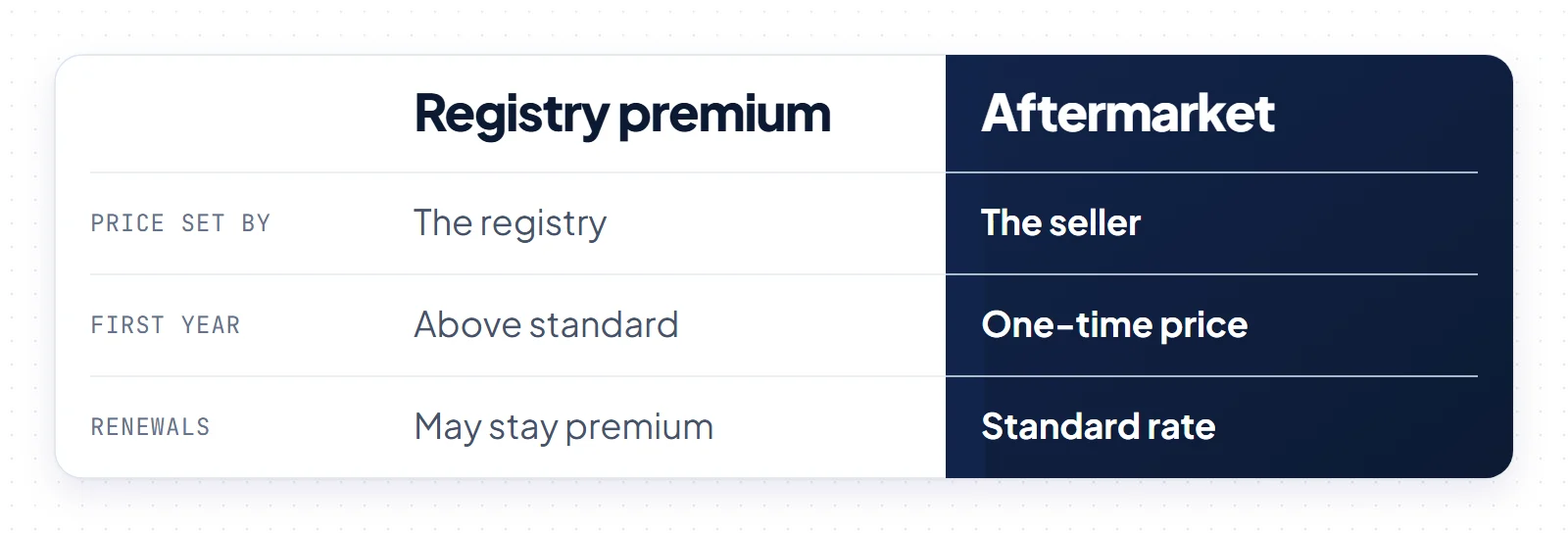
Premium domain names are domains sold above the standard registration fee, in two forms. A registry premium name carries a price set by the registry and may renew at a premium every year, as Cloudflare’s glossary describes. An aftermarket premium name has an owner who resells it for a one-time price, and it then usually renews at the standard rate.
Scarcity drives the gap between those prices and an ordinary registration. Verisign’s Domain Name Industry Brief for Q2 2026 counted 401.6 million registrations across all top-level domains at the end of the quarter, including 166.6 million .com names. With that many names in use, the short, clear name you want may already have an owner.
What are premium domain names?
Premium domain names are domains sold above the standard registration price, either by a registry that places them in a higher pricing tier or by an owner who resells them on the aftermarket. The two types differ in who sets the price, what the first year costs and, most of all, what you pay at renewal.
The Cloudflare guide to premium domains draws the line clearly. Registry premium names “typically carry a higher initial purchase price and higher renewal fees year after year,” the guide says. The registry controls that pricing, and registrars pass it on, sometimes with their own markup. Aftermarket names, by contrast, already belong to a person or company who resells them on secondary markets. They come with a high one-time price set by the seller, followed by standard renewal fees.
| Question | Registry premium | Aftermarket premium |
|---|---|---|
| Who sets the price | The registry; the registrar passes it on | The current owner (the seller) |
| First-year price | Above the standard registration fee | One-time purchase price |
| Renewal price | May stay at the premium rate every year | Standard renewal fee for the extension |
| Negotiable | Usually no, the price follows a tier | Seller decides |
| Status in .si | No premium tier in the Register.si tariff | Available through resale by owners |
The renewal trap with registry premium names
Registry premium names can renew at a premium price every year, while aftermarket premium names usually renew at the standard fee for their extension. For premium domain names in new gTLDs, ICANN’s base registry agreement sets a condition. A registry may charge a renewal price above its uniform rate only when the registrant agreed to it at the initial registration, after clear and conspicuous disclosure.
The rule sits in Section 2.10(c) of the ICANN base gTLD registry agreement. It requires registry operators to keep “uniform pricing for renewals,” with one exception: a registrant who expressly accepted higher renewal pricing in the registration agreement.
The clause stops a registry from quietly moving a name you already hold into a premium renewal tier. It does not freeze prices: under Section 2.10(b), a registry can raise renewal prices for all names after 180 days’ notice. And it does not remove a premium renewal you accepted at checkout. If you agreed to that disclosure, you keep paying a premium renewal for as long as you keep the name.
Registries also keep room to adjust their tiers. The registry operator Radix states in its published policies that each pricing tier may carry its own price for registration, transfer, redemption and renewal. It adds that it can update those prices at its discretion, subject to its agreements with registrars.
Because tiers can move, check the year-2 and year-5 price before you buy, not just the first-year price. Ask the registrar for the renewal price in writing and multiply it by the years you plan to hold the name. Then compare that total with an aftermarket alternative.
The .si country-code domain works differently. The Register.si tariff for registrars lists one flat registry fee of €10 per year, excluding VAT, for registration or renewal, in effect since January 1, 2023. It lists no premium tier, and ICANN’s gTLD agreement does not govern .si. A premium .si name is therefore an aftermarket name: you pay the seller once, and renewals follow your registrar’s ordinary .si price. Our guide to the .si domain explains how the extension works.
What makes a domain name premium?
A domain name earns a premium when buyers see scarcity, demand and branding value in it, the three drivers Cloudflare lists. In practice, premium domain names usually share five traits: they are short or scarce, carry one clear meaning, are easy to say, sit on an extension that fits the audience, and have a clean history.
Scarcity and length
Cloudflare points out that short, meaningful names are limited in supply. The Verisign figures show the scale: 166.6 million .com registrations and 148.6 million across country-code domains at the end of Q2 2026. Length cuts both ways, though. A 2026 study by Zee, Willems, Brengman and Desmet in the Journal of Brand Management found that names of about 3–4 phonemes drew the most favorable attitudes. Recognition, by contrast, improved as invented non-word names grew longer.
One clear meaning
A premium name says one thing and says it fast. Cloudflare lists brand relevance, search demand, memorability and existing recognition as the factors behind aftermarket values. A name that reads two ways, or needs explaining, gives up part of that value before anyone types it.
Easy to say and spell
Pronounceable names have measurable effects in other markets. In a 2006 PNAS study by Alter and Oppenheimer, stocks with easy-to-pronounce names and pronounceable ticker codes outperformed others in the short term. The effect faded over time. The study covers stocks, not domains, but it supports a simple point: people respond better to names they can process easily.
A common practitioner heuristic is the radio test. Say the name once out loud and see whether the listener can type it without asking how to spell it. It is a rule of thumb from the domain trade, not a research finding.
An extension that fits
The extension frames the name before the reader sees the word. With 166.6 million registrations, .com remains the default for many audiences. AI companies also look at .ai, which reads as a category label for their field. Our guide to .ai domains has more on that choice. A great word on an extension your customers do not trust is worth less to you than a good word on one they do.
Clean history, links and demand
A name with a past can carry value or risk. Cloudflare notes that expired names may keep value from existing backlinks, search visibility or brand recognition. The same history can include spam or content you would not want near your brand, which is why the checks below matter. Treat search demand and links as a bonus to verify, not a promise of traffic.
What premium domain names cost
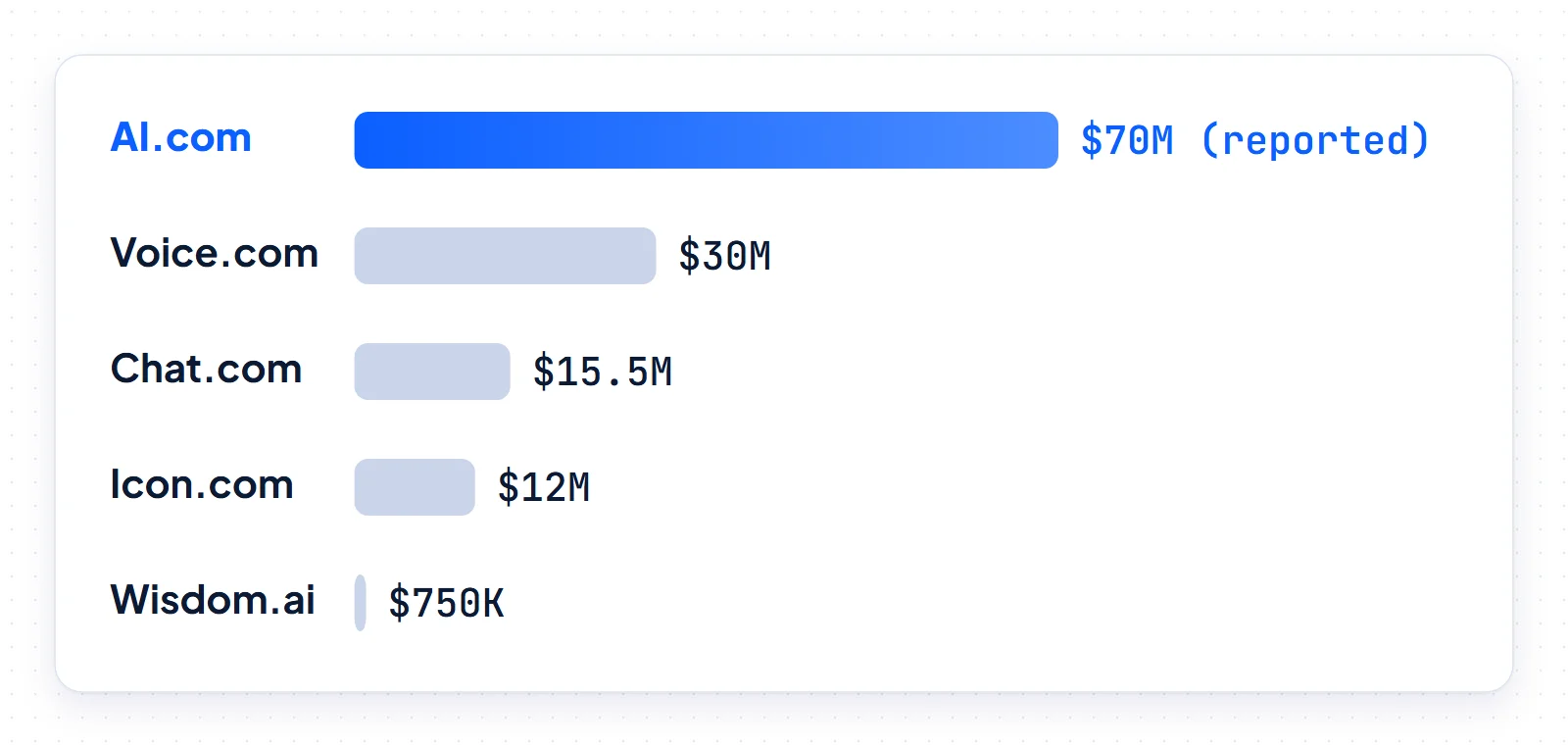
Public price data for premium domain names comes mostly from reported sales, and the widely publicized ones sit at the top of the market. In DNJournal’s chart of the top 100 sales of 2025, the top reported sale was Icon.com at $12,000,000, and the 100th place needed $99,888. Most private deals stay undisclosed, so no reliable public median sale price is available.
The largest reported figures belong to a handful of short .com names. AI.com sold for about $70 million in April 2025, as The Block reported in February 2026. Because the price surfaced only in 2026, the deal does not appear in DNJournal’s 2025 chart. DNJournal reported a $30 million sale of Voice.com in 2019. Chat.com changed hands for a reported $15.5 million in 2023, a figure its buyer, Dharmesh Shah, disclosed himself. Outside .com, DNJournal lists Wisdom.ai at a reported $750,000 as the top country-code sale of 2025.
Compare that with the cost of an ordinary registration. Verisign will raise the wholesale .com price from $10.26 to $10.97 per year on November 1, 2026, as Domain Name Wire reported in April 2026. Everything above the registration fee in a premium sale pays for the name itself: its meaning, its scarcity and the owner’s willingness to sell.
Smaller markets work at a different scale. As of October 5, 2026, the buysidomains.si portfolio lists 10 .si domains at fixed asking prices from €900 to €12,000, with a median of €1,750 by our calculation. These figures are asking prices, not sales, and they describe one seller’s catalog rather than the market. For transparency: buysidomains.si sells .si domains, including the names mentioned in this article.
How to judge the price of a premium name
Judge a premium price against three numbers: what comparable names sold for, what the name is worth to your business, and the total cost of owning it. Set a walk-away number from those three before you talk to the seller.
Comparable public sales
Look for reported sales with the same extension, a similar length, the same type of word and a recent year. A dictionary word, an invented brand and a 3-letter acronym sell to different buyers, so mixing them gives a misleading average.
Value to your business
Estimate what the name changes for you, in your own numbers. A clear name can cut misspelled emails, spare you a later rebrand and make a pitch easier to remember. None of that is guaranteed, and no domain promises rankings or traffic. If you cannot point to a concrete cost that a weaker name would create, the premium is hard to justify.
Total cost of ownership
Add the purchase price, the escrow fee and every renewal you expect to pay. As of October 5, 2026, the Escrow.com fee calculator lists standard domain fees of 2.6% up to $5,000 (minimum $50) and 2.4% from $5,000.01 to $50,000 (minimum $130). Above that, the rate drops to 1.9% up to $200,000, with a minimum of $1,200. For a registry premium name, multiply the premium renewal by the years you plan to keep it. For an aftermarket name, use the standard renewal rate.
Checks before you pay
Before you buy a premium domain, run five checks: confirm the price type and renewal rate, review the name’s history, search trademark databases, check its Google Safe Browsing status, and close the deal through escrow. Each check is cheap and catches a problem that a lower price would not fix.
- Price type and renewal. Ask whether the name is registry premium or aftermarket, and get the renewal price in writing before you pay.
- History. Open the name in the Wayback Machine and scroll through past snapshots. Look for spam, scams or content you would not want tied to your brand.
- Trademarks. Search the USPTO trademark database, EUIPO’s TMview and the WIPO Global Brand Database for the exact word and close variants in your field.
- Safe Browsing. Look up the domain in the site status tool of Google’s Transparency Report. A warning left over from a past owner can affect how browsers treat the site.
- Escrow. Pay through an escrow service, which releases the money to the seller only after the buyer confirms the transfer.
None of these checks predicts search performance. A clean history removes a risk; it does not add rankings.
Is a premium domain worth paying for?
A premium domain is worth paying for when the name will carry your brand for years and its total cost is small next to what a weaker name would cost you. It suits neither a short-lived project nor a bet on future resale value.
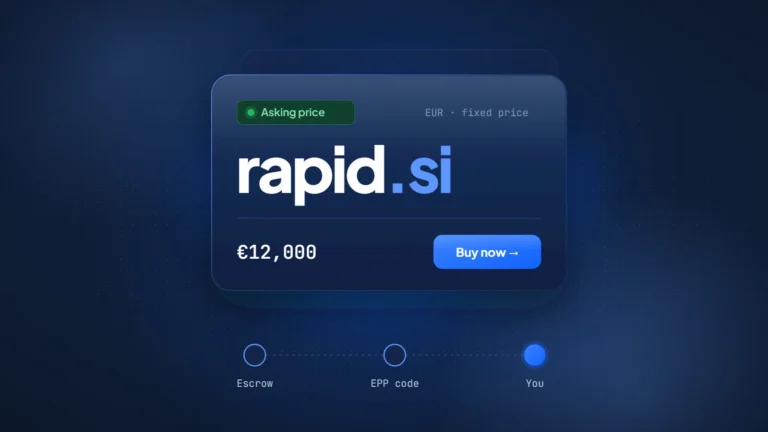
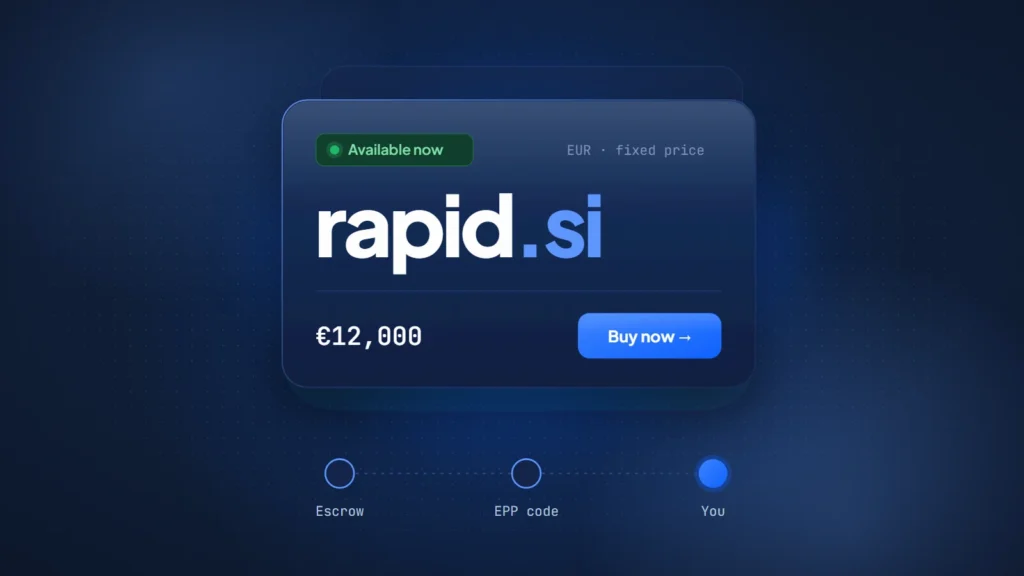
AI founders naming a company before launch gain the most from a short, clear name on an extension their market accepts, whether that is .com, .ai or a country code. The .si extension is Slovenia’s country-code domain. For AI companies it reads as SuperIntelligence, an informal association rather than an official meaning. Because the Register.si tariff has no premium tier, a premium .si name costs a one-time price plus ordinary renewals. For example, rapid.si has a fixed asking price of €12,000, and mkr.si a fixed asking price of €4,500.
Marketers planning a rebrand should compare the price with the full cost of the change: new materials, redirects and the time customers need to adjust. If the name removes a real source of confusion, the premium can earn its place in the budget. If it only looks better, a cheaper name with a clear meaning will do the same job.
Investors should read reported sales as outliers, not benchmarks. Headline deals say little about what a typical name earns, and renewals add a carrying cost to every name you hold. This article does not give investment advice, and no domain is certain to gain value.
Confirm whether the price is registry premium or aftermarket, and price five years of renewals. Compare the asking price with recent comparable sales and with your own business case. Run the five checks, set a walk-away number and pay through escrow. For a .si reference point, our .si domain listings show fixed asking prices side by side.