A domain name has no fixed price. Domain value is what a specific buyer pays for a name, and you estimate it from comparable public sales, the name’s length and meaning, its extension and its history. A registration fee, an automated appraisal and an asking price are not that value. Only a completed sale is.
Plenty of people want the number. In Ahrefs data from October 5, 2026, “domain value” draws about 2,600 searches a month in the US and 6,000 worldwide. “How much is my domain worth” draws about 900 in the US and 1,700 worldwide. The ceiling moved in February 2026, when ai.com was announced as a $70 million sale. Records like that are rare in a market of 401.6 million registered domains, the end-of-Q2 2026 total in Verisign’s Domain Name Industry Brief.
Four numbers people call domain value
Four different numbers get called domain value: the registration fee, an automated appraisal, an asking price and a completed sale price. Only the last one is money that changed hands.
The registration fee is the floor, and it says nothing about demand. For .si, Register.si charges registrars €10 a year, excluding VAT, for registration or renewal, a rate in force since January 1, 2023. The fee had been €8 since 2015. The registry states that it has no influence on the prices registrars charge domain holders, so retail prices vary.
| Number | Who sets it | What it tells you |
|---|---|---|
| Registration fee | Registry and registrar | The yearly cost of holding a name, not its market value |
| Automated appraisal | A software model | A rough estimate based on past sales data |
| Asking price | The current owner | What the seller hopes to get |
| Completed sale price | One buyer and one seller | What the name was worth to that buyer, on that date |
Mixing these up causes most pricing mistakes. Sellers quote appraisals as if they were offers, and buyers read asking prices as market rates. Keep the four numbers apart and trust completed sales most.
What raises and lowers domain value
Short, meaningful, easy-to-spell names with a clean history and no trademark conflict tend to be worth more. Long or awkward names, spam history, trademark risk and high renewal fees pull domain value down.
| Factor | Raises value | Lowers value |
|---|---|---|
| Length | Few characters, easy to say and type | Long strings, hyphens, digits that need explaining |
| Meaning | A real word or a clear, memorable brand | Misspellings and random letter mixes |
| Extension | An extension that buyers in the target market already trust | An extension with little buyer demand |
| Keywords | A word that names a product category and helps recall | Paying extra for SEO: Google says keywords in a domain name “have hardly any effect beyond appearing in breadcrumbs” |
| History | Never used, or used cleanly | Past spam or expired domain abuse |
| Trademarks | No conflict with an existing mark | A name that matches someone else’s brand |
| Running cost | Standard renewal fees | Premium renewal pricing |
Length has some research behind it. A University of Cambridge study by Thies Lindenthal found that resale prices of registered domains rose 63% between 2006 and 2012. It was published in the Journal of Real Estate Finance and Economics and announced in March 2016.
The same study found that making a surname one character longer, from 6 to 7 letters, cut .com registrations for that surname length by 24%. That figure measures demand, not price. Both figures come from one study of past data, so read them as a direction, not a formula.
Keyword names are mainly a branding asset. Google’s SEO Starter Guide, last updated December 10, 2025, lists domain keywords among the things it believes you should not focus on. A keyword name earns its price through recall and trust, not rankings.
Trademark conflict can erase value entirely. WIPO handled over 6,200 domain name cases in 2025, its highest caseload on record, and it has resolved more than 80,000 cases in 25 years.
History matters too. Google’s spam policies define expired domain abuse as buying an expired domain and repurposing it mainly to manipulate search rankings with content of little value to users.
Why automated domain appraisals disagree
Automated domain appraisals disagree because each tool is a statistical model trained on its own set of past sales, with its own assumptions. An appraisal estimates a likely price; it does not observe one. A 2022 arXiv paper by Kai Sun built a dataset of about 280,000 sales of domain names, email addresses and NFT-based names. Even the best model it tested depends on the sales data it learns from.
Vendors say their tools are machine-learning models trained on historical sales data. In Sun’s study, fine-tuned language models outperformed conventional feature-based models.
The sales data itself is uneven. Public comparables come from deals someone chose to disclose, so they lean toward reported low and mid-market sales plus a handful of headline records. A new coinage or a name in a smaller ccTLD has few true comparables, so a model has little to anchor on.
Selection bias adds more noise. Andrew Allemann of Domain Name Wire argued in 2018 that appraisals can look wrong because low estimates rarely get tested. Owners who value a name above the estimate refuse to sell at that level. Treat automated numbers as a rough range, then check them against dated sales.
Comparable public sales: the headline records
The highest publicly reported domain sale is ai.com at $70 million, closed in 2025 and announced in February 2026, according to Domain Name Wire. That is more than double the previous public record, voice.com at $30 million in 2019, which MicroStrategy reported in an SEC filing.
| Domain | Price | Year | Source |
|---|---|---|---|
| ai.com | $70 million (paid in cryptocurrency) | 2025, announced February 2026 | Domain Name Wire; DNJournal |
| voice.com | $30 million (cash) | 2019 | MicroStrategy SEC filing |
| icon.com | $12 million (reported) | 2025 | DNJournal, citing the buyer’s CEO |
| club.com | $10 million | 2025, disclosed April 2026 | DNJournal 2026 sales chart |
| green.com | $7.5 million | 2026 | DNJournal 2026 sales chart |
| bot.ai | $1.2 million | 2026 | DNJournal |
| chat.com | Not disclosed | 2024 | The Decoder |
Each price is public because a buyer or seller chose to disclose it. The SEC filing shows that the $30 million voice.com sale was paid in cash and completed on May 30, 2019. Domain Name Wire reported that Crypto.com CEO Kris Marszalek announced the ai.com purchase, with the price paid in cryptocurrency. The 2026 figures come from DNJournal’s year-to-date sales chart, and the same publication’s March 2026 sales report calls bot.ai the largest publicly reported .ai sale on record.
Some famous numbers are weaker than they look. OpenAI’s purchase of chat.com became public in November 2024 at an undisclosed price, and the seller, Dharmesh Shah, hinted that he was paid in OpenAI shares. A widely quoted $17 million for 360.com in 2015 was never officially confirmed. Icon.com’s figure came from the buyer’s CEO, so it stays a reported price.
Records show the ceiling, not your number. A useful estimate needs recent sales of names with the same extension, a similar length and a similar buyer.
How to estimate domain value yourself
You can estimate domain value yourself by building a range from comparable completed sales, then adjusting it for the likely buyer, the name’s history and its running costs. The six steps below take an afternoon.
- Find comparables by extension and length. Collect completed sales of names in the same extension, with a similar length and type, and note the year of each sale. A .com sale says little about a .si name.
- Decide who the buyer is. An end user buys a name for one business and pays for the fit. An investor buys to resell, so any investor offer has to leave room for a margin.
- Discount asking prices. A listed price is a seller’s hope, so base your range on completed sales and treat asking prices only as an upper reference.
- Check history and trademarks. Look at what the name hosted before and search trademark registers for the term. Past spam or a conflicting mark lowers value, sometimes to zero.
- Check renewal costs. Confirm the registry fee, your registrar’s retail renewal price and any premium renewal pricing, since every future owner carries that cost.
- Write a range, not a number. Set a low end you would accept from an investor and a high end you would ask of an end user.
End-user and investor prices can sit far apart, so state which buyer your range assumes. Our guide to premium domain names explains what makes a name premium and the total cost of owning one. This method is narrower: it puts a defensible range on one specific name.
Asking prices vs sales: our portfolio data
An asking price is what a seller requests, and a name can sit at that price unsold. The table below lists the fixed asking prices in the buysidomains.si portfolio on October 5, 2026. None of them is a completed sale.
| Domain | Characters before .si | Asking price (October 2026) |
|---|---|---|
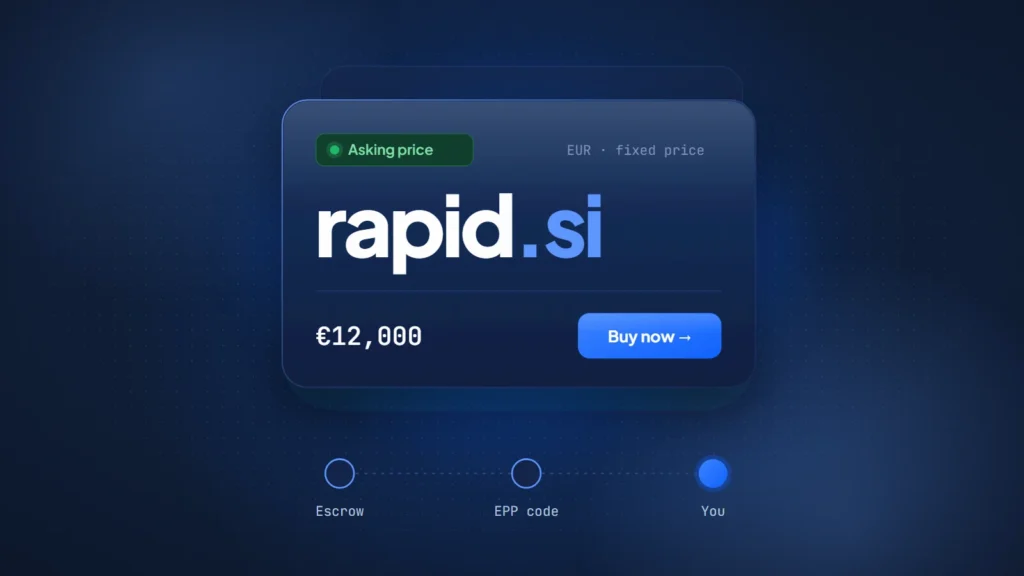
| rapid.si | 5 | €12,000 |
| essai.si | 5 | €6,000 |
| mkr.si | 3 | €4,500 |
| humanrobots.si | 11 | €3,500 |
| llmo.si | 4 | €2,000 |
| aivisibility.si | 12 | €1,500 |
| rasr.si | 4 | €1,500 |
| netserver.si | 9 | €1,200 |
| apsplus.si | 7 | €900 |
| kyberit.si | 7 | €900 |
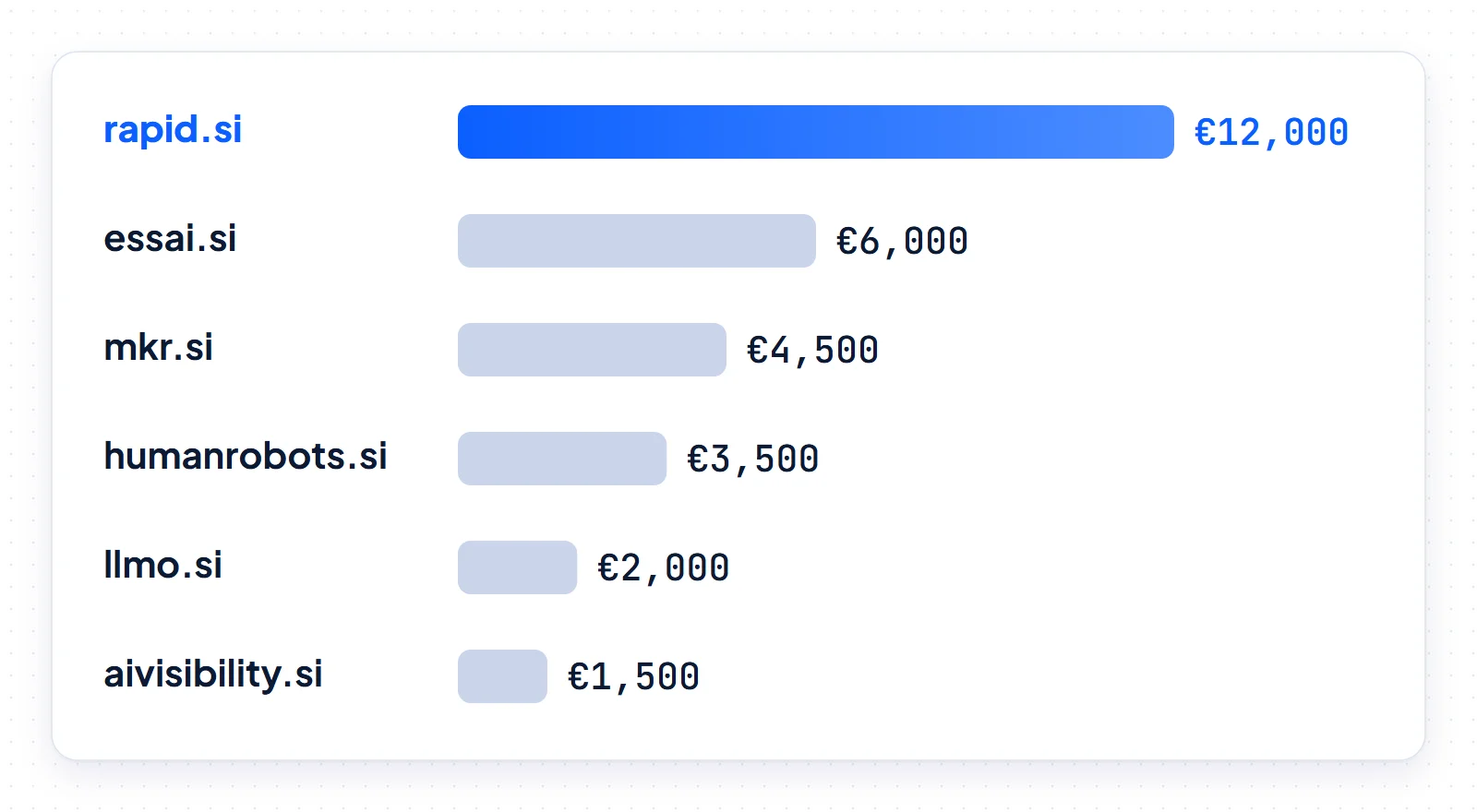
Length alone does not set these prices. The 5-letter rapid.si carries our highest ask because it is a common English word, while the 3-letter mkr.si is listed at €4,500. These are our own judgments of meaning, length and fit, and the market may judge differently. Our guide to short domain names covers 3- and 4-letter names in more depth.
Liquidity matters as much as price. No neutral, industry-wide sell-through rate exists. Andrew Allemann of Domain Name Wire reported a 1.6% sell-through rate for his own portfolio of about 2,000 names in 2022. A Boston Consulting Group study implied 4.5% for .com, which Domain Name Wire said is well above what domain investors achieve.
What makes .si domain value different
Register.si has charged registrars €10 a year for a .si domain, excluding VAT, since January 1, 2023. Almost all of a .si name’s value is therefore aftermarket value, set by buyer demand. A .si name also carries a country signal for Slovenia, which matters if a website will run on it.
.si is Slovenia’s country-code domain. For AI companies it reads as SuperIntelligence. That reading is our framing, not an official meaning, and our complete guide to the .si domain covers the country signal and registration rules.
None of the headline sales above is a .si name, so a .si estimate leans on careful comparables rather than records. Our portfolio asks range from €900 to €12,000 (October 2026), against a registry fee of €10 a year. That gap is the real valuation question: what a buyer will pay for one specific name instead of registering an available one.
The .ai extension shows how a ccTLD can build a public sales record. The largest publicly reported .ai sale on record is bot.ai at $1.2 million in 2026, and WIPO lists .ai among the top 10 ccTLDs by dispute case volume. No extension guarantees that a name will gain value, and .si is no exception. Our guide to .ai domains in 2026 covers its prices and rules.
What to do next: sellers, buyers and investors
Start with the range from the six steps above. What you do with it depends on which side of the deal you are on.
Sellers
Set an asking price you can defend with dated comparable sales, and expect a sale to take time. Keep appraisals out of the conversation unless a buyer asks, and let completed sales anchor your price.
Buyers
Compare the asking price with the cost of your next-best available name, including the rebrand you would avoid later. Check history and trademarks before you pay. If the name is already registered, read how to buy a domain that is already taken, which covers escrow and transfer steps.
Investors
Treat domains as illiquid assets with carrying costs, not investments with guaranteed returns. Budget renewals for every year a name stays unsold, and price for the end user who would build on it.