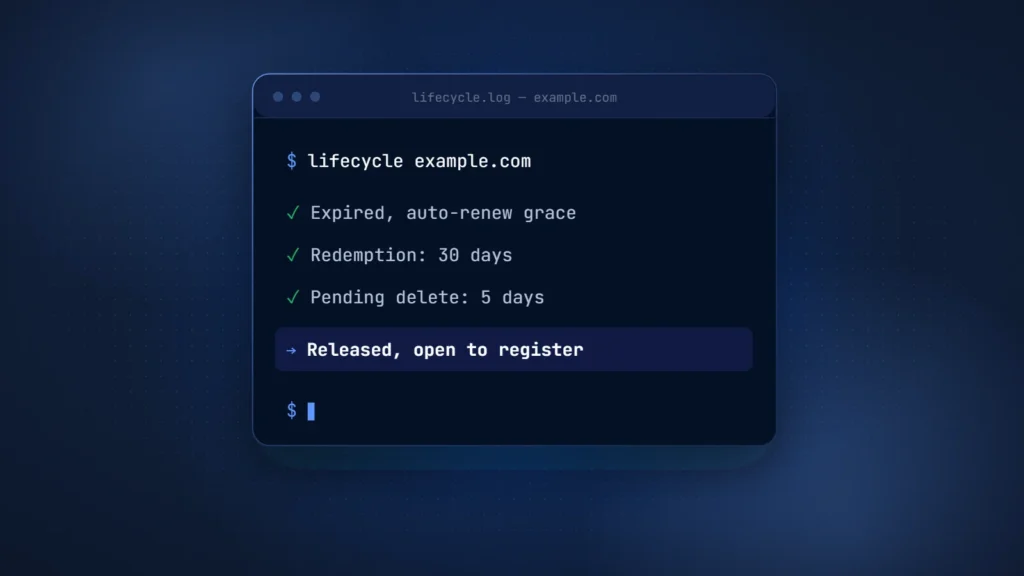
Expired domains are domain names whose registration term ended without renewal. For a .com, the registrar may let the holder renew for up to 45 days, then restore the name during a 30-day redemption period. After 5 days of pending delete, the registry releases it to anyone. Many sought-after names change hands at registrar auctions before they ever drop.
On October 5, 2026, Ahrefs estimated about 1,600 monthly US searches for “expired domains” and about 17,000 worldwide. Most results are lists and tools. This guide covers the rules behind those lists: the ICANN lifecycle, how .si differs, the four ways to acquire a name and what Google’s March 2024 spam policy allows.
What are expired domains?
An expired domain is a registration that reached the end of its paid term without renewal. It is not free yet: registry rules and registrar contracts decide who can renew, restore or buy it, and when.
Two sets of rules apply. ICANN policies and registry agreements fix the stages for generic top-level domains (gTLDs) such as .com: reminders, a Redemption Grace Period and pending delete. Registrars then decide what happens inside those limits, including how long they hold a name and whether they auction it.
Country-code domains follow their own registries and local rules. A timeline written for .com does not apply to .si or .eu. Our explainer on what a ccTLD is covers the basics.
For a buyer, the day a name becomes available depends on its extension and its registrar.
The gTLD expiry lifecycle, step by step
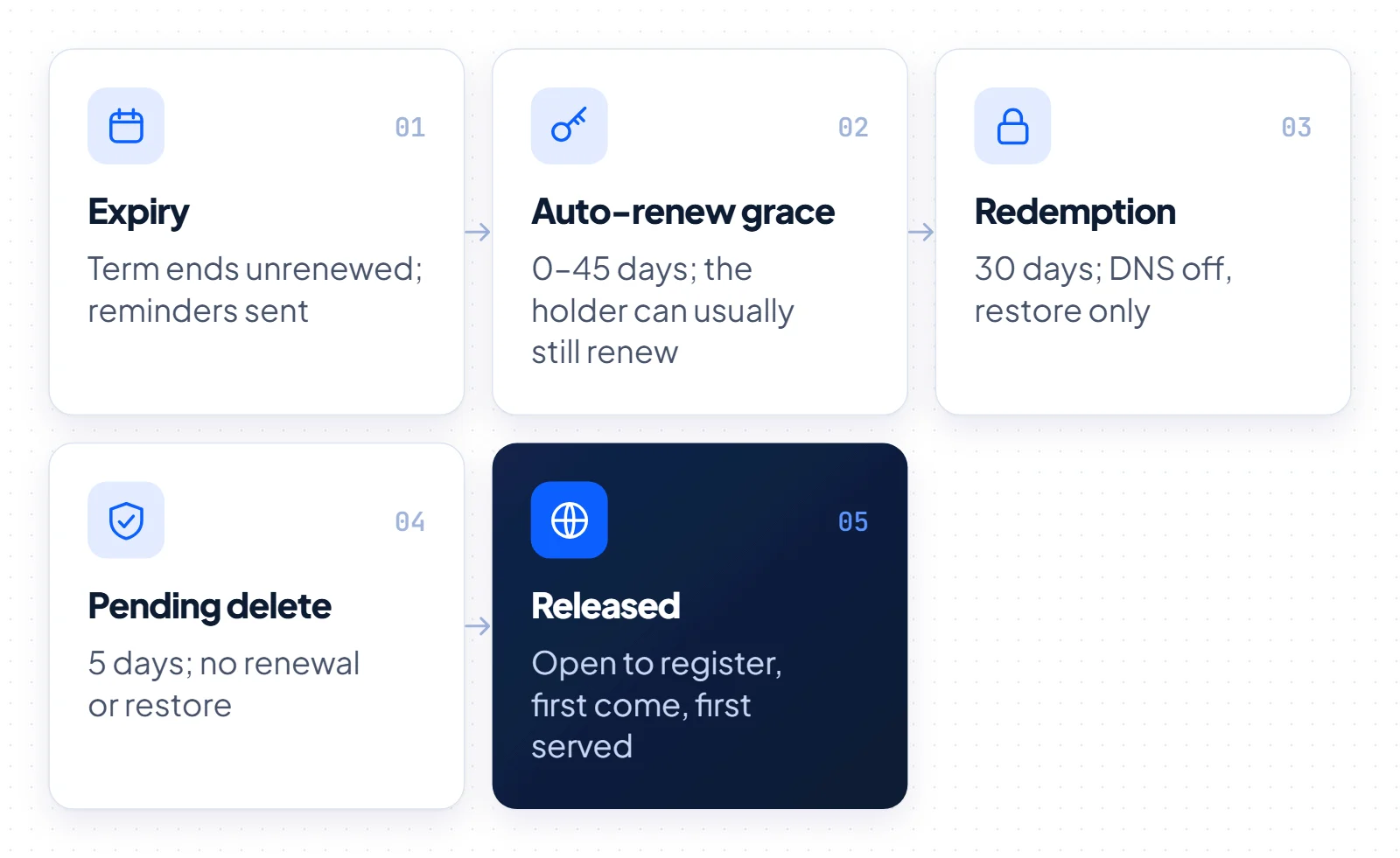
A .com name that is not renewed can pass through up to 45 days of auto-renew grace, a 30-day Redemption Grace Period and 5 days of pending delete. That adds up to about 80 days from expiry to release.
The process starts before expiry. Under ICANN’s Expired Registration Recovery Policy (ERRP), registrars must send renewal notices about one month and about one week before a name expires. If the name is still not renewed or deleted, they must send at least one more notice within 5 days after expiry.
Auto-renew grace: up to 45 days
At expiry, the .com registry renews the name automatically and opens a grace period for the registrar. Verisign’s .com registry specification sets it at 45 calendar days. ICANN’s guide for registrants describes it as a period of 1 to 45 days that registrars may offer, so the real length depends on the registrar.
During this window the previous holder can usually still renew, but the registrar’s terms decide for how long. ICANN’s policy guarantees renewal from expiry through a DNS interruption. That interruption must cover at least the last 8 days in which the holder can still renew, so the old website stops resolving before the name is lost. Some registrars also sell expiring names in their own expiry auctions during this window.
Redemption Grace Period: 30 days
Once the registrar deletes the name, the registry holds it in a 30-day Redemption Grace Period (RGP). The name leaves the zone file, and the registry disables DNS resolution and blocks transfers. Only the registrar that deleted it can restore it, at the former holder’s request. Registrars must publish their redemption fees on their websites.
Pending delete: 5 days
A name that is not restored moves to pending delete, which the .com registry specification sets at 5 calendar days. Nobody can renew or restore it at this stage. When the period ends, the registry purges the record and releases the name for registration on a first-come, first-served basis.
Treat these numbers as outer limits, not a schedule. Sponsored gTLDs are exempt from the RGP, and newer gTLDs follow their own registry agreements. ICANN’s lifecycle chart also notes that it does not show some registrar activity after expiry.
How .si domains expire: one 30-day quarantine
A .si domain follows a shorter path. On its expiry date it enters quarantine for up to 30 days with its DNS switched off. If nobody renews it, the .si domain is deleted and can be registered again.
The rules sit in the Register.si General Terms, valid from November 15, 2024. Clause 5.3.2 assigns quarantine status on the date of expiry. Under clause 5.4.2, Arnes removes the name’s pointers from the .si DNS servers, and “Domain name quarantine status may not last longer than 30 days.”
Renewal through a registrar ends quarantine and reactivates the name. If nobody renews it, clause 5.4.3 says the name is deleted after 30 days and may be registered again. The Terms contain no auto-renew grace, no Redemption Grace Period and no separate pending delete stage. Clause 5.3.3 makes registrars responsible for telling holders in time that a name is about to expire.
Other ccTLDs differ again. When an expired .eu name is deleted, EURid places it in a 40-day quarantine, during which websites and email stop working but the name can still be reactivated. After that, the name is re-released to the first person who registers it.
| Stage | gTLD (.com) | .si |
|---|---|---|
| Reminders | About 1 month and 1 week before expiry, plus one within 5 days after (ERRP) | Registrar is responsible for timely notice (General Terms 5.3.3) |
| Right after expiry | Auto-renew grace, up to 45 days; holder can usually still renew | Quarantine starts on the expiry date |
| DNS | Interrupted for at least the last 8 days in which the holder can renew; off during RGP | Pointers removed from .si DNS during quarantine |
| Recovery window | Redemption Grace Period, 30 days; restore by the deleting registrar | Quarantine, up to 30 days; renewal reactivates the name |
| Pending delete | 5 days; no renewal or restore | No separate stage in the General Terms |
| Release | Purged, then open to register, first come, first served | Deleted after 30 days, then open to register again |
| Expiry to release | Up to about 80 days | Up to about 30 days |
Our complete guide to the .si domain covers registration and renewal in more detail.
How to find and buy expired domains
You can buy an expired domain in four ways. Bid in a registrar’s expiry auction during the .com auto-renew grace of up to 45 days, or place a backorder. Rely on drop catching when the registry releases the name after up to about 80 days, or register it by hand once it drops. The right route depends on the name’s stage in its lifecycle.
Finding candidates is easy. Several websites publish free, searchable lists of expiring and recently deleted names, with filters for extension, length and age. Registrars that run expiry auctions publish their own inventories too.
- Registrar expiry auctions. During auto-renew grace, some registrars sell expiring names from their own customers to the highest bidder. At some registrars the former holder can still renew while the auction runs, which cancels it, so a winning bid is not final until the name is in your account.
- Backorders. You ask a service to try to register the name for you the moment it is released. Several buyers can backorder the same name, so popular names may end up in a private auction among them.
- Drop catching. At release, automated systems try to register names as soon as the registry frees them. ICANN’s lifecycle chart marks this “drop catch activity” at the point of release.
- Hand registration. If nobody catches the name, it becomes available at any registrar at the normal registration price.
Many good names never reach that stage, because their holders keep renewing. For a name with an active holder, the route is a direct purchase, which we explain in our guide to buying a domain that is already taken.
Expired domains with backlinks: what Google says
Buying an expired domain does not break Google’s rules, but repurposing one mainly to manipulate search rankings does. Google named this practice expired domain abuse in a spam policy announced on March 5, 2024. Sites that break the spam policies may rank lower or not appear in results at all.
Google announced three new spam policies on March 5, 2024, one of them aimed at expired domain abuse. Its spam policies page defines it: “Expired domain abuse is where an expired domain name is purchased and repurposed primarily to manipulate search rankings by hosting content that provides little to no value to users.”
Google’s examples include affiliate content on a site once used by a government agency and casino-related content on a former elementary school site. The March 2024 post sets the boundary for honest buyers: “It’s fine to use an old domain name for a new, original site that’s designed to serve people first.”
On backlinks, expectations run ahead of the evidence. We found no official Google statement on whether links to an old domain keep or lose their value after a change of owner. Google’s documentation addresses intent and content quality, so treat any promise that old links will carry rankings as a seller’s claim, not a rule.
Google does list clean-up steps for a purchased domain. Verify the site in Search Console, check the Manual Actions report, and make sure the previous owner left no URL removals behind, especially a site-wide one.
Risks to check before you buy an expired domain
The two biggest risks are a trademark claim and a reputation you inherit. Neither disappears when a name expires, and an old creation date gives no protection.
Trademarks and the UDRP
Under the UDRP, which applies to all gTLDs and to some country-code domains, a complainant must show three things. The domain is identical or confusingly similar to its trademark, and the holder has no rights or legitimate interests in it. The name was also registered and is being used in bad faith. Panels can order the domain transferred or canceled.
Timing works against buyers of old names. Section 3.9 of the WIPO Jurisprudential Overview 3.0 deals with domains that change hands. In those cases, “the date on which the current registrant acquired the domain name is the date a panel will consider in assessing bad faith.”
In practice, a name first registered in 2005 is judged from the day you bought it in 2026. Many country-code domains run their own procedures instead, and .si disputes follow the ARDS rules set out in the Register.si General Terms.
Spam history and inherited penalties
An expired name can carry its previous owner’s problems: a manual action, leftover URL removals, spam in archived copies or links from low-quality sites. Run these domain history checks before you bid. Third-party scores such as domain authority are vendor metrics, not Google signals.
- Search the name in trademark databases for the markets you sell in.
- Review archived copies of the old site for spam, adult or pirated content.
- Read the backlink profile for paid, off-topic or spammy links.
- After purchase, verify the domain in Search Console and check Manual Actions and removals.
- Plan a new, original site rather than a rebuild of the old one for its links.
Should you buy an expired domain?
Buy an expired domain when the name itself fits your plans, not for its old links. If a name matters only for its backlinks, the policy and legal risks usually outweigh the upside, so base your estimate of the domain’s value on the name itself.
For founders
Start with the brand. A short, clear name you can build on matters more than the old site’s rankings. If your ideal name has a holder who renews it every year, waiting for it to drop rarely works, so approach the holder instead.
Curated aftermarket names are another route. Slovenia’s country-code domain is .si, and for AI companies it reads as SuperIntelligence. The premium .si names in our portfolio are not expired names: their current holder sells them at fixed prices. Our guide to premium domain names explains what makes a name worth paying for.
For domain investors
Treat expired names as a volume business with real costs: auction prices, renewals and names that never sell. Nothing guarantees that a name will gain value, and backlinks do not shield you from a UDRP complaint. Check history and trademarks before every bid, and budget for the names you will let expire again.