A brandable domain is a domain name that can identify a business without describing what it sells. Common forms are an invented word, a real word used out of context or a short blend. Brandable domains trade instant meaning for distinctiveness: the name says little on day one, but it is far easier to protect and to grow into.
Searches for “brandable domains” run at about 300 a month in the US and 500 worldwide (Ahrefs, October 2026). Most pages that rank for the term sell names, so they rarely explain trademarks or quote what Google says about keywords in domains. This guide covers both, adds a five-step name test and shows three .si names as worked examples.
What is a brandable domain?
A brandable domain is a name that points to one company rather than describing a product. In trademark terms, it sits at the strong end of the USPTO distinctiveness spectrum, while descriptive and generic names sit at the weak end.
Domain investors have long argued over the definition: made-up words only, or any name a business could adopt. The trademark view settles it. A name is brandable when it identifies a source, not a category of goods.
In practice, brandable names come in a few familiar shapes:
- Coined words, invented from scratch with no prior meaning.
- Real words used out of context, where the word has nothing to do with the product.
- Suggestive words and metaphors that hint at a benefit without stating it.
- Compounds and blends, where two short words or word parts become one name.
- Altered spellings and plays on existing words.
A descriptive domain does the opposite: it names the product or the query, for example a city plus a service.
Types of brandable names and trademark strength
The USPTO ranks names on a spectrum from fanciful to generic. Its verdict: “Strong trademarks are suggestive, fanciful, or arbitrary. Weak trademarks are descriptive or generic.” Most brandable domains fall into those three strong groups.
The table maps common name types to that spectrum, with examples from the USPTO’s guide to strong trademarks, its trademark fundamentals training and company histories.
| Name type | What it is | Well-known example | Trademark strength (USPTO) |
|---|---|---|---|
| Coined (fanciful) | An invented word with meaning only for its goods | KODAK, EXXON, PEPSI | Strong |
| Real word out of context (arbitrary) | A common word with no link to the product | APPLE for computers | Strong |
| Suggestive | Hints at a quality without stating it outright | Coppertone for sun-tanning products | Strong |
| Altered word or play on words | A changed spelling or twist on an existing word | Google, a play on googol | Strong if the root word has no link to the product; a slight misspelling of a descriptive word stays weak |
| Descriptive (not brandable) | Merely describes some aspect of the product | “Creamy” for yogurt | Weak |
| Generic (not brandable) | The everyday name of the product | “Bicycle” for bicycles | Cannot function as a trademark |
Kodak shows the coined end at work. The company’s timeline dates the name to 1888, when the first KODAK camera went on sale. Google’s own history says its name was a play on googol, the number 1 followed by 100 zeros.
Strength always depends on the product, not on the word alone. APPLE is arbitrary for computers, but an apple orchard could not register it for the apples it grows. A strong position also does not mean a name is free to use.
Brandable vs descriptive domains
A descriptive domain tells visitors what you sell, and a brandable domain tells them who you are. Descriptive names are understood at once, but brandable names are easier to protect as trademarks and leave more room to grow.
| Factor | Brandable domain | Descriptive domain |
|---|---|---|
| What the name says | Who you are | What you sell |
| Memorability | Can stand out, but people may need to see it a few times before they recall it | Meaning is clear at once, but similar keyword names are easy to mix up |
| Trademark strength | Strong end of the USPTO spectrum | Weak (descriptive) or unprotectable (generic) |
| SEO effect of the name itself | Hardly any, per Google | Hardly any, per Google; its exact match domain system stops query-matching domains from getting too much credit |
| Price and availability | Invented names are more often unregistered; short real words are often already registered and sold on the aftermarket | Short keyword names are often already registered; longer variants are easier to find |
| Best fit | Companies that plan new products or markets | A local service or a short campaign |
Descriptive names still suit a local business with one service or a single campaign. Brandable names pay off when you plan to add products, enter new markets or raise money under one name.
Are brandable domains better for SEO?
Brandable domains are not better for SEO, and descriptive domains are not better either. Google’s SEO Starter Guide says keywords in a domain name have hardly any effect beyond appearing in breadcrumbs, so the choice between brandable and descriptive should rest on branding, not search.
Google’s SEO Starter Guide tells site owners to “do what’s best for your business” when they pick a name. In its words, “the keywords in the name of the domain (or URL path) alone have hardly any effect beyond appearing in breadcrumbs.” Ranking comes from the site, not the name.
Google also runs what it calls an exact match domain system. Its guide to Google Search ranking systems says the system works “to ensure we don’t give too much credit for content hosted under domains designed to exactly match particular queries.” The guide adds that domain words still count as “one of many factors” for relevance.
For Google Search, then, a brandable domain gives up almost nothing to a keyword domain. The same goes for extensions: the starter guide says the TLD “only matters if you’re targeting a specific country’s users, and even then it’s usually a low impact signal.” Extension choice is mostly a branding decision.
What makes a domain name brandable
A brandable domain is short, easy to say, easy to spell after one hearing, free of awkward meanings and natural with its extension. You can test all five before you spend money.
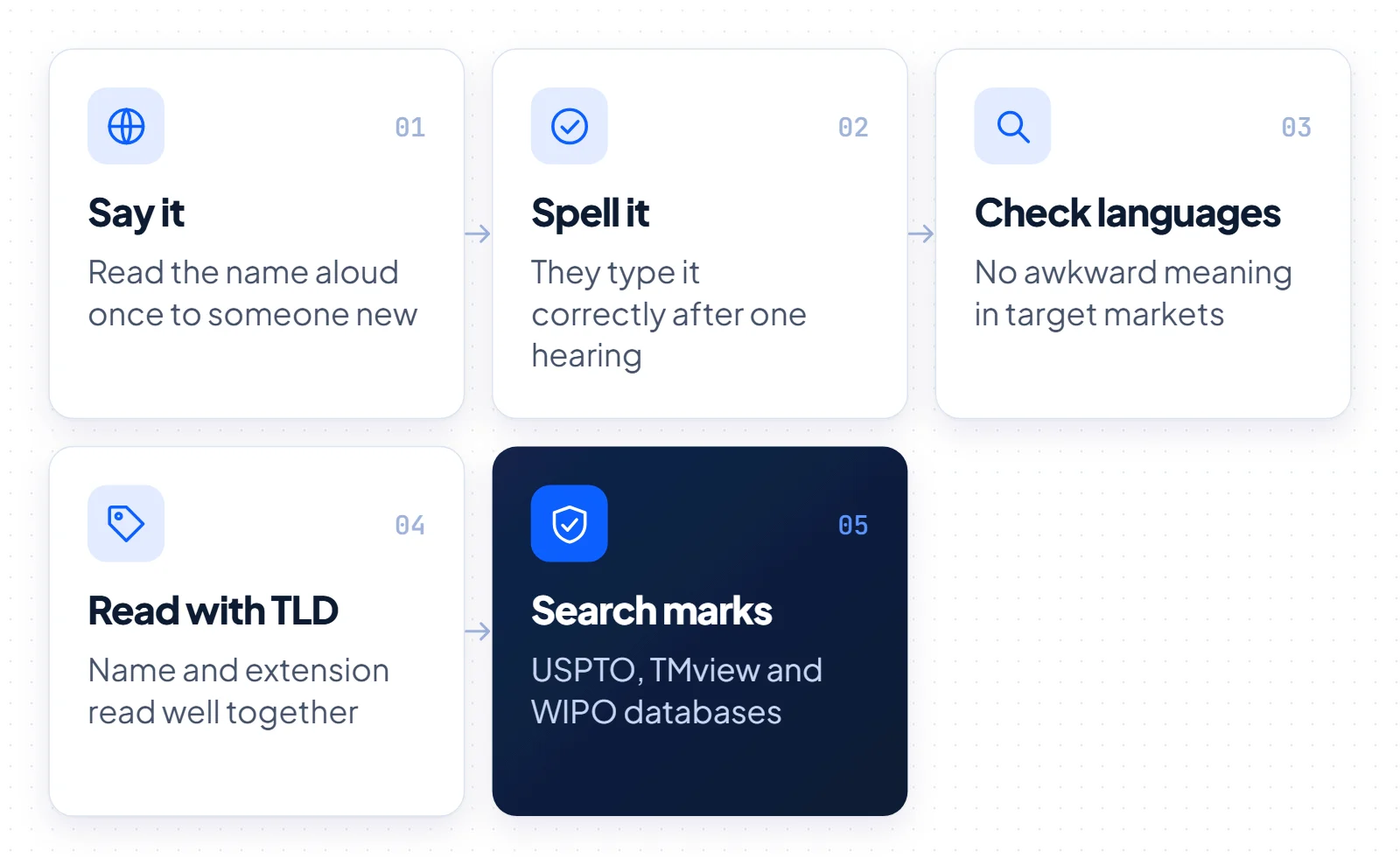
- Keep it short. Fewer letters leave less room for typos, and there is no agreed ideal length.
- Run the say-it, spell-it test. Say the name once to someone who has not seen it, then ask them to type it. If they spell it correctly, it passes. Our guide to short domain names applies the same test to 3- and 4-letter names.
- Check meaning in other languages. Look the name up in your target markets’ languages, including slang.
- Read it with the extension. Say and write the full domain; some pairs form an unwanted word.
- Search trademarks. The next section lists the databases.
Research on pronounceable names supports the say-it test, though it says nothing about domains. In a 2006 study in PNAS, Alter and Oppenheimer found that fluently named stocks outperformed stocks with disfluent names in the short term. In one of the paper’s analyses, $1,000 invested in fluently named shares yielded $112 more after one day of trading than the same sum in disfluently named shares.
The study covered company names and ticker symbols, and the effect was short-term. It does not show that a pronounceable domain ranks better or sells more.
How to check if a brandable name is trademarked
Before you buy, search the name and close variants in USPTO Trademark Search, EUIPO’s TMview and WIPO’s Global Brand Database. This is general information, not legal advice.
The USPTO’s Trademark Search replaced the older TESS system on November 30, 2023. EUIPO says you can search registered marks “free of charge” in TMview. It covers all EU national IP offices, the EUIPO and many offices outside the EU. The WIPO Global Brand Database adds international marks under the Madrid System, with search by name, goods and services, and image similarity.
Search the exact name first, then spellings that sound the same, in the goods and services you plan to offer. A near match in your own field is a warning sign.
UDRP risk for names close to existing marks
Under the UDRP, a trademark owner can take over a registered domain by proving three things. First, the domain is “identical or confusingly similar” to its mark. Second, the holder has “no rights or legitimate interests.” Third, the domain “has been registered and is being used in bad faith.” According to WIPO’s guide to the UDRP, a case with a single panelist costs $1,500 for one to five domains and usually takes about two months.
WIPO’s case overview notes that dictionary words used in an unrelated sense “can function as ‘arbitrary’ trademarks,” so real-word names need a search too. A name confusingly similar to a famous mark can, by itself, create a presumption of bad faith.
Brandable .si domains: three patterns
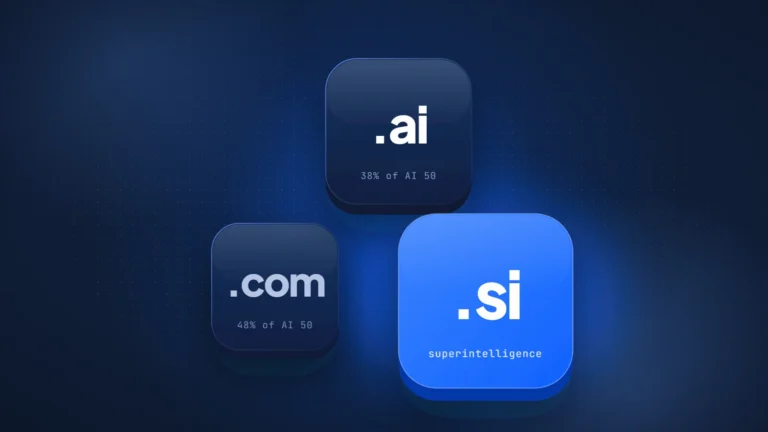
Slovenia’s country-code domain is .si. For AI companies it reads as SuperIntelligence. That reading is our framing, not an official meaning, but it gives a short .si name a second layer for AI products.
Three names from the buysidomains.si portfolio show common brandable patterns. Prices are fixed aftermarket asking prices as of October 2026. Asking prices are not sales, and our guide to estimating domain value explains the difference.
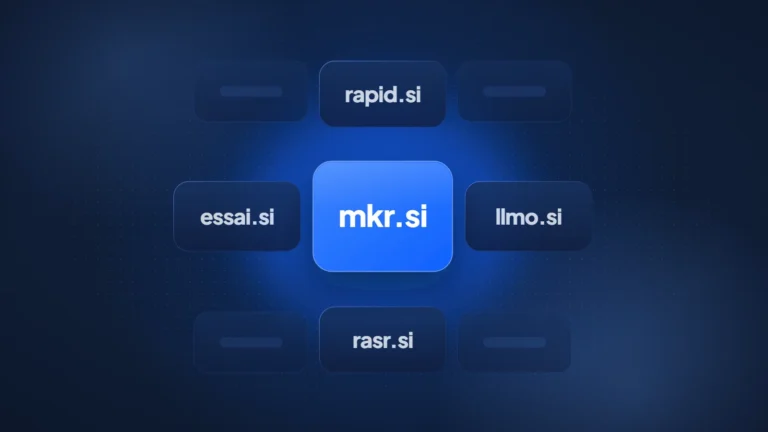
- rapid.si (€12,000) is a real word used as a brand. It names a quality rather than a product, so it can read as arbitrary or suggestive. For a business that sells speed, such as delivery, it may count as descriptive.
- mkr.si (€4,500) is a 3-letter name. Some readers may see it as a short form of “maker,” while others spell out the letters, so the spell test matters more.
- essai.si (€6,000) is a foreign word. Essai is French for an attempt or an essay, and its last two letters spell ai, which fits AI products.
A real word reads instantly but is more likely to overlap with existing marks. An abbreviation is short but less self-explanatory. Our guide to the .si domain covers registration and setup.
How to choose: guidance by reader
A brandable domain suits a company whose name must carry it for years, and a descriptive domain suits one that only has to explain a single offer. Descriptive names win on instant clarity, while brandable names win on trademark strength and room to grow. Whichever you pick, test the name and clear trademarks before you buy.
Founders
Shortlist 5 to 10 names, run the five-step test and search trademarks in every target market. Coined names are often free to register, while short real words usually come from the aftermarket. If your favorite name is already registered, read how to buy a domain that is already taken before you contact the owner.
Agencies
Present names that pass the say-it, spell-it test, with trademark search results attached. Share Google’s position on domain keywords early. For a local client with one service, a descriptive name can still be the right call.
Domain investors
WIPO’s case overview says that registering names for resale is not bad faith in itself. Names that echo a distinctive or famous mark are another matter. Judge each name as a branding asset, not a price forecast. Our guide to premium domain names covers the aftermarket side.