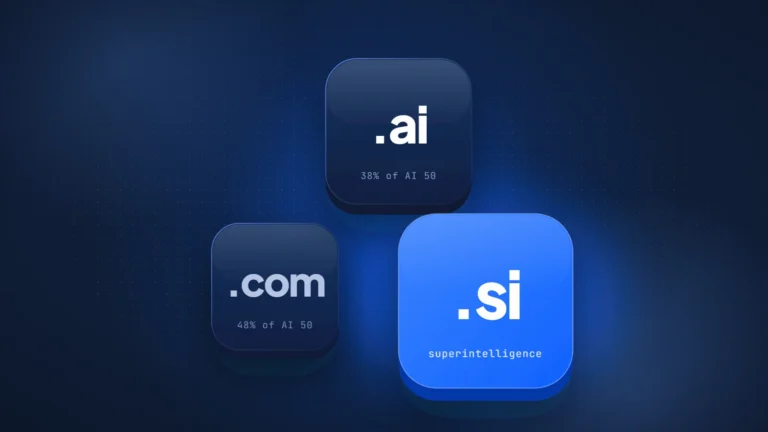
Domain hacks spell a word across the name and the extension, as in youtu.be, and have nothing to do with security breaches. Country domains such as .tv, .me, .co, .io and .ai became global brands when their letters gained a meaning. .si is Slovenia’s country-code domain. For AI companies it reads as SuperIntelligence. That makes it the 2026 test case.
Register.si counted 46,066 new .si domains in September 2026, against 3,515 in August, as the US government moved from “AI” to “Super Intelligence” wording. Search demand for the trick itself is modest: “domain hacks” draws about 70 US and 200 global searches a month (Ahrefs, October 5, 2026).
What are domain hacks?
A domain hack is a domain name that spells a word or brand when you read the name and the extension as one string. Wikipedia describes it as a name that suggests a word, phrase or name when two or more adjacent levels of the domain are joined.
Most famous domain hacks use a country-code extension, because two-letter codes complete many English words. The table shows six well-known examples and what happened to each one. “Our check” means our own redirect test on October 5, 2026.
| Domain | Owner | Spells | Status as of October 5, 2026 | Source |
|---|---|---|---|---|
| youtu.be | YouTube (Google) | YouTube (.be, Belgium) | Short-link domain since December 2009; redirects to youtube.com | TechCrunch; our check |
| goo.gl | Google (.gl, Greenland) | No new links since 2018; inactive links stopped working after August 25, 2025 | Google Developers Blog | |
| del.icio.us | Delicious | delicious (.us, United States) | Service moved to delicious.com on July 31, 2008 | The Next Web |
| instagr.am | Instagram (Meta) | Instagram (.am, Armenia) | Redirects to instagram.com | Our check |
| redd.it | reddit (.it, Italy) | Short and media domain; redirects to reddit.com | Our check | |
| bit.ly | Bitly | bitly (.ly, Libya) | Redirects to bitly.com | Our check |
The hacks that survive work as short-link layers next to a main .com, as youtu.be, redd.it and bit.ly do. Launch-stage hacks such as del.icio.us and instagr.am ended up pointing to a .com. Google stopped accepting new goo.gl links in 2018 and closed its console in 2019. Under its 2024 shutdown notice, updated in August 2025, links with no activity in late 2024 stopped working after August 25, 2025, while actively used links kept working.
How country domains became global brands
Country domains became global brands when their two letters read as a word or idea outside the home country, and when companies elsewhere started to build on them. Each boom had a dated trigger, from Tuvalu’s .tv to Anguilla’s .ai.
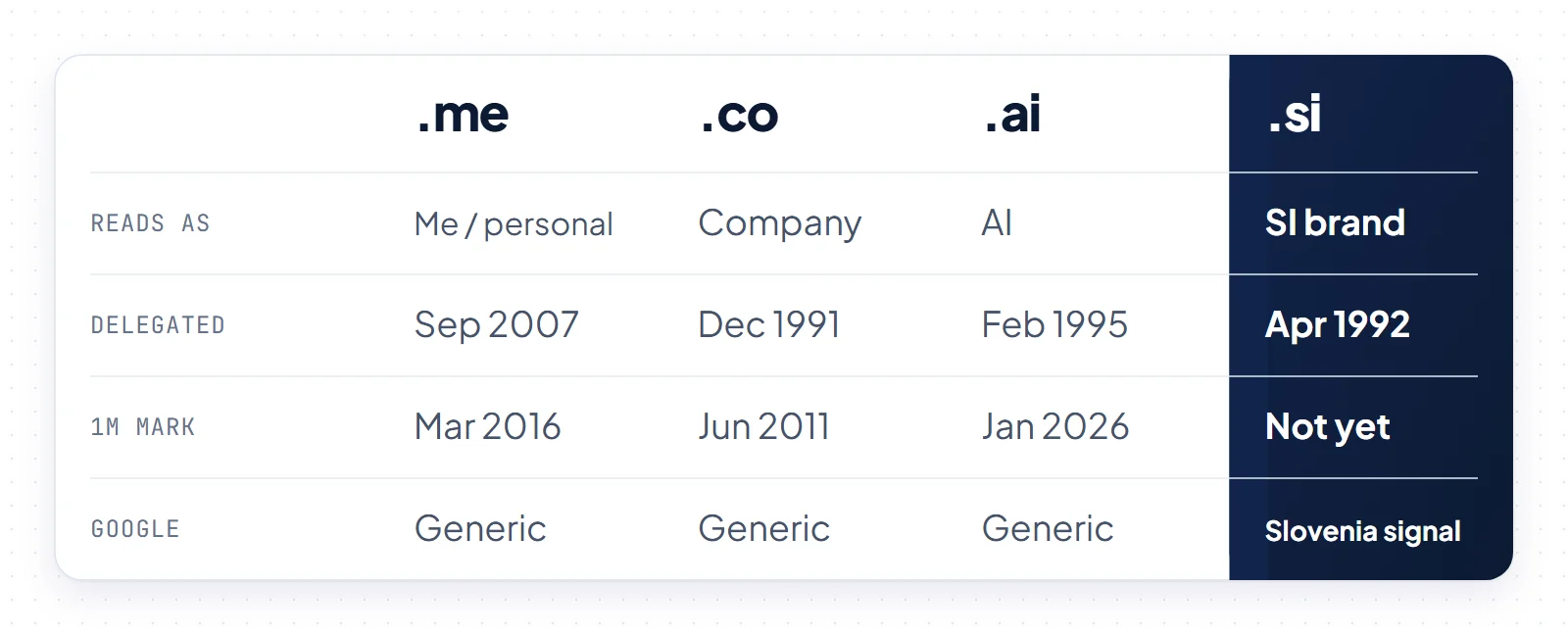
The table joins delegation dates from the IANA Root Zone Database with registration counts from registries and trade press. The counts come from different methods and years, so read them as milestones, not as one series.
| TLD | Country | Reads as | Trigger | Registrations at dated points | On Google’s generic list? |
|---|---|---|---|---|---|
| .tv | Tuvalu | Television | Delegated March 18, 1996; Verisign bought the .tv operator at the end of 2001; GoDaddy Registry contract December 14, 2021 | About 500,000 (December 2021) | Yes |
| .me | Montenegro | Me, personal | Delegated September 24, 2007; open to the public July 17, 2008 | More than 800,000 (May 2015); 1 million (March 2016) | Yes |
| .co | Colombia | Company | Delegated December 24, 1991; global relaunch July 2010 | 100,000 in the first 10 minutes (July 2010); 1 million (June 2011); more than 3 million (June 2025) | Yes |
| .io | British Indian Ocean Territory | Input/output | Delegated September 16, 1997; widely used by tech companies | 270,000 (2017); no official count since | Yes |
| .ai | Anguilla | Artificial intelligence | Delegated February 16, 1995; ChatGPT launch, November 2022 | 598,007 (January 2, 2025); more than 1 million (January 2026) | Yes |
| .si | Slovenia | SuperIntelligence (our framing) | Delegated April 1, 1992; “Super Intelligence” UN speech (September 22, 2026) and Executive Order 14434 (September 29, 2026) | 3,515 new (August 2026); 46,066 new (September 2026); 306,011 total (October 5, 2026) | No |
Verisign acquired the .tv operator at the end of 2001. When the contract came up for tender, Verisign chose not to bid. GoDaddy Registry won it on December 14, 2021, with roughly 500,000 names in the zone, according to Domain Name Wire.
Montenegro’s .me opened to the public on July 17, 2008, and passed 1 million registrations in March 2016, TechCrunch reported. Colombia’s .co took 100,000 registrations in the first 10 minutes of its July 2010 relaunch and reached 1 million in June 2011. A June 2025 GoDaddy Registry post counted more than 3 million .co domains.
Anguilla’s .ai is the most recent precedent. It grew from 598,007 registrations on January 2, 2025 to more than 1 million in January 2026, per Domain Name Wire. Anguilla Focus, citing Ministry of Finance data, put the island’s 2025 .ai revenue at EC$230.5 million. Our guide to .ai domains covers prices and rules.
What the ccTLD booms have in common
The lasting ccTLD booms share four traits: a meaning in the letters, real end users, a speculative phase and changes at the registry. Each ccTLD also stays tied to its national manager and rules, which adds a sovereignty risk.
Meaning plus end users
Readable letters attract attention; companies that run their main product on the name turn an extension into a brand. Domain Name Wire wrote in June 2026: “All successful TLDs became successful because end users chose to use them.”
A speculative phase
Every boom also attracts investors who register names to resell them. Registration totals count those names alongside real projects, so a spike in new domains measures interest, not adoption.
Operator changes
The company running a ccTLD can change while the country stays the same. .tv moved from Verisign to GoDaddy Registry in 2021. Anguilla moved the .ai backend to Identity Digital in January 2025. GoDaddy Registry said in June 2025 that it would hand .co’s technical operation to an incoming provider later that year. IANA now lists CentralNic as the .co technical contact.
Sovereignty and registry risk
A domain hack lives under the rules of the country whose code it borrows. In 2010, Libya’s registry deleted vb.ly on content grounds. In 2011, Letter.ly moved its service to letterly.net after it could not renew its .ly domain during Libya’s conflict, SoCalTech reported.
The .io extension carries a different risk. ICANN said in November 2024 that if the IO code leaves the ISO 3166-1 list, a five-year phase-out window begins. Our explainer on ccTLDs covers who runs these registries and how their rules differ.
How Google treats ccTLD meaning
Google treats 20 country-code domains, including .tv, .me, .co, .io and .ai, as generic, so they carry no country signal. Slovenia’s .si is not on that list, so Google reads a .si website as aimed at Slovenia.
The list sits in Google’s guide to multi-regional and multilingual sites, last updated December 10, 2025. It also includes .ad, .as, .bz, .cc, .cd, .dj, .fm, .la, .ms, .nu, .sc, .sr, .su, .tk and .ws. Google introduces it with one line: it “treats some ccTLDs (such as .tv and .me) as gTLDs.”
For a domain hack, this matters more than the wordplay. A hack on a generic-treated extension can serve a global site. A hack on a country-signal extension such as .si points to that country, unless it redirects to a main domain elsewhere, which is how youtu.be and redd.it work.
Is .si the next ccTLD brand?
Not yet. Slovenia’s .si already shows two traits of past booms: a reading that means something outside the country and a sharp registration spike (46,066 new names in September 2026). It does not yet show the trait that made those booms last: evidence that companies run their main products on .si names.
Reading .si as SuperIntelligence is our framing, not an official meaning. Executive Order 14434, signed September 29, 2026, directs US federal agencies to use “Super Intelligence” or “SI” instead of “AI” in their communications. It does not bind companies and has nothing to do with the .si domain. Our explainer on what SI stands for covers the abbreviation.
A strict .si domain hack needs a word that ends in “si” and splits across the dot. Most .si brand names instead keep a full word before the dot and let the extension read as SI.
The registration numbers
IANA lists April 1, 1992 as the registration date of .si, with the research network ARNES as manager. Register.si showed 306,011 .si domains on its homepage on October 5, 2026. It counted 46,066 new registrations in September 2026, about 13 times the 3,515 of August.
CircleID reported a DomainNameStat-based count by registrar Domaintechnik of 17,621 new .si domains against 7,209 new .ai domains over September 23–29, 2026. For that week, .si added more than twice as many new names as .ai.
The evidence on end users
The same CircleID report cited Netcraft data: about 52% of .si names registered through Dynadot on September 19–22 were offered for resale. “Much of the early demand appears speculative,” CircleID concluded.
Domain Name Wire reviewed 35 public .si sales from January to June 9, 2026. Only 2 went to end users: recursive.si for $20,000 and military.si for $1,795.
“What I don’t see evidence of (yet) is adoption by actual companies,” Domain Name Wire editor Andrew Allemann wrote on October 1, 2026, after the September surge.
Caveats
A spike-year total includes speculative names that may not be renewed. Google also treats .si as a Slovenia signal, unlike .tv, .me, .co, .io and .ai. The earlier booms rested on years of company adoption, while the .si record so far covers weeks.
Disclosure: buysidomains.si sells .si names, so weigh our view with that in mind. Our guide to the .si domain covers registration rules and fees.
How to use a domain hack well
Use a domain hack only if people can say it, type it and trust it to stay online. The checklist below applies the lessons of youtu.be, vb.ly and goo.gl.
- Say it aloud. If a listener cannot type the name after hearing it once, the dot in the middle becomes a support problem.
- Check the registry’s rules and stability. Read who may register, how renewals work and whether the registry has deleted names before. For .si, any natural or legal person can register through a registrar; Register.si listed 94 registrars on October 5, 2026.
- Keep a .com or .ai fallback. Run the main site on a generic extension and let the hack redirect, the way youtu.be points to youtube.com.
- Check how Google treats the extension. Look up the extension on Google’s generic ccTLD list. If it is missing, as .si is, expect a country signal for any site hosted on it.
- Check trademarks. Search trademark registers in your markets before you buy. Disputes over .si names go through Register.si’s ARDS procedure, which covers only marks valid in Slovenia. This is not legal advice.
Our guide to brandable domains covers the wider naming checks.
A .si naming example: essai.si
The name essai.si shows how a .si domain can carry two readings without being a strict hack. “Essai” is French for attempt or essay. The word is complete before the dot and ends in “ai”, and the extension adds “si”. The name reads both as a French word and as AI next to SI.
Disclosure: buysidomains.si sells essai.si at a fixed aftermarket asking price of €6,000 (October 2026). The essai.si listing has the details.
For a global product, put the main site on a generic extension and use a .si name as a brand address that redirects. For a Slovenian audience, or a team that wants the SI reading on its main site, .si can work as the home domain, as long as the team accepts the country signal.