Domain portfolio management means deciding which domain names a company owns, registering them to the company, keeping them renewed and locked, and adding defensive names only where they reduce real risk. In 2026 it also includes a new question: whether to register your brand’s .si name, after Slovenia’s registry urged trademark holders to act.
The term “domain portfolio management” draws about 200 searches a month in the US and 600 worldwide (Ahrefs, October 5, 2026). Costs and risks both moved in 2026: the .ai registry fee rose in March, Verisign announced a .com increase for November 1, and .si saw a registration rush in September.
What a company should own
A company should own its primary brand domain, its brand in the country domains where it trades, and a short list of product names and typos. It does not need its brand in every extension.
ICANN’s Security and Stability Advisory Committee (SSAC) treats this as asset management. Its registrant guide, SSAC SAC044, says “domain name registrations should be considered as an asset and therefore included in business processes such as asset management, provisioning and risk management programs”.
| Domain type | Why it matters | Priority |
|---|---|---|
| Primary brand domain (.com or your main extension) | Website, email and logins depend on it | Must own |
| Brand in country domains where you trade | Local customers type it; local squatters target it | High |
| Active product and campaign names | Launches attract lookalike registrations | High while in use |
| Common typos of the primary domain | Phishing and misdirected email | Medium, short list only |
| Brand in sector extensions (.ai, .si for AI companies) | Same-name pairs are easy to copy | Medium, case by case |
| Brand in every other extension | Mostly parked, little added protection | Low, usually skip |
Keep a name if losing it would break email, logins or trust, or if a lookalike could enable fraud.
What can go wrong: lapses, errors and lookalikes
The best-known domain incidents below were process failures rather than attacks. A renewal did not go through, or a registrar or registry let someone else take a name the company already held.
| Company | Domain | What happened | Date | Source |
|---|---|---|---|---|
| Foursquare | foursquare.com | Renewal missed; the registrar showed its own landing page instead of the site | March 25, 2010 | TechCrunch |
| google.com | A former employee bought it through Google Domains for $12 (press reports); the sale was reversed within about a minute | September 29, 2015 | Google Security Blog; press | |
| Marketo | marketo.com | Auto-renew failed; website, forms and email went down | Late July 2017 | The Register |
| google.com.ar | A resident registered it at NIC Argentina for 270 pesos; Google said it had not expired, and the registry reverted it | April 21, 2021 | BBC Mundo |
The Register put Marketo’s missed renewal fee at $35. Marketo’s CEO, Steve Lucas, said the company renews “thousands of domain name properties we own every year with precision, yet the auto renew process for registering our main domain, Marketo.com, failed.”
Google’s own account says the buyer reported the flaw and received a $6,006.13 reward, which Google doubled when the buyer donated it to charity. The Argentine case was different: a registry error rather than a lapse.
Security and renewal checklist
Secure a portfolio in a fixed order: list every name, put it in the company’s name, lock it, automate renewals, monitor changes and review it every year. Each step draws on guidance from ICANN, its SSAC or the US Cybersecurity and Infrastructure Security Agency (CISA).
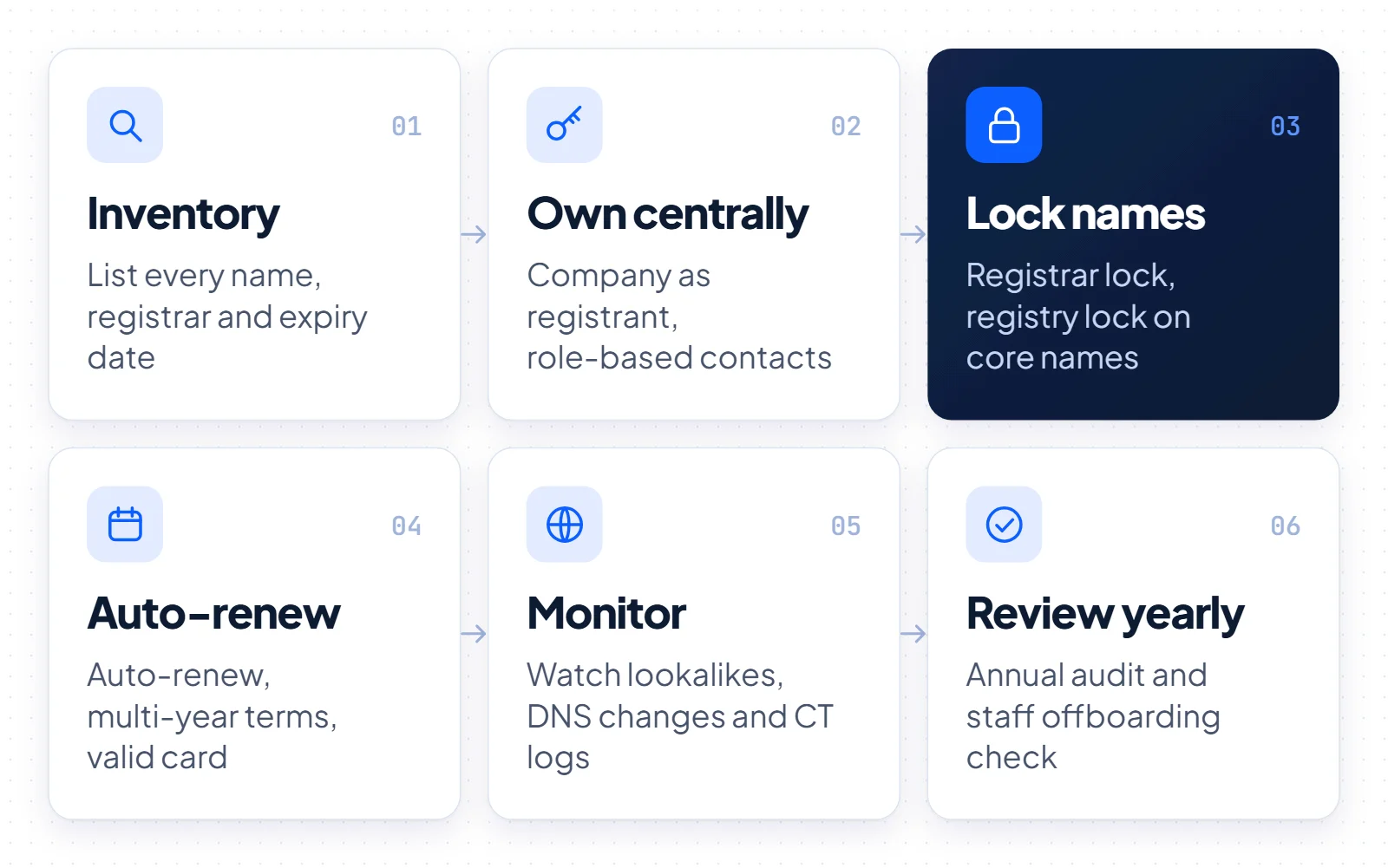
- Inventory every name. Record the registrar, account, expiry date, DNS host and business owner of each domain, and review the list every year, as SAC044 advises.
- Register to the company. SAC044 advises points of contact “that do not create a relationship between any natural person or employee”. ICANN’s 2017 good-practice blog posts add role-based email addresses.
- Protect the accounts. CISA’s Emergency Directive 19-01 (January 22, 2019, now closed) ordered agencies to audit public DNS records, change passwords on DNS accounts, add multi-factor authentication and monitor Certificate Transparency logs. Any company can copy those four actions.
- Lock the names. Under ICANN’s EPP status codes, clientTransferProhibited tells the registry to reject transfers away from your registrar. Registry-set server codes “take precedence over client codes”, and SAC044 suggests registry locks “as a complement to registrar locks”. For .si, the registry locks a name at the registrar’s request, and its price list shows the lock at €20 excluding VAT.
- Automate renewals, then check them. Turn on auto-renew, renew core names for several years and keep payment details current. For gTLDs, ICANN’s renewal policy requires reminders about one month and one week before expiry, plus a 30-day Redemption Grace Period after deletion. These are backstops; a renewal plan should never depend on them.
- Turn on DNSSEC. SAC044 encourages it, and Register.si publishes a DNSSEC policy, so .si names support it.
- Plan transfers. ICANN’s current Transfer Policy lets a registrar deny transfers within 60 days of creation or a previous transfer. A change of registrant triggers a 60-day lock unless the registrar offers an opt-out and you use it before the change. ICANN’s Transfer Policy Review recommends shorter 30-day restrictions; until they take effect, the 60-day rules apply. Our guide to EPP codes covers the transfer step.
- Offboard people. SAC044 says employee termination and transfer processes “should be modified to check if the employee has domain registration account access”.
When choosing a registrar, ask what extra protection it offers. SSAC’s report SAC040 encourages registrars to offer “stronger levels of protection against domain name registration service exploitation or misuse for customers who want or need them”.
What a domain portfolio costs over five years
At registry level, keeping 10 names costs $548.50 in .com and €500 in .si over five years, and $4,800 in .ai over six years, because .ai sells in 2-year terms. Retail totals are higher.
Figures are registry level only, excluding VAT, the ICANN fee and registrar markup. Totals are our arithmetic from published registry prices, October 5, 2026.
| TLD | Registry fee | Term | 1 name, 5 years | 10 names, 5 years | 50 names, 5 years | Source |
|---|---|---|---|---|---|---|
| .com | $10.97 per year (from November 1, 2026) | 1 year | $54.85 | $548.50 | $2,742.50 | Verisign 10-Q, Q2 2026 |
| .ai | $160 per 2-year term | 2-year minimum | $480 (3 terms, 6 years) | $4,800 | $24,000 | Domain Name Wire, February 2, 2026 |
| .si | €10 per year | 1 year | €50 | €500 | €2,500 | Register.si price list, valid from January 1, 2023 |
The .com fee has been $10.26 since September 1, 2024, and Verisign may raise it by up to 7% in each of the final four years of every six-year period. The .com totals apply the November 1, 2026 rate to all five years and exclude later increases, so treat them as a floor. Ten .ai names cost more than 50 .com names.
Five years of .ai cannot be bought in two-year terms, so the table uses three terms, or six years. Prorated, the fee equals $80 a year.
For .si, registrars set the retail price. The .si domain lock is listed at €20 excluding VAT, and the price list does not say whether it is charged once or yearly.
Defensive registrations and monitoring
Register defensive names only where a lookalike would cause real harm, and monitor the rest. They earn their fee by blocking misuse and rarely bring traffic.
In a 2017 INTA survey run by Nielsen, brand owners said their new gTLD registrations were “commonly parked and are not creating direct value other than preventing unauthorized use”.
The Trademark Clearinghouse (TMCH) helps, but only in new gTLDs. It offers Sunrise priority access and Claims notices. The TMCH operator says the Claims period lasts at least 90 days and lists a fee of $155 per record per year. TMCH does not cover .com or country-code domains such as .si and .ai.
Outside TMCH, monitoring fills the gap. Watch new registrations containing your brand, its typos and same-name pairs across extensions. Certificate Transparency logs also reveal lookalike sites once they request certificates.
When a lookalike is already registered, disputes are the fallback. The UDRP covers gTLDs, while .si cases go to Register.si’s ARDS procedure; our guide to trademarking an AI company name compares both.
Should brands register their .si name?
Brands should register their .si name if they sell in Slovenia or the EU, use SI wording, or face a real lookalike risk. The registry fee is €10 a year, while an ARDS complaint to recover a name costs €700 including VAT. Others can skip it and monitor.
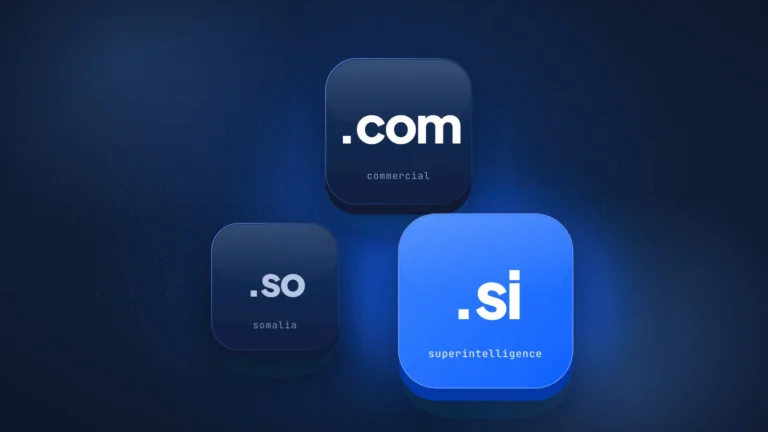
.si is Slovenia’s country-code domain. For AI companies it reads as SuperIntelligence. That reading is our framing and has no official status.
Register.si’s notice of September 24, 2026 advised holders of trademarks, slogans and company names without a .si domain to register one as soon as possible. The same notice said media talk of “million-euro earnings” for Slovenia has no real basis.
Speculators moved first. Netcraft found that about 52% of the .si names registered at Dynadot between September 19 and 22, 2026 were listed on its aftermarket by September 23. It also counted more than 44,000 matching .si and .ai pairs, 22% of all .si domains.
Our own audit points the same way. On October 5, 2026, we checked the exact .si name of every company on the Forbes 2026 AI 50. None uses .si as its main domain, and 29 of 50 brand.si names showed for-sale pages. A for-sale page shows a listing; it does not show who owns the name. The full results are in our analysis of AI company names.
In ARDS case ARDS2026/149, decided June 14, 2026, temu.si was transferred to Whaleco Technology, the company behind Temu. It had been registered about three weeks after Temu applied for its EU trademark and held unused for almost four years. The arbitrator found that passive holding can constitute bad faith use. The €700 ARDS fee, paid by the complainant, covers one to five domains; holding the name costs €10 a year in registry fees.
When a .si name makes sense
- You sell, or plan to sell, in Slovenia or elsewhere in the EU.
- Your products or campaigns use “SI” or SuperIntelligence wording.
- Your brand has an exact .ai or .com name that a same-string .si could imitate.
- You hold a trademark valid in Slovenia (an EU mark counts) or a Slovenian-registered company name, which ARDS requires if you ever need to recover a name.
When to skip it
- You have no customers, staff or plans in Slovenia or the EU, and no SI wording.
- The budget would go to names you will never use or check.
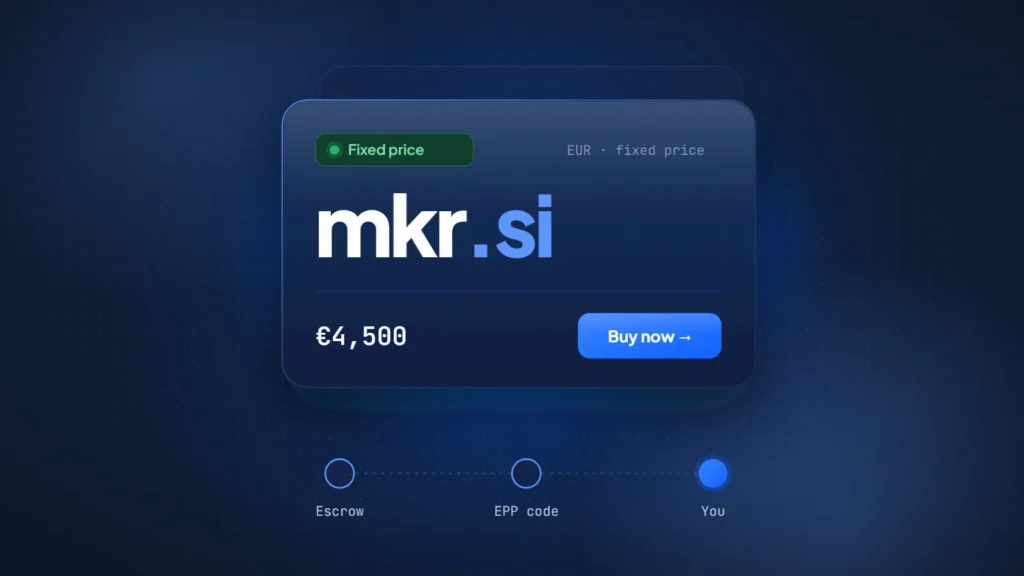
Disclosure: buysidomains.si sells .si names, including mkr.si, the name on this article’s cover image. For rules, registrars and setup, see our guide to the .si domain.
A simple domain portfolio management policy
A one-page policy keeps the portfolio from depending on one person. Adapt this template to your company and review it every year.
- Ownership: the company is the registrant of every domain, with role-based contacts. IT runs the accounts; legal approves new names.
- Accounts: few registrar accounts, each with multi-factor authentication and two named admins.
- What we register: the primary brand, country domains where we trade, active product names, the top typos and, if the criteria above apply, the .si name.
- What we skip: the brand in every extension and retired campaign names.
- Renewals: auto-renew on, multi-year terms for core names, expiry checks at 90, 30 and 7 days.
- Security: registrar lock on all names, registry lock on core names, and DNSSEC where supported.
- Monitoring: a monthly check of lookalike registrations and Certificate Transparency logs.
- Disputes: legal chooses among UDRP, ARDS and buying the domain, with a budget set in advance.
- Offboarding: remove domain account access when staff or agencies leave.
Start with the inventory, because every other step depends on it. Then lock and renew core names before deciding which defensive names, including .si, earn their fee.