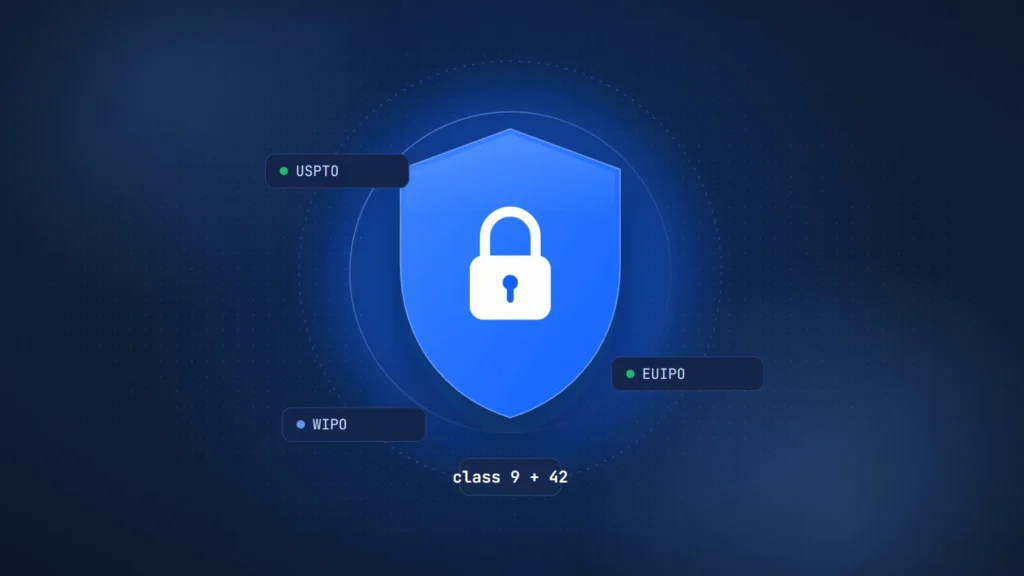
To trademark a company name, search for conflicts, file in the right classes (9 and 42 for most AI software) with the USPTO ($350 per class) or the EUIPO (€850 for one class), and expect months of examination. Descriptive words such as “AI”, “intelligence” or “superintelligence” are weak and are often disclaimed.
The phrase “how to trademark a name” draws about 11,000 US searches a month and 13,000 globally, and “trademark a company name” about 200 in the US and 400 globally (Ahrefs, October 5, 2026). The naming context shifted in September 2026. A September 19 post by President Trump floated “Superior Intelligence (SI)” as a name for AI. Executive Order 14434 of September 29 directed federal agencies to use “Super Intelligence” and “SI” in place of “Artificial Intelligence” and “AI”.
We checked every USPTO record cited here on October 5, 2026. This guide is general information, not legal advice: consult a trademark attorney before you file.
Trademark vs business name vs domain name
A trademark, a business name and a domain name are three separate registrations, and only the trademark protects the brand. Forming an LLC or buying the matching .com, .ai or .si name gives you no trademark rights.
A USPTO flyer defines a trade name as “simply the name of your business” and says you register it with your state. A trademark and a trade name can be the same word.
| Registration | What it is | Where you register it | What it protects | Cost (October 2026) |
|---|---|---|---|---|
| Trademark | A word or logo that identifies the source of goods or services | USPTO (US), EUIPO (EU); WIPO Madrid for several countries | The mark, for the listed goods and services | $350 per class (USPTO); €850 for one class (EUIPO) |
| Business name | The name of your business | Your state (US) | The company record, not the brand | Varies by state |
| Domain name | A web address such as example.si | A registrar | The address only; no trademark rights | .si registry price €10 per year excl. VAT |
How to trademark a company name, step by step
Clear the name first, then file in the right classes and answer the examiner. The USPTO splits the process into six stages, from deciding whether to apply to maintaining the registration.
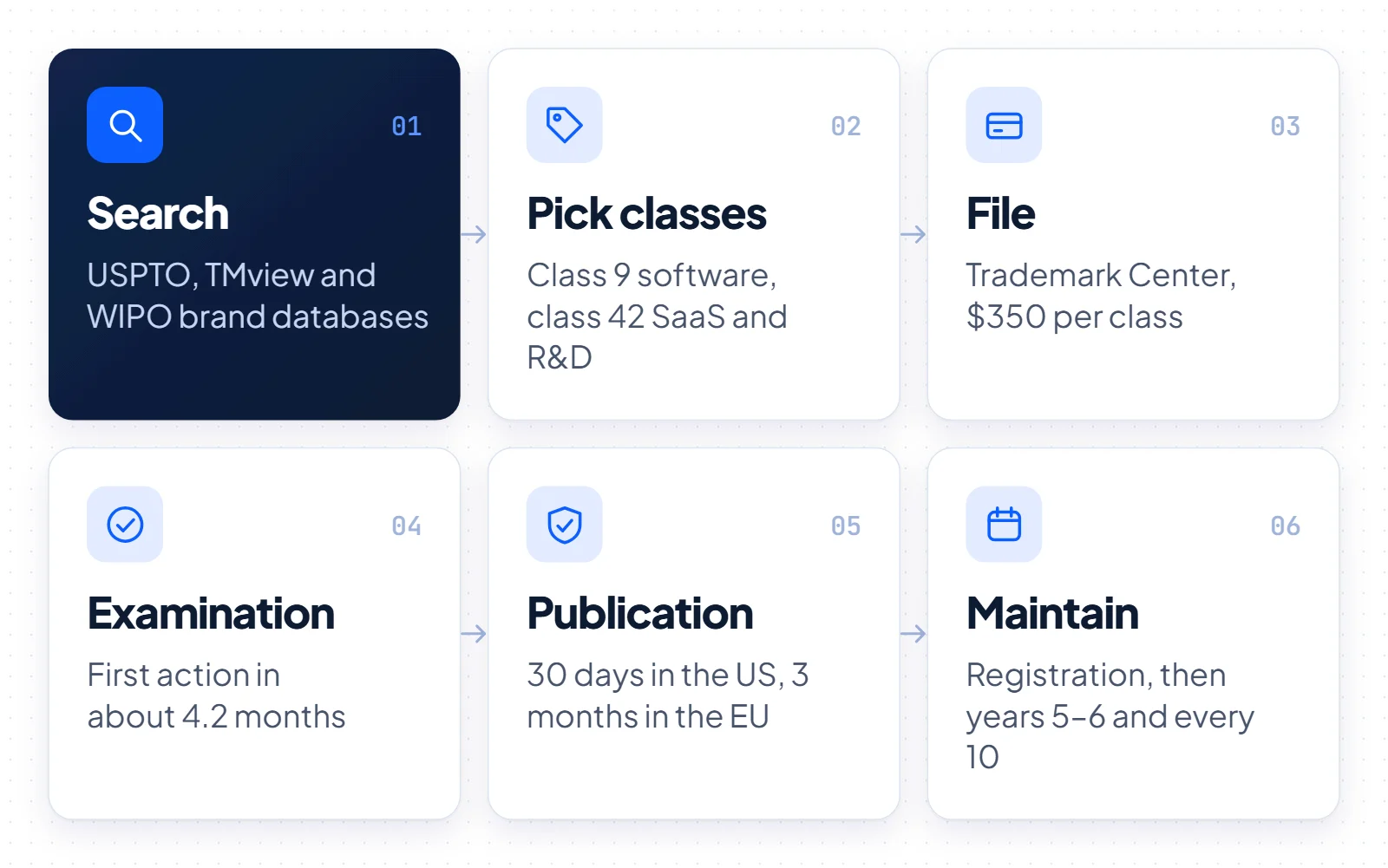
- Run a clearance search. Search the USPTO’s Trademark Search system, which replaced TESS, and EUIPO’s TMview for national, EU and international marks. Add the WIPO Global Brand Database, and look for similar names, not only exact matches.
- Pick your classes. The class 9 heading includes “recorded and downloadable multimedia files, computer software”, and the class 42 heading ends with “design and development of computer hardware and software”. The class 42 notes also list SaaS. Use USPTO Trademark ID Manual wording to avoid surcharges.
- File in Trademark Center. The USPTO calls it the only way to apply, at $350 per class. US residents need no attorney, but foreign-domiciled applicants must use a US-licensed one.
- Respond to office actions. An examining attorney may raise objections. You have 3 months to respond, and a 3-month extension costs $125.
- Get through publication. In the US, any party who believes it may be damaged has 30 days from the publication date to oppose or to request more time. At the EUIPO, owners of earlier rights can oppose within 3 months of publication.
- Register or prove use. Use-based marks proceed to registration. Intent-to-use filings get a notice of allowance, then have 6 months to file a statement of use ($150 per class) or request an extension.
- Maintain the registration. File a Section 8 declaration between years 5 and 6, then combined Sections 8 and 9 every 10 years. An EU trademark lasts 10 years and can be renewed indefinitely.
Surcharges also cost time. In April–June 2026, the USPTO approved 36.0% of stand-alone base applications on the first action, against 10.6% of applications with surcharges (USPTO dashboard).
Costs and timelines: USPTO, EUIPO and WIPO
A US filing for an AI product in classes 9 and 42 starts at $700 in government fees, before surcharges or attorney fees. At the EUIPO, the same two classes cost €900: €850 for the first and €50 for the second.
| Office | Item | Fee or time | Effective date or period |
|---|---|---|---|
| USPTO | Base application in Trademark Center, per class | $350 | Since January 2025 |
| USPTO | Insufficient information surcharge, per class | $100 | Since January 2025 |
| USPTO | Free-form text instead of the ID Manual, per class | $200 | Since January 2025 |
| USPTO | Each extra 1,000 characters of free-form text, per class | $200 | Since January 2025 |
| USPTO | Sections 8 and 15 (years 5–6), per class | $575 | Since January 2025 |
| USPTO | Sections 8 and 9 renewal (every 10 years), per class | $650 | Since January 2025 |
| USPTO | Average first action / total pendency | 4.2 / 9.8 months | Q3 FY2026 (April–June 2026) |
| EUIPO | EU trademark online: first class / second / each further class | €850 / €50 / €150 | Fees page, checked October 5, 2026 |
| EUIPO | Opposition fee and window | €320; 3 months after publication | Checked October 5, 2026 |
| WIPO | Madrid basic fee, black and white / color | CHF 653 / CHF 903 | In force since February 1, 2023 |
The USPTO’s FY2026 targets are a first action within 5 months and total pendency of 11 months or less. The April–June 2026 quarter beat both, down from 5.9 and 12 months a year earlier. The WIPO Madrid System adds a fee for each designated country, and its fees cover 10 years.
AI-specific traps: descriptive words and crowded names
The biggest risk specific to AI company names is a name that describes the product. Words such as “AI”, “GPT”, “intelligence” or “superintelligence” tell the examiner what the software does, so they make weak marks.
What the USPTO means by descriptive
Under TMEP §1209.01(b), “A mark is considered merely descriptive if it describes an ingredient, quality, characteristic, function, feature, purpose, or use of the specified goods or services”. A descriptive mark can reach the Principal Register only with proof of acquired distinctiveness under Section 2(f); otherwise it may qualify only for the Supplemental Register. The TMEP calls a generic term “the ultimate in descriptiveness” in §1209.01(c).
The GPT application
OpenAI OpCo, LLC filed GPT, serial 97733259, on December 27, 2022, in classes 9 and 42. The USPTO issued a final refusal on February 6, 2024. The refusal said the mark “merely describes a feature, function, or characteristic of applicant’s goods and services,” TechCrunch reported in a February 15, 2024 story.
OpenAI appealed the GPT refusal and requested reconsideration on August 6, 2024. A new non-final action followed on May 12, 2025, then a suspension letter on January 12, 2026. As of October 5, 2026, the GPT application is live and suspended, not registered.
Even SUPERINTELLIGENCE gets disclaimed
Under TMEP §1213, a disclaimer states that the applicant or registrant claims no exclusive right to use a specified element of the mark. Safe Superintelligence Inc. disclaimed “SUPERINTELLIGENCE” in its SAFE SUPERINTELLIGENCE application (serial 99187873). SUPERINTELLIGENCE BY IQ COMPANY, registered on April 28, 2026 as Reg. 8231198, disclaims both “SUPERINTELLIGENCE” and “COMPANY”.
Treatment varies: MATHEMATICAL SUPERINTELLIGENCE (serial 98915236) disclaims only “MATHEMATICAL”. Our Trademark Search check on October 5, 2026 found 38 records with “SUPERINTELLIGENCE” in the wordmark, 23 of them in classes 9 or 42. Another 10 records use “SUPER INTELLIGENCE”.
Fame does not clear a crowded name
Large AI companies lose naming fights too. In June 2025, new USPTO refusals of xAI’s XAI GROK and GROK logo applications cited 6 registrations and 22 pending applications, according to Gerben Law.
| Name | Parties | Key dates | Status as reported (checked October 5, 2026) | Source |
|---|---|---|---|---|
| GPT | OpenAI and the USPTO | Final refusal February 6, 2024 | Application live, suspended | USPTO TSDR; TechCrunch |
| GROK | xAI and the USPTO | Refused May 9, 2024; new refusals June 17, 2025 | June 2025 refusals of XAI GROK and GROK logo filings cite 28 prior marks and applications | Gerben Law |
| io vs iyO | IYO Inc. v. IO Products and OpenAI | TRO June 2025; Ninth Circuit affirmed December 2025; preliminary injunction April 2026 | OpenAI barred from using “io” for AI devices | IPWatchdog; Bloomberg Law |
| Cameo | Baron App (Cameo) v. OpenAI | Suit October 2025; preliminary injunction February 2026; appeal dropped April 2026 | Injunction bars OpenAI from using “Cameo” for Sora features; the feature had already been renamed “Characters” | Bloomberg Government |
| Perplexity | Perplexity Solved Solutions v. Perplexity AI | Suit January 2025; dismissed October 2025 | Dismissed with prejudice after the plaintiff failed to retain counsel, not on the merits | Bloomberg Law |
| Kepler | New Generation (TryKepler.ai) v. Keru AI (GetKepler.ai) | Filed July 2026 | Pending | Domain Name Wire |
SI and superintelligence names after the rename
New USPTO applications built on “SI” or “SUPERINTELLIGENCE” appeared within days of the September 2026 rename. Public records show at least three filed between September 30 and October 4, 2026, all awaiting examination.
| Mark | Serial | Owner | Filed | Classes | Status (October 5, 2026) |
|---|---|---|---|---|---|
| SUPERINTELLIGENCE SYSTEMS | 50137337 | An individual applicant | September 30, 2026 | 42 | Awaiting examination |
| SUPERGROK SI | 50143573 | Elon R. Musk (individual) | October 4, 2026 | 42 | Awaiting examination |
| FORWARD EDGE-SI | 50143735 | Forward Edge-AI, Inc. | October 4, 2026 | 9, 35, 42 | Awaiting examination |
The Trademark Search index lags a few days behind filings, so early October applications may be missing.
Two ARTIFICIAL SUPER INTELLIGENCE applications by one owner (serials 99325622 and 99350303) date from August 2025, and the USPTO noted on October 1, 2026 that 99325622 remains suspended. ENGINEERING SUPERINTELLIGENCE (serial 99520768, Geminus.ai, Inc.) has had an opposition pending since August 26, 2026.
The two letters alone are crowded. Our check found 153 live records with the token “SI” in classes 9 and 42, mostly unrelated to AI, such as Quantum-Si. If you build a brand on what SI stands for, search the abbreviation and both spellings of the full word.
Domains and trademarks: .si, .ai and disputes
A domain is not a trademark. The USPTO says registering a domain name “doesn’t give you any trademark rights”, whether the name ends in .com, .ai or .si.
.si is Slovenia’s country-code domain. For AI companies it reads as SuperIntelligence. That reading is our framing, not an official meaning, and Executive Order 14434 does not concern the .si registry.
The bigger risk is losing a domain that collides with someone’s mark. Generic domains such as .com use the UDRP, while .si disputes go to ARDS at Register.si.
| Aspect | UDRP (generic domains such as .com) | ARDS (.si, Register.si) |
|---|---|---|
| Which rights count | A trademark or service mark in which the complainant has rights | A trademark valid in Slovenia, a company name in the Slovenian court register, or another right recognized in Slovenia |
| Bad faith test | Registered and being used in bad faith | Registered or being used in bad faith |
| Elements | All three must be proven | All three, cumulatively |
The UDRP requires a domain that was registered and is being used in bad faith. The ARDS rules for .si domains require one that was registered or is being used in bad faith. A complaint decided by a single arbiter costs €700 incl. VAT for one to five domains.
In a notice dated September 24, 2026, Register.si urged brand owners to act: “Vsekakor pa svetujemo nosilcem blagovnih znamk, sloganov, firm, …, ki še nimajo domene pod .si, da jo čimprej registrirajo”. Our translation: “In any case, we advise holders of trademarks, slogans, company names, etc. that do not yet have a .si domain to register one as soon as possible”.
Before you buy a .si name, check the word in TMview and the USPTO search and run a domain history check. If the name is already registered, our guide on how to buy a taken domain covers legitimate routes. The .si domain guide covers rules, prices and registrars. Disclosure: buysidomains.si sells .si names, so run your own trademark checks.
Which filing route fits your AI company
Choose the office by market, then focus on the name. A distinctive word with “AI” or “SI” as a descriptor is easier to protect than a name built only from those words.
- US-first product: file at the USPTO in classes 9 and 42, from $700 in government fees.
- EU-first product: file an EU trademark, €900 for two classes.
- Several markets: compare national filings with the WIPO Madrid System (CHF 653 basic fee plus country fees).
- Domains: clear the trademark before paying for a premium domain.
Before you file or buy, test the name’s strength with our notes on brandable domains and consult a trademark attorney.