A domain broker negotiates the purchase or sale of a domain name for a client. Most brokers are paid a commission only when the deal closes, sometimes plus an upfront fee for buy-side searches. A broker is worth it for valuable or hard-to-reach names, and less so when the name already has a fixed price.
The term “domain broker” draws about 1,100 searches a month in the US and 2,500 worldwide; “domain acquisition” draws about 300 and 600 (Ahrefs, October 5, 2026). This guide covers both sides of a brokered deal and does not rank broker firms. Disclosure: buysidomains.si sells .si domains at fixed prices, which is one of the alternatives covered below.
What a domain broker does
A domain broker is an intermediary who finds the other party, negotiates price and terms, and steers the deal to closing. A broker can open talks but cannot make an owner sell.
Brokers work for the buyer, the seller or both, as the table shows.
| Role | Who hires | How paid | Typical use |
|---|---|---|---|
| Buy-side (acquisition) broker | The buyer | Success commission, sometimes plus an upfront service fee | Acquiring a registered name whose owner is hard to reach, or keeping the buyer’s name out of first contact |
| Sell-side (listing) broker | The domain owner | Commission paid from the sale proceeds at closing | Marketing a valuable name to qualified buyers and screening offers |
| Dual agent (both sides) | Buyer and seller | Commission from one or both sides | Allowed under ICA best practices only with disclosed consent |
For buyers, the main draw is distance. The broker makes first contact, so your company name stays out of the opening email. That privacy has a limit. On Escrow.com, the seller sees the buyer’s name, email, physical address and primary phone once the payment has been approved.
How much a domain broker costs
Domain brokers usually earn a success commission, a share of the final price due only when the deal closes. Domain Name Wire reported in 2011 that sales commissions are “typically 15%-20% depending on the name”. Some registrars and marketplaces also sell buy-side broker services for an upfront fee, which you may not get back if the owner says no.
Domain Name Wire also reported that one marketplace raised its fee on personally brokered sales from 10% to 15% in January 2011. Another raised its brokerage fee from 12.5% to 15% in April 2015. These are older figures. We found no neutral source with current rates, so ask every broker for a written quote.
| Structure | How it works | Watch out for |
|---|---|---|
| Success commission only | The broker earns a percentage of the final price when the deal closes and nothing if it fails | Who pays it (buyer, seller or split) and whether it sits on top of the price or inside it |
| Upfront fee plus success commission | The buyer pays a service fee to start outreach, then a commission if the deal closes | Whether the fee is refundable if the owner refuses, and how long the outreach lasts |
| Sell-side commission | The seller’s broker takes the commission from escrow at closing, out of the sale proceeds | Exclusivity terms, the length of the agreement and how offers reach you |
| Confidential broker deal | Escrow.com can hide the purchase price, escrow fee and broker commission from buyer and seller | A spread you cannot see, so get the broker’s fee and who pays it in writing |
Escrow is a separate cost. On October 5, 2026, the Escrow.com fee calculator listed 2.6% ($50 minimum) for deals up to $5,000 and 2.4% ($130 minimum) from $5,000.01 to $50,000. The buyer, the seller or the broker can pay the escrow fee, or it can be split between buyer and seller or between buyer and broker. If a deal is canceled after the funds arrive, or the buyer rejects the domain, the buyer pays the escrow fee regardless of the agreed split.
When a domain broker is worth it
A domain broker is worth it when the name is valuable, the owner is hard to reach, or you want your identity kept out of first contact. A broker adds little when the name already has a listed price or when its price is lower than the broker’s fees.
Reaching owners has become harder. Under ICANN’s Registration Data Policy, registrars may publish a pseudonymized email address or a link to a web form instead of the owner’s email. ICANN’s May 25, 2026 advisory said the Policy “does not include an explicit requirement” that registrars offer a free-text option or forwarding. It also described at least one registrar form that only sends the owner a system-generated notice that someone is trying to reach them. For .si names, Register.si says “only the contact email address will be disclosed” when the holder is a natural person.
A broker is likely worth it if two or more of these apply.
- The owner’s data is redacted and your messages through the registrar’s form go unanswered.
- The name is valuable enough that skilled negotiation can save more than the commission costs.
- You want to keep your company’s name out of the opening contact.
- You are selling a valuable name and want access to qualified buyers.
Skip the broker if any of these is true.
- The name has a fixed price, so you can buy it directly through escrow.
- RDAP data or a parked page gives you a working way to contact the owner.
- An upfront fee would be a large share of the likely price.
Brokers also handle some of the largest public sales. DNJournal reported that Icon.com sold for $12,000,000 in 2025, brokered by Andrew Miller, and Commerce.com for $2,200,000 in February 2025, with broker Larry Fischer. These are publicly reported prices, compiled by the trade press.
How the domain broker process works
A brokered purchase usually runs in six steps: owner lookup, outreach, negotiation, written terms, escrow and transfer. The broker leads the first four, and escrow protects both sides through the last two.
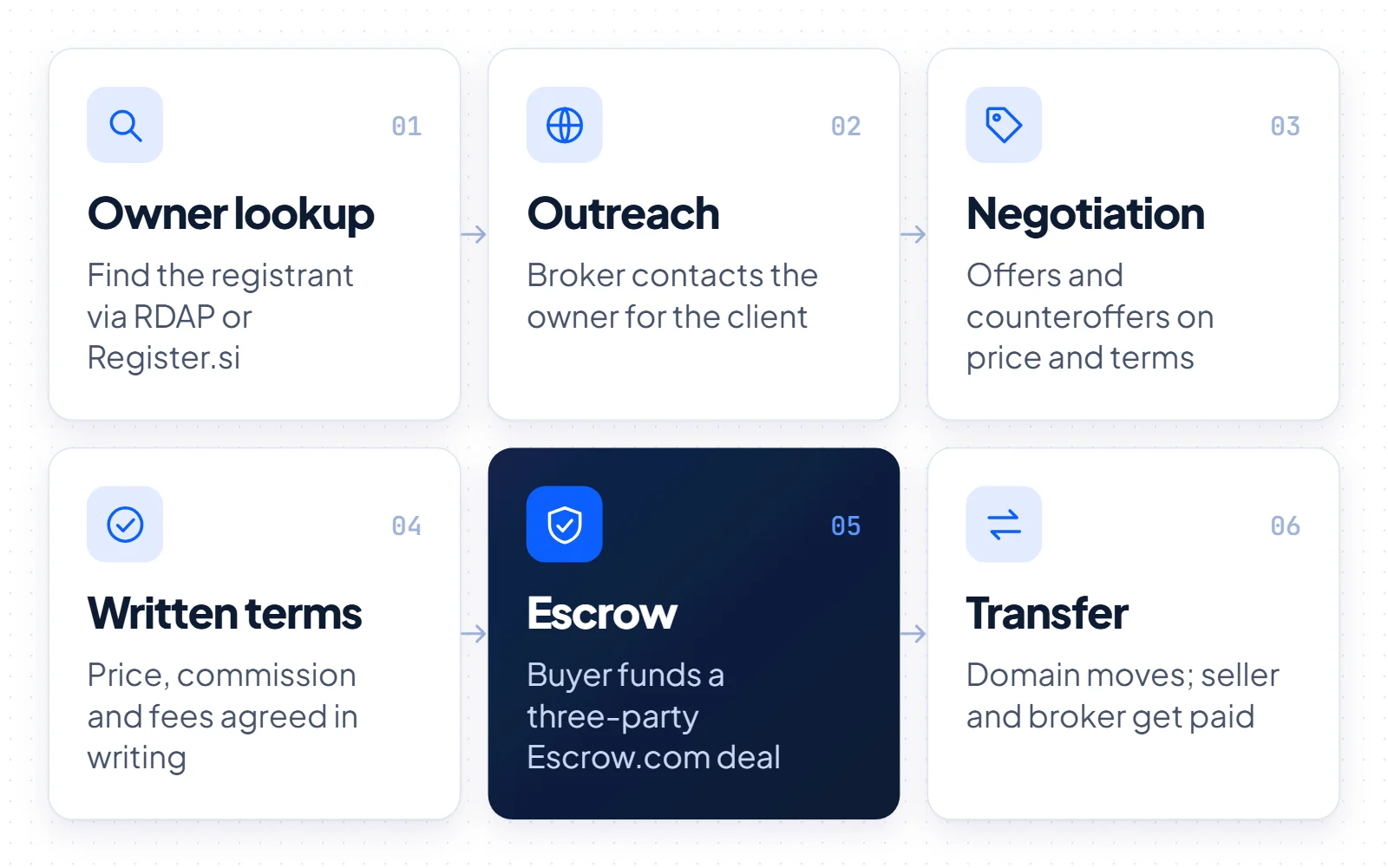
- Identify the owner. Since January 28, 2025, ICANN has treated RDAP, not WHOIS, as the definitive source for gTLD registration data, with its own lookup at lookup.icann.org. For .si names, the registry is Register.si.
- Reach out. The broker contacts the owner, often without naming the client, and confirms whether the name is for sale.
- Negotiate. Offers and counteroffers set the price, payment terms and timing.
- Agree in writing. The price, who pays the commission and the escrow fee, the deadline and the transfer method go into a written agreement.
- Fund escrow. On Escrow.com, “Once the Buyer, Seller, and Broker agree to terms, the Broker then starts a three-party transaction,” and the buyer funds it. Our guide to how domain escrow works covers fees and fake-escrow warning signs.
- Transfer and release. The seller moves the domain, usually with an EPP (auth) code, and the buyer confirms it arrived. Our domain transfer guide covers the technical steps. At the close, according to Escrow.com’s broker service page, “the Seller is paid the Seller’s proceeds and the Broker is paid the commission amount.”
How to vet a domain broker
Vet a domain broker on paper before you pay anything. Require a written agreement that sets out all fees, disclosed conflicts, payment only through escrow and no promise of a guaranteed result. The first two come from the Internet Commerce Association (ICA).
The ICA’s best practices for domain name brokers are a voluntary code for member brokers. Domain Name Wire reported on March 29, 2023 that the ICA would stay out of disputes with brokers over it. We found no formal license or certification for domain brokers, so use the checklist below.
- Written agreement. The ICA says brokers should “always employ a written brokerage agreement that adequately sets out all fees, duties, terms, rights, and obligations” for both broker and client.
- Fees in writing. Ask what the broker earns and from whom, especially in Escrow.com’s confidential mode, which hides the price, escrow fee and commission from both sides.
- No hidden dual agency. Under the ICA code, a broker should not represent both buyer and seller on the same domain name unless the client consents and the dual agency is disclosed.
- Client first. The code asks brokers to serve the client’s interests “uninfluenced by the basis of remuneration”, so ask how the broker’s pay changes with the price.
- Real authorization. Brokers should not claim to act for a buyer, seller or domain name without written authorization. When a broker reaches out about a name whose owner has not authorized it, its first message should state: “I am not acting for the domain name owner, nor am I authorized by the domain name owner to do outreach on this domain name.”
- No guarantees. No broker can make an owner sell, so treat a guaranteed result tied to an upfront fee as a red flag.
- Escrow only. Type the escrow address yourself. Escrow.com warns that a site resembling Escrow.com is likely fraudulent, and that fraud sites have given out the real license number of its subsidiary.
- Track record. Ask for closed deals you can check in trade press such as DNJournal.
Common broker scams
The oldest trick is the paid appraisal. Domain Name Wire described the pattern in 2005: someone offers to buy your domain, then requires an appraisal before the deal can proceed. By 2020, a variant used a fake broker who demanded the owner buy an appraisal before any funds moved. A real buyer has no reason to make you pay a third party first.
Alternatives to a domain broker
You have three alternatives to a domain broker: contact the owner yourself, buy a name with a fixed price, or check the name’s history and value before you decide.
Contact the owner directly
Start with an RDAP lookup, a parked page with an offer form or the registrar’s contact form. Write a short, specific message and propose escrow from the start. Skip ICANN’s Registration Data Request Service: it serves requesters with a legitimate interest, such as law enforcement, and does not guarantee disclosure. Our guide on how to buy a domain that is already taken walks through the full do-it-yourself route.
Buy a fixed-price name
When a domain has a listed price, a broker adds cost but little bargaining power. As noted above, buysidomains.si sells .si domains. Our homepage describes our process in four steps.
- “Pick a domain. Buy at the listed price or send an offer.”
- “Pay via Escrow.com. Card or bank transfer.”
- “Get the transfer code. We send the EPP (auth) code within 24 hours.”
- “Funds released. Once you confirm ownership, Escrow.com pays the seller.”
Buyers pay no fees because the seller covers escrow, and the transfer usually takes about a day. For example, rapid.si has a fixed aftermarket asking price of €12,000 (October 2026). As our homepage puts it, “We only get paid once you have it,” because Escrow.com holds the money until the domain is in your name.
Check history and value first
Before you hire anyone or make an offer, use our guides to domain value and domain history to set a realistic price ceiling and review the name’s past use.
Which route fits your deal
Use a domain broker for valuable names with unreachable owners, go direct when the owner answers, and buy outright when a fixed price is listed. On every route, close through escrow and put every fee in writing.
- Buyer with a reachable owner: make contact yourself and keep a broker as a fallback if talks stall.
- Buyer facing a redacted owner and a valuable name: hire a buy-side broker paid mainly on success, under a written agreement.
- Seller of a valuable name: compare sell-side brokers on commission, exclusivity and sales you can verify.
The same rules apply to .si names, which drew many new buyers in September 2026. .si is Slovenia’s country-code domain. For AI companies it reads as SuperIntelligence. Register.si’s lookup shows when a .si name was registered, and a fixed-price .si listing like rapid.si needs no broker at all.