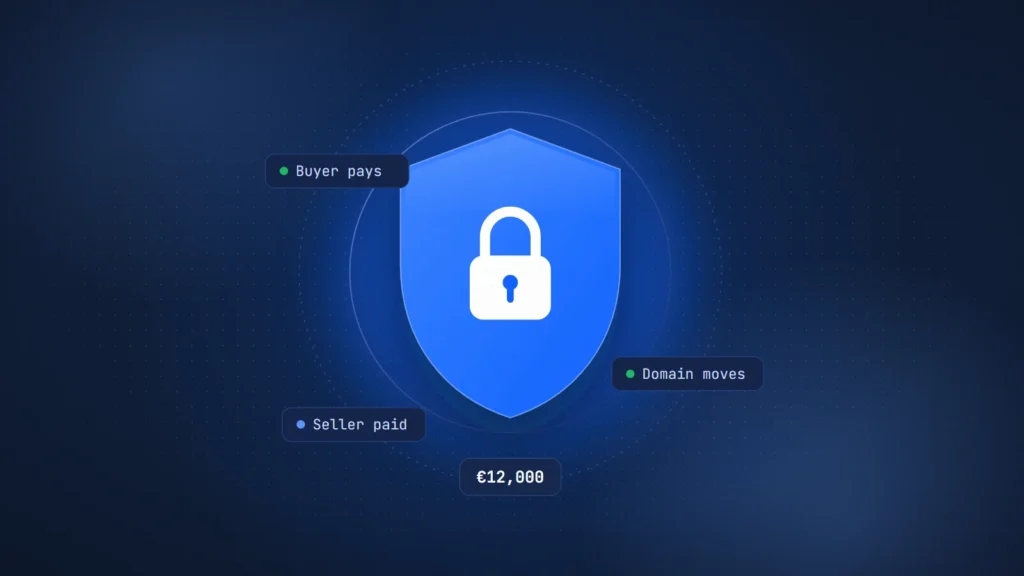
Domain escrow is a three-party arrangement for buying or selling a domain name. The buyer pays a licensed escrow agent such as Escrow.com, and the seller transfers the domain. The agent releases the money only after the transfer is confirmed or the inspection period ends. Neither side has to hand over money or the name on trust.
The query “domain escrow” draws about 70 searches a month in the US and 100 worldwide (Ahrefs, October 5, 2026). Most searchers are mid-deal and want three answers: the steps, the fee and proof the service is real.
How domain escrow works, step by step
Domain escrow on Escrow.com follows five steps: agree, pay, transfer, inspect and release. The buyer never pays the seller directly, so Escrow.com can hold the money until the domain shows up in the buyer’s name.
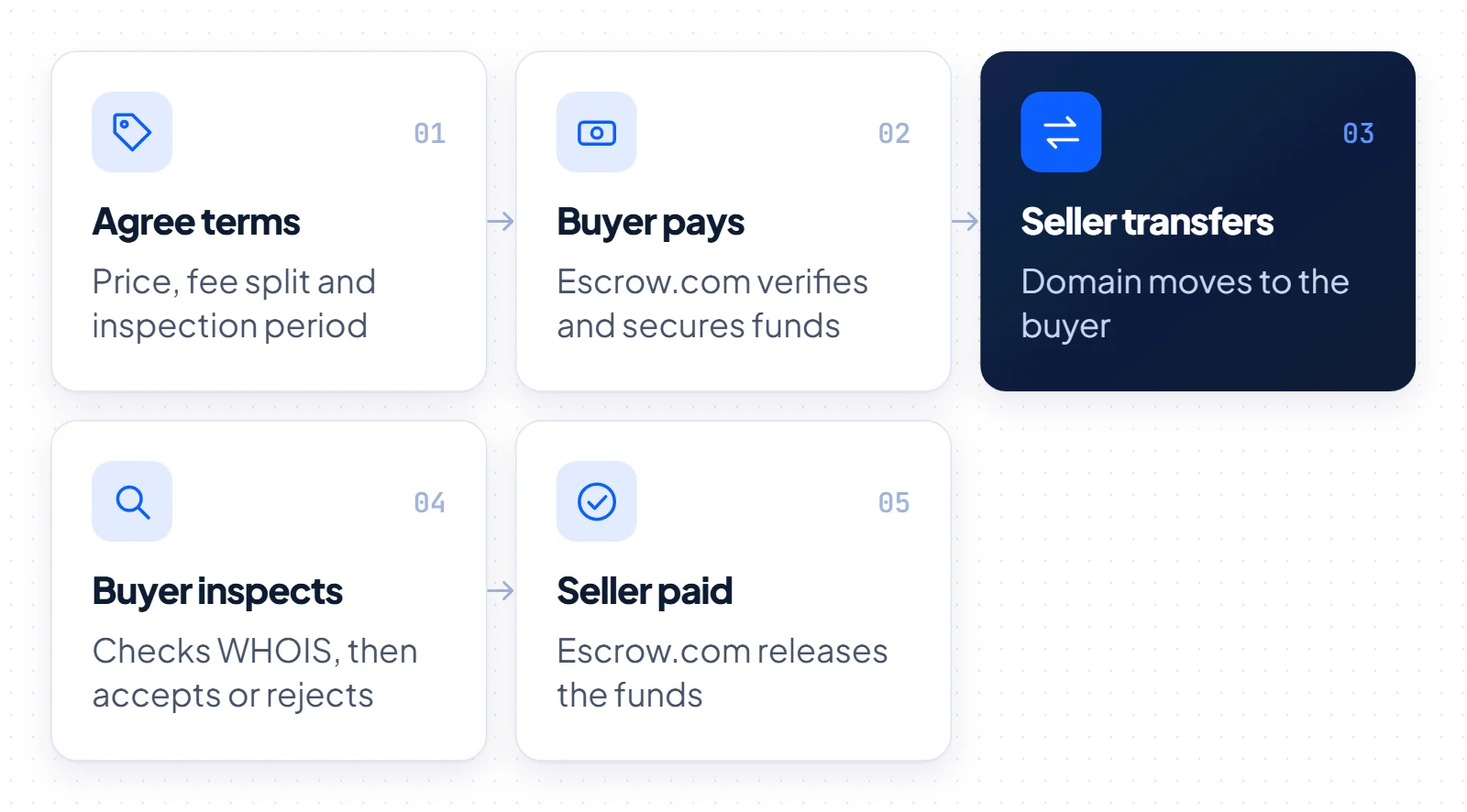
Here is how Escrow.com describes its domain process.
- Agree to terms. Buyer and seller set the price, who pays the escrow fee and the length of the inspection period.
- Buyer pays Escrow.com. Once Escrow.com verifies and secures the payment, it tells the seller to transfer the domain.
- Seller transfers the domain. The seller moves the domain to the buyer and notifies Escrow.com. With the Concierge service, Escrow.com staff handle this step.
- Buyer inspects and accepts. The inspection period starts when the buyer confirms possession or Escrow.com sees the change in WHOIS. It lasts 1 to 30 calendar days, as agreed at the start.
- Seller gets paid. Escrow.com releases the funds when it can verify the transfer or when the inspection period ends.
Escrow.com confirms the new registrant in the registrar’s WHOIS record. It still advises buyers to check those details before approving release, and it does not run lien or trademark searches.
Silence counts as acceptance. Under Escrow.com’s General Escrow Instructions, a buyer who does nothing during the inspection period has accepted the domain, and the funds go to the seller.
Domain escrow fees on Escrow.com
As of October 5, 2026, Escrow.com’s standard domain escrow fee is 2.6% (minimum $50) up to $5,000 and 2.4% (minimum $130) from $5,000.01 to $50,000. The rate falls as the deal grows, down to 0.7% above $10 million. Concierge, where Escrow.com holds the domain itself, costs double.
| Domain value (USD) | Standard escrow fee | Concierge fee |
|---|---|---|
| $0–$5,000 | 2.6% ($50 minimum) | 5.2% ($100 minimum) |
| $5,000.01–$50,000 | 2.4% ($130 minimum) | 4.8% |
| $50,000.01–$200,000 | 1.9% ($1,200 minimum) | 3.8% |
| $200,000.01–$500,000 | 1.5% ($3,800 minimum) | 3.0% |
| $500,000.01–$1 million | 1.2% ($7,500 minimum) | 2.4% |
| $1 million–$3 million | 1.0% ($12,000 minimum) | 2.0% |
| $3 million–$5 million | 0.95% ($30,000 minimum) | 1.9% |
| $5 million–$10 million | 0.9% ($47,500 minimum) | 1.8% |
| Over $10 million | 0.7% (quote on request) | 1.4% |
| Card or PayPal payment | Fee plus 3.05% payment processing fee | Fee plus 3.05% payment processing fee |
Card and PayPal payments carry the extra 3.05% fee and cannot exceed $5,000 excluding fees. They also require at least one party with a completed Escrow.com transaction. Most premium domain deals therefore settle by wire, and international wires add $25. For sellers, the fee calculator lists $10 for a domestic wire payout, $20 for an international one and nothing for ACH.
Worked example: a €12,000 domain
Take a €12,000 sale, the October 2026 asking price of rapid.si in our portfolio, used only as an example. When we checked Escrow.com’s fee calculator on October 5, 2026, euro deals from €5,000.01 to €50,000 used the same 2.4% rate with a €130 minimum. We assume the buyer pays in euros by wire, with no currency conversion.
- Standard fee: €12,000 × 2.4% = €288, above the €130 minimum.
- Split 50/50: €288 ÷ 2 = €144 for each side.
- Seller pays all: they net €12,000 − €288 = €11,712, before any payout wire fee.
- Concierge: €12,000 × 4.8% = €576.
In dollars, a $12,000 deal costs $12,000 × 2.4% = $288. Small deals hit the minimum, so a $1,500 domain pays $50 rather than $1,500 × 2.6% = $39. These are our calculations, not an Escrow.com quote, so run the Escrow.com fee calculator before you sign.
Who pays the escrow fee
On Escrow.com, buyer and seller decide who pays the escrow fee for a domain: the buyer pays 100%, the seller pays 100%, or each pays 50%. Escrow.com adds the fee to the purchase price when the buyer pays and deducts it from the proceeds when the seller pays. If either side cancels after the funds are approved, or the buyer rejects the domain, Escrow.com charges the buyer 100% of the escrow fee.
That rule gives buyers a reason to check the domain’s history, trademarks and registrar details before funding the deal. If a listing says nothing about fees, ask before you open the transaction. The split changes what the seller nets.
How long domain escrow takes
Escrow.com says most domain escrow transactions finish within 1 to 20 business days. The slowest step is usually the registrar transfer, which takes from a few minutes to 6 weeks, depending on the registrar.
| Stage | Typical time (per Escrow.com) |
|---|---|
| Account verification (required over $3,000) | Up to 1 business day |
| Wire payment processed | 1–5 business days |
| PayPal or card payment processed | Within 1 business day |
| Domain transfer by the registrar | A few minutes to 6 weeks |
| Inspection period | 1–30 calendar days, agreed upfront |
| Payout by domestic wire | Generally 1 business day |
| Payout by international wire | 3–5 business days |
Transfer locks cause most of the surprises. Under the ICANN Transfer Policy in force on October 5, 2026, a registrar must give you the Auth-Code within 5 calendar days of your request. A registrar may deny a transfer to another registrar within 60 days of the initial registration or a previous transfer. You also cannot move a domain to another registrar within 60 days of changing the registrant’s name, organization or email address.
The ICANN Board adopted the Transfer Policy Review recommendations on June 7, 2026. As of October 5, 2026, ICANN had not announced an effective date for the revised policy, so these rules may change. Check the ICANN registrant FAQs before you plan around the 60-day windows. Before opening an escrow, ask the seller when they registered the domain, last transferred it and last changed its holder.
How to spot a fake escrow service
A fake escrow service is a website that imitates a real escrow agent, takes the buyer’s payment and never delivers. Escrow.com says it belongs to no escrow consortium and is not affiliated with any other escrow site, so any claimed affiliation with Escrow.com is a warning sign.
Escrow.com’s fraud prevention page lists these red flags.
- The site claims an affiliation with Escrow.com.
- The design looks similar to Escrow.com.
- Contact details are missing.
- The site’s own domain was registered only weeks or months ago.
- The pages have poor spelling and grammar, or broken links.
- It asks for person-to-person payments such as Western Union.
- The escrow fees look suspiciously low.
In an April 30, 2003 press release, the FTC described a fake escrow site that told sellers the money was in hand so they would ship the goods. Its advice still applies: if the other party insists on an escrow or payment service you have never heard of, check it out first.
Two habits make fake sites much harder to fall for. Type escrow.com into the browser yourself, and take contact details from the company’s website, never from an email. Escrow.com lists California DFPI license number 9631867 on its licenses page. Confirm it in the DFPI’s own licensee records, not through a badge on a website.
Domain escrow vs other ways to pay
Domain escrow is the option built around a licensed third party that holds the money until the domain has moved. The alternatives can be cheaper or faster, but each asks one side to trust the other or a platform.
| Method | Who holds the money | Main risk | Best fit |
|---|---|---|---|
| Domain escrow | A licensed agent, until the transfer is confirmed or inspection ends | Fees, which on Escrow.com run from 2.6% down to 0.7% at standard rates with a $50 minimum; fake escrow sites | Deals between parties who have not traded before |
| Direct bank transfer | The seller, from the moment of payment | The buyer pays before the domain moves | Partners who already trust each other |
| Card or PayPal, paid directly | The seller, subject to the processor’s dispute rules | A payment dispute can follow after the domain has moved | Small amounts |
| Marketplace checkout | The platform, under its own terms | Protection and fees depend on the platform’s terms | Domains listed on that platform |
A direct transfer saves the fee but moves all the risk to whoever acts first.
Domain escrow for .si domains
Domain escrow works the same way for .si domains, but the transfer follows Register.si rules rather than ICANN’s gTLD policy, as with any country code domain. Slovenia runs .si as its national domain, and for AI companies it reads as SuperIntelligence.
Register.si separates two changes on its registrar and registrant transfers page. A holder change can start at any time at the current holder’s request. A registrar completes it after both the current and the new holder confirm, and the registry sends both an automatic email. A registrar change uses an authinfo code, which the holder sets through the current registrar and gives to the new one.
The Register.si tariff for registrars, valid from January 1, 2023, lists €0 for a change of registrar and €0 for a transfer to a third party. That is the registry’s price to registrars, not necessarily yours. Register.si’s guidance gives no fixed timeframes and does not mention the ICANN 60-day lock, so don’t assume gTLD rules apply.
In a .si escrow deal, the holder change is the moment that matters. Release the funds only after the registry’s email has arrived and your registrar or the WHOIS record confirms you as the new holder. When the holder is a private individual, .si WHOIS shows only the contact email address, so check that it is yours. Our complete guide to the .si domain covers registration rules and prices.
When to use domain escrow
Use domain escrow whenever you deal with someone you have not traded with before and the price is more than you would accept losing. On very small sales, weigh the $50 minimum fee against the risk.
How buysidomains.si sells
We sell .si domains at fixed prices, take payment through Escrow.com and move each name with the EPP (auth) code. Our guide to buying a domain that is already taken walks through the process. Our guide to premium domain names explains what drives asking prices.
If you are the buyer
Agree on the inspection period and the fee split in writing, check the WHOIS record before you approve release, and run your own trademark search. Above $5,000, plan for a wire, because card and PayPal payments stop there.
If you are the seller
Wait for Escrow.com’s instruction before you transfer anything, and never act on a payment confirmation that arrives only by email. Check for any 60-day lock before you list. If you pay the fee, price it in: on a €12,000 sale, the standard fee is €288.
Small deals vs large deals
On small deals, standard escrow with a short inspection period is enough. Concierge costs double, so it earns its fee on large deals, where more money is at stake.