LLM optimization (LLMO) is the practice of making your brand and pages easy for AI assistants such as ChatGPT, Gemini, Claude and Perplexity to find, understand and cite. No official definition exists. The closest research term is generative engine optimization (GEO), from a KDD 2024 paper. That paper tested which page edits make sources more visible in AI answers.
Interest is real but still modest. On October 5, 2026, Ahrefs showed “llm optimization” at about 1,700 monthly searches in the United States and 6,300 worldwide. The short form “llmo” had about 800 US and 9,300 global searches. So most people who type the abbreviation search from outside the United States.
The phrase also has a technical meaning. Engineers use LLM optimization for making models run faster or cheaper, with methods such as quantization and speculative decoding. The PyTorch team, for example, described an LLM running almost 10x faster than its baseline with no loss of accuracy. This article covers the marketing sense: getting your content into AI answers.
What is LLM optimization?
LLM optimization is a working label, not a standard. It describes the steps a brand takes so that large language models retrieve its pages, describe it correctly and link to it as a source.
No search engine, AI lab or standards body has published an official definition of LLMO. Even the acronym is crowded: on arXiv, LLMO can also stand for Large Language Model Optimizer. The academic work closest to the marketing practice uses a different name, GEO.
The authors of GEO: Generative Engine Optimization describe it as “a flexible black-box optimization framework for optimizing web content visibility for proprietary and closed-source generative engines” (KDD 2024). You cannot see inside ChatGPT or Gemini, so you change your content and measure what happens. LLMO adds the technical basics: crawl access, indexing and consistent brand facts.
LLMO vs SEO vs GEO and AEO
SEO aims for ranked links in search results, while LLMO aims for mentions and citations inside generated answers. GEO is the research name for that goal, and AEO (answer engine optimization) is a related industry label.
| Practice | Focus | Where it shows | What you control | Evidence base |
|---|---|---|---|---|
| SEO | Ranking pages for queries | Search results | Content, technical setup, links | Search engine documentation |
| LLMO | Being cited by AI assistants | AI Overviews, AI Mode, ChatGPT, Claude, Perplexity | Crawler access, content, brand facts | No official definition; GEO research and crawler docs |
| GEO / AEO | Source visibility in generated answers | AI answer engines | Page content (GEO tested text edits) | GEO: KDD 2024 paper; AEO: industry term |
The overlap matters more than the labels. Google says you can apply the same foundational SEO best practices to its AI features as to Search overall. LLMO is best read as SEO plus a few additions, not a replacement for it.
How LLMs choose what to cite: training vs retrieval
Large language models answer from two places: parametric memory learned during training and non-parametric memory, meaning documents retrieved at answer time. The 2020 retrieval-augmented generation (RAG) paper by Lewis and colleagues describes this split. For LLM optimization, retrieval is the part a site owner can check and change. Google’s AI features retrieve pages from its Search index.
Large pre-trained language models “have been shown to store factual knowledge in their parameters,” notes the paper that introduced retrieval-augmented generation (RAG). It pairs them with a retriever.
Google’s guide to optimizing for generative AI features, updated July 10, 2026, says those features use retrieval-augmented generation, also called grounding. These features rely “on our core Search ranking systems to retrieve relevant, up-to-date web pages from our Search index,” the guide adds. It also describes query fan-out: the model issues several related searches at once to fetch more results for a single question.
Classic SEO therefore remains a prerequisite. Google’s AI features documentation states that a page “must be indexed and eligible to be shown in Google Search with a snippet” to appear as a supporting link.
OpenAI and Anthropic run separate crawlers for search and for training. OpenAI says GPTBot crawls content “that may be used in training our generative AI foundation models,” while OAI-SearchBot surfaces sites in ChatGPT search. Anthropic documents the same split. Perplexity says PerplexityBot, its search crawler, is not used to crawl content for AI foundation models.
| Company | Search crawler (answers and citations) | Training crawler | User-triggered fetcher |
|---|---|---|---|
| OpenAI | OAI-SearchBot | GPTBot | ChatGPT-User |
| Anthropic | Claude-SearchBot | ClaudeBot | Claude-User |
| Perplexity | PerplexityBot | None listed; PerplexityBot is not used for foundation models | Perplexity-User |
Sources for the table: OpenAI’s crawler overview, Anthropic’s Help Center and Perplexity’s bot documentation, checked October 5, 2026. OpenAI states that sites opted out of OAI-SearchBot will not be shown in ChatGPT search answers, though they can still appear as navigational links. Each crawler has its own robots.txt token, so you can block training and still allow search.
LLM optimization methods that have evidence
The best-supported methods are unglamorous: be crawlable, be indexed, and write pages that carry their own evidence. Each step cites a primary source.
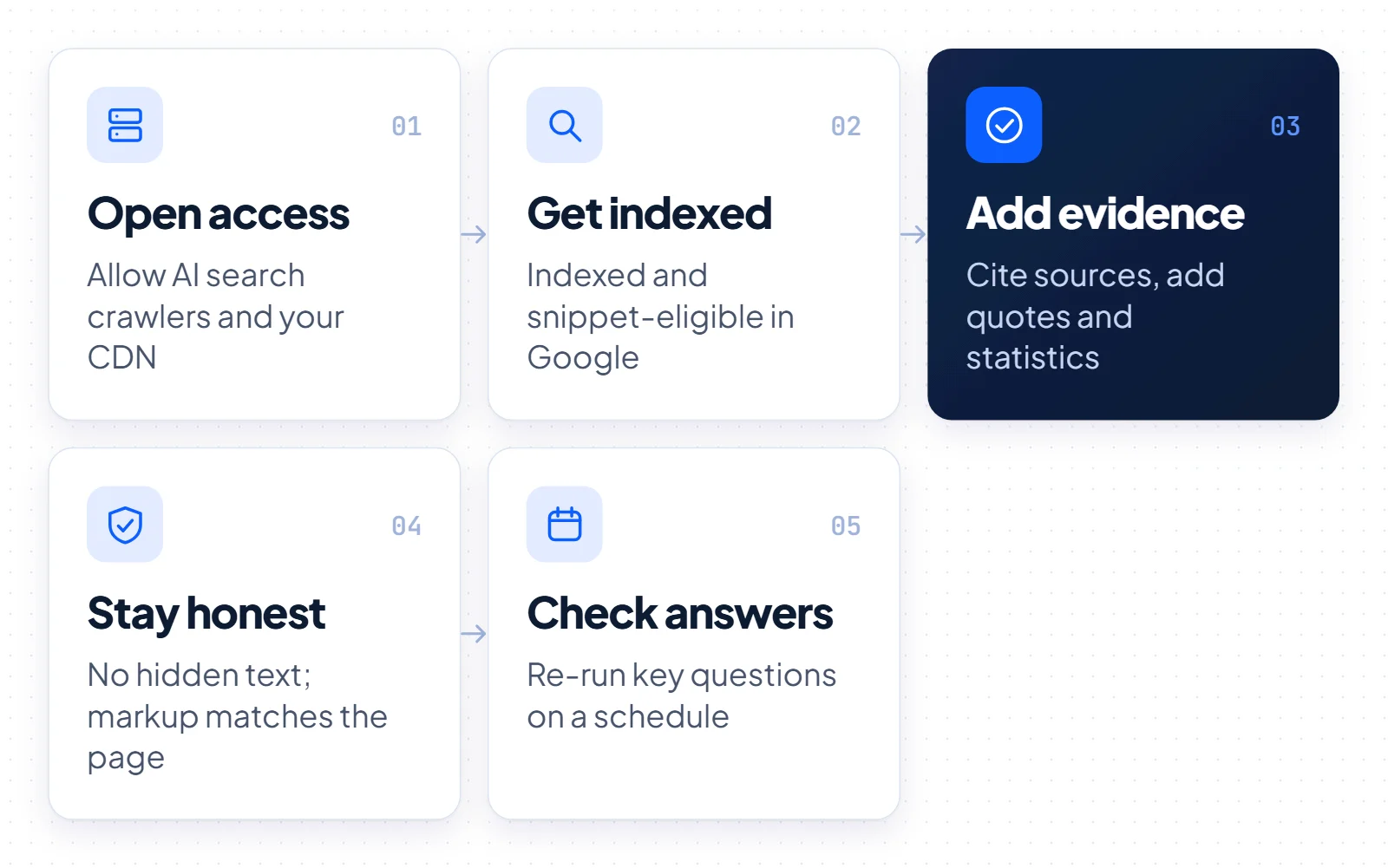
- Allow the search crawlers. Check robots.txt for OAI-SearchBot, Claude-SearchBot and PerplexityBot. Google’s best practices also ask that crawling be allowed in robots.txt “and by any CDN or hosting infrastructure,” since a firewall can block what robots.txt permits.
- Get indexed and stay eligible for snippets. “There are no additional requirements to appear in AI Overviews or AI Mode, nor other special optimizations necessary,” Google’s AI features page states. Fix indexing, internal links and page experience first.
- Cite sources, add quotations and add statistics. According to the GEO paper, these three methods “achieved a relative improvement of 30-40% on the Position-Adjusted Word Count metric and 15-30% on the Subjective Impression metric.” Cite Sources lifted visibility for the site ranked fifth in search results by 115.1%, while the top-ranked site lost 30.3% on average.
- Write fluently and simply. In the same study, Fluency Optimization and Easy-to-Understand raised visibility by 15–30%, and combining Fluency Optimization with Statistics Addition beat any single strategy by more than 5.5%.
- Skip keyword stuffing and puffed-up tone. The GEO authors found that keyword stuffing offers “little to no improvement on generative engine’s responses,” and an authoritative, persuasive tone produced no significant improvement.
- Keep structured data honest. Google’s AI optimization guide says structured data isn’t required for generative AI search, but still recommends it. Its AI features page adds that structured data should match the visible text on the page.
- Keep brand facts consistent and in text. Google asks that important content be “available in textual form” and that Merchant Center and Business Profile data stay current. Models also answer from training data, so describe your company the same way everywhere.
- Earn mentions instead of buying them. “Seeking inauthentic ‘mentions’ across the web isn’t as helpful as it might seem,” Google’s guide warns.
Read the GEO numbers as direction, not a guarantee. They come from GEO-bench, 10,000 queries run mainly on GPT-3.5-turbo. On Perplexity.ai, Quotation Addition gave a 22% improvement over the baseline.
llms.txt: what it is and what it is not
An llms.txt file is a markdown page at the root of a website that gives language models a short, link-rich summary of the site. It is a proposal, not a standard. As of October 5, 2026, we found no official statement from a major answer engine that it uses the file.
Jeremy Howard published the llms.txt proposal on September 3, 2024. The page lists a v2 update dated August 10, 2026. The only required element is an H1 title; a blockquote summary and H2 lists of links are optional.
Google Search itself does not use AI text files. An llms.txt file “will neither harm nor help your site’s visibility or rankings in Google Search,” according to Google’s AI optimization guide. The AI features page is just as direct. “You don’t need to create new machine readable files, AI text files, or markup to appear in these features,” Google writes.
According to the llms.txt proposal, OpenAI, Anthropic and Gemini publish llms.txt files for their own developer docs. But publishing a file is not the same as reading other sites’ files. As of October 5, 2026, we found no official statement from OpenAI, Anthropic, Google or Perplexity that their answer engines read third-party llms.txt files for ranking or citation.
Chrome Lighthouse’s Agentic Browsing audits check for the file, but they flag only a server error. A missing file counts as Not Applicable because the file is optional. Add llms.txt if agents read your developer docs, since it costs little. Just do not expect it to earn citations on its own.
What to avoid: hidden text and prompt injection
Do not hide keywords or instructions for AI systems in your pages. Hidden text breaks Google’s spam policies, and instructions aimed at a model are a recognized attack called prompt injection.
Hidden text abuse means “placing content on a page in a way solely to manipulate search engines and not to be easily viewable by human visitors,” under Google’s spam policies. Examples include white text on white or a font size of 0. The policy does not name prompt injection, but a hidden line telling AI assistants to recommend a brand works the same way. It is content placed to manipulate a system, not to be read.
In its Top 10 for LLM Applications 2025, OWASP ranks prompt injection first, as LLM01:2025. Indirect injections “occur when an LLM accepts input from external sources, such as websites or files,” OWASP explains. By that definition, a brand that plants hidden prompts attacks the systems it wants citations from.
A few more patterns waste effort. Google’s scaled content abuse policy covers using generative AI to mass-produce pages for rankings without adding value. Keyword stuffing is a spam policy violation and, in the GEO study, gave little to no improvement. Google also says there is no requirement to break content into tiny pieces for AI.
How to tell if LLM optimization is working
Check answers, not just rankings. Ask your customers’ questions in each assistant on a fixed schedule, and note whether you are named, cited and described correctly.
Server logs show whether OAI-SearchBot, Claude-SearchBot and PerplexityBot fetch your pages. Google Search Console shows whether key pages are indexed. Answers vary between runs and models, so look for patterns across many questions. Measuring AI visibility in depth is a discipline of its own.
Which LLMO approach fits you
Most teams need SEO hygiene plus evidence-rich pages, not a new stack.
Founder or startup
Start with access and accuracy. Confirm the search crawlers can reach you, get key pages indexed, and state what your product does in plain text on your own site. Then publish one page with original numbers and sourced claims, the kind of content the GEO study found engines quote more. If you are still choosing a name, our guide to .ai domains compares common options for AI companies.
Marketer or agency
Audit crawler access, rework pages with citations, quotations and statistics, and track a fixed question set over time. Avoid promising citations from llms.txt or hidden prompts, because none of the sources above supports either.
Choosing a name
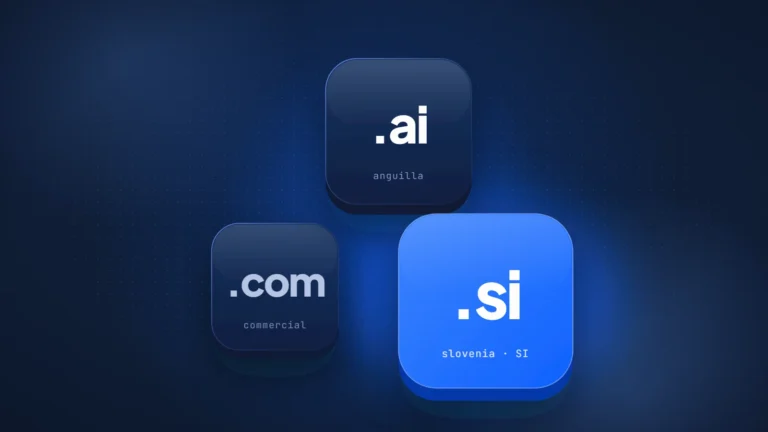
An agency that builds an LLMO practice also needs a name that says what it does. .si is Slovenia’s country-code domain. For AI companies it reads as SuperIntelligence. That reading is our framing, not an official meaning. Our explainer on what superintelligence is covers the concept itself.
A name like llmo.si spells the discipline’s acronym in four letters, while aivisibility.si names the outcome clients track. Our notes on premium domain names explain what makes a name worth paying for. No domain name earns citations on its own. That work comes from the methods above.