What is DNSSEC? DNSSEC (Domain Name System Security Extensions) adds digital signatures to DNS records. A resolver can then verify that an answer came from the domain’s real zone and was not altered on the way. It authenticates DNS data and protects its integrity. It does not encrypt anything.
The standard is two decades old. The IETF published the core specifications, starting with RFC 4033, in March 2005, and the DNS root zone has carried signatures since July 15, 2010. On October 11, 2026, the root completed its second key rollover as planned, according to IANA; the first was in 2018. Adoption at the domain level still lags, and our own check below shows by how much.
What is DNSSEC? How the chain of trust works
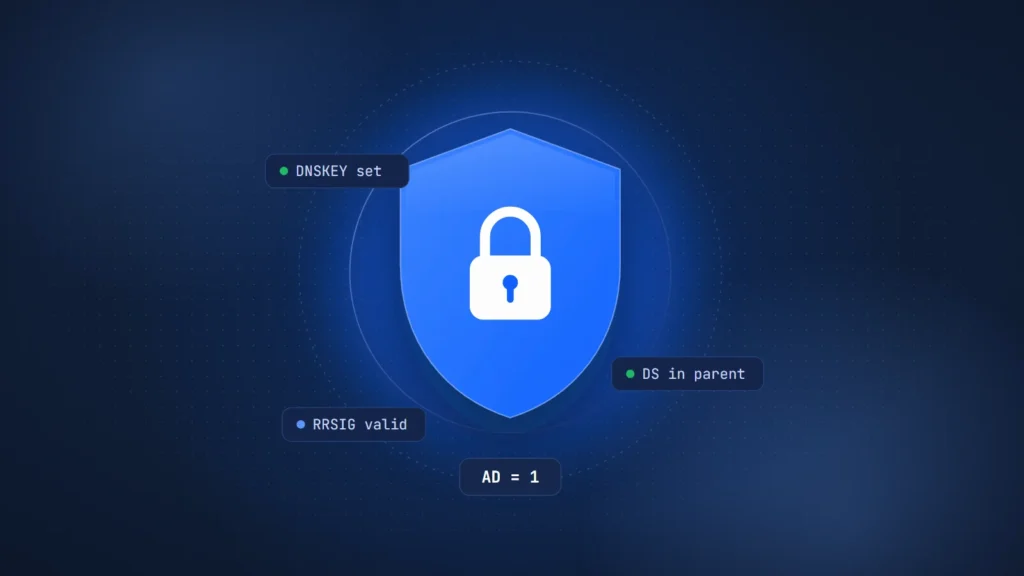
DNSSEC works as a chain of trust. Each zone signs its own records with a private key. The parent zone vouches for that key by publishing a DS record, a hash of the child zone’s key. A validating resolver starts at the root, whose key it already trusts, and follows those links down to your domain.
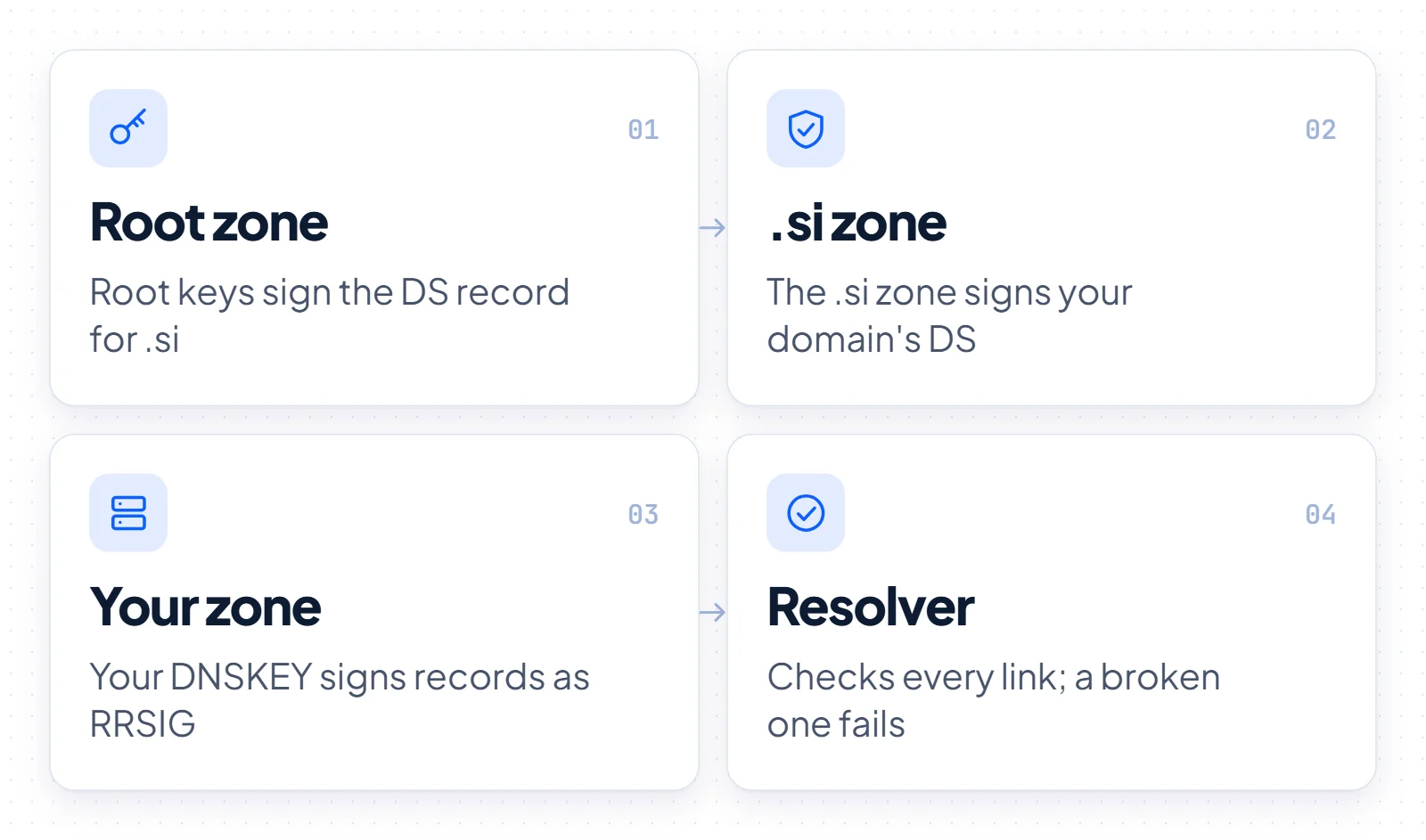
RFC 4033 introduced four record types that make this work:
- DNSKEY holds a zone’s public keys. Many zones use two: a key-signing key (KSK) and a zone-signing key.
- RRSIG holds the signature over a set of records, such as all address records for one name. It contains signatures, not keys.
- DS (Delegation Signer) is a hash of the child zone’s KSK, published in the parent zone. It is the link between two levels.
- NSEC is signed proof that a name does not exist. NSEC3, defined in RFC 5155 in March 2008, does the same with hashed names, which makes it harder to list every name in a zone.
Take a lookup for a .si name. The resolver uses the root’s trusted key to verify the root’s signed DS record for .si, then checks that the .si zone’s DNSKEY matches that DS. It repeats the step one level down: the .si zone’s signed DS record for your domain must match your DNSKEY. Finally, it uses your key to check the RRSIG on the record requested. If every link holds, the resolver marks the answer as authenticated with the AD flag.
If one link breaks, the resolver returns a failure instead of an answer. That strictness is both the point and the risk. An unsigned domain resolves normally, but a signed domain with a bad signature becomes unreachable for everyone behind a validating resolver.
What DNSSEC protects against, and what it does not
DNSSEC protects against forged DNS answers, such as cache poisoning, where an attacker tricks a resolver into storing a false record. It does not encrypt DNS traffic, does not stop denial-of-service attacks and does not help when an attacker controls the registrar account behind a domain.
Cache poisoning turned into a mainstream worry in 2008, when the Kaminsky bug (CVE-2008-1447) showed how practical the attack was against recursive resolvers. That disclosure became a common argument for signing. The standard itself states the limits: RFC 4033 says DNSSEC offers no confidentiality “due to a deliberate design choice” and does not protect against denial of service.
| Threat | Does DNSSEC stop it? | What helps instead |
|---|---|---|
| Cache poisoning of a resolver | Yes, for users of a validating resolver | DNSSEC signing plus validation |
| DNS answers altered between DNS servers and a validating resolver | Yes, the signature no longer matches | DNSSEC signing plus validation; DNS over TLS or HTTPS for the last hop to your device |
| Eavesdropping on DNS queries | No, DNSSEC does not encrypt | DNS over TLS (RFC 7858) or DNS over HTTPS (RFC 8484) |
| Denial-of-service attacks | No | Capacity and DDoS protection at the DNS host |
| Registrar account takeover | No, the attacker can change NS and DS records | Registry lock and multi-factor authentication |
| Lookalike phishing domains | No, a lookalike domain can be signed too | Brand monitoring and defensive registrations |
The registrar gap is not theoretical. Cisco Talos documented the Sea Turtle DNS hijacking campaign on April 17, 2019. It compromised at least 40 organizations across 13 countries, and Talos recommended registry lock and multi-factor authentication. In our reading, whoever holds your registrar login can replace your name servers and DS record together, and the chain then vouches for their keys. Our guide to domain hijacking and registry lock covers that defense.
Who signs their domains: our November 2026 check
Only 5 of 30 major AI and big-tech domains had a DNSSEC DS record in the BuySI Domains check on November 4, 2026. All 11 top-level domains we tested were signed. The same check found 5 of 30 well-known Slovenian .si websites signed, and 0 of the 16 .si names BuySI Domains lists for sale. The data comes from Google Public DNS, which showed whether each parent zone held a DS record.
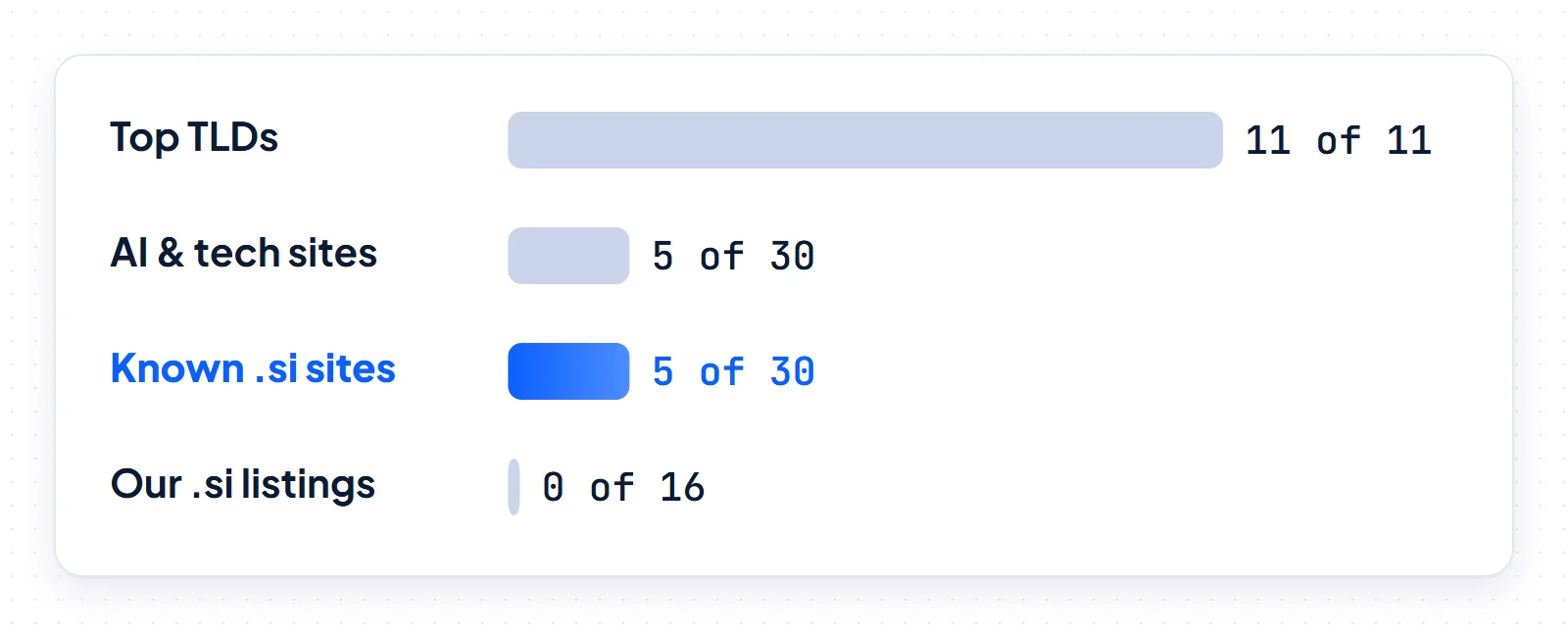
The TLD level is complete: .com, .ai, .si, .io, .co, .me, .org, .net, .app, .dev and .inc all have a DS record in the root zone and return validated answers. The gap sits one level down, where each domain holder has to opt in.
Among the 30 AI and big-tech names, the signed five were huggingface.co, elevenlabs.io, scale.com, databricks.com and cloudflare.com. The unsigned 25 include openai.com, anthropic.com, x.ai, mistral.ai, perplexity.ai, google.com, microsoft.com, apple.com, amazon.com and github.com. Even 5 of 30 is above the wider market. Verisign reported on August 10, 2023, that 4.2% of .com domains and 5.1% of .net domains were signed.
Our sample of 30 well-known Slovenian .si websites covered government, the registry, banks, retailers, media and universities, and 5 of 30 were signed. As for our own listings, 0 of the 16 .si names BuySI Domains lists for sale are signed today. They are parked, and the new owner’s DNS host signs them after transfer, which is the right order for a name about to change hands.
DNSSEC and .si domains
.si domains can use DNSSEC: Register.si deployed DNSSEC for .si on December 1, 2011, and completed the chain of trust to the root on December 24, 2011. Signing an individual .si domain is optional, and the domain holder turns it on through their registrar or DNS provider. According to APNIC Labs data for November 2, 2026, about 61% of users in Slovenia fully validate DNSSEC, against about 40% worldwide.
Validation is unusually common in Slovenia. Register.si notes that Arnes recursive resolvers have validated since June 2011. For a signed .si domain, that cuts both ways: more visitors get the protection, and more visitors lose access if a signature breaks.
We found no public count of signed .si domains from Register.si. Our sample of 5 of 30 well-known Slovenian sites is the closest public signal we know of, and it suggests signing is far from the norm among prominent .si sites. If you hold a .si name, your domain registrar or DNS provider is the place to turn it on.
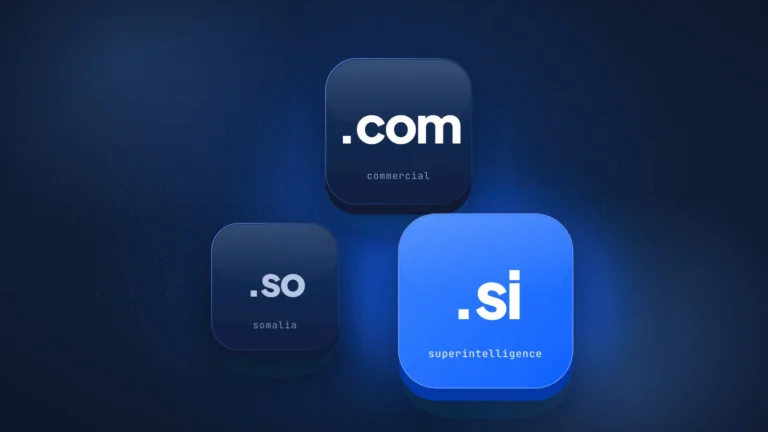
.si is Slovenia’s country-code domain. For AI companies it reads as SuperIntelligence. Our guide to the .si domain covers the extension in more depth.
The name kyberit.si borrows “Kyber”, the post-quantum algorithm that NIST standardized as ML-KEM in 2024. A name like that sets an expectation that the DNS behind it is signed. BuySI Domains lists kyberit.si for sale.
What are the downsides of DNSSEC? Why many big domains skip it
The main downside of DNSSEC is fragility. A signing mistake does not degrade quietly: validating resolvers refuse to answer, and the domain vanishes for their users. Key rollovers, DNS host changes and software bugs all create chances for that mistake.
Slack learned this on September 30, 2021, during its third attempt to enable DNSSEC on slack.com. A bug in how Amazon Route 53 handled wildcard records with NSEC led resolvers to cache false “no such record” answers. Slack’s engineering write-up says the outage hit less than 1% of its online users and lasted 24 hours.
Randy Bush offered one explanation for the gap on the bind-users mailing list on August 1, 2022. His guess was that big operators “see dnssec as fragile” and measure DNS outages in thousands of dollars a minute. That is one engineer’s view, not a survey, but it fits the pattern in our check.
Validation itself has had flaws. KeyTrap (CVE-2023-50387), disclosed in February 2024, let a single DNS packet stall validating resolvers for between about 1 minute and 16 hours, according to the ATHENE researchers. Patches were out by February 13, 2024.
The counterweight is automation. Many managed DNS hosts offer signing as a single setting with automatic key rollovers, and CDS and CDNSKEY records let a DNS host signal DS updates to the parent. The root itself rolled its key on October 11, 2018, and again on October 11, 2026. What remains risky is manual key handling and moving between providers, covered next.
How to check and enable DNSSEC
Checking takes a minute, and enabling usually means changing a few settings at your DNS host and registrar. Follow these steps in order.
- Check the TLD. Nearly every major TLD is signed. All 11 we tested on November 4, 2026, including .si, .com and .ai, had a DS record in the root.
- Check your domain. Run
dig DS example.si. A DS record in the answer means the parent zone vouches for your key; no DS record means there is no chain of trust, because the domain is either unsigned or signed but not yet linked to its parent.dig +dnssec example.sishows the RRSIG records, and the AD flag from a validating resolver confirms the full chain. - Use a visual checker. DNSViz draws the chain from the root to your domain and marks any broken link.
- Turn on signing at your DNS host. The host creates the keys and signs the zone. Prefer a host that rolls keys automatically.
- Publish the DS record. Add the DS record your host gives you at your registrar. Some hosts automate this step, so ask whether your registry accepts automatic updates.
- Verify, then re-check after changes. Test again with DNSViz once the DS appears, and again after every change of DNS host.
Once your zone is signed, the protection extends to the records your mail depends on. MX and DMARC records are ordinary DNS records, so a signed zone protects them for validating resolvers.
DNSSEC when a domain is sold or moves to a new DNS host
A DS record that points to keys nobody uses anymore breaks the domain on every validating resolver. RFC 6781 describes two safe paths when you change DNS operators. If the old and new operators cooperate, the old operator pre-publishes the new keys so both sets validate during the switch. If they do not, the registry removes the DS record first, and the domain runs without DNSSEC protection during the change. The holder adds the new DS once the new host signs the zone.
Register.si gives the same warning from the other side: switching DNSSEC off at the DNS host without removing the DS breaks resolution for validating users. This matters when you buy a domain. After the domain transfer, which starts with the EPP code, the new owner’s DNS host signs the zone and the new DS goes in. Buying a parked, unsigned name keeps that sequence simple.
Do you need DNSSEC? Who should sign now and who can wait
Most domains benefit from DNSSEC once a DNS host manages the signing and someone on your team owns it. The decision turns on how you run your DNS, not on how famous the domain is.
Sign now if your DNS host offers managed signing with automatic key rollovers and you have no DNS move planned. The same applies to names built around security, finance or public services, and to sites with many visitors in high-validation countries such as Slovenia.
Wait until the move is done if you are about to change DNS hosts, sell the domain or complete a purchase. Sign once the new host runs the zone, which avoids the DS handover that RFC 6781 describes for moves between DNS operators.
Fix ownership first if your DNS is complex, spread across providers or managed by hand, and nobody is responsible for keys. Slack’s outage shows how one edge case can make a domain unreachable for some users for a full day.
In every case, secure the registrar account first. Registry lock and multi-factor authentication cover the attack DNSSEC cannot, and they carry no outage risk.