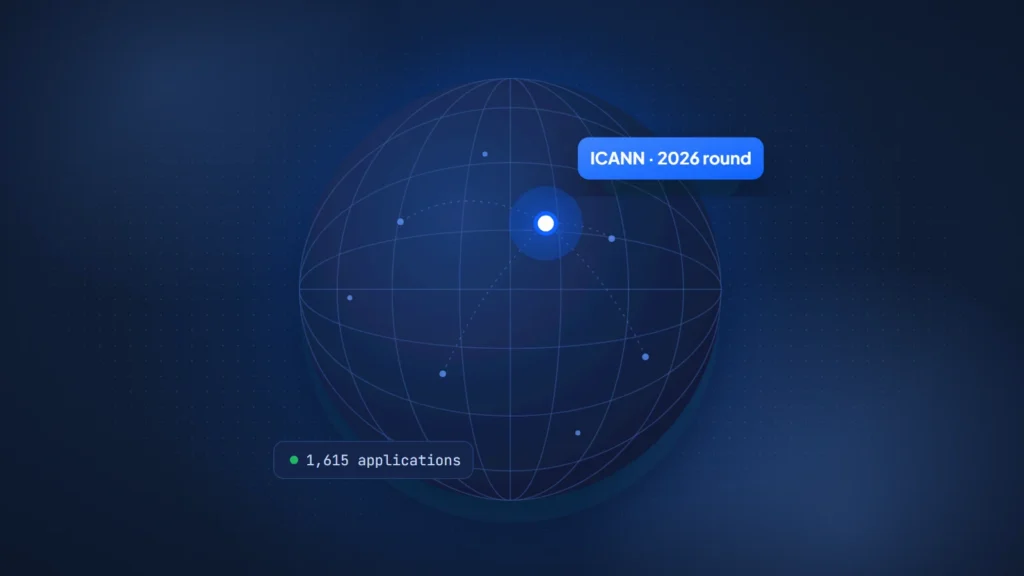
A new gTLD is a generic top-level domain added to the internet’s root through ICANN’s New gTLD Program. That is how .app and .xyz arrived after the 2012 round. The 2026 round is the first application window since 2012, and no string from its 1,615 applications can be registered yet.
ICANN made the applications public on October 7, 2026. Meta applied for .superintelligence as an open registry. At 17 characters, .superintelligence is the longest ASCII string among the round’s active primary applications. ICANN gives no launch date for it. The most contested AI string, .agent, drew 13 applicants, including Google, Meta and OpenAI.
This guide covers the 2026 numbers, what the AI labs applied for and when anything could go live. It ends with a comparison of .superintelligence and .si, Slovenia’s two-letter country-code domain.
What is a new gTLD?
A new gTLD (new generic top-level domain) is an extension approved through ICANN’s application program, not one created in the early days of the internet. Legacy gTLDs include .com, .org and .net. New gTLDs from the 2012 round include .app, .xyz and .online. ICANN’s statistics list that round at 1,930 applications and 1,241 delegated TLDs.
Generic TLDs differ from country-code TLDs (ccTLDs). A ccTLD is a two-letter extension tied to a country or territory and run under local rules, such as .de for Germany or .ai for Anguilla. ICANN reserves all two-letter ASCII strings for country codes, which is why no one could apply for .ai or .si in 2026. Our guide to country-code domains explains how ccTLDs work.
The 2012 numbers need one term explained. Delegation is the final step, when a TLD is added to the internet’s root zone so that names under it can work. ICANN’s program statistics, updated August 31, 2026, also list 653 withdrawn applications. Of the signed registry agreements, 494 include Specification 13, the clause for .brand TLDs.
Usage of those TLDs is uneven. ICANN’s monthly registry reports for June 2026 show 9,153,912 .xyz names, 7,433,320 .top names, 3,963,748 .online names and 1,478,674 .app names. Many brand TLDs went the other way. ICANN’s termination page lists about 150 TLDs whose operators gave notice to end their contracts, mostly brands such as .mcdonalds, .intel and .volkswagen.
New gTLD applications in the 2026 round: the numbers
The 2026 new gTLD round received 1,615 applications from 481 applicants. The figures come from ICANN’s Reveal Day announcement and its application statistics for October 7, 2026. More than half of the applications, 891 of them, compete with at least one other applicant for the same string. Brand applications account for 333.
The application window ran from April 30 to August 12, 2026. ICANN counted 1,663 submissions, and 1,616 proceeded after payment. ICANN’s Reveal Day announcement and statistics page give these figures:
- 1,615 applications from 481 applicants.
- 333 brand applications, plus 16 community, 15 geographic and 21 internationalized (IDN) applications.
- 51 applications requesting Applicant Support, ICANN’s fee-reduction track.
- By region: North America 864, Europe 506, Asia/Australia/Pacific 218, Africa 16, Latin America and the Caribbean 11.
Our own count of ICANN’s application export found 986 unique strings (buysidomains.si analysis of ICANN’s Reveal Day data, October 17, 2026). ICANN’s contention file groups 891 applications into 263 identical-string contention sets. A contention set is a group of applicants for the same string, and only one of them can win it.
Two rules have changed since 2012. The first is the price: ICANN’s fee FAQ says the evaluation fee is expected to be $227,000 per application, up from $185,000 in 2012.
The second is contention. ICANN’s 2026 auction rules ban every form of private resolution of contention sets, including private auctions. In 2012, only 16 of 234 contention sets went to an ICANN auction, and most of the rest settled privately. In 2026, a contested string goes either to Community Priority Evaluation or to an ICANN ascending-clock, second-price auction. In that auction, the price rises round by round until one bidder remains.
What is a brand TLD? Open, brand and community new gTLDs
Every 2026 application follows one of three models: open, brand or community. The model decides who may register names under the TLD. For founders, that matters more than the string itself.
- Open (generic) TLD: the registry sells names to the public through registrars, under its own policies. .app and .xyz work this way.
- Brand TLD (.brand): under Specification 13, only the operator, its affiliates or its trademark licensees may register names. The string must be a trademark, not a generic word.
- Community TLD: the applicant claims to represent a defined community and can request Community Priority Evaluation, which can win a contested string without an auction.
The AI applicants show the split. Meta Registry Holdings, a Meta Platforms subsidiary, filed 18 applications. Twelve are brand strings, such as .facebook, .instagram, .whatsapp and .llama. The other 6 are non-brand strings, including .agent, .metaverse and .superintelligence. OpenAI applied for 15 strings, 5 of them brand (.openai, .chatgpt, .codex, .gpt and .oai). Anthropic filed two brand applications, .anthropic and .claude. Open Agent Registry filed a community application for .agent.
“Open” in an application does not mean open to everyone on equal terms. Meta’s non-brand applications describe a namespace “open to any eligible registrant who has an affinity with this term”. Eligibility rules, prices and launch phases are not final. They can change before any registry contract is signed.
Meta’s .superintelligence application, explained
Meta applied for .superintelligence as an open, non-brand TLD. As of October 17, 2026, Meta is the only active applicant for the string. The application, MRHL2653T-T55386, sits in Pre-Evaluation Processing, like all 18 of Meta’s filings.
The string .superintelligence is 17 characters long. That makes it the longest ASCII string among the active primary applications of the 2026 new gTLD round. The next longest is .registeredagent, at 15 characters. Because the application is non-brand, the stated plan is a public namespace, unlike Meta’s closed brand applications for .facebook and .instagram.
One detail confused early coverage. Radix, a registry operator, listed .superintelligence only as a replacement string for its .fintech application. A replacement string is a backup an applicant names in case its first choice fails. ICANN’s system shows that record as deactivated, and .superintelligence does not appear in the Reveal Day contention file.
Domain Name Wire reported on October 7, 2026, that the Radix application is void. Contention could still arise later, from string-similarity checks or from objections after String Confirmation Day on November 17, 2026. Applying does not guarantee that Meta will operate the TLD.
Meta has given no public reason for the application. The context is public, though. Meta published an essay titled “Personal Superintelligence” in July 2025, and its AI research group carries the name Meta Superintelligence Labs. Our profile of Meta Superintelligence Labs covers the group behind the name.
The AI strings: who applied for .agent, .agi and the rest
The .agent string is the most contested AI string of the 2026 new gTLD round, with 13 applicants including Google, Meta and OpenAI, according to ICANN’s Reveal Day data. Domain Name Wire ranks .agent tied for first with .lab and .labs combined, which drew 7 and 6 applications.
The 13 .agent applicants are Charleston Road Registry (Google), ECHO Domain Co, Elegant Leader Ltd, FireLabs Capital, Internet Land & Cattle, Intercap Registry, Ipollo Tech, Meta Registry Holdings, Open Agent Registry, OpenAI OpCo, Rein Check LLC, Radix and XYZ.COM. OpenAI says it would run .agent on an open registration model. Google likewise says it intends an open registry. If the community application does not prevail and more than one applicant remains, the string goes to an ICANN auction. Private settlements are banned in 2026.
| String | Applicants | Type | In contention? |
|---|---|---|---|
| .superintelligence | 1: Meta (Radix backup deactivated) | Open, non-brand | No |
| .agent | 13, incl. Google, Meta, OpenAI | Non-brand (one community) | Yes, 13 |
| .agi | 7, incl. OpenAI | Non-brand | Yes |
| .asi | 5, incl. OpenAI | Non-brand | Yes |
| .mcp | 5, incl. Google, OpenAI | Non-brand (Google’s is community) | Yes |
| .gpt | 3, incl. OpenAI (brand) | Mixed | Yes |
| .intelligence | 3, incl. Google | Non-brand | Yes |
| .model | 3, incl. OpenAI | Non-brand | Yes |
| .llm | 2 | Non-brand | Yes |
| .robot | 9 | Non-brand | Yes |
| .openai, .chatgpt, .codex, .oai | OpenAI | Brand | No |
| .claude, .anthropic | Anthropic | Brand | No |
| .gemini, .deepmind | Brand | No | |
| .copilot | Microsoft | Brand | No |
| .llama, .metaai | Meta | Brand | No |
Source: ICANN Reveal Day data and contention file, October 7, 2026. Contention means an identical-string set before String Confirmation Day.
Some obvious AI strings drew no application, including .nvidia, .bot, .llms and .agents. And .ai cannot appear in this list, since two-letter strings belong to country codes. Our guide to the .ai domain explains how Anguilla’s extension works.
Some sellers already offer “.agent” names. Those names live on alternative naming systems outside ICANN’s root. They do not resolve in standard browsers without extra software, and they have nothing to do with the 2026 round.
When can you register a new gTLD from the 2026 round?
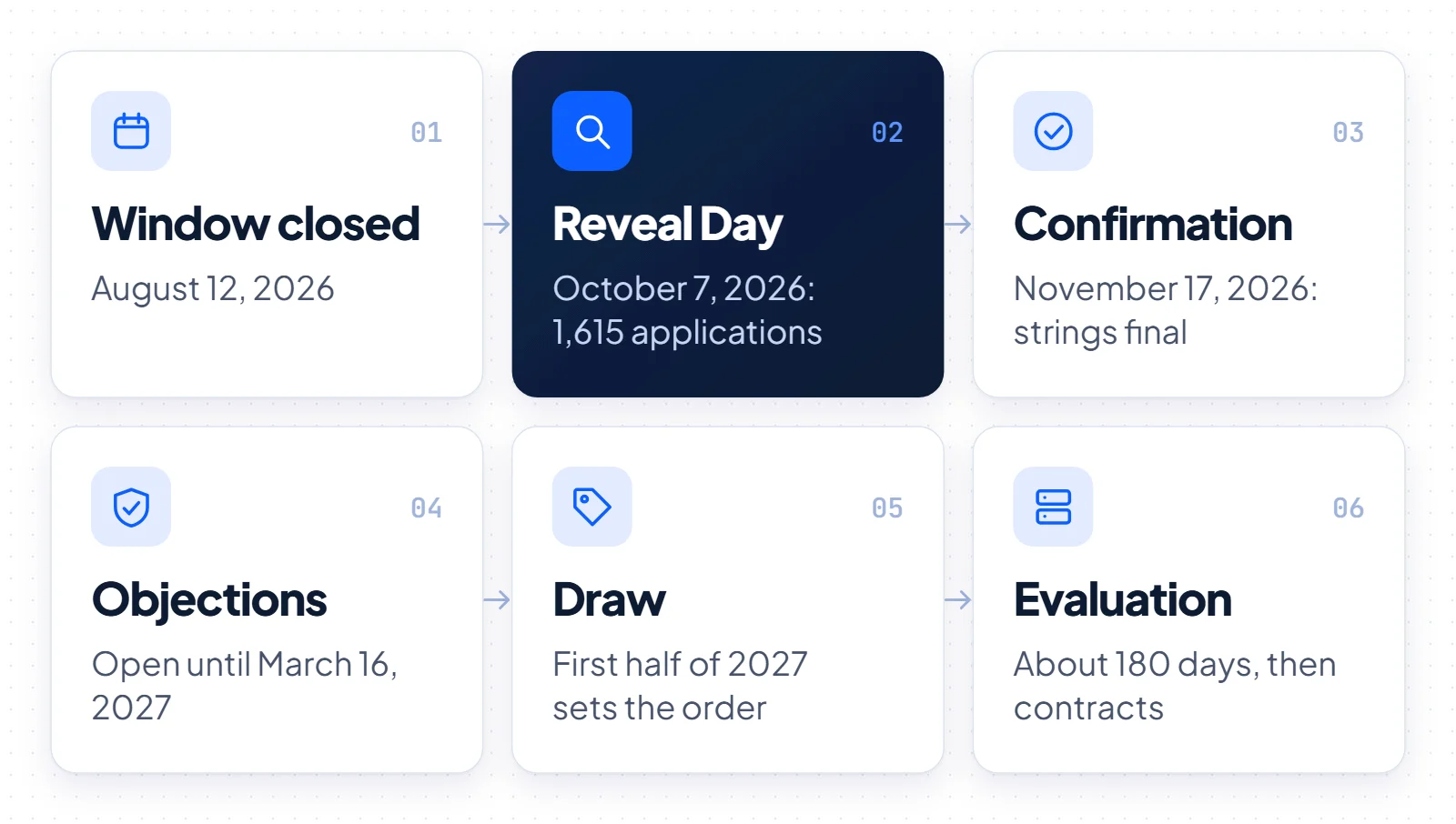
No 2026-round TLD can be registered before 2027, and as of October 17, 2026, ICANN has not published a delegation or launch date for any of them. Before a registry can sign a contract, an application must clear five gates. They are the Replacement Period, String Confirmation Day (November 17, 2026), the objection window (to March 16, 2027), a prioritization draw and about 180 days of string evaluation.
- Replacement Period: October 8–21, 2026.
- String Confirmation Day: November 17, 2026, when ICANN publishes the final list of applied-for strings and updated contention sets. The refund deadline follows on November 27, 2026.
- Community Input and Objections: November 17, 2026 to March 16, 2027.
- Prioritization Draw: expected in the first half of 2027, to set the processing order.
- String Evaluation: about 180 days per application, then contracting.
Law firm Traverse Legal, writing on October 8, 2026, cites an ICANN estimate of 15.5 to 16 months for a simple application. Simple means no objection and no contention. After contracting, a new registry usually opens a sunrise phase, a priority window for trademark holders, before general availability. A contested string such as .agent adds an auction, and possibly disputes, on top of that.
The .web precedent shows how long a contested string can take. According to Wikipedia’s account, Nu Dot Co, backed by Verisign, won .web at an ICANN auction in July 2016 for $135 million. The string was added to the root only on July 23, 2026, a decade later. By the same account, general availability is expected in the first quarter of 2027 or earlier.
.superintelligence vs .si: 17 letters later or 2 letters now
The .si extension is Slovenia’s country-code domain. For AI companies it reads as SuperIntelligence. That reading is a framing, not an official meaning. The practical difference is timing: .si is a two-letter extension that resolves today, while .superintelligence has 17 letters and no launch date.
| Factor | .superintelligence | .si |
|---|---|---|
| Length | 17 characters | 2 characters |
| Type | Proposed open gTLD | Slovenia’s ccTLD |
| Operator | Applicant: Meta Registry Holdings | Register.si (Arnes) |
| Status | Pre-evaluation, no launch date | Live |
| Entry cost for the operator | $227,000 evaluation fee (expected) | n/a |
| Wholesale price per name | Not published | €10 per year, excl. VAT |
| Registrations | 0 | 426,492 |
| Registrars | None | 102 |
| Earliest availability | Not before 2027 (no ICANN date) | Now |
Source: ICANN application record and 2026 fee FAQ; Register.si live counter and registrar tariff, read by buysidomains.si on October 17, 2026.
The exact-match .si name is already taken. On October 17, 2026, buysidomains.si checked Register.si’s RDAP records (RDAP is the standard lookup for domain registration data) and the live site. The domain superintelligence.si was registered on July 26, 2023, and shows a live site titled “Superintelligence”. Its owner is not public, and it is not ours. The same check shows meta.si registered since April 4, 2005, with no website.
Price is the clearest difference. Register.si charges registrars €10 per year, excluding VAT, for each .si name. Meta has published no price for .superintelligence names, and no registrar can sell them. Register.si’s counter showed 426,492 .si domains and 102 registrars on October 17, 2026, with 46,066 registered in the previous month.
Disclosure: buysidomains.si sells .si domain names, including AI-themed ones such as essai.si, so read this comparison with that in mind. For rules, prices and how the extension works, see our .si domain guide and our overview of superintelligence domains.
What to do about the new gTLD round now
The right move depends on whether you need a name or a namespace. Most founders need a name, and the 2026 round will not deliver one before 2027.
- If you need a domain this quarter, register or buy in an extension that resolves today: .com, a ccTLD such as .si or .ai, or a gTLD from the 2012 round. Waiting for .agent or .superintelligence means waiting on objections, a draw, evaluation and possibly an auction.
- If you want a .agent or .superintelligence name later, track String Confirmation Day on November 17, 2026 and the objection window to March 16, 2027. Then read each registry’s eligibility policy and sunrise rules once they are published.
- If your trademark matches an applied-for string, check ICANN’s application list now. The Community Input and Objections window closes on March 16, 2027, so take advice from a trademark lawyer before then.
- If you run a large brand, treat a .brand TLD as a multi-year project. The 2026 window closed on August 12, 2026, so a brand that did not apply must wait for a later round. Budget at least the $227,000 evaluation fee, plus a fixed ICANN fee of $6,250 per quarter under the current base registry agreement.
About 150 TLDs from the 2012 round, most of them brands, have already given notice to end their contracts, so a .brand only makes sense with a real use for it. For an AI startup choosing a name this year, the practical choice is not .superintelligence against .si. It is a live extension today against a string that may launch in 2027 or later, under policies nobody has finished writing.