Domain flipping is buying or registering domain names to resell them for more than they cost, usually without building anything on them. Some investors report profits, but the base rates are low. Commonly cited sell-through rates are 1–2% of names a year, so in any given year almost every name goes unsold while renewal fees keep running.
The question has new weight in late 2026. Verisign raises the wholesale price of a .com name from $10.26 to $10.97 a year on November 1, 2026. Slovenia’s .si registry recorded 46,066 new names in September 2026, and Domain Name Wire traced most of the resale activity to investors. This guide describes how people flip domains and what the numbers say as of October 22, 2026; it is not financial advice.
How domain flipping works
Domain flipping is the practice of registering or buying domain names in order to resell them for more than their total cost. That cost includes the purchase price, every renewal fee paid while the name waits for a buyer, and any sales commission. Most flippers never build a website on the names they hold; the name itself is the product.
Flippers acquire names in four main ways:
- Hand registration: registering an unclaimed name at the standard fee, often soon after news creates interest in a word.
- Expired names: bidding on names whose owners let them lapse, or catching them when they drop. Our guide to buying expired domains safely covers the mechanics.
- Aftermarket purchases: buying from another owner below the price the flipper expects an end user to pay.
- New or newly popular extensions: registering early in an extension that is getting attention, which is what happened with .si in 2026.
The selling side follows a fairly standard sequence:
- Pick names a business might want, and check them against existing trademarks.
- Set an asking price, ideally based on comparable public sales; our explainer on what makes a domain name valuable describes the usual factors.
- List the names where buyers look, and wait for inquiries. Marketplaces typically take a percentage commission on each sale.
- Close the deal through domain escrow, so the buyer’s money is held until the name has moved.
- Renew the names that did not sell, or let them go.
Most of the time sits between steps 3 and 4. An investor with a few hundred names spends most years renewing names nobody asked about. That is why the sell-through rate matters more than any single sale price.
Is domain flipping profitable? Why sales are rare
Some investors report profits from domain flipping, but no official statistic shows how many, and the public sell-through rates are low. Andrew Allemann of Domain Name Wire wrote on July 2, 2024 that for passive portfolios like his, “a sell-through rate of 1-2% is considered solid.” He reported his own annualized rate as 1.36% on about 2,500 names in the first half of 2024, down from 1.96% a year earlier.
On about 2,500 names, an annualized rate of 1.36% works out to roughly 17 sales in six months. The other names did not sell in that period, and their renewals still fell due. Allemann’s numbers describe one experienced investor’s books, not the whole market.
Survey data points the same way. Identity Digital, a registry operator with an interest in investor demand, ran a 2025 study that included a survey of more than 100 domain investors. As DN Journal reported on June 17, 2026, the median investor held about 100 domains, 82% sold fewer than 50 names a year, and 66% had careers outside domain investing.
Neither figure is measured market data. No registry or neutral body publishes a market-wide sell-through rate, and public sales databases miss private deals. Unsold names that quietly expire do not appear in any sales report either. Guides that lead with record sales show the visible tail of the market, not the typical outcome.
What it costs to hold names for three years
At a 1% annual sell-through rate, one sale has to cover about 100 name-years of renewals. For .si names at the €10 registry fee, that is €1,000 per sale. For .com names at Verisign’s $10.97 wholesale price, it is $1,097. Both figures exclude purchase prices, retail markups, commissions and tax (BuySI Domains calculation, October 22, 2026).
The prices behind that calculation come from three places. Register.si’s tariff for registrars sets €10 a year, excluding VAT, for each .si registration or renewal. That is the fee the registry charges registrars; the retail price a holder pays is higher and set by each registrar.
Verisign CEO Jim Bidzos said on April 23, 2026, that the .com wholesale price rises to $10.97 on November 1, 2026. Netcraft estimated on September 24, 2026, that a .ai name costs around $180 at retail for the minimum two-year registration, about $90 a year.
| Names held for 3 years | .si at registry fee (€, ex VAT) | .com at wholesale ($) | .ai at approx. retail ($) | Sales at 1% a year |
|---|---|---|---|---|
| 10 | €300 | $329 | $2,700 | Under 1 |
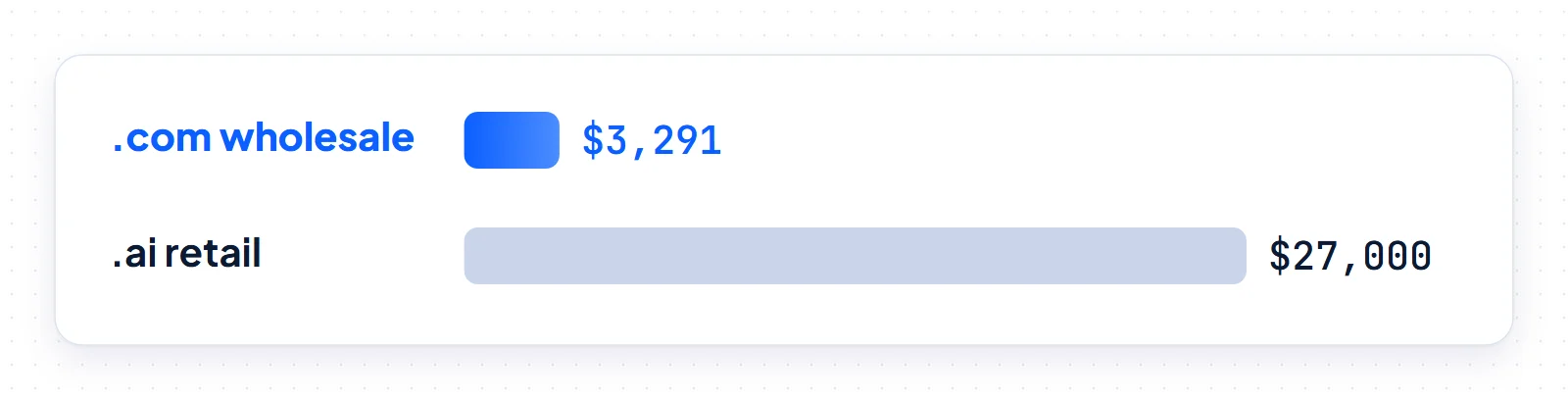
| 100 | €3,000 | $3,291 | $27,000 | About 3 |
| 1,000 | €30,000 | $32,910 | $270,000 | About 30 |
Compiled by BuySI Domains on October 22, 2026: names multiplied by the annual fee and 3 years. The table covers renewals only. It assumes no .com price change after November 1, 2026 and excludes VAT, retail markups, acquisition costs and commissions.
The .ai column annualizes Netcraft’s approximate retail price for a two-year minimum term, not a registry tariff. Because .ai names are sold in two-year terms, the actual outlay for a three-year hold is higher. The .com column is Verisign’s wholesale price alone, without ICANN’s per-year fee.
For .ai at Netcraft’s retail estimate, the single sale a year implied by a 1% rate has to cover roughly $9,000 of renewals across 100 names. At 2%, every break-even figure halves. Profit starts only after the sale also covers purchase prices, fees and the owner’s time.
This arithmetic is why experienced investors prune. Dropping names that draw no inquiries lowers the bar for the names that remain, and our guide to domain portfolio management covers how owners make those renewal decisions.
Is domain flipping illegal?
Domain flipping is legal when the names are generic or brandable and not tied to someone else’s trademark. The legal risk is bad faith. Under the UDRP, registering a name mainly to sell it to a trademark owner counts as evidence of bad faith. Under the US Anticybersquatting Consumer Protection Act, courts can award statutory damages of $1,000 to $100,000 per domain name.
ICANN’s Uniform Domain Name Dispute Resolution Policy (UDRP) sets out three things a complainant must prove under paragraph 4(a):
- the domain name is “identical or confusingly similar” to a mark in which the complainant has rights;
- the holder has “no rights or legitimate interests” in the name;
- the name “has been registered and is being used in bad faith.”
Paragraph 4(b)(i) lists one form of bad faith that matters for flippers: acquiring a name “primarily for the purpose of selling” it to the mark owner or a competitor for more than the documented out-of-pocket costs. A UDRP panel can cancel the name or transfer it to the complainant. WIPO said on January 14, 2026, that it handled “over 6,200 domain name cases” in 2025, its highest caseload on record.
In the United States, the ACPA targets anyone with a “bad faith intent to profit” from a mark. Under 15 U.S.C. §1117(d), a plaintiff may choose statutory damages of “not less than $1,000 and not more than $100,000 per domain name.” Our explainer on cybersquatting and how UDRP cases are decided walks through real disputes.
The UDRP does not cover .si. Disputes over .si names go through Register.si’s own alternative dispute resolution procedure. According to the registry’s fees page, read on October 22, 2026, a single arbiter costs €700 including VAT (€573.77 before VAT) for 1 to 5 domains, about 57 times the €10 annual registry fee.
Flipping after the 2026 .si rush
The 2026 .si rush was a wave of investor registrations in September 2026 that Domain Name Wire linked to a speech by Donald Trump. .si is Slovenia’s country-code domain. For AI companies it reads as SuperIntelligence. That reading is our framing, not an official meaning.
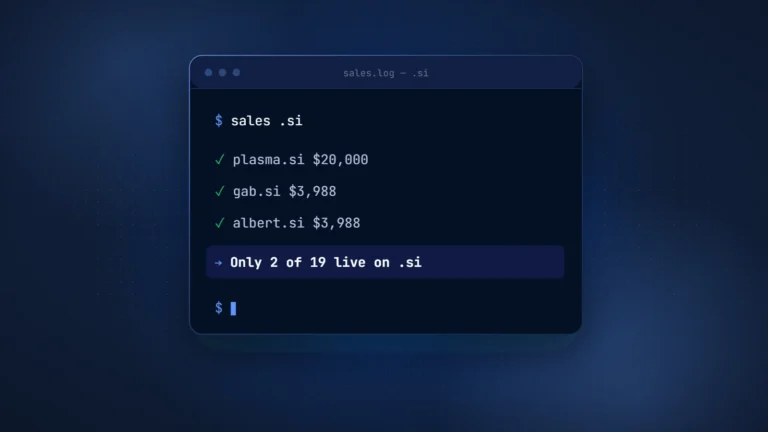
Register.si counted 444,383 .si domains at 11:58 UTC on October 22, 2026, after 46,066 new registrations in September 2026. The Slovenian Press Agency reported 3,515 new names in August. Domain Name Wire reported on October 1, 2026, that most .si aftermarket activity traced back to domain investors, and that it saw no evidence yet of adoption by actual companies.
The resale share was visible early. Netcraft reported that about 52% of the .si names it detected as registered at one registrar, Dynadot, from September 19 to 22, 2026, were listed on that registrar’s aftermarket by September 23. That figure covers one registrar and three days, not the whole .si zone.
End users have been scarce among the buyers on record. Domain Name Wire reviewed the 35 .si sales NameBio showed from January to June 9, 2026 and found only two that looked like purchases by end users. Our tracker of reported .si domain sales follows the public record since then. In its October 1, 2026 report, Domain Name Wire also noted that names “have been relisted at higher prices.”
The registry itself has stayed cautious. Register.si said, as the Slovenian Press Agency reported on September 28, 2026, that media speculation about Slovenia earning millions from the interest in .si has “no real basis” (translated). That statement was about national revenue, not about investors’ returns.
For names registered for one year, the renewal arithmetic arrives in September 2027. At the €10 registry fee alone, renewing all 46,066 September names for one year would cost €460,660 before registrar markups. Names that have not sold by then face the same break-even arithmetic as names in any other extension.
Disclosure: BuySI Domains sells .si domain names at fixed prices, so we have a commercial interest in this market.
What to check before flipping a domain
Domain flipping is a slow inventory business in which the costs are certain and the sales are not. Anyone weighing it can test a plan against five checks drawn from those numbers:
- Trademarks: search the relevant trademark registers before buying. A name that matches a brand invites a dispute, not a buyer.
- Renewals: the retail price a registrar charges, not the registry fee, is what a holder pays each year, and the table above shows how three years of it add up.
- No-sale scenario: work out what happens if a name never sells. At 1–2% a year, going unsold is the likely outcome for any single name in a given year.
- Tax: rules on domain sales differ by country, so ask a tax adviser before the first sale.
- Exit: decide in advance which names you will drop and when.
Domain flipping does not produce predictable income. The public numbers, from Allemann’s 1.36% to Identity Digital’s survey, show why most names go unsold in any given year. A useful test for any plan is whether its owner can carry the renewals through several years without a sale.