Cybersquatting is registering, trafficking in or using a domain name in bad faith to profit from someone else’s trademark. A typical case is a famous brand name held to resell to the brand owner. The two main remedies are ICANN’s UDRP, an administrative procedure, and the US Anticybersquatting Consumer Protection Act (ACPA), which runs through the courts.
Domain name disputes keep climbing. WIPO says it handled over 6,200 such cases in 2025, its highest caseload on record. People search for the topic too: “cybersquatting” draws about 900 US searches a month and 4,700 worldwide, while “udrp” draws about 350 and 1,400 (Ahrefs, October 5, 2026).
What is cybersquatting?
Cybersquatting is the bad-faith use of a domain name to profit from a trademark you do not own. Intent decides: the same string can be fair for one holder and abuse for another.
The ICANN Uniform Domain Name Dispute Resolution Policy lists four examples of bad faith in paragraph 4(b). The list is not exhaustive:
- Registering a name primarily to sell it to the mark owner for more than your documented out-of-pocket costs.
- Registering it to block the owner from the matching domain, when you have a pattern of such conduct.
- Registering it primarily to disrupt the business of a competitor.
- Using it to attract users for commercial gain by creating a likelihood of confusion with the complainant’s mark.
Owning a common word is not cybersquatting by itself. In the sting.com case, a WIPO panel denied the complaint because “sting” is a common English word and bad faith was not proven. What matters is which mark a name points to and how the holder uses it.
Types of cybersquatting
Most cybersquatting falls into three patterns: classic brand squatting, typosquatting and name squatting. Reverse domain name hijacking is the opposite abuse, where a complainant misuses the dispute process against a legitimate holder.
| Type | What it looks like | Typical remedy |
|---|---|---|
| Classic cybersquatting | An exact brand name registered to sell to the owner or to trade on its reputation | UDRP transfer or cancellation; ACPA suit in a US court |
| Typosquatting | A misspelled or slightly altered brand name that catches typing errors, often for ads or phishing | UDRP transfer; URS suspension in new gTLDs |
| Name or identity squatting | A celebrity’s or public figure’s name registered by someone with no link to the person | UDRP transfer when the name works as a mark |
| Reverse domain name hijacking (RDNH) | “Using the Policy in bad faith to attempt to deprive a registered domain-name holder of a domain name” (UDRP Rules, paragraph 1) | Panel declares the complaint an abuse of the proceeding; no money penalty |
Typosquatting overlaps with phishing. Interisle’s 2025 phishing study, covering May 2024 to April 2025, found that 77% of all domain names used in phishing attacks were maliciously registered by cybercriminals. Phishing domains rose 38% to over 1.5 million, the highest ever recorded. The study counts phishing domains in general, not typo domains alone.
Under Rule 15(e) of the Rules for UDRP, a panel that finds a complaint was brought in bad faith must declare it an abuse of the administrative proceeding. No money penalty follows.
Is cybersquatting illegal?
In the US, cybersquatting is a civil matter under the ACPA, not a criminal one: a mark owner sues, and a court can award money. The UDRP adds an administrative route for gTLDs such as .com; it can transfer or cancel the domain but cannot award damages.
Under 15 U.S.C. § 1125(d), a person is liable in a civil action by a mark owner if they have a bad faith intent to profit from the mark. They must also register, traffic in or use a domain name that is identical or confusingly similar to the mark, or dilutive of a famous mark. A court can order forfeiture, cancellation or transfer of the name.
Money is what sets the ACPA apart. Under 15 U.S.C. § 1117(d), a court can award statutory damages of “not less than $1,000 and not more than $100,000 per domain name” as it considers just. No UDRP panel can do that.
Paragraph 4(i) of the UDRP limits remedies to cancellation of the domain or its transfer to the complainant. WIPO’s guide states that a panel “cannot award money judgments, nor lawyers’ costs” and that the UDRP does not stop either party from going to court.
For new gTLDs, the Uniform Rapid Suspension System (URS) offers what ICANN calls “a lower-cost, faster path to relief” for the most clear-cut cases. The burden of proof is clear and convincing evidence. A winning complaint suspends the name for the rest of its term instead of transferring it.
This is general information, not legal advice. If you face a real dispute on either side, talk to a trademark lawyer before you file or respond.
How UDRP works, step by step
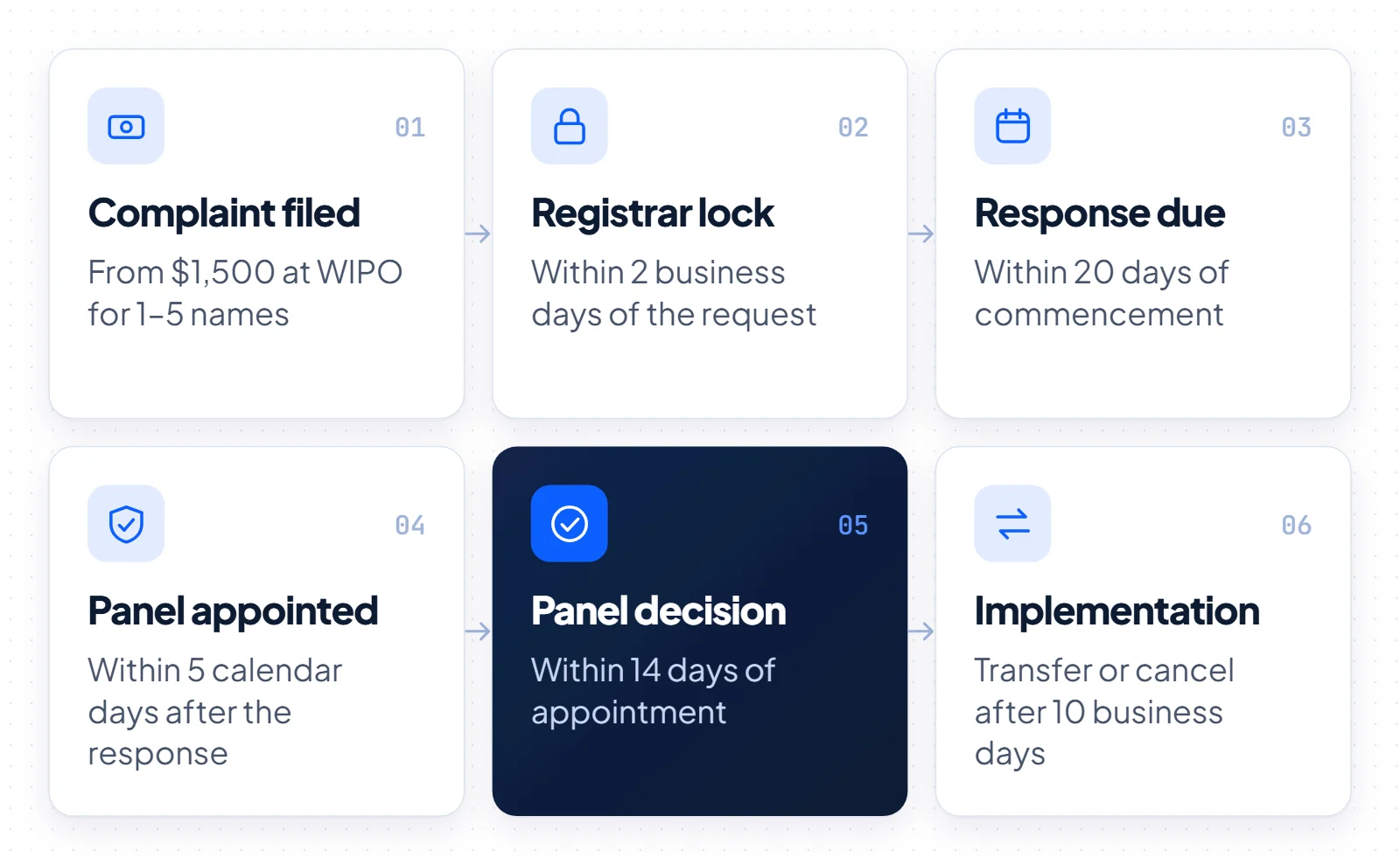
A UDRP case is an administrative procedure with fixed deadlines set by ICANN’s Rules. WIPO says a case “normally should be completed within 2 months” from the date it receives the complaint. The holder has 20 days to respond, and the registrar waits 10 business days before it transfers or cancels the name.
To win, the complainant must prove all three elements under Policy paragraph 4(a):
- “your domain name is identical or confusingly similar to a trademark or service mark in which the complainant has rights”;
- “you have no rights or legitimate interests in respect of the domain name”; and
- “your domain name has been registered and is being used in bad faith”.
The procedure then follows six steps:
- Complaint. The trademark owner files with a provider such as WIPO. The WIPO fee for 1–5 domains is $1,500 with a single panelist or $4,000 with three panelists.
- Registrar lock. The registrar verifies the details and confirms the lock within 2 business days of the request.
- Response. The holder has 20 days from the date the proceeding commences to file a response.
- Panel. A single panelist is appointed within 5 calendar days after the response arrives or the response deadline passes.
- Decision. The panel decides within 14 days of its appointment, and the provider sends the decision to the parties within 3 business days.
- Implementation. The registrar waits 10 business days before transferring or canceling the name. If the holder files a lawsuit in an eligible court and sends the registrar official proof within that window, the change is put on hold.
A recent case shows the clock in practice. In WIPO case D2025-3784 over snoopdogghome.shop, the complainant filed on September 17, 2025, and the proceeding commenced on September 23. The panel decided on November 10, 2025, about 8 weeks after filing.
Real cybersquatting cases and outcomes
In WIPO decisions, names that trade on a famous mark usually go to the complainant. Complaints over common words, or without proof of bad faith, tend to fail.
| Domain | Case | Year | Outcome |
|---|---|---|---|
| worldwrestlingfederation.com | D99-0001, the first UDRP case | 2000 | Transferred; three days after registering, the holder said he meant to sell it to the complainant, and he later asked $1,000 |
| juliaroberts.com | D2000-0210 | 2000 | Transferred; pattern of celebrity-name registrations, listed on eBay |
| sting.com | D2000-0596 | 2000 | Denied; “sting” is a common English word and bad faith was not proven |
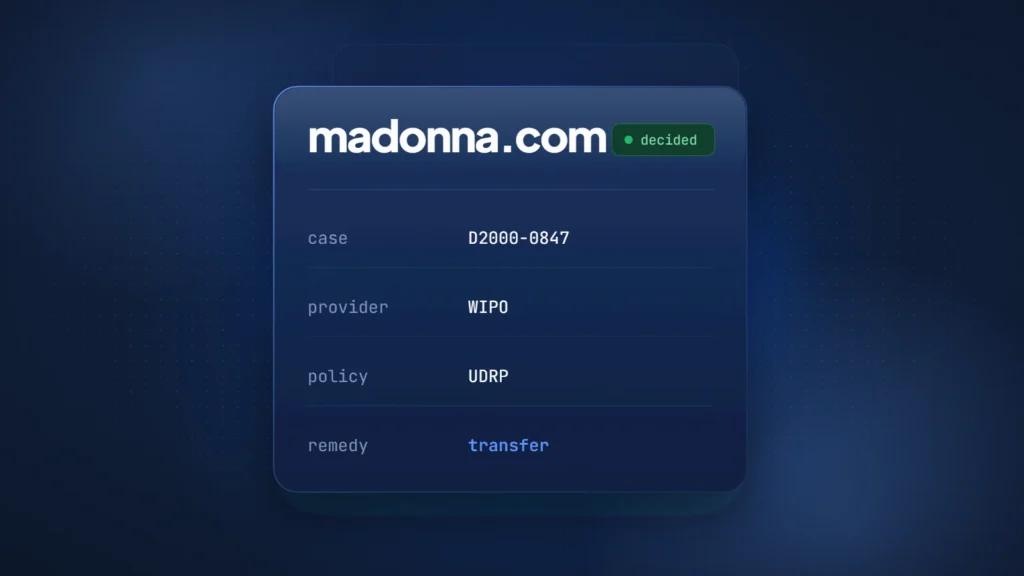
| madonna.com | D2000-0847 | 2000 | Transferred; adult site trading on the complainant’s fame |
| snoopdogghome.shop | D2025-3784 | 2025 | Transferred; counterfeit goods and impersonation, respondent defaulted |
| upscaleavenues.com | D2025-4174 | 2025 | Denied, with an RDNH finding; the complaint cited nonexistent UDRP cases |
The madonna.com panel described the use as “an intentional effort to trade upon the fame of Complainant’s name and mark for commercial gain” and ordered the transfer. In the upscaleavenues.com case, the panel suggested AI hallucinations as “the most charitable interpretation” of the invented citations.
WIPO handled a record 6,282 domain name cases in 2025, up from 6,168 in 2024, according to the WIPO case statistics page, accessed October 5, 2026. Of the 5,343 WIPO cases decided in 2025, 92.27% ended in transfer, 1.48% in cancellation and 6.25% in a denial. Settled and terminated cases are not part of those shares.
How to avoid buying a domain that invites a complaint
Before you buy an aftermarket name, check that it does not match someone else’s mark and has no dispute history. A clean name used for its own meaning gives a complainant little to work with.
- Run a trademark search. Check the name in the USPTO database, EUIPO’s eSearch plus and the WIPO Global Brand Database, in the markets where you plan to operate. Our guide to brandable domain names covers trademark checks at the naming stage.
- Check the domain’s history. Look for past disputes, old content and a transfer-prohibited status. Our domain history checklist covers WIPO’s case search and the other public tools.
- Use the name for its own meaning. A dictionary word, a coined name or your own brand used for a real product stays clear of the Policy’s bad-faith examples.
- Keep records. Save the purchase agreement, your business plan and early screenshots of use, because they show a legitimate interest if a complaint arrives.
- Pay through escrow. A domain escrow service keeps a clear record of the payment and the transfer.
For the full purchase process, from finding the owner to the transfer, see how to buy a domain that is already taken. The UDRP is not a way to buy a domain, and filing against a legitimate holder risks an RDNH finding, as the upscaleavenues.com case shows.
How brand owners can fight cybersquatting
Brand owners limit cybersquatting by watching new registrations, registering obvious variants first and acting quickly. The legal route depends on the TLD and whether you need damages.
- Monitor. Watch for new registrations that contain your mark or close misspellings, and check whether they host ads, copied content or login pages.
- Register defensively. Hold your brand in the main TLDs and in the ccTLDs of your markets, plus the most likely typos.
- Act fast. Once a UDRP complaint is filed, the registrar locks the name within 2 business days of the provider’s request, so it cannot move to a new holder while the case runs.
- Choose the route. Use the UDRP for transfer or cancellation, from $1,500 at WIPO. Use the URS for clear-cut cases in new gTLDs when suspension is enough. Use the ACPA in a US court when you need damages of $1,000 to $100,000 per domain name.
Cybersquatting disputes over .si domains
Disputes over .si domains do not go to WIPO or the UDRP. The .si domain is Slovenia’s country code; for AI companies it reads as SuperIntelligence. Its registry, Register.si, runs its own alternative dispute resolution (ADR) procedure, decided by independent arbiters. Register.si says the procedure usually takes about 2 to 3 months, with transfer or deletion as the remedies. For 1–5 domains with one arbiter, the fee is €573.77 excluding VAT, or €700 including VAT.
Under the Register.si ADR procedure guidelines, the registry works with five professionally qualified and independent external arbiters. One arbiter decides by rotation, or a panel of three on request. The complainant must show a name identical or confusingly similar to its trademark, company name or other right, and no legitimate interest of the holder.
The bad-faith test is where .si differs. Registration or use in bad faith is enough, while the UDRP requires both. On timing, the holder has 21 days to respond, the decision follows within 14 days of the arbiter’s appointment and enforcement follows 21 days later.
In a .si dispute, read the Register.si rules first. Then get advice from a trademark lawyer before you file or respond. Our complete guide to the .si domain explains how .si registration works.