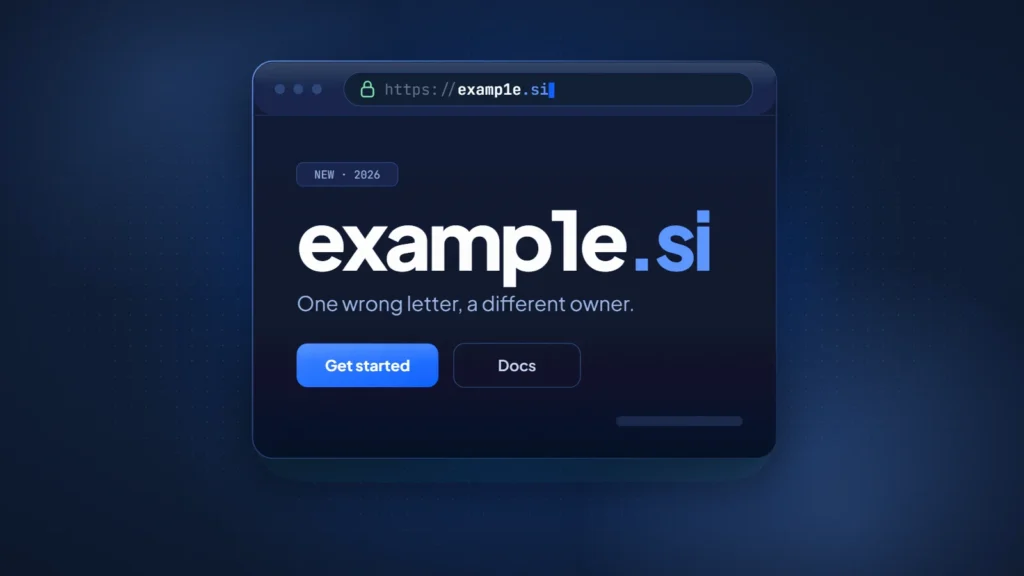
Typosquatting is the registration of a domain that differs from a real brand’s address by a likely typing mistake. Think of a dropped letter, a neighboring key, a look-alike character or the wrong extension. The squatter collects the mistyped traffic for ads, phishing, malware or resale. It is a form of cybersquatting.
The issue got sharper in September 2026. In the 25 hours after President Trump addressed the UN General Assembly on September 22, 2026, registrations of .si domains overtook .ai, Netcraft reported. The spike came amid his “super intelligence” rename of AI. Because s sits next to a on a QWERTY keyboard, every .ai brand now has a possible twin one key away. For scale, “typosquatting” gets about 5,100 monthly searches in the US and 12,000 worldwide (Ahrefs, October 17, 2026).
How typosquatting works
Typosquatting works because people type fast and rarely read an address bar closely. A visitor who mistypes a brand’s address lands on the squatter’s page instead. A 2005 arbitration panel quoted the classic definition, “the intentional misspelling of words with intent to intercept and siphon off traffic from its intended destination”.
The business model sets the danger. Parked pages earn ad income, phishing pages copy a login screen, and some names exist only to be sold back to the brand. Look-alikes also work by email, where a sender address one character off passes a quick glance.
Palo Alto Networks Unit 42 counted 13,857 squatting domains registered in December 2019, about 450 per day. Of those, 2,595 (18.59%) were malicious and 5,104 (36.57%) presented a high risk to users, according to its report of September 1, 2020. The data is dated, but it shows that more than a third of squatted names carry real risk.
What is an example of typosquatting?
The best-documented early example is googkle.com. In Google Inc. v. Sergey Gridasov, decided July 5, 2005, a National Arbitration Forum panel transferred googkle.com, ghoogle.com, gfoogle.com and gooigle.com to Google. The panel found that the sites tried to download viruses, trojan horses and spyware to visitors’ computers. Six patterns cover most cases:
| Type | How it works | Documented example | Source and date |
|---|---|---|---|
| Misspelling | An extra, swapped or neighboring letter | googkle.com and ghoogle.com for google.com | Google v. Gridasov, National Arbitration Forum, July 5, 2005 |
| Omission | A letter left out | tailspintoy.com for tailspintoys.com (illustrative brand) | Microsoft Support, accessed October 17, 2026 |
| Homoglyph or IDN | Characters that look like the real ones, including Unicode | аррӏе.com written in Cyrillic; 17 homoglyph domains that impersonated Microsoft’s Office 365 business customers | Xudong Zheng, April 14, 2017; Microsoft court order, July 16, 2021 |
| TLD swap | Same name, different extension | brand.ai and brand.si, one key apart | Netcraft, September 24, 2026 |
| Combosquatting | The brand plus an extra word | youtube-live.com; 87 .com names pairing brands with “superintelligence” | Kintis et al., ACM CCS 2017; Netcraft, October 1, 2026 |
| Bitsquatting | One bit flips in a computer’s memory | mic2osoft.com; 52,317 requests across test domains | Artem Dinaburg, Black Hat USA 2011 white paper, July 2011 |
Three rows need context. Xudong Zheng’s аррӏе.com looked identical to apple.com in Chrome and Firefox. Chrome 58 fixed the display, while Firefox left users to switch on a punycode setting themselves. Bitsquatting needs no human error: a hardware fault flips one bit during a domain lookup, or in Dinaburg’s words, “bitsquatting relies on computers to make mistakes”. Combosquats last: Kintis et al. found that almost 60% of abusive combosquatting domains stayed live for more than 1,000 days.
Is typosquatting illegal?
Typosquatting is illegal in the United States when it is done in bad faith against a trademark. The Anticybersquatting Consumer Protection Act of 1999 (ACPA) is codified at 15 U.S.C. §1125(d). It covers anyone who registers, traffics in or uses a domain that is identical or confusingly similar to a mark, with a bad faith intent to profit. Under 15 U.S.C. §1117(d), the mark owner can elect statutory damages of $1,000 to $100,000 per domain name.
Bad faith is the hinge. In Lamparello v. Falwell (2005), a federal appeals court held that using a mark in the domain of a gripe site criticizing the mark holder is not cybersquatting. The Truth in Domain Names Act of 2003 (18 U.S.C. §2252B) is narrower than often claimed. It punishes misleading domain names used to deceive people into viewing obscene material (up to 2 years). Deceiving minors into viewing harmful material carries up to 10 years. It is not a general anti-typosquatting law.
Most brand owners never go to court. Under the Uniform Domain-Name Dispute-Resolution Policy (UDRP), a complainant must prove three elements. The domain is identical or confusingly similar to its mark, and the holder has no rights or legitimate interests in it. Finally, the name was registered and is being used in bad faith. The only remedies are cancellation or transfer. The WIPO Jurisprudential Overview 3.0 settles two points for typos. Section 1.9 treats a “common, obvious, or intentional misspelling” of a mark as confusingly similar. Section 1.11.1 disregards the TLD at that step, so a different extension does not help a squatter.
The WIPO Arbitration and Mediation Center administered 6,282 domain name cases in 2025, 1.8% more than in 2024 and its busiest year since the service began 25 years ago. Among the 87 ccTLDs that use WIPO for disputes, .ai had the third-most case filings in 2025, according to WIPO’s January 14, 2026 review. National ccTLDs such as .si run their own procedures, covered below. This is general information, not legal advice.
What is the difference between typosquatting and cybersquatting?
Cybersquatting is the umbrella term: registering, trafficking in or using a domain with bad faith intent to profit from someone else’s trademark. Typosquatting is the subset that depends on mistakes, such as misspellings, neighboring keys or look-alike characters. An exact brand name registered in another extension to sell to the brand is cybersquatting. Registering googkle.com is typosquatting. A brand.si registered in bad faith next to a live brand.ai is both, because s and a sit side by side on a QWERTY keyboard.
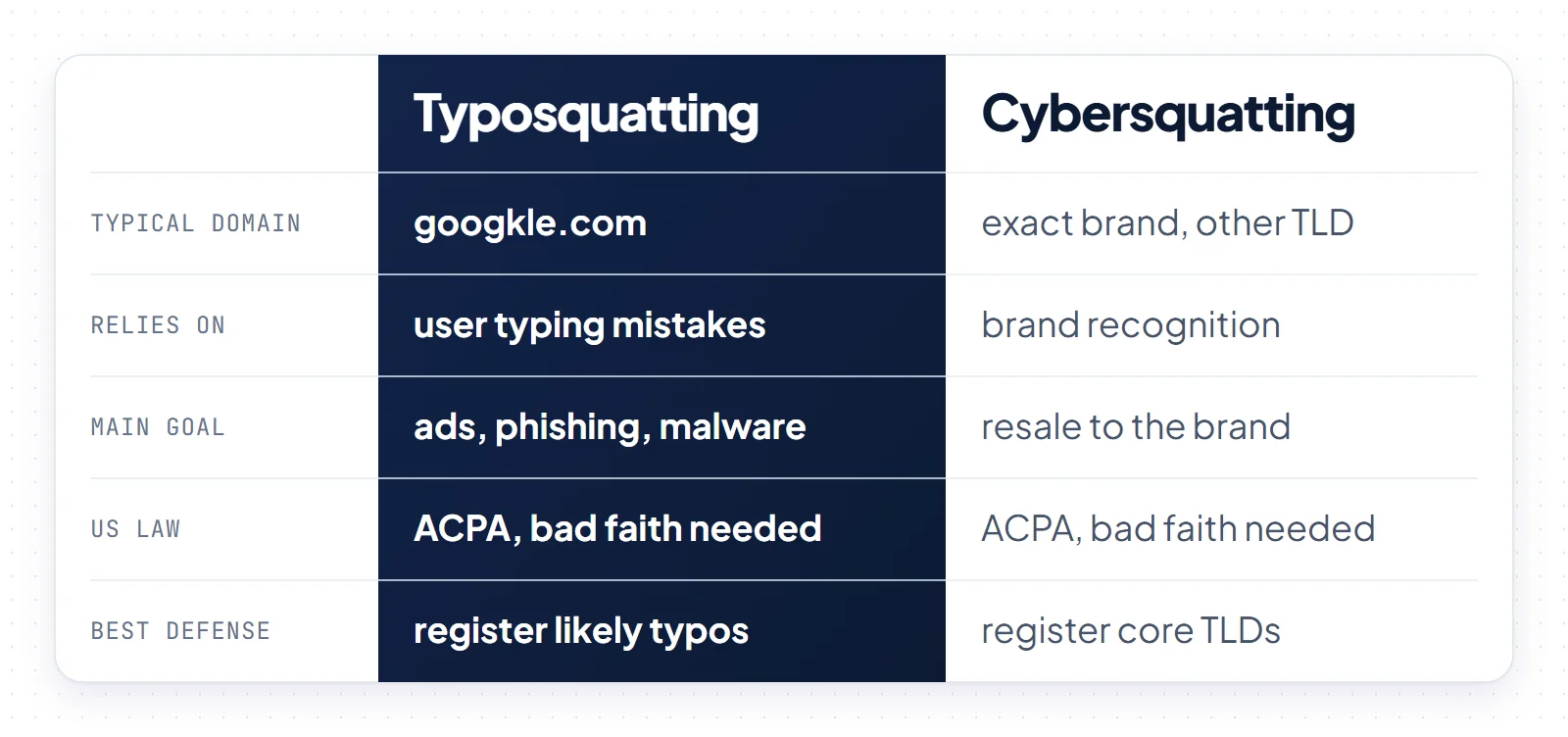
In court the same bad-faith test applies to both. The difference shows in prevention. Against cybersquatting you hold your name in the extensions your market uses; against typosquatting you also hold the few misspellings users really type.
Typosquatting risk for .ai brands after the 2026 .si rush
The typosquatting risk for .ai brands is that a matching .si name sits one keystroke away, because s and a are neighbors on a QWERTY keyboard. .si is Slovenia’s country-code domain, and for AI companies it reads as SuperIntelligence. That reading is our framing, not an official one, but the rename debate made .si a busy extension in September 2026.
Netcraft reported on September 24, 2026 that more than 44,000 registered .si and .ai domains share the same second-level string, which is 22% of all .si domains. A shared name is not proof of bad intent: many pairs are likely defensive or speculative registrations, and Netcraft said it saw “a low level of fraud on the .si TLD”. By its October 1, 2026 update, Netcraft had seen no rise in phishing around the rename.
The risk Netcraft describes is structural: a .si domain is “a one-keystroke typo of its .ai equivalent”, so criminals could register .si look-alikes of legitimate .ai sites. Some 1,500 pairs resolved to the same IP address, though Netcraft notes that a shared IP does not imply common ownership.
Speculation is visible: approximately 52% of the .si names Netcraft saw registered at one registrar, Dynadot, between September 19 and 22, 2026 were listed on its aftermarket by September 23. On October 1, 2026, Netcraft also reported 87 .com names pairing well-known brands with “superintelligence”, registered on September 29 and each listed for resale at $20,000. Our analysis of .si after the 2026 rush has more data.
How .si disputes work
Disputes over .si names go to Register.si’s own ADR procedure, known as ARDS. Each case goes to one arbiter, or to a panel of three on request, drawn from Register.si’s five independent external arbiters. The complainant must show three things. First, the name is identical or confusingly similar to a right valid in Slovenia, such as a trademark valid on Slovenian territory. Second, the holder has no legitimate interest. Third, the name was registered or is being used in bad faith. Register.si lists letter swaps and typos such as prosche.si and merkator.si as typical cases where similarity is found.
The procedure runs in Slovenian, though English evidence usually needs no translation. It takes about 2 to 3 months. The registry blocks the disputed name on the same day it confirms the complaint is complete, so the name cannot be deleted or transferred during the case. The fee for a single arbiter and 1 to 5 domains is €573.77 plus VAT (€700 including VAT), with 50% refunded to a winning complainant (Register.si fee schedule, accessed October 17, 2026). The outcome is deletion or transfer. A brand with only a US trademark may lack standing, so check rights in Slovenia with counsel.
What .ai brands should do about their .si
The cheapest fix is to hold the matching .si yourself. Netcraft put a one-year .si registration at around $11 at retail, against around $180 for the 2-year minimum on .ai (retail estimates, September 24, 2026). Any accredited .si registrar can do it; see how .si registration works for holder rules and terms. Then ask for registry lock, which blocks every change except renewal. The Register.si tariff for registrars lists it at €20 excluding VAT; your registrar sets the end price.
Next, publish DMARC with p=reject on the parked name and keep holder data accurate, since Register.si can delete names with incomplete data. Track renewals with your other defensive domains.
Disclosure: buysidomains.si sells .si names at fixed prices through Escrow.com, but you do not need us to protect your own brand. If the matching .si is held by someone else and not abused, see buying a domain someone else owns.
How to check and defend against typosquatting
Two free tools show what an attacker would register. dnstwist is an open-source permutation engine that can test TLD swaps against a dictionary of extensions and list only variants already registered. CIRCL’s Typosquatting-finder, from the Computer Incident Response Center Luxembourg, does the same in a browser, covering omissions, homoglyphs and wrong TLDs. Sort the results: phishing or malware sites need a takedown request and possibly a dispute, parked or for-sale names need monitoring, and unrelated businesses can be left alone.
A defense plan against typosquatting has five steps:
- Map variants. Run dnstwist or CIRCL on your main domain, including TLD swaps such as .ai to .si.
- Register the core. Hold your name in the extensions your customers use and the few typos they really make.
- Lock. Put registry lock on the primary domain and key defensive names.
- Set DMARC. Publish p=reject on every domain, including parked ones that never send mail.
- Monitor and enforce. Rescan on a schedule and file a UDRP or ARDS complaint when bad faith is clear.
DMARC has a limit. It stops spoofing of your exact domain, and Microsoft advises p=reject for domains that never send email. Yet RFC 9989, the May 2026 DMARC standard that replaced RFC 7489, says in section 2.2 that it does not address “visually similar domain names”. Look-alikes need registration and monitoring.
What to do next
- AI company on .ai with paying customers: register the matching .si now, add registry lock, set DMARC to reject and scan for other swaps. For a dispute route in Slovenia, consider trademarking your AI company name with coverage there.
- Startup still choosing a name: run dnstwist before you commit. A name whose one-key variants already host active sites can leak traffic and email from day one. Our guide to choosing an .ai domain covers the extension side.
- Established brand on .com: cover the three to five likeliest typos and the ccTLDs of your main markets, then monitor. Hundreds of permutations rarely pay off.
- Brand that found an active phishing typo: report it to the host and registrar first, then file a UDRP or ARDS complaint, and use the ACPA when damages matter.