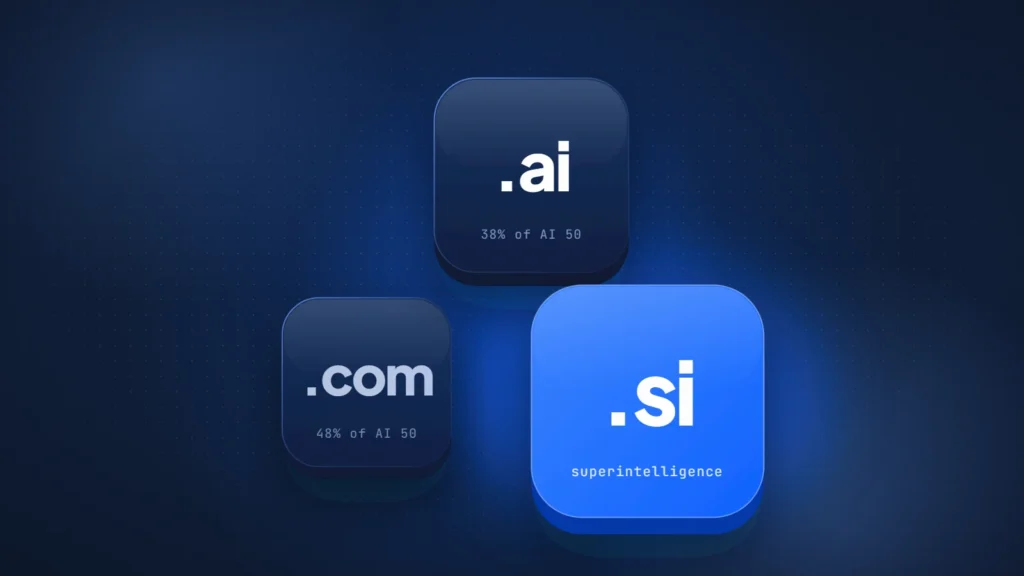
Good AI company names are short, one-word and easy to own as a domain. In the buysidomains.si audit of the Forbes 2026 AI 50 on October 5, 2026, 52% of core names are real dictionary words, and the median core name has 6 letters. On domains, 48% of companies run on .com and 38% on .ai. None uses .si yet.
People look for this in two ways. The query “ai company names” draws about 200 US and 400 global searches a month, and “ai business names” about 150 and 250 (Ahrefs, October 5, 2026). Most ranking pages are either long company lists or idea generators full of invented names. This study counts the real names and domains of 50 leading AI companies instead, then turns the patterns into a checklist.
Our audit of the Forbes 2026 AI 50: method
We took all 50 companies on the Forbes 2026 AI 50 and checked each one’s primary website on October 5, 2026. The method is simple, so anyone can repeat it with the public list and a command-line HTTP client.
The Forbes 2026 AI 50 is the eighth edition of the list and was published on April 16, 2026. It covers private AI companies that together raised $305.6 billion, according to Forbes. Forbes presents the 50 names in alphabetical order, not as a ranking.
For each company, we found the primary website from its own pages, from the URL Forbes lists where it gives one, and from search. We then requested every domain with curl between 20:01 and 20:07 UTC and recorded the final host after redirects. Where a site blocked automated requests, we checked its redirect headers instead.
To classify names, we split each one into a core brand and an optional descriptor: AI, Labs, Lab, Intelligence or Superintelligence. The core gets exactly one type, so the types add up to 100%, while descriptors are counted separately and can overlap. Mistral AI, for example, counts as a real word with an AI descriptor. We also counted letters and requested the exact brand plus .si, such as openai.si, for all 50 companies.
Name types are judgment calls, and a second reviewer could move 2–4 companies to a different type. Mercor, Rogo, Suno, Krea and Legora count as coined here, though some may be words in other languages. Crusoe and Harvey count as person names. The domain counts are firm.
How AI company names are built
More than half of the AI 50 use an ordinary dictionary word as their core name: 26 of 50 companies, or 52%. None is named after a founder. Compounds come second with 11 (22%), and coined words account for 9 (18%). The median core name has 6 letters, and 46 of 50 core names are a single word.
| Name type (core brand) | Companies | Share | Examples |
|---|---|---|---|
| Real dictionary word | 26 | 52% | Cursor, Notion, Glean |
| Compound of words | 11 | 22% | Databricks, Midjourney, HeyGen |
| Invented or coined | 9 | 18% | Suno, Replit, Synthesia |
| Person name | 3 | 6% | Harvey, Crusoe, EliseAI |
| Acronym | 1 | 2% | Fal |
| Total | 50 | 100% |
Few of the dictionary words describe the product. Cursor, Notion, Glean and Runway borrow a familiar word and give it a new meaning in context, so they are easy to say and still stand apart. None of the three person names, Harvey, Crusoe and EliseAI, belongs to a founder.
Length is the clearest pattern: core names range from 3 letters (Fal) to 16, and 28 of 50 have 6 letters or fewer.
Generic descriptors are the exception. Only 8 companies (16%) put AI in the name, such as Mistral AI, Together AI and Fireworks AI. Five (10%) use Labs or Lab, including ElevenLabs, World Labs and Thinking Machines Lab, and two (4%) use Intelligence or Superintelligence.
The Labs suffix has become a small genre of its own. In an August 22, 2026 post on his personal blog, David Freifeld paired every number from 00 to 99 with Labs and found a matching company or page for 71 of them. He flagged 35 as AI-related, counting a .ai domain or AI-centered products. He also called his own selection criteria loose, so treat the post as a hobby audit, not a statistic.
Which domains AI companies use
Our October 5, 2026 audit of the Forbes 2026 AI 50 found 24 of 50 companies (48%) running their main site on .com and 19 (38%) on .ai. Only 2 (4%) used .io, 5 (10%) used other extensions such as .co, .app and .dev, and none used .si.
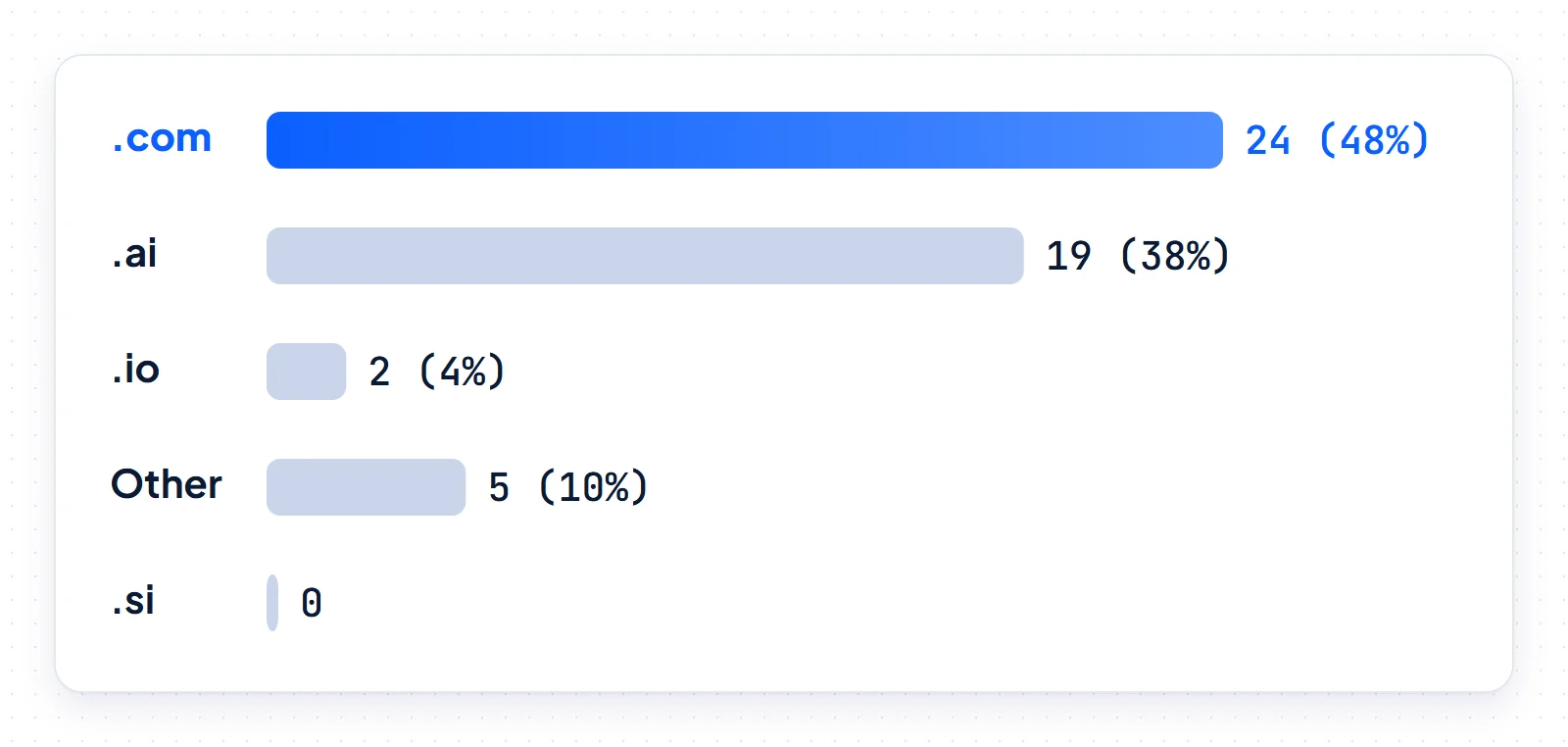
| Extension | Companies | Share | Examples |
|---|---|---|---|
| .com | 24 | 48% | anthropic.com, openai.com, cursor.com |
| .ai | 19 | 38% | mistral.ai, perplexity.ai, harvey.ai |
| .io | 2 | 4% | elevenlabs.io, synthesia.io |
| Other (.co, .app, .dev, .website, .inc) | 5 | 10% | baseten.co, gamma.app, ssi.inc |
| .si | 0 | 0% | None |
Exact matches dominate. In 46 of 50 cases the domain is the brand itself, sometimes with AI moved into the extension, as with mistral.ai for Mistral AI. The four exceptions are bfl.ai, pi.website, ssi.inc and surgehq.ai, and three of them shorten long multi-word names into initials.
Several companies have settled on the plain .com. For cognition.ai, rogo.ai, cyera.io, notion.so and runwayml.com, the older domains now redirect to the .com. The AI suffix pulls the other way: six of the eight companies with AI in their name use a .ai domain, and only OpenAI and EliseAI use .com.
What the patterns teach about naming an AI company
The AI 50 point to a simple rule. Choose a short, one-word name you can own as an exact-match domain, and add AI only when the core word cannot stand on its own. Beyond the list, the wider market adds one trend to watch, the steady rise of .ai.
- Keep the core name short. More than half of the AI 50 manage with 6 letters or fewer, which helps on a logo, in an app store and in a spoken introduction.
- Use one word. 46 of 50 core names are a single word, and long multi-word names tend to end up as initials in the domain, such as bfl.ai for Black Forest Labs.
- Own the exact-match domain. 46 of 50 domains match the brand exactly, and five companies now redirect older domains to the plain .com.
- Treat AI as optional. Only 16% of the AI 50 use it, mostly on dictionary words such as Together, Fireworks and Surge, where it separates a common word from its other uses.
Startup data shows that rise most clearly. Identity Digital provides the backend registry services for .ai. In an August 4, 2026 newsroom post, it reported that the share of Y Combinator companies using .ai rose from 8% in 2020 to a peak of 30% in 2025. It did not publish a sample size, and as the backend operator it has a commercial interest in the trend.
Registrations point the same way. The .ai domain passed 1 million registrations on January 20, 2026, according to the Government of Anguilla, as reported by DomainIncite. The AI 50 still lean toward .com, so .ai is a common choice among leaders, not the default. Our guide to .ai domains covers prices and registration rules.
SI and superintelligence names
Among the AI 50, only Safe Superintelligence uses SI as a meaningful part of its brand, on the domain ssi.inc. Outside the list, the newer superintelligence labs also keep their domains short and leave the long word out.
Recursive Superintelligence runs on recursive.com, and on October 5, 2026, recursive.si redirected there. NameBio recorded a $20,000 aftermarket sale of recursive.si, reported in May and June 2026 with Recursive named as the buyer. Ineffable Intelligence uses ineffable.ai, while Meta Superintelligence Labs does not appear to have a standalone domain and lives on Meta’s sites. Our overview of superintelligence domains compares these labs in more detail.
Where .si fits
When we checked on October 5, 2026, none of the Forbes 2026 AI 50 companies used .si as its primary domain, and the exact brand plus .si names are mostly held by others. That makes .si an open option for new names, not a shortcut to a famous one.
.si is Slovenia’s country-code domain. For AI companies it reads as SuperIntelligence. That reading is our framing, not an official meaning. Separately, Executive Order 14434, signed on September 29, 2026, directs US federal agencies to use “Super Intelligence” and “SI” in place of “AI” in official documents. The order has nothing to do with the domain.
Our audit also checked the exact brand plus .si for all 50 companies. Only replit.si redirects to the company’s own site, and sambanova.si shows a brand-protection page. Of the rest, 29 show for-sale pages on domain marketplaces, 6 belong to unrelated Slovenian sites, 8 are parked or blank and 5 did not respond.
For buyers, this is mainly a trademark question. Buying the .si version of a famous AI brand can expose you to a claim from the brand owner, whatever the asking price. If the name you want is already registered, read how to buy a domain that is already taken, and consult a trademark attorney before you pay.
There is also a search limit. Google Search Central lists .ai and .io among the country-code domains it treats as generic, but not .si, so Google reads a .si site as a signal for Slovenia. For a global AI company, a .si name fits best as an SI-branded product or a short address alongside a .com or .ai main site. Our complete guide to the .si domain covers the setups. For transparency, buysidomains.si sells .si names.
Checklist before you pick a name
Check a candidate name in this order: trademarks first, then the domain, then how it sounds, then the domain’s past. Each step costs less than fixing the problem after launch.
- Run a trademark search. Search the official trademark databases for the markets and classes you plan to use, and consult a trademark attorney before you commit. Our guide to brandable domains explains why distinctive names are easier to protect.
- Secure the exact-match domain. 46 of the AI 50 own the domain that matches their brand. Short names are scarce, so read our guide to short domain names before you settle for a longer variant.
- Do the say-it test. Say the name once, out loud, and ask someone to spell it and type the domain. If they hesitate, expect lost visits and misdirected email.
- Check the domain’s history. Look at what the domain hosted before, including archived pages, and at any links or spam you would inherit.
For a global AI product, pick a short word and secure its .com or .ai. Keep AI out of the name unless the core word is too common to protect on its own. If you want an SI-branded product or a second brand address, a .si name is a reasonable addition once the trademark check is clear.