Physical AI is artificial intelligence that perceives, reasons about and acts in the physical world through a body: a robot arm, a humanoid, a car or a camera network. A chatbot outputs text. A physical AI system outputs motion, and its mistakes have physical consequences. NVIDIA, Google DeepMind and a growing group of robotics startups build it.
NVIDIA CEO Jensen Huang called physical AI “the next frontier of AI” at CES on January 6, 2025. On September 24, 2026, the International Federation of Robotics reported a record 5 million industrial robots operating in factories in 2025. Five days later, on September 29, 2026, The Economist ran an opinion essay arguing for a physical version of the AI singularity.
What is physical AI?
Physical AI is the branch of artificial intelligence that acts on the physical world. The system senses its surroundings, builds an internal model of how that world behaves, and acts through motors, wheels or grippers. The NVIDIA glossary says physical AI lets autonomous systems such as cameras, robots and self-driving cars “perceive, understand, reason, and perform or orchestrate complex actions in the physical world.”
IBM draws the line at software: physical AI covers systems that operate in and interact with the physical world, “rather than existing only in software or digital environments.” A language model can describe how to fold a shirt. A physical AI system has to find the sleeve and move a hand without tearing the fabric.
Several labels describe the same field. A February 2026 primer from Georgetown’s Center for Security and Emerging Technology (CSET) notes that the field “lacks a shared name.” Companies use “embodied AI,” “physical AI,” “embodied machine intelligence” or “generative physical AI.” The terms overlap almost completely, so check what a system actually does: perceive, plan, move, or all three.
Who coined the term “physical AI”?
No single person can be credited with coining “physical AI.” The earliest formal academic definition we found is a November 2020 paper in Nature Machine Intelligence, “Skills for physical artificial intelligence,” by Aslan Miriyev and Mirko Kovač. Imperial College London said the work defined the term for the first time. NVIDIA CEO Jensen Huang then popularized “physical AI” from 2024 onward, first at NVIDIA’s GTC and Computex keynotes and then at CES in January 2025.
As Imperial College London described it, the 2020 paper framed physical AI as a research agenda. That agenda draws on materials science, mechanical engineering, computer science, biology and chemistry.
NVIDIA turned the phrase into a product category. At CES on January 6, 2025, Huang launched Cosmos, a platform of world foundation models that generate synthetic training data for robots and autonomous vehicles. A year later, on January 5, 2026, an NVIDIA press release quoted him: “The ChatGPT moment for physical AI is here.” IBM’s January 2026 explainer credits Huang with popularizing the term.
The marketing worked. CSET wrote that, measured by Google Search, physical AI is the trend that “appears to have gotten the most traction in the past year.”
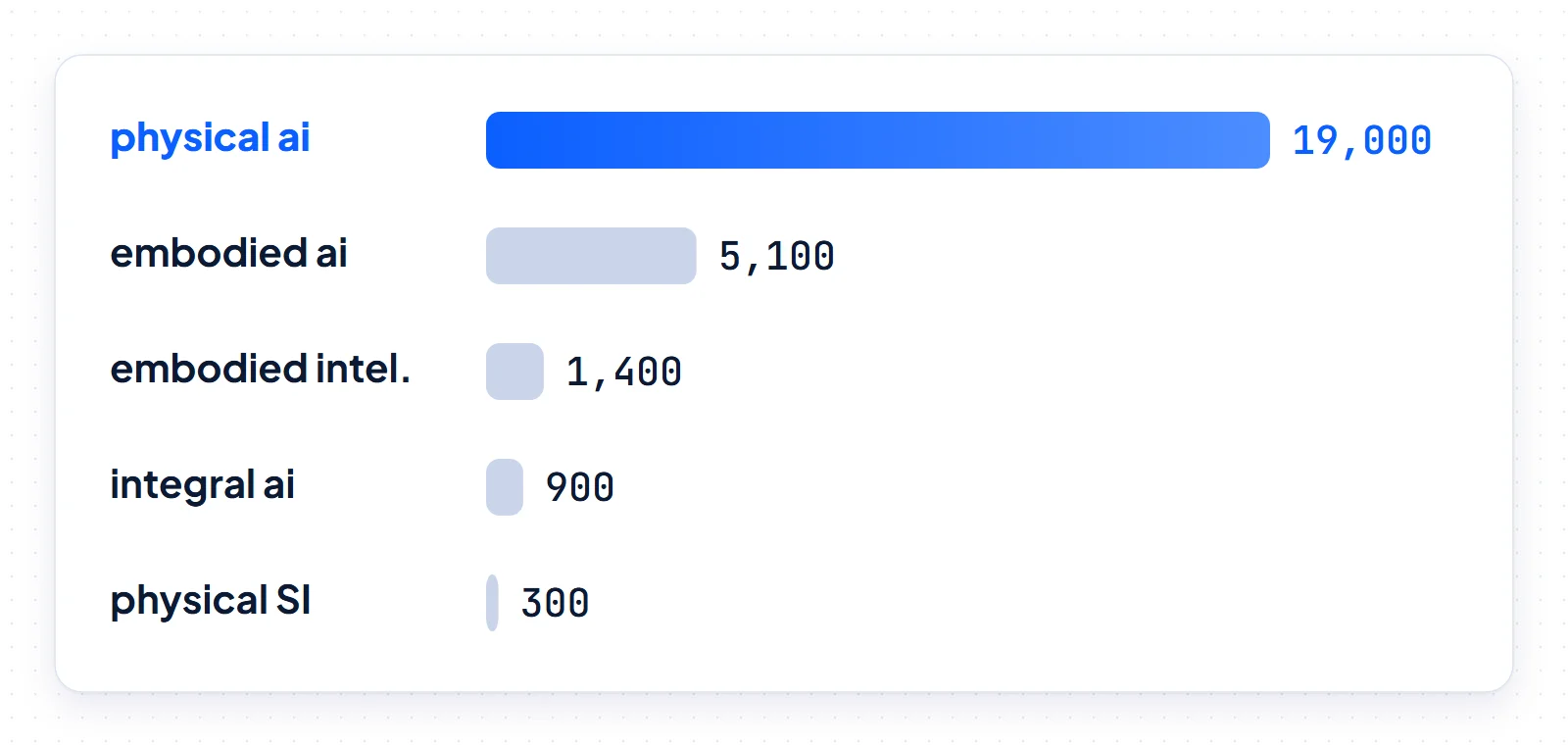
Search data points the same way. Ahrefs estimates about 19,000 global monthly searches for “physical ai” (4,600 in the US). Searches for “embodied ai” reach 5,100 and for “embodied intelligence” 1,400 (Ahrefs, October 6, 2026). Physical AI even beats “superintelligence,” at 11,000 monthly searches. These are estimates, but the gap is clear.
How physical AI works
Physical AI systems run a loop: sense the scene, predict how the world will respond, practice in simulation, act, and feed the results back into training. Two kinds of models drive recent progress: world models that predict physical outcomes, and vision-language-action (VLA) models that turn instructions into motor commands.
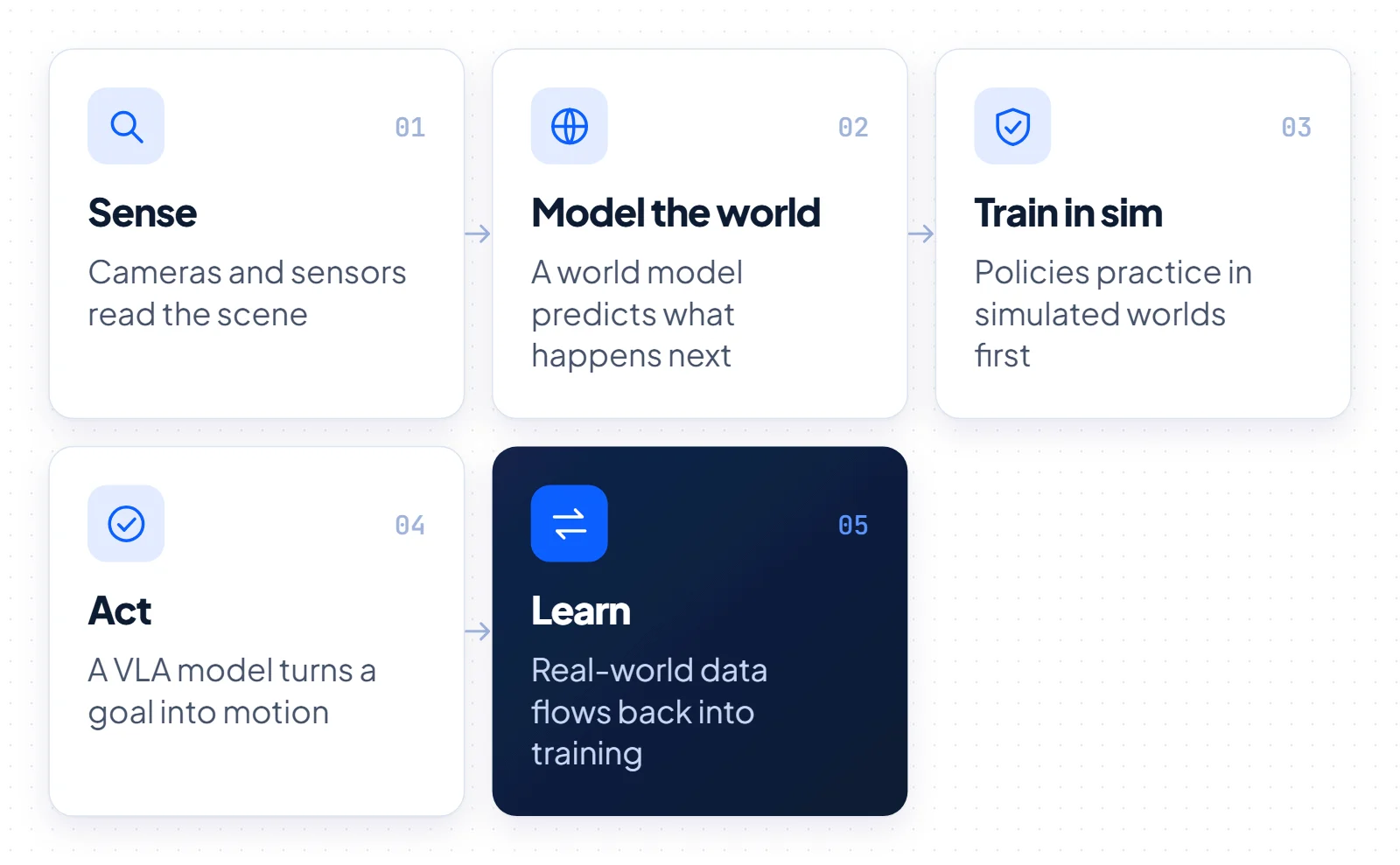
- Sense. Cameras, lidar and force sensors produce noisy, incomplete data that must be processed in real time.
- Model the world. A world model predicts what happens if the robot pushes, grips or turns. NVIDIA’s Cosmos generates synthetic scenes so robots can train on situations that are rare or dangerous to record.
- Train in simulation. Policies practice in simulated environments first. The hard part is transfer: behavior learned in simulation can break on a real floor with real friction.
- Act. A VLA model maps camera images and a written goal to motor actions. Google DeepMind built Gemini Robotics on Gemini 2.0 by adding physical actions as a new output modality (March 12, 2025). Physical Intelligence’s π0 (October 2024) uses a VLA design to control several robot types with one model.
- Learn. Deployments produce new data. In 2023, Google DeepMind and 33 academic labs pooled more than 1 million trajectories from 22 robot types in the Open X-Embodiment dataset so one model could learn from many bodies.
Physical AI is a stack, not one model. A weakness in any layer shows up as a dropped box or a stalled car.
Physical AI examples
The clearest physical AI examples work in mapped, repetitive or fenced-off settings. Humanoids and home robots exist too, mostly as pilots and preorders.
- Robotaxis. Waymo gave about 400,000 paid rides a week across six US cities, Bloomberg reported on February 11, 2026.
- Warehouses. Amazon says it has deployed its 1 millionth robot across more than 300 facilities. By the company’s own estimate, its DeepFleet foundation model improves the fleet’s travel time by 10%.
- Factories. The International Federation of Robotics counted 5 million industrial robots operating in 2025, up 9%. China installed 354,000 units that year, 59% of the global total.
- Humanoids. Figure AI, Apptronik, Agility Robotics and Boston Dynamics build humanoids for logistics and manufacturing. Boston Dynamics is bringing Gemini Robotics to its new Atlas, which Hyundai plans to use in car plants from 2028. Our overview of humanoid robot companies covers this group in detail.
- Homes. 1X opened preorders for its NEO home humanoid in October 2025 at $20,000 or $499 per month.
Physical AI companies and the names they chose
Physical AI companies split into hardware makers, model builders and humanoid startups. The table lists 14 of them with the domain of each main website, checked on October 6, 2026.
| Company | What it builds | Website | Extension |
|---|---|---|---|
| Physical Intelligence | Robot foundation models (π0, π0.5) | pi.website | .website |
| Figure AI | Humanoid robots and the Helix VLA model | figure.ai | .ai |
| Skild AI | General-purpose robot brain | skild.ai | .ai |
| 1X Technologies | NEO home humanoid | 1x.tech | .tech |
| Agility Robotics | Digit logistics humanoid | agilityrobotics.com | .com |
| Apptronik | Apollo humanoid | apptronik.com | .com |
| Boston Dynamics | Atlas, Spot and Stretch robots | bostondynamics.com | .com |
| Tesla | Optimus humanoid | tesla.com | .com |
| Field AI | Autonomy foundation models | fieldai.com | .com |
| Archetype AI | Newton sensor foundation model | archetypeai.io | .io |
| Covariant | RFM-1 warehouse picking model | covariant.ai | .ai |
| Waymo | Robotaxis | waymo.com | .com |
| Integral AI | Embodied AGI and world models | integral.ai | .ai |
| NVIDIA | Cosmos, Isaac GR00T and robot computers | nvidia.com | .com |
Of 14 physical AI companies reviewed by buysidomains.si on October 6, 2026, 7 use .com, 4 use .ai, and 1 each uses .website, .tech and .io. Five of the 14 sit on country-code domains that are read as words: .ai is Anguilla’s domain and .io belongs to the British Indian Ocean Territory. Hardware incumbents such as Boston Dynamics, Tesla and NVIDIA stay on .com, while AI-native startups pick .ai or unusual extensions.
Physical Intelligence pairs the Greek letter its models are named after with an extension few companies would consider: pi.website. Physical Superintelligence, a physics lab launched on September 1, 2026, chose psi.inc, which puts “SI,” for superintelligence, inside the name itself. That choice leads to the .si question in the final section.
How far are we from physical AI?
Physical AI is deployed at scale in structured settings and still far from general-purpose. The International Federation of Robotics counted 5 million industrial robots in factories in 2025, and Waymo gave about 400,000 paid rides a week in February 2026. General-purpose humanoids are further off: UC Berkeley roboticist Ken Goldberg describes a “100,000-year data gap” between robot training data and the text behind large language models.
The optimistic case rests on money. Skild AI raised $1.4 billion at a $14 billion valuation in January 2026. On August 28, 2026, TechCrunch reported that a16z had created a $1.1 billion “Machine Age” fund for the physical buildout of AI. Morgan Stanley estimates the humanoid market could reach $5 trillion by 2050.
The cautious case rests on data and hardware. In a UC Berkeley interview published in September 2025, Goldberg said capable humanoids are “not going to happen in the next two years, or five years or even 10 years.” CSET argues that physical AI faces the same technical and economic barriers that have slowed robotics for generations. Batteries, motors and sensors improve more slowly than software.
Both views fit the evidence: structured physical AI is a working industry, while general-purpose robots have no agreed timeline.
From physical AI to physical superintelligence
Physical superintelligence is an informal term for AI that would exceed human ability in understanding and changing the physical world, not only in reasoning. As of October 2026, we found no major AI lab using it as a technical term. Three sources gave the idea visibility in 2025–2026: an Economist opinion essay by Jeff Schneider, the company Integral AI and the startup Physical Superintelligence.
Schneider, a robotics researcher, argues in a September 29, 2026 Economist By Invitation essay that a “physical singularity” may be nearer than many assume. In his framing, the threshold comes when machines can extract materials, transport them and build factories that build more machines. Industrial capacity would then grow with less human labor.
He places that threshold within the next decade or two, while noting that physical AI tolerates far less error than a chatbot. That is his opinion, not a consensus forecast.
Integral AI is a Tokyo company founded in 2021 by former Google researchers Jad Tarifi and Nima Asgharbeygi. In December 2025, it claimed to have built the “world’s first AGI-capable model,” with a mission to scale it toward “embodied superintelligence.” Both are the company’s own claims, not independently verified.
Physical Superintelligence (PSI) is a Cambridge, Massachusetts lab founded by Matt Pines, Alex Wissner-Gross and Alex Klokus. It launched on September 1, 2026 with a $58 million seed round led by Breakthrough Energy Ventures. PSI is not a robotics company. It calls itself an AI-native physics lab that aims to create new world models, engineer physical systems beyond human design and discover new physical laws.
Search demand is small: Ahrefs estimates about 300 global monthly searches for “physical superintelligence” (October 6, 2026). For the broader concept, see our guide to what superintelligence is and our explainer on AGI vs ASI.
What this means if you are naming a physical AI company
.si is Slovenia’s country-code domain. For AI companies it reads as SuperIntelligence. That reading is informal, not an official meaning, but PSI already put the same two letters into psi.inc. For a physical AI founder, choosing a domain comes down to four checks.
- Say what the robot does. Figure and Waymo can afford invented brand words. A smaller humanoid or warehouse startup gains more from a name that explains the product on first read.
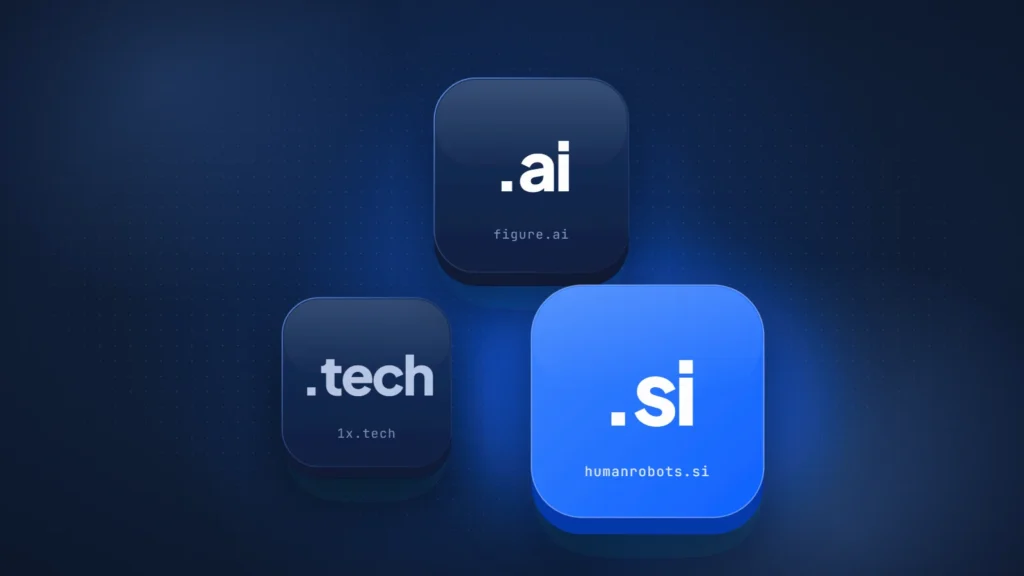
- Keep it short. Names like pi.website, 1x.tech and figure.ai are easy to say on a sales call or across a factory floor.
- Pick an extension that reads as part of the name. .ai does this for model companies, and .si does it for a team whose story points toward superintelligence. Our comparison of the best domain for an AI startup weighs the options side by side.
- Check trademarks before you buy. Search the registers in your main markets for the name and close variants. Our guide to AI company names covers choosing and testing a name.
One genuine example: humanrobots.si describes humanoid robotics in two plain words. We sell it on buysidomains.si at a fixed aftermarket price, so read this as our own listing, not neutral advice. It suits a humanoid integrator or a robotics media project better than a company that wants an invented brand word.
For hardware sold to enterprise buyers, .com puts you next to Boston Dynamics. For model builders, .ai is the category norm. If your story is about where physical AI leads, a .si name says that in two letters. Whichever extension you pick, register the exact match of your brand before you announce it.