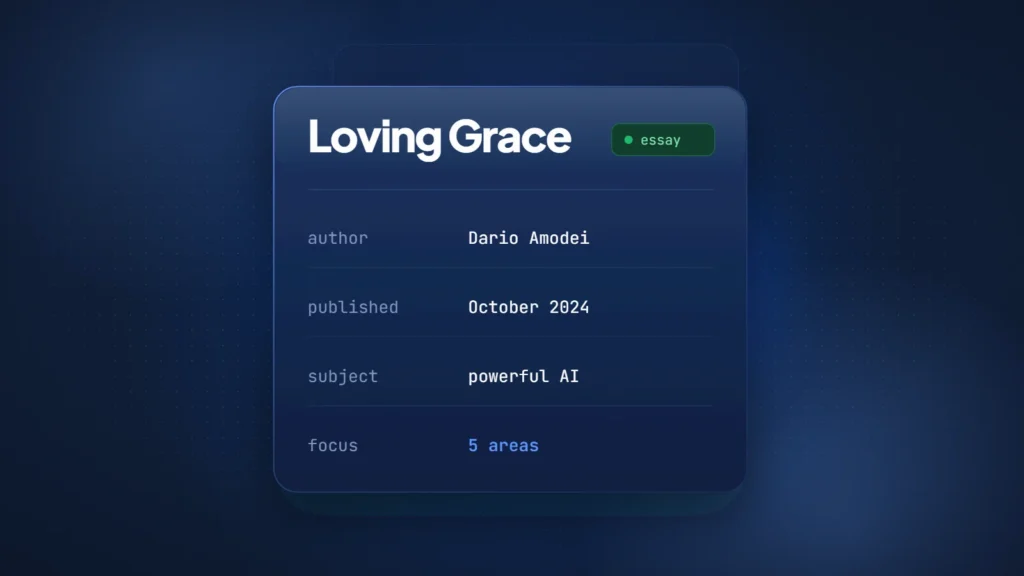
Machines of Loving Grace is a long essay by Anthropic CEO Dario Amodei, published on his personal site darioamodei.com in October 2024. Subtitled “How AI Could Transform the World for the Better,” it argues that powerful AI could compress 50–100 years of progress in biology and medicine into 5–10 years. It then turns to mental health, poverty, governance and work.
The essay runs to roughly 14,000 words, according to Sherwood News. Its central claim is blunt: “most people are underestimating just how radical the upside of AI could be.” Anthropic’s own policy documents cite it, and Amodei’s later essays reuse its vocabulary. This guide sets the essay’s claims beside its own hedges in one table. It then covers what was said after the essay and a domain-name check we ran on November 3, 2026.
Where the name Machines of Loving Grace comes from
The title borrows from Richard Brautigan’s poem “All Watched Over by Machines of Loving Grace.” Brautigan wrote it in January 1967 as poet-in-residence at Caltech, and it became the title poem of a free collection printed that April. Amodei does not name Brautigan in the text. His first footnote links to the poem instead.
The phrase has two other well-known uses, which explains the mixed search results. John Markoff used it for his 2015 book “Machines of Loving Grace: The Quest for Common Ground Between Humans and Robots.” An industrial rock band from Tucson, Arizona, also took its name from the poem and was active from 1989 to 1999. This article covers the essay only.
The essay itself has a clear shape. It opens with a framework for thinking about AI’s effects, works through five numbered areas, ends with a section called “Taking stock,” and carries 29 footnotes. In “Taking stock,” Amodei turns to Iain M. Banks’s novel “The Player of Games” and its society, the Culture. In footnote 29 he admits he is “breaking my own rule not to make this about science fiction.”
What Amodei means by powerful AI
Powerful AI is Dario Amodei’s term, used in Machines of Loving Grace, for a model “smarter than a Nobel Prize winner across most relevant fields.” It has every interface a human working virtually has, from text and audio to video, mouse, keyboard and internet access. It can work on tasks “that take hours, days, or weeks to complete” and control existing tools and robots, though it has no body of its own. It runs as “millions of instances” at “roughly 10x–100x human speed,” which Amodei condenses into a “country of geniuses in a datacenter.”
The label is deliberate. “I dislike the term AGI,” Amodei writes, and footnote 3 calls it “an imprecise term that has gathered a lot of sci-fi baggage and hype.” He defines powerful AI with a list of properties rather than a single benchmark.
On timing he stays careful. “I think it could come as early as 2026,” he writes, which sets an earliest date rather than a forecast.
The framework section explains why even such a system would not change everything overnight. Amodei argues that “we should be talking about the marginal returns to intelligence,” meaning how much extra intelligence helps while other bottlenecks remain. He names five limiting factors:
- Speed of the outside world
- Need for data
- Intrinsic complexity
- Constraints from humans
- Physical laws
This framework is the part of the essay most worth rereading. Every bold claim that follows is bounded by these five brakes, and the essay says so repeatedly.
What Machines of Loving Grace is about: the five areas
Machines of Loving Grace applies its framework to five areas: biology and physical health, neuroscience and mental health, economic development and poverty, peace and governance, and work and meaning. Dario Amodei’s confidence falls roughly in that order, from conditional dates in biology to no timeframe at all for work and meaning. The headline idea is the “compressed 21st century”: AI could “compress the progress that human biologists would have achieved over the next 50–100 years into 5–10 years.”
| Area | What the essay claims | The essay’s own timeframe or hedge |
|---|---|---|
| Biology and physical health | “Reliable prevention and treatment of nearly all natural infectious disease,” “elimination of most cancer,” cures for genetic disease, prevention of Alzheimer’s, and a possible doubling of the human lifespan to about 150 years | If achieved “7–12 years from now (which would be in line with an aggressive AI timeline)”; on lifespan, “no guarantee this is biologically possible” |
| Neuroscience and mental health | “Most mental illness can probably be cured” | “Might reasonably be completed in 5–10 AI-accelerated years” |
| Economic development and poverty | 20% annual GDP growth in the developing world; Sub-Saharan Africa reaching China’s current per-capita GDP | A “dream scenario” over 5–10 years; “not what happens by default”; Amodei is “not as confident” |
| Peace and governance | An “entente strategy” in which a coalition of democracies leads on AI | “Very difficult to achieve”; Amodei is “not nearly as confident” |
| Work and meaning | Meaning “comes mostly from human relationships and connection, not from economic labor” | No timeframe; offered as reflection, not projection |
Read the right-hand column before the middle one. Amodei sets out a clear confidence ladder:
- Biology and health: his most confident section, with conditional dates.
- Neuroscience and mental health: framed in the same 5–10 year window as biology.
- Economic development: “not as confident,” and explicit that “success is not guaranteed.”
- Peace and governance: “not nearly as confident,” with an admission that his ideas “may be unrealistically utopian.”
- Work and meaning: the hardest area to pin down, with no numbers at all.
The two most quoted numbers in Machines of Loving Grace need the most care. The doubling of lifespan to about 150 years comes with Amodei’s own line that there is “no guarantee this is biologically possible.” The 20% annual GDP growth figure for the developing world is labeled a “dream scenario.” Both are hedged aspirations, not forecasts, and quoting them as predictions misstates the essay.
The peace section is where the essay makes a policy argument. In the entente strategy, democracies use a stick (military superiority) and a carrot (sharing AI’s benefits) to bring other countries along. The hoped-for result is a lasting democratic advantage Amodei calls an “eternal 1991.” He does not assume the technology gets there on its own: “I see no strong reason to believe AI will preferentially or structurally advance democracy and peace.”
The last area turns from capability to purpose. Amodei suspects a large universal basic income “will only be a small part of a solution” and argues that relationships, not jobs, are where most people find meaning.
What Amodei and his critics have said since October 2024
Since October 2024, Amodei has published a companion piece on the risks and given tighter dates, while critics have focused on the geopolitics. Everything below is attributed to its source. None of it is our forecast.
The Adolescence of Technology, January 2026
The Adolescence of Technology is Dario Amodei’s January 2026 follow-up to Machines of Loving Grace, subtitled “Confronting and Overcoming the Risks of Powerful AI.” Fortune reported that it was published on January 26, 2026, and runs to about 20,000 words. Where the first essay “focused on the positive implications,” this one covers autonomy, misuse for destruction, misuse for seizing power, economic disruption and indirect effects.
Amodei’s follow-up essay reuses the “country of geniuses in a datacenter” and describes Machines of Loving Grace as “the dream of a civilization that had made it through to adulthood.” Its timing is tighter. Powerful AI “could be as little as 1–2 years away,” Amodei writes, and he asks readers to imagine it arriving “in ~2027.”
Anthropic’s timeline and We Must Pace the Frontier
Anthropic had already put a company date on the idea. In policy recommendations published in March 2025, it said it expects powerful AI to arrive in “late 2026 or early 2027.” As of November 2026, that window has opened. This article does not judge whether Anthropic’s expectation will hold.
In September 2026, Amodei published “We Must Pace the Frontier” on darioamodei.com. It proposes pacing capability progress through third-party evaluators, coordination among democracies and wider global coordination. It also repeats the biology claim that AI “could cure most major diseases in the next 5–10 years.”
How others read it
The sharpest early critique targeted the entente strategy. In “The Hopium Wars: the AGI Entente Delusion,” posted on LessWrong on October 13, 2024, Max Tegmark called the approach “fundamentally flawed.” Other readings are kinder. In a review dated April 18, 2026, writer Jacob Brazeal looked at Amodei’s prediction of powerful AI as soon as 2026. He wrote that it “seems basically correct, give or take a year or two.” These are readings of the essay, not positions Amodei holds.
Powerful AI, AGI or superintelligence: the naming question
Amodei chose a plain label, while several other labs now say “superintelligence” outright. The difference is mostly vocabulary, but vocabulary shapes how products and companies get named.
Three examples from 2025 show the shift. Sam Altman’s “The Gentle Singularity,” dated June 10, 2025, states that “Humanity is close to building digital superintelligence.” On July 30, 2025, Meta set out a goal of “personal superintelligence to everyone.” On November 6, 2025, Microsoft AI’s Mustafa Suleyman published “Towards Humanist Superintelligence,” announcing that Microsoft AI had formed an MAI Superintelligence Team.
Most definitions of artificial superintelligence describe a system that outperforms the best humans across nearly every cognitive field. Amodei’s powerful AI sits close to that bar without claiming it. One instance is “smarter than a Nobel Prize winner across most relevant fields,” and millions of copies at 10x–100x human speed push the aggregate picture further. Amodei never calls this superintelligence; the comparison is ours, a mapping of definitions rather than a quote.
For the definitions themselves, see our guide to what artificial superintelligence means and our breakdown of the difference between AGI and ASI. His case against the AGI label sits in footnote 3, quoted earlier.
.si is Slovenia’s country-code domain. For AI companies it reads as SuperIntelligence. That reading is informal, not an official meaning of the extension, and what .si stands for goes well beyond AI. The framing is why the labs’ move toward “superintelligence” matters to anyone naming an AI product.
The essay’s phrases as domain names
Every phrase we tested from Amodei’s essays is already registered as a .com, and four of five are registered as .ai. BuySI Domains checked five phrases from Machines of Loving Grace and The Adolescence of Technology as second-level names on November 3, 2026, using RDAP at Verisign for .com and Identity Digital for .ai.
| Phrase as a name | .com status (year registered) | .ai status (year registered) |
|---|---|---|
| machinesoflovinggrace | Registered (2009) | Registered (2025) |
| lovinggrace | Registered (2004) | Registered (2025) |
| countryofgeniuses | Registered (2026) | Registered (2026) |
| powerfulai | Registered (2016) | Registered (2026) |
| adolescenceoftechnology | Registered (2026) | Not registered |
| Registered out of 5 | 5 | 4 |
The registration years show when interest arrived. Three of the .com names predate the essay, led by lovinggrace.com from 2004. All four registered .ai names were created in 2025–2026, after the essay appeared. countryofgeniuses.com and adolescenceoftechnology.com were both registered within a month of the January 2026 follow-up.
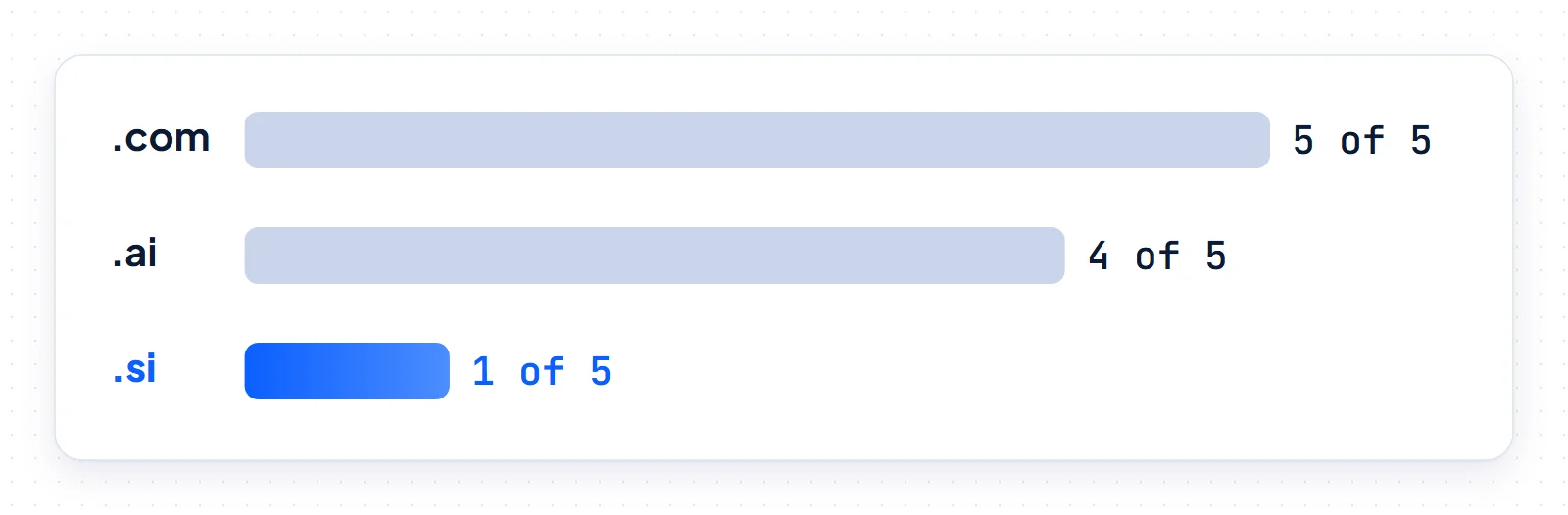
In .si, one of the five phrase names is registered, according to our check at Register.si on the same day. Adding the two author and company names, darioamodei and anthropic, 3 of the 7 names we checked are registered in .si. In line with Register.si’s RDAP terms, we report .si results only as aggregate counts.
One detail is easy to miss: the essays live on darioamodei.com, registered in 2011, not on anthropic.com. For the record, anthropic.com dates to 2001, anthropic.ai to 2020 and darioamodei.ai to 2024.
Another route for founders is to name the format rather than borrow a famous phrase. essai.si is one example: “essai” is French for essay, and the full name carries both AI and SI. BuySI Domains lists essai.si for sale. It suits a long-form publication, a newsletter or a research tool about AI.
How to read Machines of Loving Grace in 2026
Read Machines of Loving Grace as one lab leader’s case for what could go right, and pair it with The Adolescence of Technology on what could go wrong. On its own, either essay gives a lopsided picture. The right entry point depends on why you are reading.
- Founders building AI products: start with the framework and the five limiting factors. They explain why capability does not turn into impact at the same speed, and where the bottlenecks sit.
- Readers in health and life sciences: the biology section is the most concrete and the most confident. Note the conditional dates and the explicit hedge on lifespan.
- Policy readers: read the peace section next to Tegmark’s critique and “We Must Pace the Frontier.” Together they show how the entente idea has been argued since 2024.
- Timeline watchers: line up “as early as 2026” (October 2024), “late 2026 or early 2027” (March 2025) and “~2027” (January 2026). Treat them as the author’s ranges, not settled dates. For other long-form views, compare Leopold Aschenbrenner’s Situational Awareness and the AI 2027 scenario.
- Founders naming a company: the essays’ exact phrases are mostly taken in .com and .ai. Names that describe a category, rather than quote a famous text, leave more room.
Whatever your reason, read the footnotes in the original essay. Much of the hedging lives there, including the note that explains why Amodei chose “powerful AI” over AGI.