You cannot buy a domain permanently. You register it for a fixed term: 1 to 10 years for .com and other ICANN-governed gTLDs, and 1 to 5 years for .si. You keep it for as long as you keep renewing. Miss the renewal, and the name eventually goes back to the open pool for anyone to register.
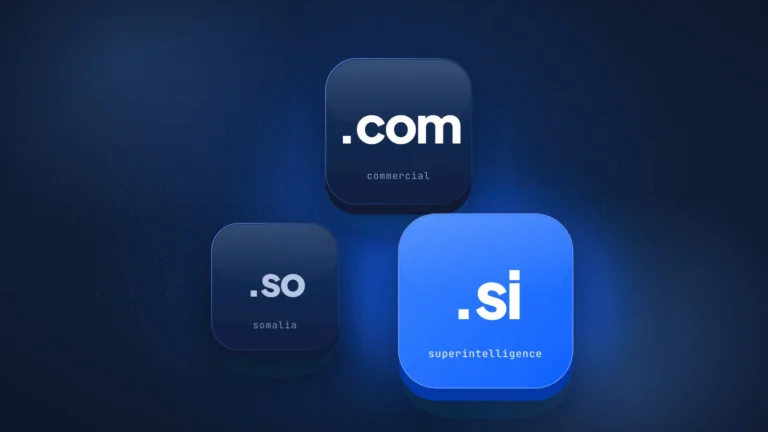
The question carries more weight than usual in late 2026, especially for .si. The .si TLD is Slovenia’s country-code domain. For AI companies it reads as SuperIntelligence. On October 1, 2026, CircleID reported that Register.si counted 46,066 new .si registrations in September, and every one of those names has an expiry date. Search data shows the same interest. According to Ahrefs (October 17, 2026), “buy domain permanently” gets about 100 US and 250 global searches a month. “Can you buy a domain forever” gets about 80 global searches.
Can you buy a domain permanently, or only register it?
No. What you buy is a registration, a contract that lets you use a name for a set period. ICANN’s page on registrants’ benefits and responsibilities says every gTLD registration must run under a registration agreement with an ICANN-accredited registrar. It also says the registrant assumes “sole responsibility” for the name.
A domain registration is a time-limited, renewable right to use a name, granted under contract. For .com and other gTLDs, that contract is a registration agreement with an ICANN-accredited registrar. For .si, Register.si’s General Terms grant the holder “the limited, transferable, renewable and exclusive right to use the Domain name for the entire Period.” Neither system offers a one-time purchase that never expires.
Even a prepaid decade is not absolute. Under ICANN’s Uniform Domain Name Dispute Resolution Policy (UDRP), a panel can order a name cancelled or transferred to a complainant, no matter how many years remain on it. Register.si’s General Terms likewise allow transfers ordered by a court or an alternative dispute resolution decision. Buying a taken name works the same way: you take over the registration and its renewals, not a deed. Our guide to buying a domain that is already taken covers that process.
What courts say about domain ownership
US courts have split on whether a domain name is property, and the split explains why “permanent ownership” is the wrong frame.
In Kremen v. Cohen (9th Circuit, July 25, 2003), the court treated sex.com as property and ruled that Network Solutions could be held liable for conversion after handing it to a fraudster on the strength of a forged letter. The case went back to the trial court and later settled. “Like a share of corporate stock or a plot of land, a domain name is a well-defined interest,” the opinion said. In Network Solutions v. Umbro (Supreme Court of Virginia, April 21, 2000), the court called a registration “the product of a contract for services between the registrar and registrant.” It then refused to let a creditor garnish it.
Both views fit practice: you hold a defined, exclusive interest, and it exists only while the contract runs. Kremen applied California law and binds only federal courts in the Ninth Circuit. Umbro answered a garnishment question under Virginia law. Neither governs .si, where Register.si defines the holder’s right in its own terms.
What is the longest you can register a domain for?
The longest registration term is 10 years for .com and other ICANN gTLDs, 5 years for .si, and 10 years for .ai according to registrar documentation. ICANN’s base registry agreement for new gTLDs allows registrations in one-year steps up to 10 years, and a renewal may not push the expiry more than 10 years out. The .com registry agreement specifications set the same 10-year ceiling for initial and renewal terms.
| TLD | Minimum term | Maximum term | After expiry (rules as of October 17, 2026) |
|---|---|---|---|
| .com | 1 year | 10 years (renewals capped at 10 years ahead) | Auto-renew grace of up to 45 days, then a 30-day redemption period, then about 5 days before release |
| .ai | 2 years (per registrar documentation) | 10 years (per registrar documentation) | Set by the .ai registry, not ICANN’s expiry policy; check your registrar’s terms |
| .si | 1 year | 5 years | Quarantine from the expiry date: DNS off, up to 30 days to renew, then deleted and open to anyone |
The .com figures come from the registry specifications published by ICANN. The 45-day grace is the registry’s maximum, and registrars may delete a name sooner under the 2013 Registrar Accreditation Agreement. The .ai TLD is a country-code domain that Identity Digital has operated for Anguilla since January 2025, so ICANN’s gTLD expiry rules do not bind it by contract.
Some registrars sell “lifetime” plans. Since ICANN caps gTLD terms at 10 years and Register.si caps .si terms at 5, these plans collect money up front and renew on your behalf in blocks. You are relying on that registrar to keep renewing, and to stay in business, for decades.
How to get as close to permanent as possible
Permanence is a habit, not a purchase. Five controls cover most of the risk of losing a name you intend to keep:
- Use the longest term. Register or renew for the maximum the registry allows: 10 years for .com, 5 years for .si.
- Turn on auto-renew. ICANN notes that automatic renewal works only if you keep your payment information current, so use a card with a distant expiry date.
- Keep contact data current. ICANN requires registrants to answer registrar inquiries within 15 days. Use an email address on a different domain, so renewal notices still arrive if this one lapses.
- Add a second contact. A shared mailbox or a second person on the account means one departure cannot strand the name.
- Add a registry lock. It blocks hijacking and unauthorized changes at the registry level.
A registry lock protects against theft, not against forgetting. Register.si says that with a lock in place nobody can make configuration changes “except for domain renewal.” Removing the lock takes a written request from the registrar plus a verification call. Its domain status documentation also states that delete-prohibited statuses do not prevent a domain from expiring.
The Register.si tariff lists registry lock at €20 (VAT excl.), valid since January 1, 2023, but that is the fee the registry charges registrars. Your registrar sets its own price and decides whether to offer the lock at all.
If you hold several names, our notes on managing a domain portfolio cover renewal schedules and defensive registrations.
What happens if you forget to renew?
You do not lose the name the moment it expires. For gTLDs, ICANN builds in reminders, a grace window and a redemption period. For .si, the registry applies a quarantine of up to 30 days.
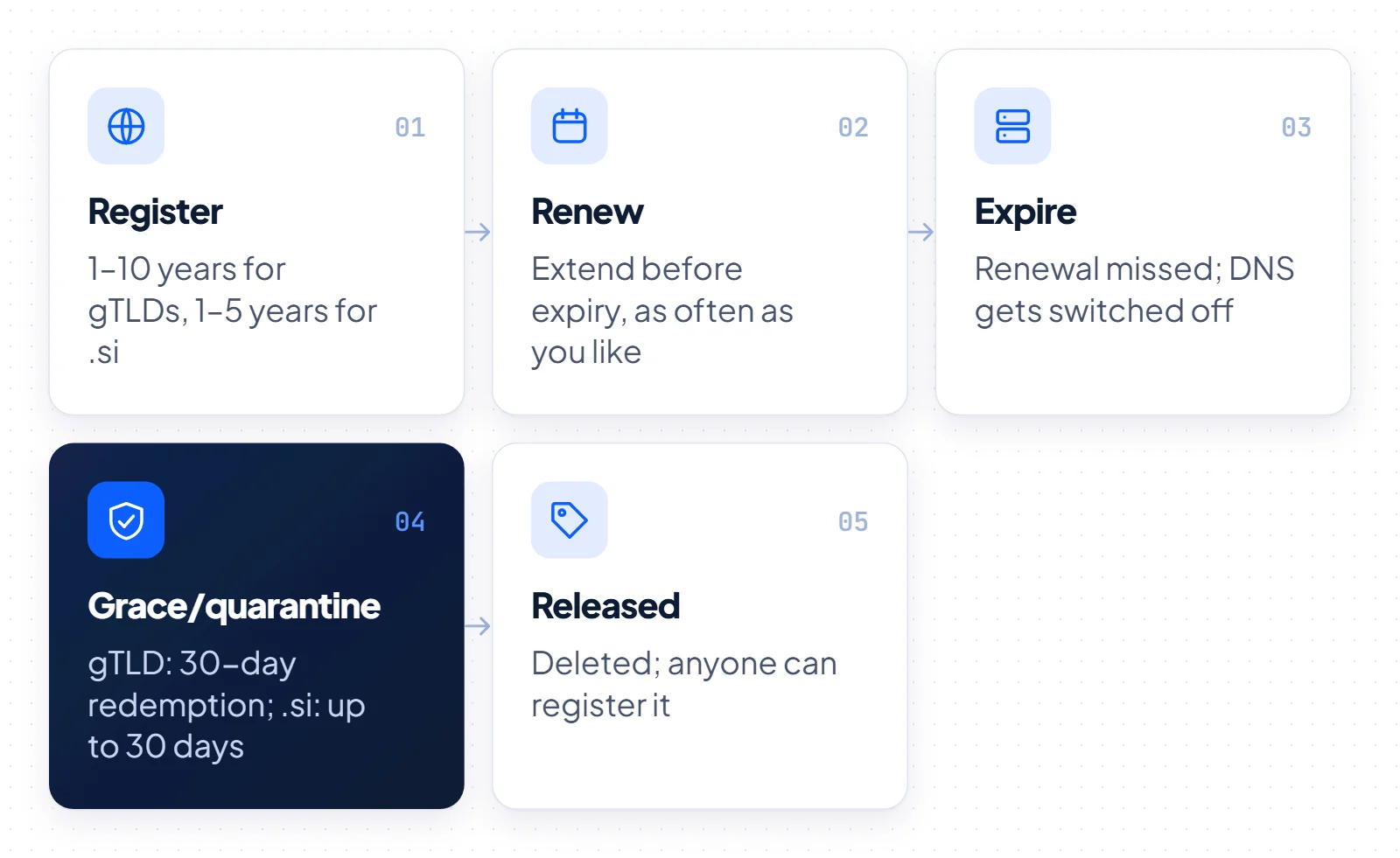
For .com and other gTLDs, ICANN’s Expired Registration Recovery Policy requires registrars to send renewal reminders about one month and one week before expiry. Registrars must send another notice within 5 days after expiry. The registrar must cut DNS resolution for at least the last 8 days the name is still renewable, so the website and email stop. After deletion, gTLD registries other than sponsored ones must offer a 30-day Redemption Grace Period. For .com, about 5 more days follow before the name is purged and released.
Large companies have learned this the hard way. According to The Register, Microsoft let passport.com lapse in December 1999, partly disrupting Hotmail. In October 2003 it let hotmail.co.uk expire until a private individual registered it and arranged to hand it back. Foursquare’s domain expired on March 25, 2010, and its registrar replaced the site with its own landing page until Foursquare quickly renewed it, TechCrunch reported. On July 25, 2017, MarTech reported that marketo.com had lapsed after a missed renewal and that applications engineer Travis Prebble paid the renewal himself. “I didn’t buy the domain, just paid renewal,” he said, which sums up the point of this article.
Our guide to expired domains explains what happens to names nobody rescues.
How .si terms, renewal and quarantine work
You can register a .si name for 1 to 5 years and renew it without limit. There is no gTLD-style grace and redemption period, only a quarantine of up to 30 days. Register.si, operated by Arnes, sets these rules in its General Terms (version published November 15, 2024), because ICANN leaves policy for country-code domains to each ccTLD manager.
If the holder does not renew a .si domain, Register.si puts it in quarantine on the expiry date. The registry also removes the domain’s pointers from the .si DNS at once, so the website and email stop working. The holder can still renew through the registrar during quarantine, which lasts at most 30 days. If nobody renews, the name is deleted and may be registered again by anyone. Registrars, not the registry, are responsible for warning holders that the term is ending.
During the term, a .si holder can transfer the name to a third party, and the transfer does not change the registration period. The General Terms define a holder as any natural or legal person.
Register.si charges registrars €10 per year (VAT excl.) for registration or renewal, under the tariff valid from January 1, 2023. The registry states it has no influence on the retail prices registrars set. Our .si domain guide covers who can register and how.
The first renewal test is due in 2027. A .si term ends on the same day of the month as the registration date. One-year names from the September 2026 rush therefore reach their first expiry in September 2027.
No public figure shows how many rush names were registered for one year. Netcraft found that about 52% of .si names registered through Dynadot from September 19 to 22, 2026, were later offered for resale (CircleID, October 1, 2026). That suggests many holders may weigh the renewal fee against what a buyer would pay.
Buying a premium .si name
Disclosure: buysidomains.si sells .si names at fixed prices through Escrow.com. Each listed name carries a fixed aftermarket asking price, for example the three-letter mkr.si. That price buys the holder position, not permanence.
The buyer pays Escrow.com, which says it “can withhold payment until we’re satisfied the domain name has been transferred.” The seller then transfers the name at Register.si, and the buyer becomes the holder for the remaining term. Every renewal from then on is the buyer’s. Register.si charges registrars €0 for a transfer to a third party under the same tariff. Our explainer on how domain escrow works walks through each step.
Is it worth owning a domain?
For a name you will build on, yes, as long as you treat renewal as a standing cost rather than a one-time event. A site and its email depend on the name, and ICANN warns that missing a renewal means you risk losing it. What to do next depends on where you stand:
- Launching on a .com or another gTLD: register for 10 years, turn on auto-renew and request a registry lock for the main brand name.
- Holding a .si you use: renew for 5 years, the maximum Register.si allows, set auto-renew with your registrar and ask whether it offers a registry lock.
- Holding a one-year .si from the September 2026 rush: decide before September 2027 whether to keep it. If you will not use it, let it go on purpose rather than by accident.
- Buying a taken name: budget for the aftermarket price once and the renewal every year after. Pay through escrow, and confirm the holder change at the registry before you announce the name.