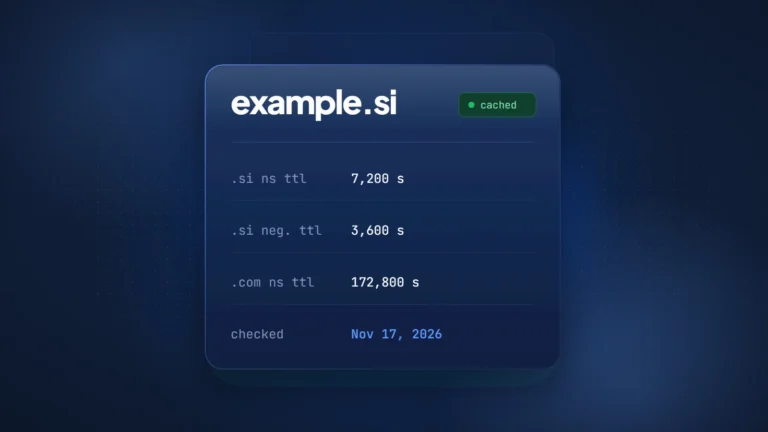
A domain backorder is a request to a registrar or drop-catch service to register a specific domain the moment the registry deletes it. It is an attempt, not a reservation. The current holder can still renew, other services race for the same name, and contested catches usually end in an auction.
Two things have changed since late 2025. GoDaddy stopped selling backorders: its archived help guide calls the product legacy and says it was no longer updated as of October 7, 2025. And .si went through a registration rush, from 190,719 names in August 2026 to 425,141 on October 17, 2026, according to Register.si’s domain count. Interest in the mechanism is measurable: “domain backorder” draws about 500 monthly searches in the US and 1,500 worldwide (Ahrefs, October 17, 2026).
What does “domain backorder” mean?
A domain backorder is a standing order asking a registrar or a drop-catch service to register a named domain as soon as the registry deletes it. Dynadot describes the service as an attempt to register a name for you once it completes its expiration and drop process. A backorder gives you no right to the name. Name.com says placing one is never a guarantee, and a 2017 USENIX study notes that drop-catch services do not control a domain when you place the order.
Drop catching, as Wikipedia defines it, is registering a domain the instant its registration lapses. The backorder is the customer order; drop catching is the automated race that fills it. Neither touches a domain that keeps renewing.
To backorder a domain is to bet that the holder lets the registration lapse and that your provider wins the race. If you need a name by a launch date, it is the wrong tool.
How a domain backorder works for .com and other gTLDs
A backorder waits out the full ICANN expiry cycle, which for .com and other generic top-level domains can run about 80 days from expiry to drop.
- Reminders. Under ICANN’s Expired Registration Recovery Policy, registrars must send renewal notices about one month and about one week before expiry.
- Auto-renew grace. The registrar may offer a grace period of 1 to 45 days in which the holder can still renew. The registrar must interrupt DNS for at least the last 8 days of that window.
- Redemption. After deletion, gTLD registries must offer a 30-day Redemption Grace Period in which only the previous holder can restore the name.
- Pending delete. An unrestored name sits in PendingDelete for 5 days.
- Release. The registry releases it on a first-come, first-served basis, per ICANN’s registrant FAQ. This is the moment backorders fire.
Under ICANN rules, an expired .com can spend up to 45 days in auto-renew grace, 30 days in the Redemption Grace Period and 5 days in PendingDelete. Only then does the registry release the name, so the whole cycle adds up to about 80 days. Registrars describe their own timelines: Name.com refers to a 77-day deletion process, and Dynadot says most domains drop about 75 days after expiry.
Not every expired name reaches the drop: the 2017 USENIX study found that some registrars sell their customers’ expired names during the grace period. Check the name’s status in WHOIS or RDAP before you order, since Name.com only accepts a backorder once a drop date is set.
Drop catching: why most backorders are a race
At release, specialist services fire requests through many registrar accounts at once. Lauinger and colleagues reported in 2017 that drop-catch services use multiple rate-limited registrar credentials and place servers physically close to the registry. Citing industry sources, they described Verisign’s daily .com drop as starting at 2pm ET and lasting up to an hour.
In the 2017 USENIX study “Game of Registrars”, drop-catch services controlled over 75% of accredited registrars and caused more than 80% of domain creation attempts. Yet they represented at most 9.5% of successful creations. The same study found that about 10% of deleted .com domains were re-registered the same day. For .org, over half of drop-day re-registrations happened within 30 seconds.
Miramirkhani et al. (WWW 2018) followed 28.4 million pending-delete .com, .net and .org names from January to October 2017. On average only about 10% of dropped domains were caught, mostly on release day, with a median day-one rate of about 11%.
The numbers cut both ways. Most dropped names attract nobody, so a backorder on an obscure name often succeeds. A valuable name draws several catchers, and the winner usually auctions it.
What a domain backorder costs, and who wins
Most backorder services charge only when they catch the name. A contested catch becomes an auction, and the backorder fee is then only the opening bid.
Dynadot says placing a backorder is free and you pay only on a catch. On October 17, 2026, its page displayed €22.24 for a standard .com catch when viewed from Slovenia, with higher-priced priority options. If several customers backorder a name, Dynadot runs a public auction for 7 to 10 days, and the first backorder holder receives the initial bid.
Other providers set their own terms. Name.com allows one backorder per domain and refunds in full if it does not obtain the name. Crazy Domains’ help page states there is no refund once you buy the service. A Network Solutions guide (June 5, 2026) says private auctions among backorder holders usually last 72 hours.
The 2017 USENIX paper reported drop-catch starting prices of up to 10 times the annual registration fee, with winners typically decided in a three-day private auction.
What was GoDaddy’s domain backorder?
GoDaddy Backorders & Monitoring was a paid service that tried to acquire a domain when it became available. Per GoDaddy’s archived help guide, a purchase included Domain Monitoring, an auctions membership, $25 toward a first auction bid and one year of registration.
When GoDaddy caught a name from another registrar, a sole backorder holder paid an extra $15 for delivery, and several holders went to a private auction. Names expiring at partner registrars went to a 10-day public auction instead. It covered nine extensions: .biz, .co, .com, .info, .me, .mobi, .net, .org and .us. The guide calls it a legacy product, no longer sold or updated since October 7, 2025.
| Option | How it works | Cost model (as published) | Odds | Fits when |
|---|---|---|---|---|
| Single-registrar backorder | One registrar tries to register the name at release | Often free to place, pay on catch (Dynadot: €22.24 for .com, October 17, 2026) or refund on failure (Name.com) | Good for uncontested names; weak against dedicated catchers | Low-interest names, small budget |
| Drop-catch service | Specialist fires requests through many registrar accounts at the drop | Pay on catch; starting prices up to 10 times the annual fee (2017 study); contested names go to auction | Best chance at the drop; final price set by rival bidders | Names other people also want |
| Registrar expired-domain auction | The holder’s registrar sells the expired name before it drops | Auction price set by bidders | Only where the registrar runs one; the name may never reach the drop | Names still in grace |
| Contact the holder before expiry | You negotiate with the current holder and pay through escrow | Negotiated price plus escrow fee | Depends on the holder; works for active names too | Names you need by a fixed date |
None of the providers we checked publish backorder success rates; the academic figures above are the best public guide.
What a backorder cannot do
A backorder only works on names that actually drop, in extensions your provider supports. It cannot:
- Stop the holder renewing. The holder can renew through grace and restore through redemption, and GoDaddy’s guide named renewal by the current registrant as one reason a backorder could fail.
- Pull a name out of redemption. Only the previous holder can restore a gTLD name during the 30-day Redemption Grace Period.
- Force a sale of a live domain. That takes a negotiated purchase; see our guide to buying a domain that is already taken.
- Cover every extension. Dynadot says it does not drop-catch its full list of registrable TLDs.
- Override a country-code registry. ccTLDs set their own rules. Canada’s CIRA releases deleted .ca names in a To Be Released session every Wednesday at 19:00 UTC, while .si uses a single quarantine.
- Clean up the past. A caught name keeps its old backlinks and reputation, so review its domain history before you build on it.
Can you backorder a .si domain?
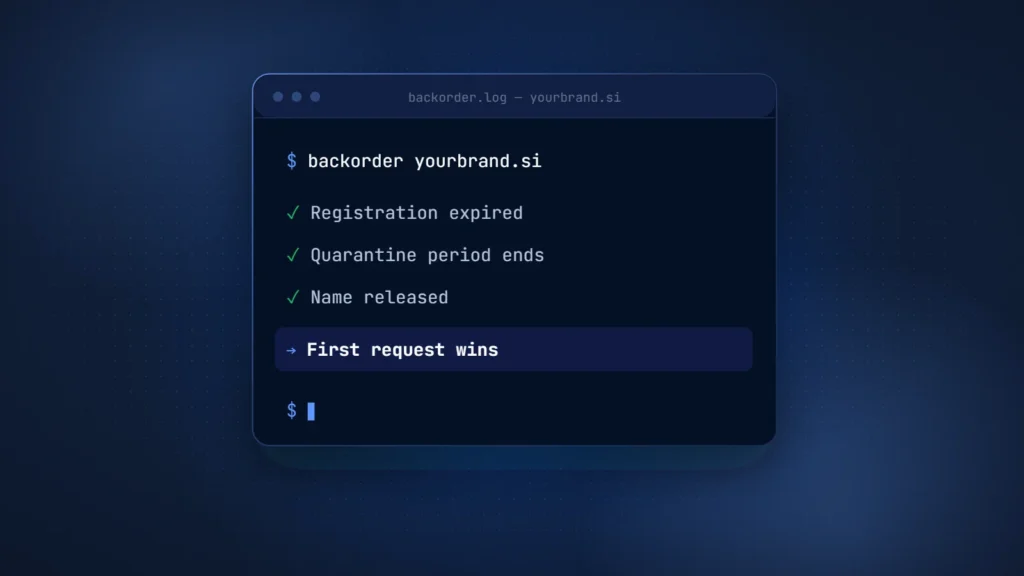
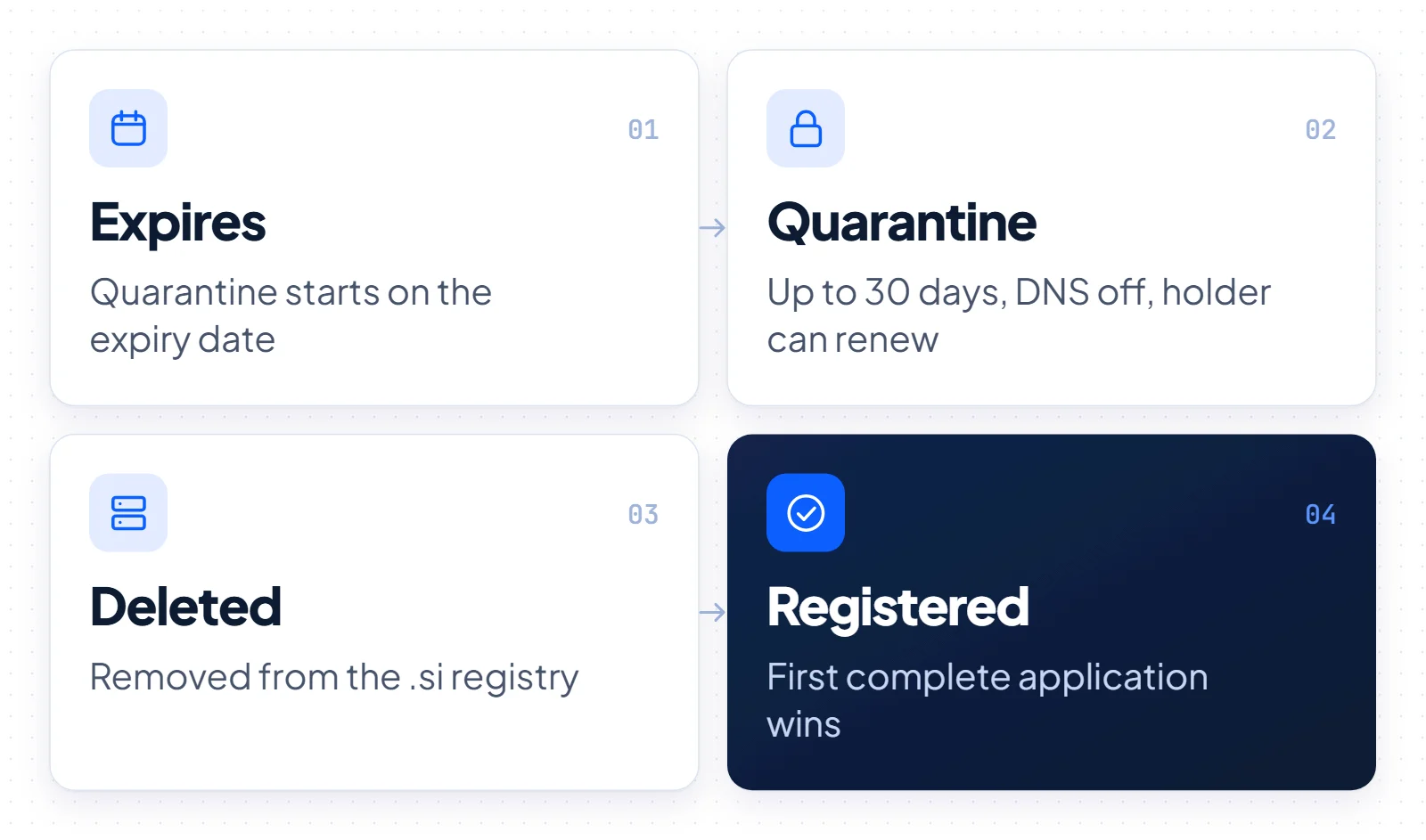
You cannot backorder a .si domain at the registry. .si is Slovenia’s country-code domain. For AI companies it reads as SuperIntelligence, which is our framing, not an official meaning. Register.si offers no backorder. Under its General Terms (November 15, 2024), a lapsed .si spends at most 30 days in quarantine. Register.si then deletes the name, and it goes to the first complete application.
Register.si’s General Terms (November 15, 2024) set the .si release rules. An unrenewed .si gets quarantine status on its expiry date (art. 5.3.2), and quarantine also applies after a deletion request (art. 5.4.1). During quarantine the registry removes the name from the .si DNS, and the status may last no longer than 30 days (art. 5.4.2). If the holder does not renew, Register.si deletes the name and it may be registered again (art. 5.4.3). The registry processes complete applications first come, first served (art. 5.2.1).
Per Register.si’s page on renewing and deleting, the holder can ask the registrar to renew any time before quarantine ends, which reactivates the name. The General Terms describe no registry backorder, waitlist or reservation service. We also found no public list of .si names due for deletion and no published release time. Any service selling a “.si backorder” is a registrar trying to submit the first application after deletion, under the same first-come rule as everyone else.
When a .si can lapse depends on its term. Holders register or renew .si names for 1 to 5 years, and each period ends on the same day of the month as the registration (art. 5.1.1). Names registered for one year in September 2026 come up for renewal in September 2027. We found no public breakdown of rush registrations by term, so the size of any lapse wave is unknown.
For a specific .si, these steps beat waiting:
- Check the name’s status and expiry in WHOIS or RDAP. A quarantined name no longer serves a website or email.
- Contact the holder before expiry and agree on a price. Pay through domain escrow and complete the move with the EPP code.
- If the name is already in quarantine, ask your registrar to apply at deletion, knowing the holder can still renew.
- Compare with names that are for sale now. buysidomains.si sells .si names at fixed prices through Escrow.com, so we have an interest in this option.
Our guide to expired domains covers quarantine in more detail, and the .si domain guide explains who can register a .si and what the €10 yearly registry fee covers.
Backorder or buy now: how to decide
Pick the route by how much the name matters and how long you can wait.
- An obscure gTLD name you can live without: place a pay-on-success backorder and wait out the roughly 80-day cycle.
- A name others will want: expect an auction. Set your ceiling first and compare it with what the holder might accept today.
- A name you need for a launch date: skip the backorder and contact the holder, with escrow protecting both sides.
- A .si name: there is no registry queue to join. Track the expiry date, approach the holder before quarantine, or buy a .si that is listed for sale.
A backorder costs little to place. Treat it as a bet on a lapse, and pursue the name you actually need through its holder.