A domain registrar is the accredited company that registers domain names for the public and submits them to the registry that runs each top-level domain. In practice, the answer to what is a domain registrar is the business you pay to register, renew, point and transfer a name. That holds for .com, .ai, .si and any other extension.
The registrar is also the party a public lookup reliably names. Since January 28, 2025, RDAP has been the definitive source for gTLD registration data, and an RDAP lookup shows the sponsoring registrar for any gTLD name.
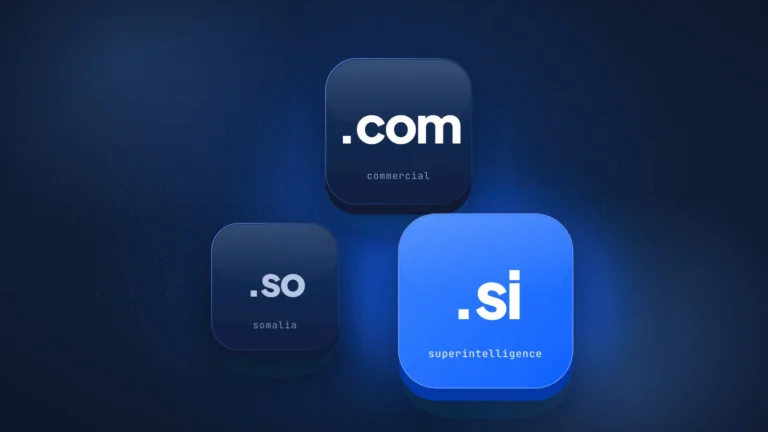
This guide uses .si as its worked example. .si is Slovenia’s country-code domain. For AI companies it reads as SuperIntelligence. The .si zone has its own registry and accreditation rules, and its registrars are a mix of local and foreign companies. We checked which registrars hold 32 well-known .si names.
What is a domain registrar and what does it do
A domain registrar is a company accredited to take domain registrations from customers and record each name with its top-level domain’s registry. ICANN defines a registrar as “an organization through which individuals and entities (registrants) register domain names.” During registration, the registrar checks that the name meets the registry’s rules and sends it to the registry operator. A registrar that signs ICANN’s Registrar Accreditation Agreement (RAA) becomes an ICANN-accredited registrar.
Day to day, a registrar handles five jobs:
- Registration and renewal. It books the name for a term, up to 10 years for most gTLDs and 1 to 5 years for .si, and renews it before expiry.
- Nameservers. It sends your nameserver changes to the registry, so the name points to the right DNS host.
- Transfer codes. It issues the EPP or auth code that authorizes a transfer to another registrar.
- Locks. It sets “client” status codes, such as a transfer or delete lock, when you ask.
- Registrant data. It collects the holder’s details and passes the required fields to the registry.
A registrar does not own the top-level domain or its master database. That is the registry’s job. A registrar also does not have to host your website or your DNS. Many registrars sell both as extras, but you can use a different company for each role.
Some shops that sell domains are not registrars at all. They are resellers. Under section 3.12 of the 2013 RAA, the accredited registrar stays responsible for every name it sponsors, even when a reseller handles the customer. A reseller must also name that registrar if a customer asks.
Registry vs registrar vs registrant
The registry runs the database for one top-level domain, the registrar sells and manages registrations in it, and the registrant holds the right to use the name. For .com the registry is Verisign. For .ai it is the Government of Anguilla, with Identity Digital as technical operator, and for .si it is Arnes, which runs Register.si. A registry takes its add, change and delete requests from registrars, so a registrant normally works through one.
| Role | What it does | .com | .ai | .si |
|---|---|---|---|---|
| Registry | Keeps the master database of all names in one TLD | VeriSign Global Registry Services | Government of Anguilla (Identity Digital runs the platform) | Arnes, through Register.si |
| Registrar | Sells registrations, sends changes to the registry, issues transfer codes | GoDaddy.com, LLC (IANA ID 146) | Cloudflare Registrar and other accredited registrars | Webtasy, Telekom Slovenije, INWX and other accredited registrars |
| Registrant | Holds the right to use the name for the paid term | You, the customer | You, the customer | You: any natural or legal person |
The table shows why “who owns my domain” is the wrong question. You hold a renewable right to use the name. The registry keeps the record, and the registrar is the company you deal with to change it.
Who can become a domain registrar
A company can become a domain registrar only after accreditation from whoever sets the rules for the TLD. For generic TLDs such as .com, that is ICANN. For country-code TLDs, each registry runs its own accreditation, which is one reason country-code domains differ so much in their rules.
ICANN’s route is formal and costly. Applicants pay a non-refundable US$3,500 application fee, and ICANN deems US$70,000 or more in working capital adequate for a new registrar. Once approved, a registrar pays US$4,000 a year, plus variable fees and US$0.20 per transaction.
ICANN’s list of accredited registrars showed 3,325 accreditations on October 21, 2026. That figure overstates the number of real companies, because many accreditations belong to the same groups, often for drop-catching expired names.
The .si registry sets a different bar. Register.si’s guide to becoming a registrar asks for a seat in the European Union, or ICANN accreditation for companies outside the EU. A candidate also needs an active website, must pass the registry’s Operational Test & Evaluation (OT&E) and must meet an annual quota set in its registrar agreement.
Register.si’s registrar list showed 100 accredited registrars on October 21, 2026, and 39 of them sit outside Slovenia, including GoDaddy, Namecheap, MarkMonitor, EPAG and INWX. Arnes itself may act as registrar only for legal persons on the ARNES research network, which is why Slovenian universities appear under Arnes in our data.
Someone who wants to sell domains without that overhead usually becomes a reseller instead.
Which registrars hold well-known .si domains
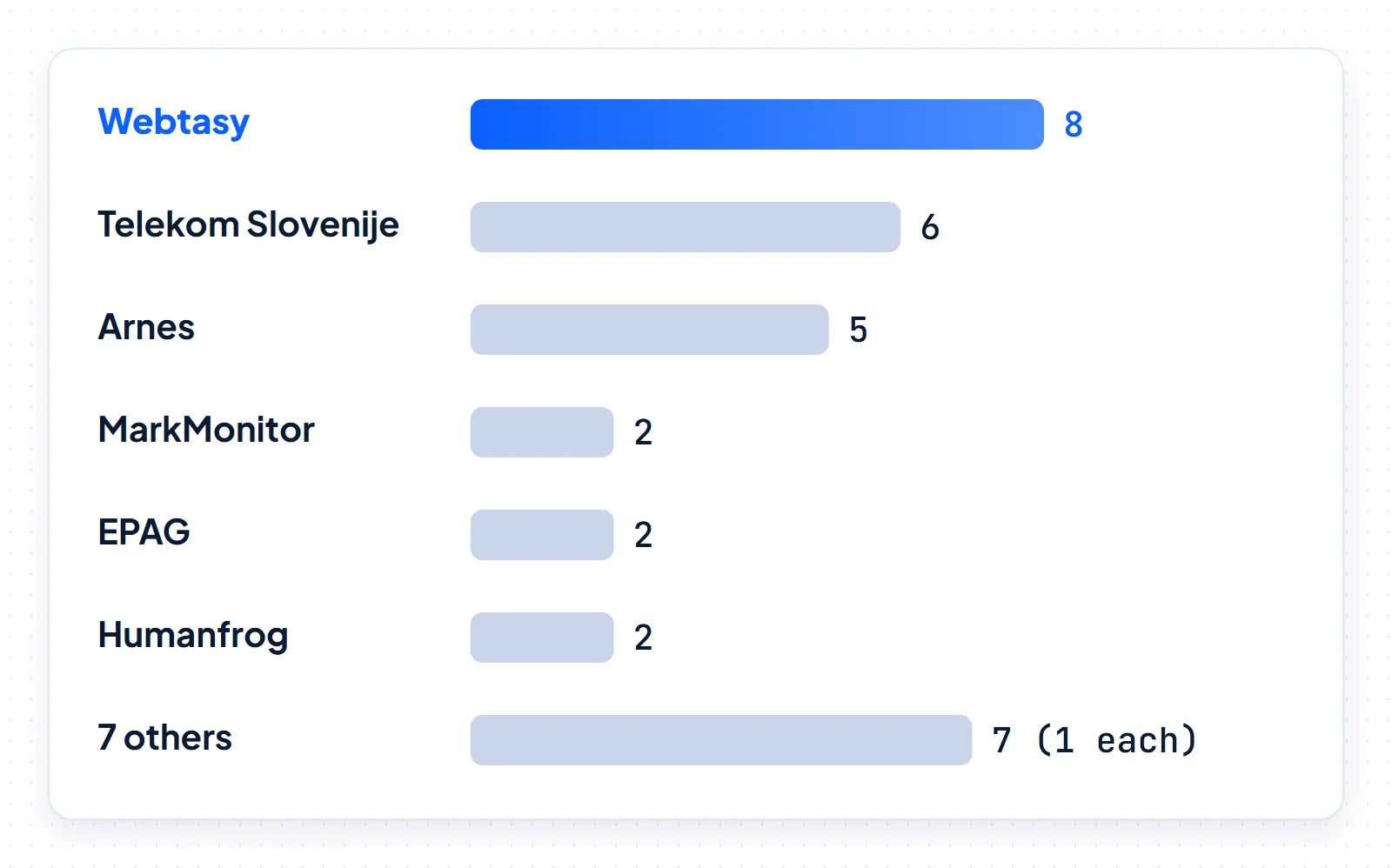
A BuySI Domains RDAP check of 32 well-known .si domains on October 21, 2026 found 13 different registrars. Webtasy led with 8 names, followed by Telekom Slovenije with 6 and Arnes with 5. We queried the .si registry’s own server, rdap.register.si, for a sample that covers banks, telecoms, media, retail, universities, government and tech. Four of the 13 registrars appear on Register.si’s list of foreign registrars: MarkMonitor in the US, EPAG and INWX in Germany, and Plus Hosting Grupa in Croatia.
| Registrar | Domains in sample | Example domains |
|---|---|---|
| Webtasy, d.o.o. | 8 | sava.si, rtvslo.si, mercator.si, gorenje.si, elan.si, pipistrel.si, outfit7.si, celtra.si |
| Telekom Slovenije, d.d. | 6 | nlb.si, nkbm.si, petrol.si, telekom.si, 24ur.si, delo.si |
| Arnes | 5 | uni-lj.si, um.si, ijs.si, arnes.si, register.si |
| MarkMonitor, Inc. | 2 | lek.si, zemanta.si |
| EPAG Domainservices GmbH | 2 | a1.si, spar.si |
| Humanfrog d.o.o. | 2 | posta.si, triglav.si |
| Ministry of Digital Transformation | 1 | gov.si |
| T-Media d.o.o. | 1 | krka.si |
| Telemach Slovenija d.o.o. | 1 | telemach.si |
| Plus Hosting Grupa d.o.o. | 1 | zurnal24.si |
| AOI d.o.o. | 1 | hofer.si |
| INWX GmbH | 1 | lidl.si |
| Webicom d.o.o. | 1 | bitstamp.si |
Source: .si registry RDAP server, checked by BuySI Domains on October 21, 2026.
None of the 32 records listed a registrant entity, because anonymous RDAP returned only the registrar role. That matches Register.si’s RDAP rules, which hide holder and technical contact data from anonymous users. The .si WHOIS still publishes some data, but for private individuals it shows only an email address.
The lock statuses also differ. The registry’s own domain, register.si, carries server delete, transfer and update prohibitions, which the registry sets. Two MarkMonitor names, lek.si and zemanta.si, carry client delete and update prohibitions, which the registrar sets. ICANN’s guide to EPP status codes says server codes take precedence over client codes. The other 29 names showed a plain “active” status.
The government domain gov.si has no outside registrar: its registrar of record is the Ministry of Digital Transformation itself. RDAP also showed DNSSEC as active on 5 of the 32 names. Treat these results as a snapshot of well-known names, not a census of the whole .si zone.
How to find a domain’s registrar
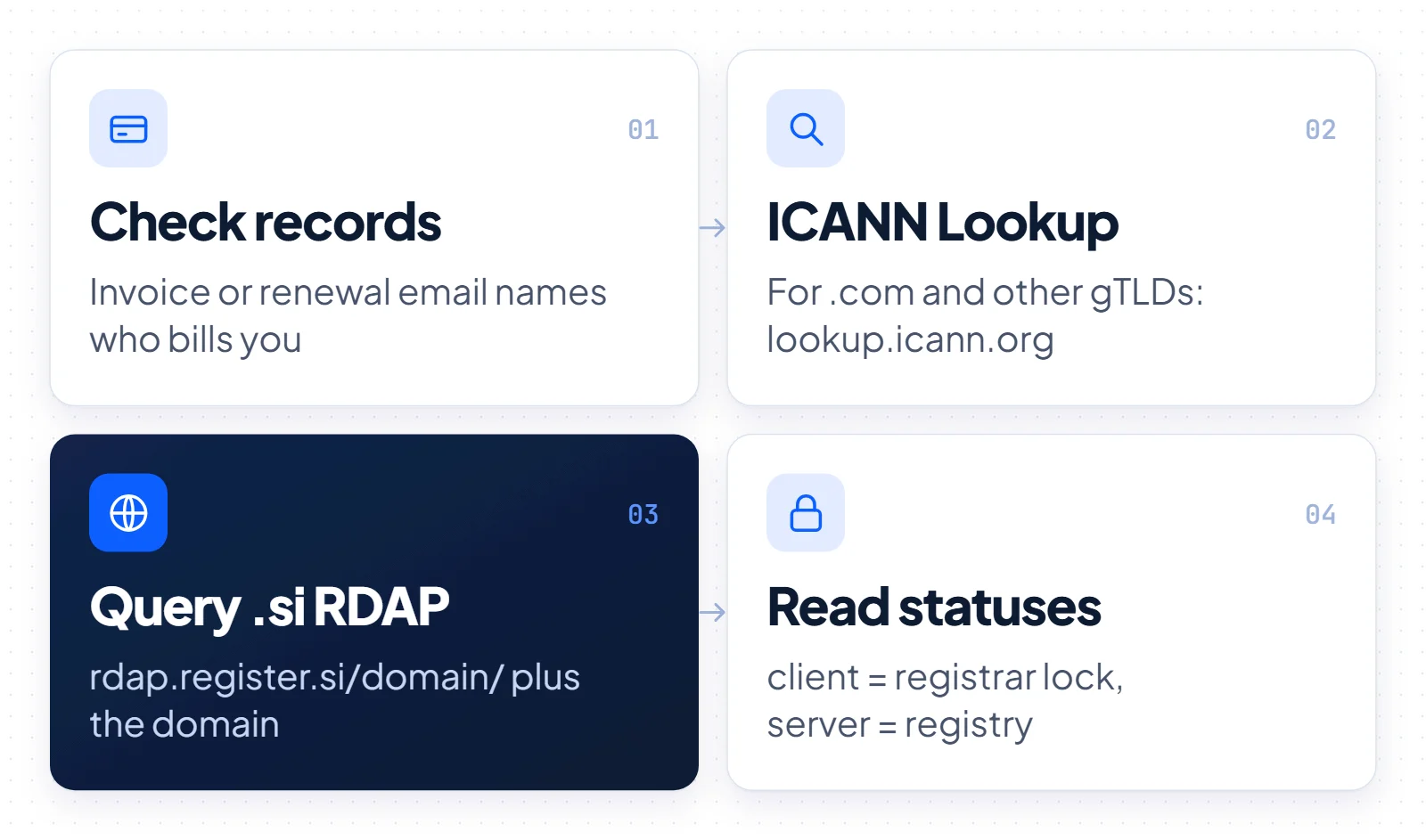
To find a domain’s registrar, run an RDAP lookup on the right server and read the registrar field. For gTLDs such as .com, ICANN Lookup finds the server for you. For .si, you query Register.si’s RDAP server directly. The registrar field names the accredited registrar, even when you bought the name from a reseller.
- Check your own records. If the domain is yours, the renewal invoice or reminder email names the company that bills you. That company may be a reseller, so confirm with the next steps.
- Use ICANN Lookup for gTLDs. Enter the name at lookup.icann.org. ICANN points users to this RDAP-based service for generic TLD data.
- Query the .si registry for .si names. Open rdap.register.si/domain/ followed by the name, for example rdap.register.si/domain/arnes.si. The JSON response lists the registrar as an entity with the role “registrar”.
- Read the status codes. Codes that start with “client” come from the registrar. Codes that start with “server” come from the registry, and a transfer lock in either group blocks a move.
How to choose a registrar
Judge a registrar on four things: whether it sells your extension, what renewal costs, how well it protects your account and how transfers work. The first-year price tells you the least, because every later year is billed at the renewal price.
Check that it sells the extension
Not every large registrar sells every country-code domain. For .si on October 21, 2026:
- Namecheap sells .si and appears on Register.si’s registrar list. Its .si registration page pitches the extension to “Super Intelligence” businesses, a marketing angle rather than an official meaning.
- Porkbun sells .si on its own .si page to registrants worldwide, through an upstream registrar.
- INWX is an accredited .si registrar and states that .si has no residency requirement.
- GoDaddy appears on Register.si’s list of accredited .si registrars.
- Gandi offers .si only to customers with a Gandi Corporate Services contract.
- Cloudflare Registrar did not have .si on its TLD list.
Compare renewal terms, not launch offers
Registrars set their own retail prices, and the .si registry says it has no influence on them. Look at the renewal price for year two and beyond, plus any fee to transfer out. Our guide to .si renewal prices at different registrars lays out those terms.
Protect the account
Turn on two-factor authentication and keep a registrar lock on any name that matters. For valuable .si names, Register.si also offers a registry lock, which blocks any change to the domain’s settings except renewal. Check DNSSEC support too.
Changing registrars or buying a domain
Moving a domain changes its registrar, not its registry. For gTLDs, you remove the transfer lock, get the auth code from the current registrar and give it to the new one. Our step-by-step guide to transferring a domain covers the full process.
The ICANN Transfer Policy in force on October 21, 2026 still lets a registrar deny a transfer within 60 days of registration or of a previous transfer. It also requires a 60-day transfer lock after a change of registrant, unless the registrar lets the holder opt out before the change.
On June 7, 2026, the ICANN Board adopted 47 recommendations to change those rules. According to the Board’s briefing materials, they include a mandatory 30-day transfer restriction after registration, plus a 30-day restriction after a transfer that registrars may lift early under set conditions. They would also end the 60-day lock after a change of registrant and rename the auth code Transfer Authorization Code, or TAC. ICANN has not set an effective date yet, so the current 60-day rules still apply.
The .si rules are simpler. To change registrar, the holder sets an authinfo code at the current registrar and gives it to the new one, and the registration period stays the same. A change of holder runs through the registrar once both the old and new holder confirm, and the .si rules mention no 60-day lock afterward.
Buying an existing name from its holder combines both steps. With a .si, the registrar records the change of holder, and the buyer can then move the name to any registrar. Our guide to .si domains covers the holder rules. A name like netserver.si suits a hosting, DNS or registrar business. BuySI Domains lists netserver.si for sale.
Your next step depends on where you stand:
- You already own a domain: look up its registrar, check that it matches the company that bills you, and turn on 2FA and a transfer lock.
- You are registering a new .si: start from Register.si’s registrar list or a registrar whose .si page you can check, and compare renewal terms first.
- You are buying a name: agree with the seller which registrar will record the change of holder before any payment.
- You want to sell domains yourself: start as a reseller, and seek accreditation only once you have the volume and technical staff for it.