Domain renewal is the fee you pay every year after the first registration term ends, and it is the real long-term cost of a domain. First-year prices are often discounted, so compare the renewal price before you register, and renew before the expiry date to keep the name, the website and the email working.
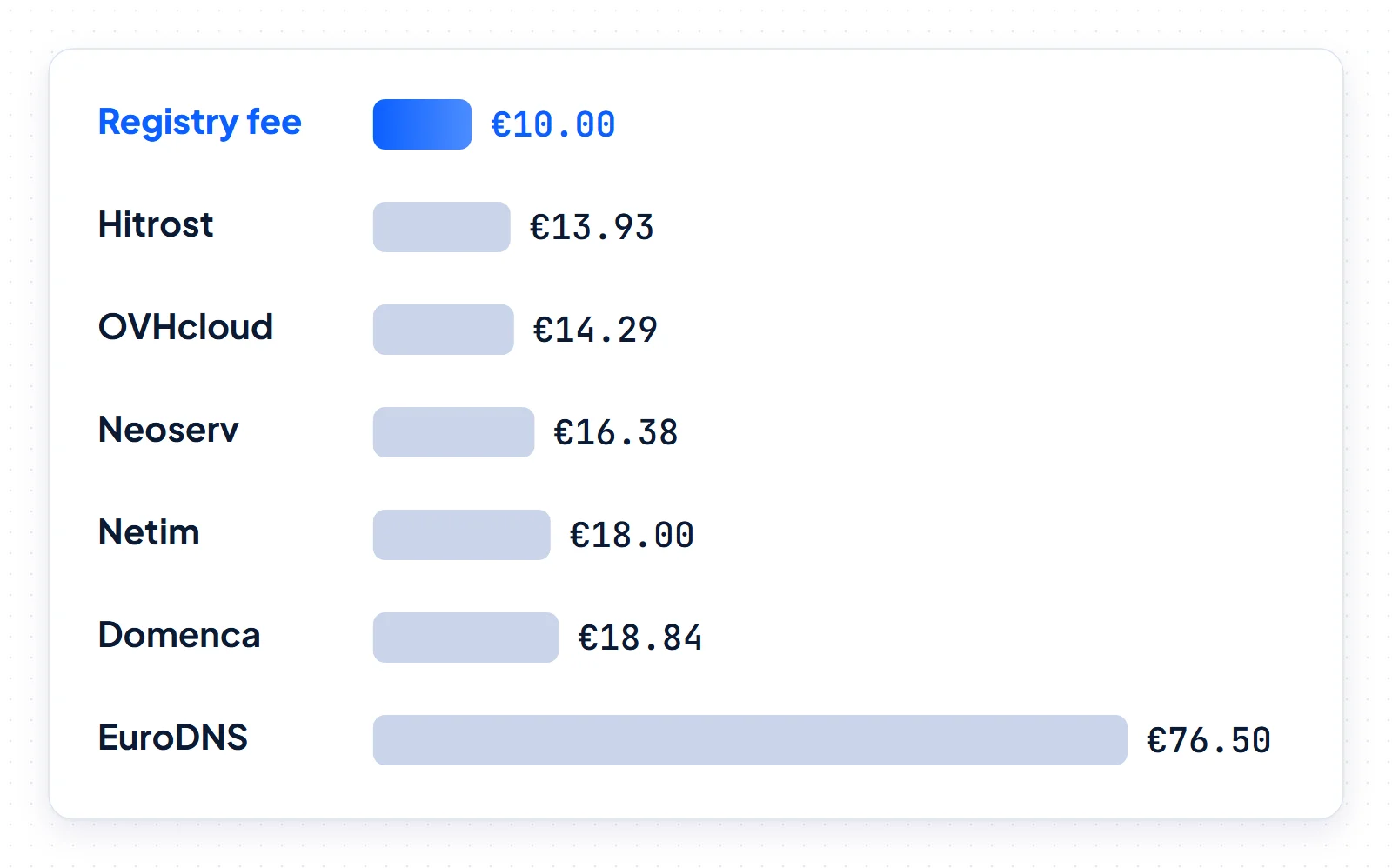
On October 18, 2026, buysidomains.si checked .si prices on 13 registrars’ own pages. Register.si, the .si registry, charges every registrar €10 a year before VAT. Euro renewal prices ran from €13.93 before VAT at Hitrost.com to €180 before VAT for Gandi’s corporate-only offer. The three Slovenian registrars in our check sell the first year for roughly €11 before VAT, barely above the registry fee, and earn their margin on renewal.
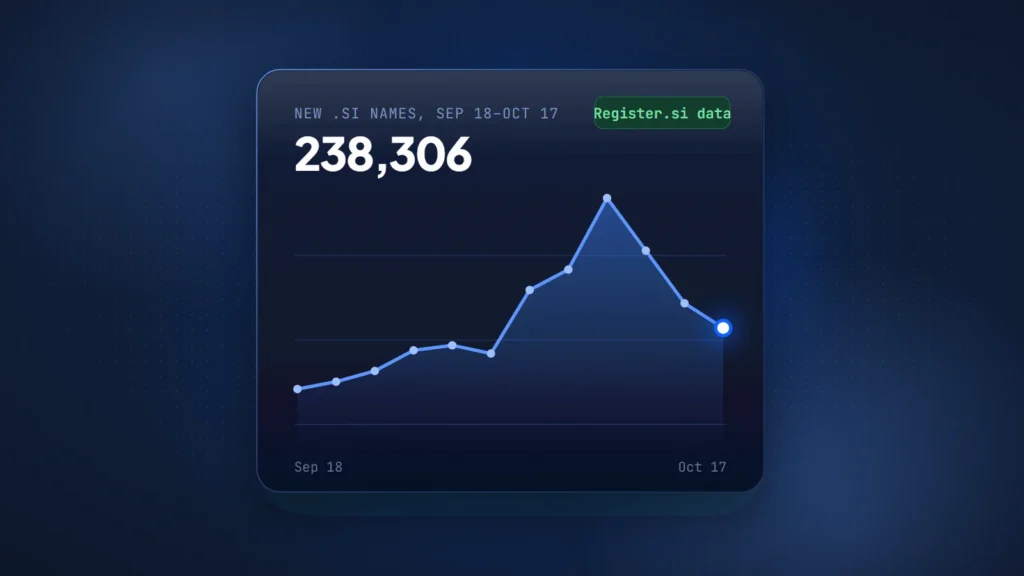
Timing matters more than usual this year. Register.si’s daily chart counts 238,306 new .si names registered between September 18 and October 17, 2026. Every one of those registered for a single year comes up for its first renewal in September or October 2027. The registry does not publish how many holders chose one year, so the size of that wave is still unknown.
Why does domain renewal cost more than the first year?
Domain renewal extends your registration for another term at the registrar’s renewal price, not its first-year promotion. The second year often costs more because registrars use cheap first years to win customers and recover the discount later.
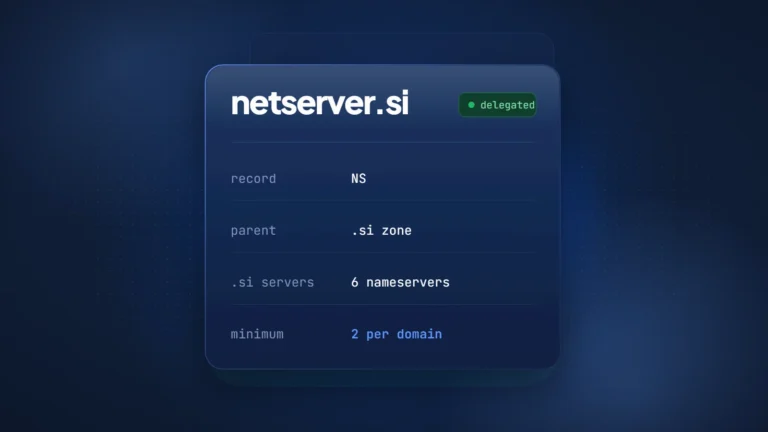
Every renewal price has two parts. The registry that runs the extension charges the registrar a wholesale fee, and the registrar adds its margin, support and billing costs. For .si, the fee is €10 per year before VAT for registration or renewal, according to Register.si’s tariff for registrars. The tariff states that these fees are for registrars only, so no holder ever pays Register.si directly.
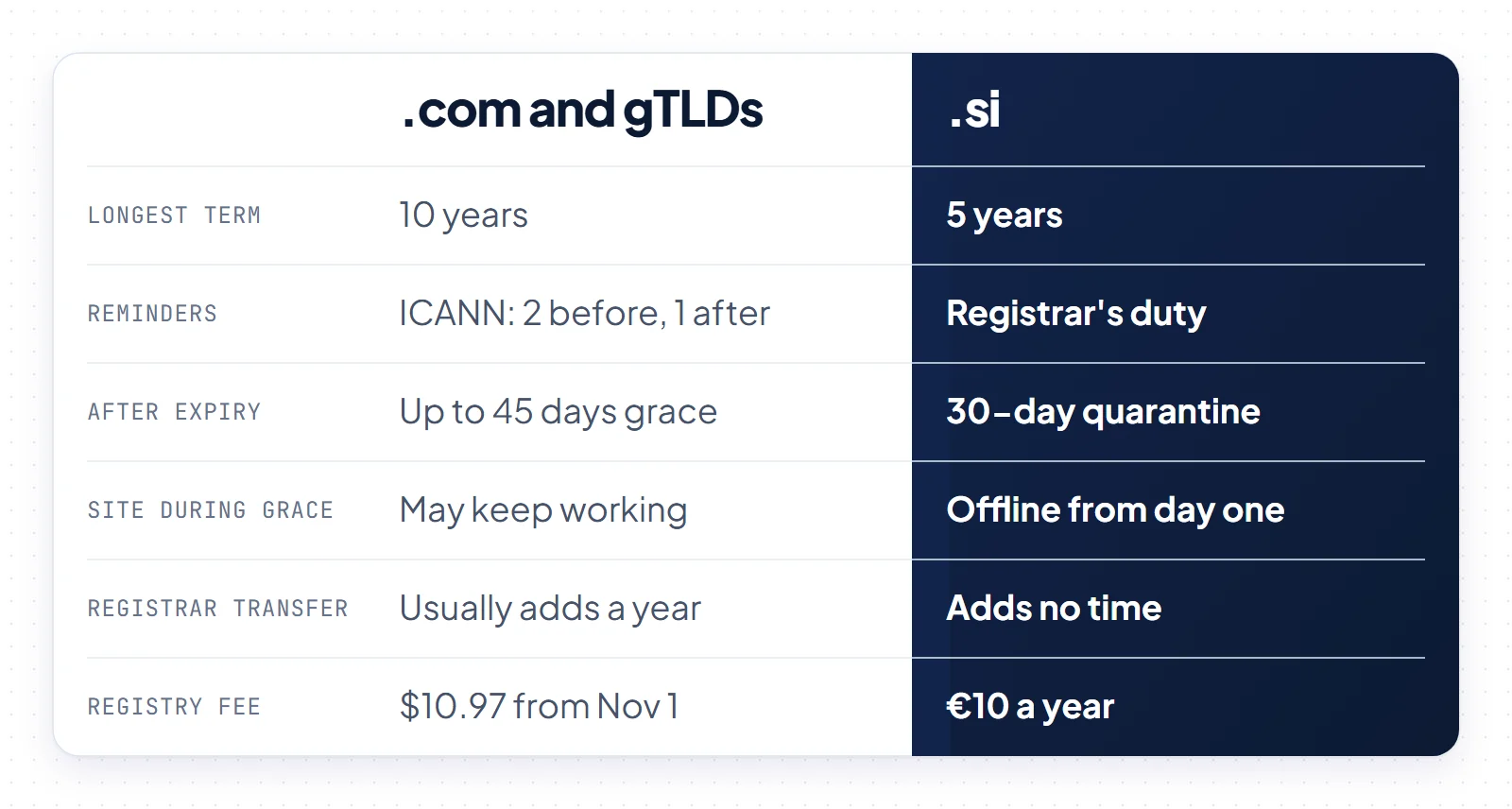
Wholesale fees move too. Verisign, which runs .com, raises its wholesale fee from $10.26 to $10.97 per year on November 1, 2026, according to its quarterly filing with the SEC. The increase covers new names and renewals alike, so holders of existing names feel it at their next renewal. ICANN adds $0.20 a year on top.
Some extensions also set minimum terms. Registrar documentation shows that .ai registrations and renewals require at least 2 years, so a single .ai renewal bill always covers two years. Our guide to domain cost breaks down registration, renewal and aftermarket prices across extensions.
Domain renewal prices for .si: our check of 13 registrars
Renewal prices for .si ranged from $11.57 a year at Dynadot (US dollars) to €180 a year before VAT at Gandi (euros) in our October 18, 2026 check, against a registry fee of €10 a year before VAT. The cheapest first year did not always mean the cheapest five years.
We read each registrar’s own .si price page between 12:36 and 12:52 UTC on October 18, 2026. Prices stay in the currency and VAT basis each registrar shows, so compare rows within each group. Dollar prices are as listed: only INWX states that its prices are net of VAT, and checkout may add VAT depending on where you are. The five-year cost is one first-year registration plus four renewals at the prices we saw that day.
| Registrar | First year | Renewal (per year) | 5-year cost | Notes |
|---|---|---|---|---|
| US dollars, as shown by the registrar | ||||
| Dynadot | $11.57 | $11.57 | $57.85 | Same price every year |
| Spaceship | $10.98 | $11.98 | $58.90 | 8% off the first year |
| INWX | $12.75 | $13.75 | $67.75 | Net of VAT; restore after expiry $60 |
| Namecheap | $12.88 | $15.48 | $74.80 | 19% off the first year |
| Porkbun | $20.47 | $17.57 | $90.75 | Both sale prices (regular $23.70); not on Register.si’s accredited list |
| 101domain | $49.99 | $89.99 | $409.95 | Discount applies to the first year only |
| Euros, before VAT | ||||
| OVHcloud | €14.99 | €14.29 | €72.15 | Renewal cheaper than the first year |
| Netim | €18.00 | €18.00 | €90.00 | No restoration after expiry |
| EuroDNS | €14.99 | €76.50 | €320.99 | Promo price; not on Register.si’s accredited list |
| Gandi | €90.00 | €180.00 | €810.00 | Corporate contract only; not on Register.si’s accredited list |
| Euros, including 22% Slovenian VAT | ||||
| Hitrost.com | €13.49 | €16.99 | €81.45 | Promo first year (regular €16.99); renewal shown reduced from €20.99 |
| Neoserv | €13.99 | €19.98 | €93.91 | Promo runs to October 31, 2026; transfer with renewal €12.49 first year |
| Domenca | €13.99 | €22.98 | €105.91 | List price |
GoDaddy and Name.com sell .si, but their prices were not visible to our check, so they are not in the table. Cloudflare does not support .si. Porkbun, EuroDNS and Gandi sell .si names but are not on Register.si’s accredited list. Several first-year prices are promotions that end soon, so treat the first-year column as a snapshot.
At the three Slovenian registrars, .si renewal costs far more than the first year. Hitrost.com, Neoserv and Domenca sell the first .si year for €13.49 to €13.99 including VAT, which is €11.06 to €11.47 before VAT, about €1 above the €10 registry fee. They renew it for €16.99 to €22.98 including VAT, 26% to 64% more than the first year. At these registrars the margin sits in the renewal.
EuroDNS showed the widest gap between first-year and renewal prices for .si names: its €76.50 renewal is 5.1 times its €14.99 promotion, both before VAT. Over five years, a .si name cost $57.85 at Dynadot and €810 before VAT at Gandi, while the registry’s share over the same period is €50 before VAT.
What happens if you don’t renew a domain
If you don’t renew, a .com or other gTLD name usually gets weeks of grace, while a .si name enters quarantine on its expiry date and stops resolving. The rules differ because ICANN policy covers gTLDs, and Register.si sets the rules for .si.
For gTLDs, ICANN’s Expired Registration Recovery Policy requires registrars to send reminders about one month and about one week before expiry, plus one notice within five days after it. ICANN’s registrant guide to the ERRP says a registrar may offer an auto-renew grace period of 1 to 45 days. ICANN’s renewal FAQ describes a 30-day Redemption Grace Period after deletion, then 5 days of pending delete before the name drops.
An unrenewed .si domain enters quarantine on its expiry date, and the DNS pointers are removed, so the website and email stop working that day, according to Register.si’s general terms. Renewing during quarantine reactivates the name. Quarantine lasts no longer than 30 days. After that, Register.si deletes the .si name and anyone can register it.
Reminders are the registrar’s job. Clause 5.3.3 of the general terms makes registrars responsible for telling holders about expiry in time, and the registry relies on them to do it.
Our guide to expired domains covers recovery, and our domain backorder guide explains how others try to catch names that drop.
How to renew a domain, step by step
To renew a domain, check the expiry date, make sure the registrar can reach you, and pay for the next term before that date. The six steps below work for .si and gTLD names alike, with one .si exception on transfers.
- Check the expiry date in WHOIS or RDAP. Register.si advises .si holders to check it via WHOIS and contact their registrar to renew in time.
- Confirm the registrant email. Reminders go to the contact on file. If that address belongs to a former employee, nobody reads the notice.
- Turn on auto-renew and check the card. Auto-renew only works if the payment method is valid on the day the registrar charges it.
- Renew for several years. A .si name can be renewed for one to five years at a time, and gTLD names can be registered up to 10 years ahead. Paying upfront fixes the price for those years.
- Verify the new expiry date in RDAP. A receipt shows you paid, but only the registry record shows the renewal went through.
- Don’t count on a transfer to add time to a .si name. Register.si charges €0 for a change of registrar, and under clause 6.3.3 the change does not alter the registration period.
That last step catches people who know gTLDs, where a transfer usually adds a year. Moving a .si name is still useful for getting a lower renewal price. Our guides to transferring a domain and to the EPP code cover the process.
Auto-renew pitfalls that cost people their domains
Auto-renew prevents most lapses, but it fails quietly when the card expires, the email goes stale, or the registrar charges earlier than you expect. Check those three things once a year.
An expired card is the simplest way to lose a name. When the charge fails, the registrar’s warnings go to whatever email it holds. If that inbox runs on the expiring domain itself, the warnings stop arriving at the moment they matter.
Renewal windows vary by registrar. Amazon Route 53 says it attempts auto-renewal 35 days before expiry, and Dynadot described attempts starting 15 days before in a December 2022 post. Turning auto-renew off has deadlines too. OpenSRS says all .si domains on its platform renew automatically by default, and to let a name lapse, you must turn the setting off more than 2 days before expiry.
Contact data now matters for .si as well. Per OpenSRS, Register.si has run risk assessments on holder contact data since July 1, 2026 under the EU’s NIS2 rules. Domains are suspended if the holder does not complete verification within 21 days. Register.si itself confirms it can deactivate names whose holder data cannot be proven, so a paid renewal does not protect a name that fails verification.
Domain renewal scams: how to spot a fake renewal notice
A fake domain renewal notice is a bill or email from a company that is not your registrar, made to look like a routine renewal. Paying it can move your domain to another registrar or buy nothing at all.
The pattern is old. In 2003 the FTC said Domain Registry of America sent mailings that looked like renewal notices from consumers’ current registrars. Under the settlement, the company could be required to provide redress to up to 50,000 consumers. The same year, the FTC barred Network Solutions from presenting a transfer as only a renewal. In 2010 the FTC halted a cross-border scheme whose operators posed as registrars and billed for “website address listing”, with a suspended judgment of $4,261,876.
ICANN’s warning still applies. In a September 29, 2014 alert, ICANN said it does not process domain registrations or collect fees from registrants directly. Watch for these red flags:
- The sender is not the registrar named in your WHOIS or RDAP record.
- The notice arrives by post or email weeks before your registrar’s own reminder.
- The price is far above your current renewal price, or the bill adds “listing” or search services.
- Paying or signing authorizes a transfer, often in small print.
- The message claims to come from ICANN or the registry and asks for payment.
- A link leads to a login page on a domain that is not your registrar’s.
When in doubt, type your registrar’s address into the browser yourself, log in, and check the renewal status there.
The 2027 .si domain renewal wave
The .si zone more than doubled in about seven weeks of 2026, so an unusually large number of .si names reach their first renewal date in autumn 2027. Register.si’s daily chart shows 238,306 new .si names between September 18 and October 17, 2026.
Daily registrations passed 10,000 on September 30, with 11,331, and peaked on October 5 at 21,756. Between October 12 and 17 they ran at 5,778 to 8,465 a day. The chart shows 190,719 .si names at the end of August 2026, and Register.si’s live count on October 18 was 431,732.
.si is Slovenia’s country-code domain. For AI companies it reads as SuperIntelligence. That reading is informal, not official, and our page on moving from .ai to .si covers what founders weigh before switching.
Renewal dates for .si names follow registration dates. Register.si starts each new period on the same day of the month as the registration, so a .si name registered for one year on October 5, 2026 expires on October 5, 2027. Without renewal it enters quarantine that day and is deleted 30 days later. Names registered for two to five years come due later.
Nobody knows what share will lapse, because Register.si does not publish how many registrations were for one year. Hostinger, reviewing 34,582 new .si names registered by 11,623 of its customers between September 23 and October 7, 2026, found that 58.3% had no clear topic. Looking ahead to the first .si renewals, it wrote that for investors holding dozens of short names, “plenty of those names will probably expire quietly”.
For holders, the practical step is to renew deliberately: decide before September 2027 which names you will keep, and check your renewal price rather than the promotion you paid. Names that are not renewed return to open registration after the 30-day quarantine.
What to do before your next domain renewal
Renew the names you rely on for several years at a time and at a fair renewal price, let speculative names go on purpose, and read the renewal price before you register anything new.
- If a name runs your website or email, renew it for several years. A .si name takes up to five years at once, and at the lower prices in our check, five years from first registration cost $57.85 at Dynadot or €72.15 before VAT at OVHcloud.
- If your renewal price is high, move the name well before expiry. The registry charges nothing for a .si registrar change, but the move adds no time, so renew at the new registrar.
- If you hold speculative names from the autumn 2026 rush, decide before September 2027 which ones to keep. Our domain portfolio management guide covers how to sort them.
- Before you register any new name, read the renewal line, not the promotion. In our check, renewal ran from below the first-year price at OVHcloud and Porkbun to 5.1 times it at EuroDNS.