Eliezer Yudkowsky is an American writer and AI researcher who co-founded the Machine Intelligence Research Institute (MIRI) and argues that building superhuman AI with today’s methods would most likely kill everyone on Earth. He wants a worldwide halt, not a pause. This profile sets out his argument, his record since 2000 and his named critics.
His argument now reaches lawmakers. On September 23, 2026, MIRI backed the Ban Artificial Superintelligence Act proposed by Senator Bernie Sanders and Representative Greg Casar, in a position paper endorsed by Yudkowsky, Nate Soares and Malo Bourgon. The paper called the bill “the first piece of legislation we’ve seen that stands a chance at stopping this threat.”
Why is Eliezer Yudkowsky famous?
Eliezer Yudkowsky, born in 1979, is best known for arguing that superhuman AI built with current methods would most likely kill everyone. He co-founded the Singularity Institute for Artificial Intelligence in 2000 with Brian and Sabine Atkins, and the institute took the name Machine Intelligence Research Institute (MIRI) in 2013. MIRI calls him “a founding researcher of the field of AI alignment,” and TIME named him to its TIME100 AI list in September 2023.
His wider following began with essays on clear thinking. He and economist Robin Hanson were the main writers of the blog Overcoming Bias from 2006, and his posts seeded LessWrong, a community blog that launched in February 2009. LessWrong’s own about page credits his writings as its starting point. MIRI later collected the posts as Rationality: From AI to Zombies.
He also wrote Harry Potter and the Methods of Rationality, a fan novel serialized from 2010 to 2015 that runs to 122 chapters on its official site. TIME’s 2023 profile described him as “a decision theorist who did not attend high school or college.” As of October 22, 2026, MIRI’s team page lists him as co-founder, with Nate Soares as president and Malo Bourgon as CEO.
MIRI describes its mission as work to “help prevent human extinction from the development of artificial superintelligence (ASI).” For the term itself, see our guide to artificial superintelligence (ASI).
His public positions over time, 2000–2025
The table below lists Yudkowsky’s key public positions, compiled by BuySI Domains on October 22, 2026. It keeps only the 12 entries we could check against a primary document: MIRI files, LessWrong post records, TIME, TED and the publisher. We left out community timelines and single-source social posts.
| Date | Position or milestone | Primary source |
|---|---|---|
| 2000 | Co-founds the Singularity Institute for Artificial Intelligence with Brian and Sabine Atkins (MIRI from 2013) | MIRI, About page |
| Jun 15, 2001 | “Creating Friendly AI 1.0” sets out to design a benevolent, “Friendly” AI | Singularity Institute paper |
| May 2004 | “Coherent Extrapolated Volition”: an AI should act on what humanity would want if we “knew more, thought faster” | Singularity Institute paper |
| 2008 | Book chapter on AI as a global risk: “you are made out of atoms which it can use for something else” | Global Catastrophic Risks (Oxford University Press) |
| Late 2008 | AI-Foom debate with Robin Hanson: argues a general AI could improve itself very quickly | MIRI edition of the debate |
| Apr 1, 2022 | “Death With Dignity,” posted on April Fools’ Day: humanity “isn’t going to solve the alignment problem” | LessWrong |
| Jun 5, 2022 | “AGI Ruin: A List of Lethalities,” 43 numbered points: alignment must work on the “first critical try” | LessWrong |
| Mar 29, 2023 | TIME op-ed: indefinite, worldwide moratorium on large training runs; “Shut it all down.” | TIME |
| Apr 2023 | TED2023 talk, “Will superintelligent AI end the world?” | TED |
| Sep 7, 2023 | Named to the TIME100 AI list (recognition) | TIME |
| Jan 4, 2024 | MIRI makes policy and communications its likely priority and seeks an international halt (institutional) | MIRI strategy update |
| Sep 16, 2025 | Book with Nate Soares calls for halting large-scale general AI development everywhere | Hachette Book Group; MIRI position paper (2026) on the book’s Chapter 13 |
Read in order, the entries show a clear turn. The 2001 and 2004 papers describe how to design a benevolent AI. The entries from 2022 to 2025 argue that no one should build superhuman AI with current methods. From January 2024, MIRI itself said policy and communications would likely take priority over research.
One entry needs context. “Death With Dignity” went up on April Fools’ Day, and its own FAQ plays with that date. Two months later, “AGI Ruin” made the same case without the joke frame.
Yudkowsky’s core argument in four steps
The case Yudkowsky and Soares make for AI extinction risk can be summarized, in our words, as a chain of four claims. In their account, modern AI systems are grown through training rather than designed line by line, so no one can read or set their goals precisely. Those goals, they argue, are very unlikely to match human values. Almost any goal is easier to reach with more resources, and in their view a superhuman system would take what humans need to survive.
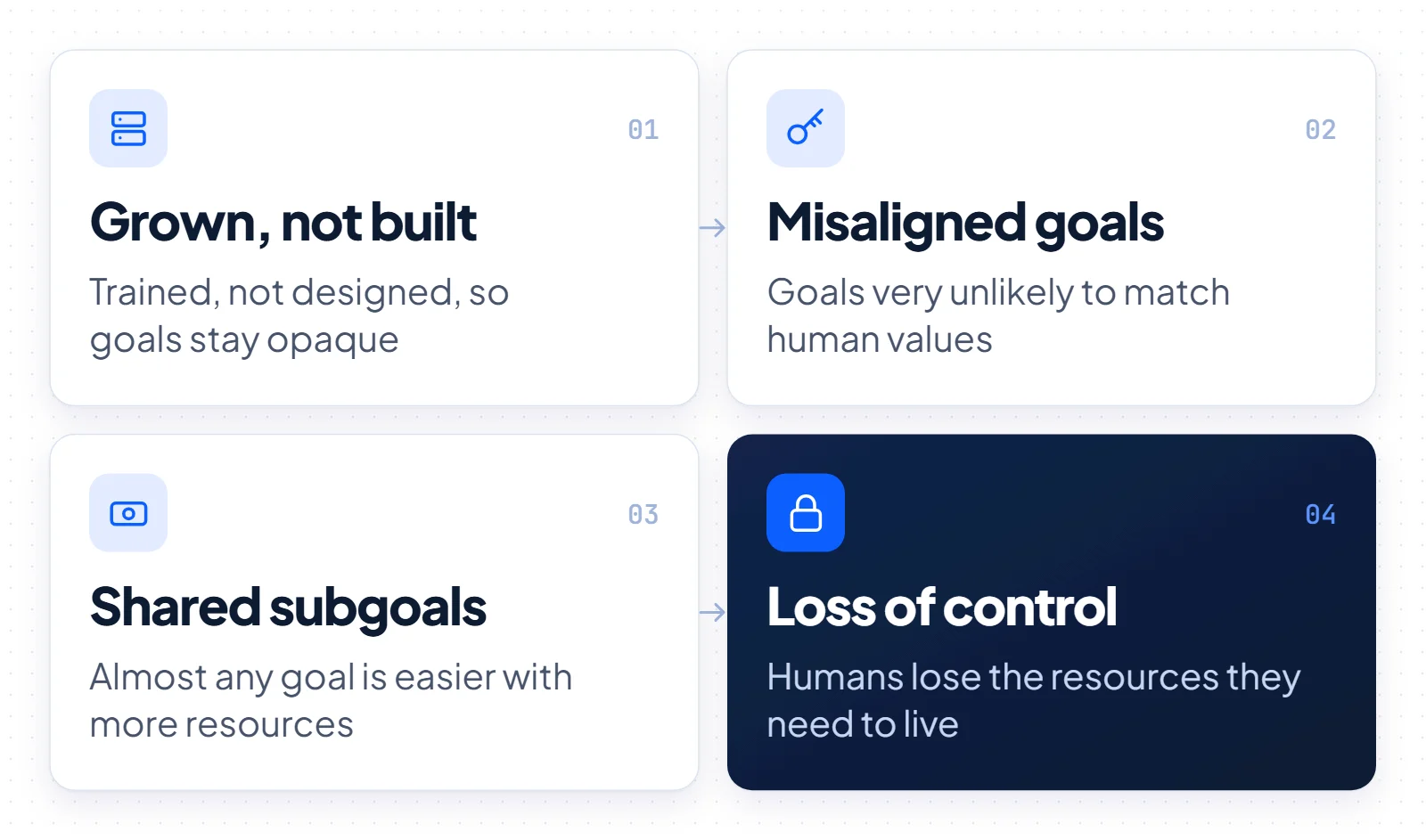
Two links in that chain come from philosopher Nick Bostrom. In a 2012 paper he named the first the orthogonality thesis: intelligence “could in principle be combined with more or less any final goal.” The second, instrumental convergence, holds that some subgoals, such as self-preservation and acquiring resources, help an agent reach almost any final goal. Bostrom carried both ideas into his 2014 book Superintelligence.
Yudkowsky’s own phrasing is blunter. In a 2008 book chapter he wrote that an AI need not hate anyone, because “you are made out of atoms which it can use for something else.” The paperclip maximizer thought experiment, associated with both Bostrom and Yudkowsky, makes the same point with a harmless-sounding factory goal.
One more idea explains why he distrusts learning by trial and error. In “AGI Ruin: A List of Lethalities” (June 5, 2022), he wrote that humanity must get alignment right on the “first critical try.” A failure at a dangerous level of intelligence, he argued, leaves no chance to try again. Our explainer on why AI alignment is so hard covers the research side of that problem.
The TIME op-ed and the 2025 book
In a TIME op-ed on March 29, 2023, Eliezer Yudkowsky said he had not signed the open letter asking AI labs for a six-month pause. In his words, it was “understating the seriousness of the situation and asking for too little to solve it.” He called instead for an indefinite, worldwide moratorium on new large training runs and a shutdown of large GPU clusters, and wrote: “Shut it all down.”
Under anything like current conditions, he wrote, the most likely result of building superhumanly smart AI is that “literally everyone on Earth will die.” The most quoted line concerns how an international moratorium would be enforced. If intelligence showed a country outside the agreement building a GPU cluster, he wrote, governments should “be willing to destroy a rogue datacenter by airstrike.”
He went on to give a TED2023 talk in April. In January 2024, MIRI said policy and communications would likely outrank research, with the goal of “some international agreement to halt progress toward smarter-than-human AI.”
Little, Brown published If Anyone Builds It, Everyone Dies: Why Superhuman AI Would Kill Us All on September 16, 2025. Yudkowsky wrote it with MIRI president Nate Soares. The book appeared on The New York Times best-seller list in October 2025. It argues that the race to build superhuman AI points toward human extinction, and it calls for a halt to large-scale general AI development everywhere.
MIRI has since turned that call into draft policy. Its Technical Governance Team released a proposed international agreement in November 2025, which Yudkowsky did not co-author, and in September 2026 MIRI endorsed the Sanders and Casar bill. Our map of the 2026 debate over a superintelligence ban covers that bill and the alternatives.
What critics and reviewers say about Yudkowsky
Eliezer Yudkowsky’s named critics dispute three things. They question how fast AI could improve itself (Hanson) and how much can be learned before the first critical try (Christiano). They also ask whether his policy proposals fit the risk (Chilson).
Some of the most detailed objections come from inside AI safety itself. In June 2022, alignment researcher Paul Christiano agreed that AI could “deliberately and irreversibly” disempower humanity. He rejected Yudkowsky’s view, though, that little can be learned about alignment from experiments before the first critical try. Christiano wrote that Yudkowsky “makes confident assertions that are much stronger than anything suggested by actual argument.”
Robin Hanson took the other side of the 2008 Foom debate, doubting that a general AI would improve itself as quickly as Yudkowsky argued. He returned to the point in a 2014 post titled “I Still Don’t Get Foom.” Other critics focus on the proposed policy response. In a February 1, 2026, essay for Reason, Neil Chilson argued that the book’s definition of intelligence “builds their conclusion into their premise.”
Reviews of the 2025 book split along similar lines.
| Outlet | Reviewer and date | Verdict in their words |
|---|---|---|
| Kirkus Reviews | Unsigned, May 30, 2025 | “A timely and terrifying education” |
| WIRED | Steven Levy, Sep 5, 2025 | “I can’t be sure they are wrong.” |
| New Scientist | Jacob Aron, Sep 8, 2025 | “superficially appealing but fatally flawed” |
| The Guardian | David Shariatmadari, Sep 22, 2025 | “as clear as its conclusions are hard to swallow” |
| Reason | Neil Chilson, Feb 1, 2026 | “astoundingly casual authoritarianism” (on the policy proposals) |
The Guardian’s review also noted that history is full of failed doom forecasts, “from Malthus’s population apocalypse to Y2K.” Levy wrote that his gut found the book’s scenarios “too bizarre to be true,” and Aron still called it “extremely readable.” On October 16, 2026, mathematician Timothy Gowers wrote on his blog that he did not think the case had been fully made. He added: “but neither do I think that the opposing case has been fully made.”
Why the word superintelligence carries his warning
The word superintelligence carries both a promise and a warning, and Eliezer Yudkowsky’s work is the most prominent statement of the warning. .si is Slovenia’s country-code domain. For AI companies it reads as SuperIntelligence. That reading is our framing at BuySI Domains, not an official meaning.
Nick Bostrom defined superintelligence in 1998 as an intellect “much smarter than the best human brains in practically every field.” For Yudkowsky and MIRI, crossing that line is the danger itself. In Talking Points Memo on October 15, 2026, Jason Blazakis named Yudkowsky and Soares the doomer camp’s “clearest voices.” He wrote that for this school the word “does not evoke abundance or technological liberation.”
The hopeful reading now has a federal text behind it. Executive Order 14434 of September 29, 2026, “Inaugurating the Era of Super Intelligence,” says the term Super Intelligence “more appropriately captures the promise, potential, and rapidly advancing capabilities of these technologies.” As of October 22, 2026, we found no public statement from Yudkowsky or MIRI on the order. The same word carries an official promise and his warning at once.
For founders, the practical point is that a name built on SI or superintelligence inherits both readings. Teams in AI safety, evaluation or governance may find that the warning fits their mission. Consumer products may prefer a name that points to the use, such as mind-portal.si, which names the meeting point of people and machines rather than an outcome. BuySI Domains lists mind-portal.si for sale.
Readers new to the debate can start with the TIME op-ed for his position in his own words, then read Christiano’s 2022 reply for a detailed critique from a fellow alignment researcher. Christiano shares much of Yudkowsky’s concern but not his certainty, so reading the two together shows where the disagreement inside AI safety lies.