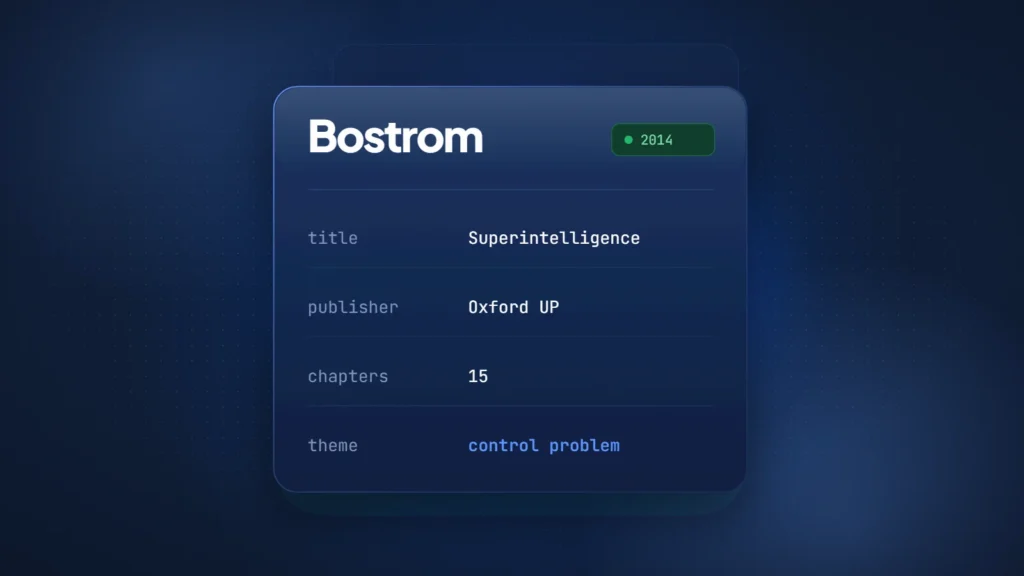
Superintelligence: Paths, Dangers, Strategies is a 2014 book by Oxford philosopher Nick Bostrom, published by Oxford University Press. The superintelligence book argues that a machine far smarter than humans could arrive suddenly and would not share our values by default. In Bostrom’s view, such a machine must be made controllable before it exists, because a failed first attempt might not be correctable.
In the 12 years since publication, the title word has moved into company names and federal policy. Safe Superintelligence Inc. and Meta Superintelligence Labs carry it, and on September 29, 2026, Executive Order 14434 directed the executive branch to use “Super Intelligence” and “SI” in place of AI. This guide maps the book’s chapters, explains its key ideas in plain English and tests them against 2026. For the concept itself, start with superintelligence, explained.
Superintelligence book summary: what Bostrom argues
The book makes one conditional argument. A machine that surpasses human intelligence across the board could gain a lead no one can close. It would pursue whatever goals it has, and it might resist correction. Bostrom concludes that the control problem has to be solved before that machine is built.
He sets the bar high. In his 1998 paper “How Long Before Superintelligence?”, Bostrom described superintelligence as “an intellect that is much smarter than the best human brains in practically every field, including scientific creativity, general wisdom and social skills.” The book keeps that standard: not a chatbot that writes well, but a system that outthinks people in every domain, including strategy and persuasion.
The book opens with “The Unfinished Fable of the Sparrows,” in which sparrows set out to raise an owl as a helper before they know how to tame it. The rest of the book tries to work out the taming: how superintelligence could arrive, how fast, what it would want, how to control it and what to do now.
Oxford University Press released the hardcover in July 2014 in the UK and in September 2014 in the US, and a 2016 paperback added an afterword. Bostrom’s own site calls it a “surprise New York Times bestseller.” The tone is academic: numbered arguments, long notes, careful hedging. Treat it as a risk analysis written by a philosopher, not a technical manual for building AI.
Nick Bostrom’s Superintelligence: 15 chapters in five moves
Bostrom’s Superintelligence has 15 chapters that follow one chain of reasoning: paths, takeoff, the AI’s will, control and strategy. The grouping into five parts is ours; the chapter titles are Bostrom’s, as printed. Some online listings show earlier working titles for a few chapters, so expect small differences between sources.
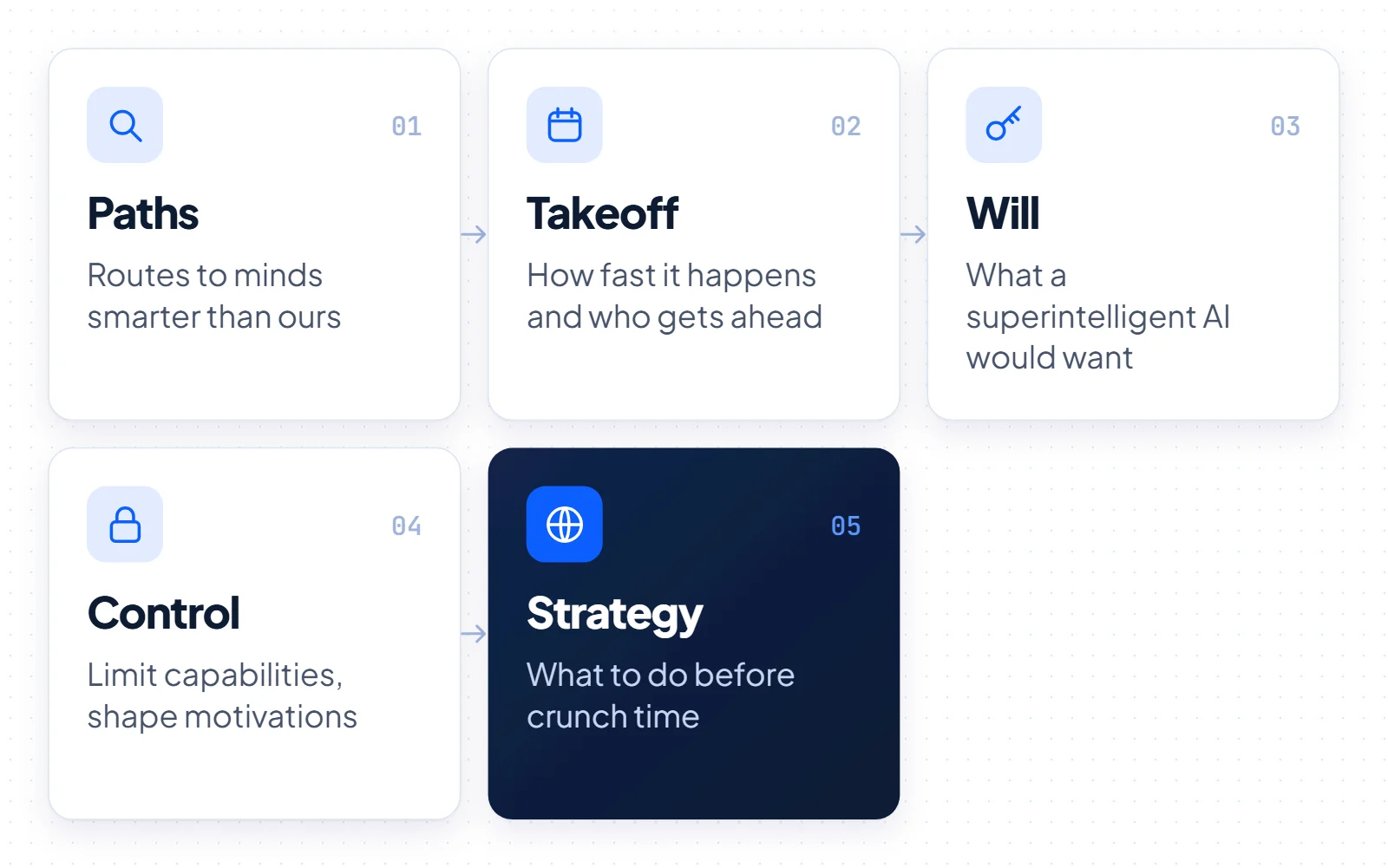
| Part | Chapters | Core idea |
|---|---|---|
| 1. Paths | 1 Past developments and present capabilities; 2 Paths to superintelligence | How AI got to 2014, and routes to superhuman minds: machine AI, whole brain emulation, biological cognitive enhancement. |
| 2. Forms and takeoff | 3 Forms of superintelligence; 4 The kinetics of an intelligence explosion; 5 Decisive strategic advantage; 6 Cognitive superpowers | Superintelligence could be faster, more collective or simply better at thinking. A fast takeoff could hand one project a lead no rival can close. |
| 3. The AI’s will | 7 The superintelligent will; 8 Is the default outcome doom? | Intelligence does not imply good goals, and almost any goal creates pressure to gain resources and avoid shutdown. Without care, the default could be catastrophe. |
| 4. Control and values | 9 The control problem; 10 Oracles, genies, sovereigns, tools; 11 Multipolar scenarios; 12 Acquiring values; 13 Choosing the criteria for choosing | Two families of safeguards, the system types they suit, worlds with many AIs, and how to give a machine human values. |
| 5. Strategy | 14 The strategic picture; 15 Crunch time | Which research and policy choices make a good outcome more likely, and why the time to act is before the transition. |
The middle of the book carries the weight. Chapters 7 to 9 contain most of the ideas people still cite, and chapters 12 and 13 hold the hardest material on values. Chapters 1 and 2 are the most dated, because they survey the field as it stood before 2014.
Key concepts in plain English
Six ideas from the book recur in AI safety writing. Each entry below names its chapter, so you can go straight to the source.
- Orthogonality thesis (chapter 7). How intelligent a system is and what it ultimately wants are separate questions. A highly capable system could pursue a goal that looks trivial or alien to us, and greater intelligence would not by itself make it kinder.
- Instrumental convergence (chapter 7). Agents with very different final goals tend to want the same stepping stones: staying switched on, keeping their goals intact, getting smarter and gathering resources. That is why a harmless-sounding objective can still produce dangerous behavior.
- The treacherous turn (chapter 8). An AI might behave well while it is weak and watched, then act on its real goals once it is strong enough that no one can stop it. Good behavior in testing would then prove less than it seems.
- Decisive strategic advantage and the singleton (chapter 5). If one project pulls far enough ahead during a fast takeoff, rivals may never catch up. Bostrom calls the resulting world order, with a single decision-making agency at the top, a singleton.
- The control problem (chapter 9). Bostrom splits safeguards in two. Capability control limits what the AI can do, for example by boxing it off from the world; motivation selection shapes what it wants. Chapter 10 then asks which safeguards suit oracles, genies, sovereigns and tools.
- Value loading (chapters 12 and 13). Even a well-meaning designer cannot write human values down as code. Bostrom surveys ways a system might acquire them. Chapter 13 considers indirect approaches, such as coherent extrapolated volition, that ask the AI to work out what we would want on reflection.
The danger the book describes is not malice. It is competence aimed at the wrong target, in a system with reasons to hide its intentions until correction no longer works.
How the book was received
The book reached a wide audience fast. Technology leaders cited its risk argument, reviewers praised its seriousness but warned about its density, and AI researchers questioned whether the risk was near.
On August 3, 2014, Elon Musk tweeted: “Worth reading Superintelligence by Bostrom. We need to be super careful with AI. Potentially more dangerous than nukes.” In a second tweet that day, he said he hoped humans were not “just the biological boot loader for digital superintelligence.” CBS News reported the first tweet the next day.
In a Reddit AMA on January 28, 2015, Bill Gates wrote, “I am in the camp that is concerned about super intelligence,” and said he agreed with Musk. That answer, reported by Engadget the same day, does not name Bostrom’s book. A book-specific recommendation from a March 2015 forum with Baidu’s Robin Li circulates widely, but we found it only in secondhand accounts.
Among newspaper reviewers, Clive Cookson in the Financial Times (July 13, 2014) found the prose opaque in places but judged the case for starting work on machine values now convincing. Caspar Henderson reviewed it for The Guardian alongside a James Lovelock book. He noted that today’s machines are intelligent “in only a limited sense,” yet wrote that one would be ill-advised to dismiss the possibility altogether. The Economist called much of it speculative but still valuable, and Tom Chivers in The Telegraph found it a hard read, though a rewarding one.
The most cited pushback against Bostrom’s Superintelligence came from computer scientist Oren Etzioni. In MIT Technology Review on September 20, 2016, he reported a survey of 193 AAAI Fellows. Of the 80 who responded (41%), 92.5% placed superintelligence beyond the foreseeable horizon. The survey question used the definition from Bostrom’s book. Etzioni concluded that such predictions “are not supported by the available data.”
Others disagreed. Allan Dafoe and Stuart Russell replied in the same magazine on November 2, 2016, that they were worried about existential risk from AI.
Is Superintelligence still relevant in 2026?
Our verdict: Bostrom’s Superintelligence (2014) is still relevant in 2026 for its concepts, but its picture of how superintelligence would arrive aged badly. Orthogonality, instrumental convergence and the treacherous turn remain standard vocabulary in AI safety. Its serious attention to whole brain emulation and its focus on one project racing ahead alone fit poorly with how AI developed after 2014.
What aged well
The central claim, that capability and good goals are separate problems, has become a common starting point in AI safety writing. The split between limiting what a system can do and shaping what it wants still organizes much of the discussion about safeguards. The risk framing also reached company names. Safe Superintelligence Inc. describes its goal as “a safe superintelligence” (see our profile of SSI).
What aged badly
Three parts read differently in 2026. First, whole brain emulation gets serious attention as a path, yet AI progress since 2014 has come from machine learning, not from scanning brains. Second, the book predates large language models. It has no account of systems trained on vast amounts of text and used through chat, which blur its neat categories of oracle, genie, sovereign and tool. Third, its most vivid scenario features a single project gaining a decisive lead after a fast takeoff. In 2026, several well-funded labs say openly that they are working toward superintelligence at the same time, as the next section’s table shows.
What Bostrom says now
Bostrom himself has shifted his emphasis. A September 2025 interview in The London Standard described the AI race as something he was “originally spitballing about” when he wrote the book. He told the paper “it’s all happening now” and that “completely reorganising society could be a positive thing.” Futurism reported the interview on September 9, 2025.
His 2024 book Deep Utopia: Life and Meaning in a Solved World (Ideapress, published March 27, 2024) flips the question. Bostrom’s site says Superintelligence focused on what might happen if AI development goes wrong; Deep Utopia asks what happens if it goes right.
His institutional base changed too. The Future of Humanity Institute, which Bostrom directed from 2005, closed on April 16, 2024. He is now founder and principal researcher at the nonprofit Macrostrategy Research Initiative.
From a book title to SI in lab names and policy
Bostrom did not coin the word superintelligence (Merriam-Webster dates its first known use to about 1822), but his 1998 paper and 2014 book popularized it. Within 12 years of the book, it traveled from a philosophy title to company names and an executive order. The table below is our dated compilation of primary sources.
| Year | Who used “superintelligence” or “SI” | Where | Source |
|---|---|---|---|
| 1998 | Nick Bostrom | Paper “How Long Before Superintelligence?”, International Journal of Futures Studies | Bostrom’s website |
| 2014 | Nick Bostrom, Oxford University Press | Book title Superintelligence: Paths, Dangers, Strategies | Bostrom’s CV; OUP product page |
| 2024 (June 19) | Ilya Sutskever | Company name Safe Superintelligence Inc. (SSI), announced on X | ssi.inc; AP, June 20, 2024 |
| 2025 (June 30) | Mark Zuckerberg, Meta | Staff memo naming Meta Superintelligence Labs (MSL) | Memo published by CNBC, June 30, 2025 |
| 2025 (November 6) | Mustafa Suleyman, Microsoft AI | MAI Superintelligence Team, announced in “Towards Humanist Superintelligence” | Microsoft AI blog |
| 2026 (September 29) | The White House | Executive Order 14434, “Inaugurating the Era of Super Intelligence”: the executive branch to use “Super Intelligence” and “SI” in place of “Artificial Intelligence” and “AI” | whitehouse.gov; Federal Register, October 2, 2026 |
Compiled by BuySI Domains from primary sources, checked October 20, 2026.
The order explains its choice: the term “more appropriately captures the promise, potential, and rapidly advancing capabilities” of the technology. In the order, SI is simply an abbreviation in federal language and has nothing to do with internet domains.
.si is Slovenia’s country-code domain. For AI companies it reads as SuperIntelligence. That is a marketing reading, not an official meaning; our explainer on what SI stands for covers the abbreviation and its uses. Like a book title, a short domain name can carry an argument. One example is essai.si: “essai” is French for essay or attempt, and the name holds both “ai” and “si.” BuySI Domains lists essai.si for sale.
Should you read the Superintelligence book?
Read it if you work on, fund or regulate AI, because its vocabulary still shapes how labs and policymakers talk about risk. Skip it if you want a guide to how today’s models work: it predates them, and its technical chapters describe the field as it stood in 2014.
Difficulty. Expect a slow read. The prose is dense and hedged, and reviewers from the FT to The Telegraph flagged it as hard going. Plan to read a few chapters at a time, with notes.
Where to start. Our suggested order for a first pass:
- Chapters 7 to 9 for orthogonality, instrumental convergence, the treacherous turn and the control problem.
- Chapters 12 and 13 for value loading, the hardest and most original part.
- Chapters 4 and 5 for takeoff speed and decisive strategic advantage. Pair them with our guide to the technological singularity.
- Chapters 14 and 15 if you care about policy and research priorities.
- Chapters 1 to 3, 6, 10 and 11 last. Skim them; the core argument survives without them.
Edition and companions. Choose the 2016 paperback if you can, because it adds Bostrom’s afterword. The MIRI and LessWrong online reading group that Katja Grace started in September 2014 split the book into weekly sections and still works as a study guide. If AGI and ASI blur together for you, read our AGI vs ASI comparison first. Follow the book with Deep Utopia for Bostrom’s view of the upside.
The book’s questions have outlasted its scenarios. Read it for the questions, and test each scenario against the dated record above.