Domain hijacking is the wrongful takeover of a domain name’s registration. The attacker gains control of the registrar account, changes the holder or moves the name to another registrar, then decides where it points. Unlike a changed DNS record, a stolen registration cannot be fixed by the holder alone.
A company domain carries the website, the email and every sign-in link, so losing it breaks all three at once. In July 2024, attackers took domains from at least a dozen organizations at a single registrar in four days. Yet our RDAP check of 30 AI company domains found that only 5 of 30 show the pattern of a registry lock, the one lock a stolen password cannot open.
What is domain hijacking?
Domain hijacking changes who controls a domain’s registration. DNS hijacking changes only where the name resolves, while the registration stays with its holder. In 2005, ICANN’s Security and Stability Advisory Committee (SSAC) defined domain hijacking as “the wrongful taking of control of a domain name from the rightful name holder.” The holder can restore DNS records alone, but a stolen registration needs a registrar, a dispute process or a court.
Four neighboring terms often get mixed up with it.
| Term | What changes | Who or what is attacked | How it is undone |
|---|---|---|---|
| Domain hijacking | Holder, registrar account or registrar of record | The registrar account, registrar or registry | Registrar action, transfer dispute or court order |
| DNS hijacking | DNS records (A, MX, NS); the registration stays | DNS host or registrar credentials | Restore records, rotate credentials |
| DNS cache poisoning | A forged answer in a resolver’s cache | Recursive resolvers and their users | Flush the cache; DNSSEC validation prevents it |
| Cybersquatting | Nothing on your domain; a lookalike is registered in bad faith | A trademark | UDRP complaint or court case |
| Reverse domain name hijacking | Nothing, unless the complaint succeeds | A legitimate holder, via a bad-faith UDRP complaint | Panel denies the complaint with a bad-faith finding |
The last two rows are legal disputes, not intrusions. Under the UDRP Rules, reverse domain name hijacking means using the policy “in bad faith to attempt to deprive” a holder of a domain. Our guide to cybersquatting and UDRP complaints covers both sides of that process.
How domains get hijacked
Most domain hijacking starts with a person or an account, not with the DNS protocol. SSAC’s 2009 report SAC040 found that taking an organization’s entire domain portfolio needs only “a user account and password.” Five paths recur.
- Registrar account takeover. Phishing or a reused password opens the account. SAC040 describes the Comcast incident of May 28, 2008: attackers entered Comcast’s Network Solutions account, which held about 200 domains, and changed the DNS for comcast.net.
- Social engineering of registrar support. Attackers compromised Perl.com in September 2020, but nobody noticed until January 27, 2021. The suspected cause, unconfirmed by Network Solutions, was a social engineering attack with phony documents. The domain moved through BizCN and Key Systems before its recovery on February 5, 2021. In his account of the Perl.com hijacking, brian d foy wrote that two-factor authentication “probably would have saved us much of this trouble.”
- A contact email on a lapsed or weak domain. Password resets go to the contact address. If that address sits on a domain that expires or is compromised, the attacker receives the reset.
- Registrar, registry or DNS-provider compromise. In the Sea Turtle campaign, Cisco Talos reported on April 17, 2019, that attackers went after registrars and registries and compromised at least 40 organizations in 13 countries. Curve Finance lost about $570,000 after a DNS hijack on August 9, 2022. Curve suspected its registrar, iwantmyname, but the cause was never settled publicly.
- Migration gaps. Squarespace agreed in June 2023 to take over about 10 million Google Domains names and migrated them over the following months. From July 9 to 12, 2024, attackers hijacked domains of at least a dozen organizations, mostly crypto firms such as Compound Finance and Celer Network. Researchers at MetaMask and Paradigm told KrebsOnSecurity that migrated accounts had no password and no MFA, so anyone with the contact email could claim them. Squarespace instead blamed “a weakness related to OAuth logins” and said the migration involved no changes to MFA.
Across 16 years of cases, the weakest point is whatever controls the account: a password, a support desk, an inbox or a migration default.
Domain lock vs registry lock: what each status blocks
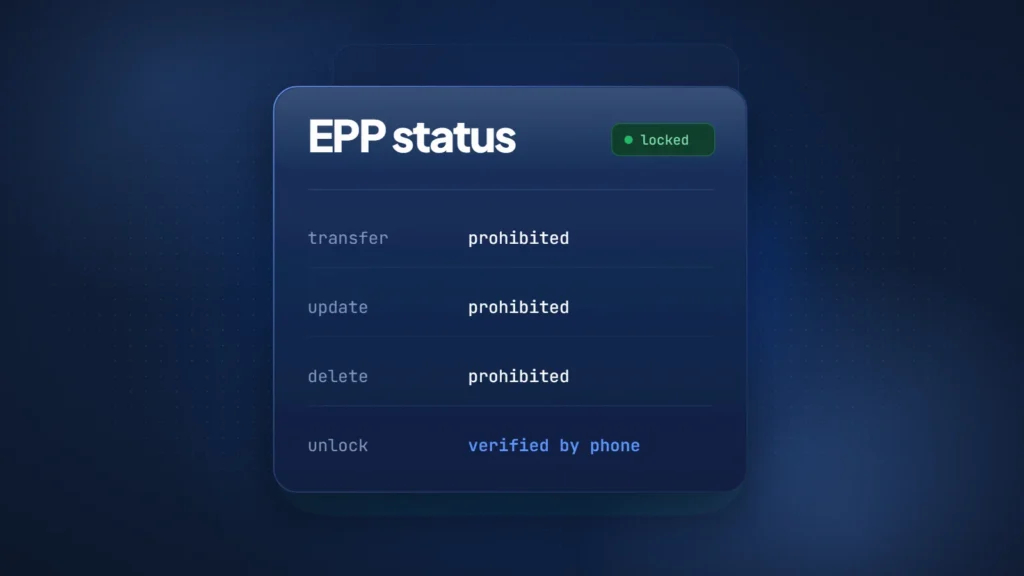
A domain lock, also called a registrar lock, uses client statuses such as clientTransferProhibited. The registrar sets them, and anyone who gets into the registrar account can remove them. A registry lock uses server statuses, which registries set. According to ICANN’s EPP status code page, server codes “take precedence over client codes.” Removing a registry lock needs out-of-band verification, such as a phone call to a named person.
| EPP status | Set by | What it blocks | How it is removed |
|---|---|---|---|
| clientTransferProhibited | Registrar | Transfer to another registrar | Toggle in the registrar account |
| clientUpdateProhibited | Registrar | Contact and name server updates | Toggle in the registrar account |
| clientDeleteProhibited | Registrar | Deletion | Toggle in the registrar account |
| serverTransferProhibited | Registry | Transfer to another registrar | Registrar request plus out-of-band verification |
| serverUpdateProhibited | Registry | Any update | Registrar request plus out-of-band verification |
| serverDeleteProhibited | Registry | Deletion | Registrar request plus out-of-band verification |
The out-of-band step is the whole point. At Verisign, which runs .com and .net, an authorized registrar contact must take a phone call and give an individual security phrase. At Register.si, the registrar sends a written request and the registry confirms it by phone. Verisign counts a domain as registry-locked only when all three server statuses show.
A registrar lock stops casual and automated transfers. It does not stop an attacker who holds your password, because that attacker can switch it off in the same session. Before a legitimate move, our guide to transferring a domain between registrars explains when to lift each lock.
How many AI companies lock their domains
Only 5 of 30 leading AI company domains we checked show the pattern a registry lock leaves, although all 30 carry clientTransferProhibited, the standard registrar transfer lock. Those 5 carry all three server statuses: serverDeleteProhibited, serverTransferProhibited and serverUpdateProhibited. DNSSEC signing shows on 8 of 30. BuySI Domains ran the RDAP lookups on October 23, 2026, for domains from openai.com and anthropic.com to mistral.ai and elevenlabs.io.
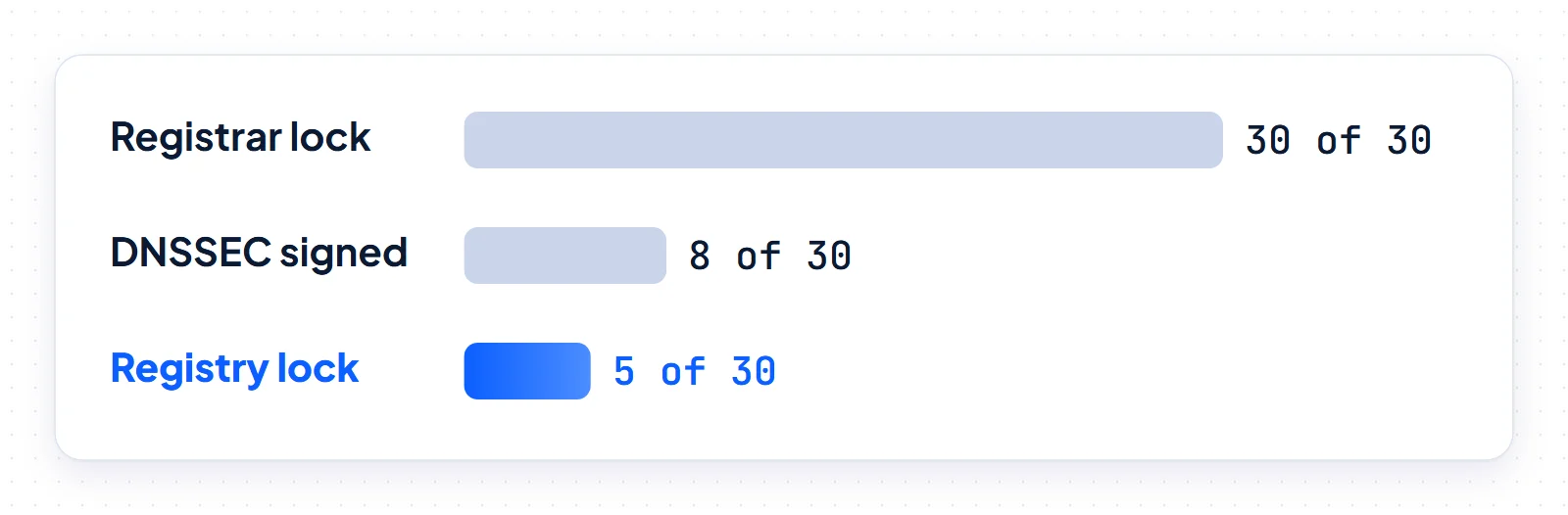
The five domains with the full server pattern are openai.com, nvidia.com, x.ai, thinkingmachines.ai and elevenlabs.io. Of these five, only elevenlabs.io is also DNSSEC-signed. The other 25 of 30 show client-side statuses only, so their protection depends entirely on the registrar’s own account controls, with no registry-level check behind them.
RDAP does not label anything “registry lock”. Registries can set server statuses for other reasons, so we describe the five as consistent with a registry lock, not as confirmed. We queried the registry RDAP servers for .com, .ai, .io, .co, .inc and .company through the rdap.org bootstrap. Status records change, so a lookup on another day can differ.
Domain hijacking and .si domains
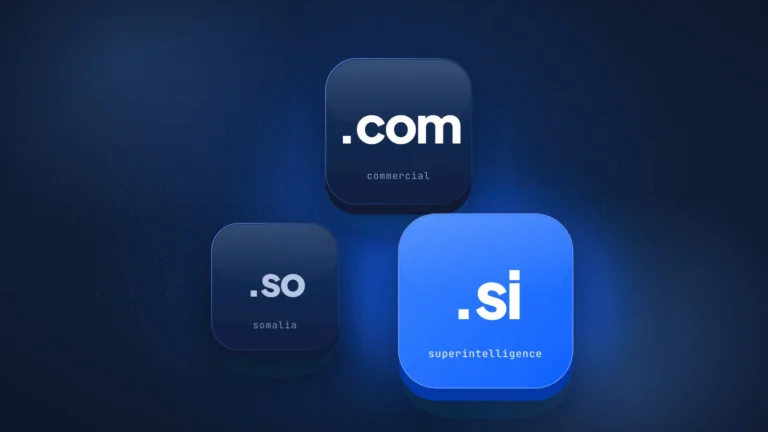
A .si domain is secured against hijacking differently from a .com, because it has no client transfer prohibited status. Instead, its registry, Register.si, relies on a holder-set password, holder consent and an optional Registry Lock. The .si extension is Slovenia’s country-code domain. For AI companies it reads as SuperIntelligence, which is our framing, not an official meaning.
Moving a .si domain to another registrar needs an authinfo password (geslo) that the holder sets, valid until first use or 16 days at most. A change of holder needs the consent of both the current and the future holder under Article 6.4.2 of the Register.si General Terms.
Register.si also offers Registry Lock for .si domains on the registrar’s request. A locked .si domain cannot be changed, transferred or deleted, but it can still be renewed. To lift the lock, the registrar sends a written request, and Register.si verifies it only during office hours, by calling the registrar’s appointed person. The registry charges registrars €20 excl. VAT for Registry Lock under the tariff in force since January 1, 2023, and registrars set their own end prices.
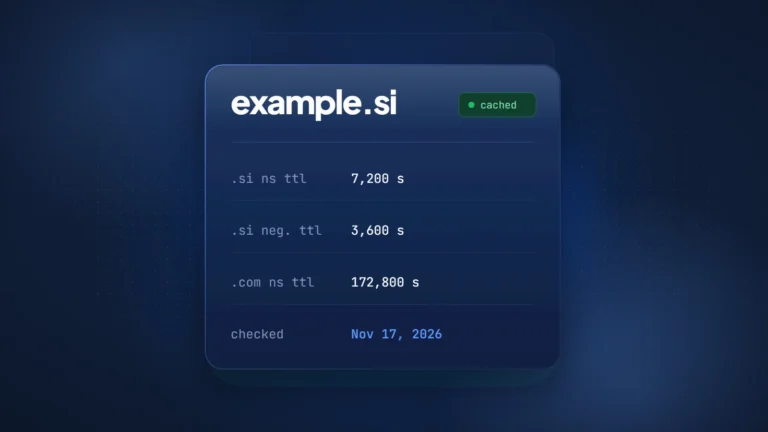
We ran the same RDAP check against Register.si on October 23, 2026. The .si names matching all 30 AI company names are registered, and none shows a transfer-prohibited status. That is expected: .si has no client transfer prohibited status, and only the registry sets the server one. Of 8 large Slovenian brand domains we checked, 1 shows the three server statuses that Register.si ties to locked domains.
A security brand such as kyberit.si, a name built for a cybersecurity company, is exactly the kind of name to put under Registry Lock after purchase. BuySI Domains lists kyberit.si for sale. Our guide to the .si domain covers the extension in more depth.
How to prevent domain hijacking
Preventing domain hijacking takes six steps: secure login, safe contact email, lock statuses, registry lock, DNSSEC and monitoring. Together they close the common attack paths of account takeover, support-desk fraud, a weak contact email, registrar compromise and migration gaps. The steps follow ICANN SSAC’s registrant guide SAC044 and CISA Emergency Directive 19-01. CISA issued the directive in January 2019 and has since closed it, but its four required actions remain a sound baseline.
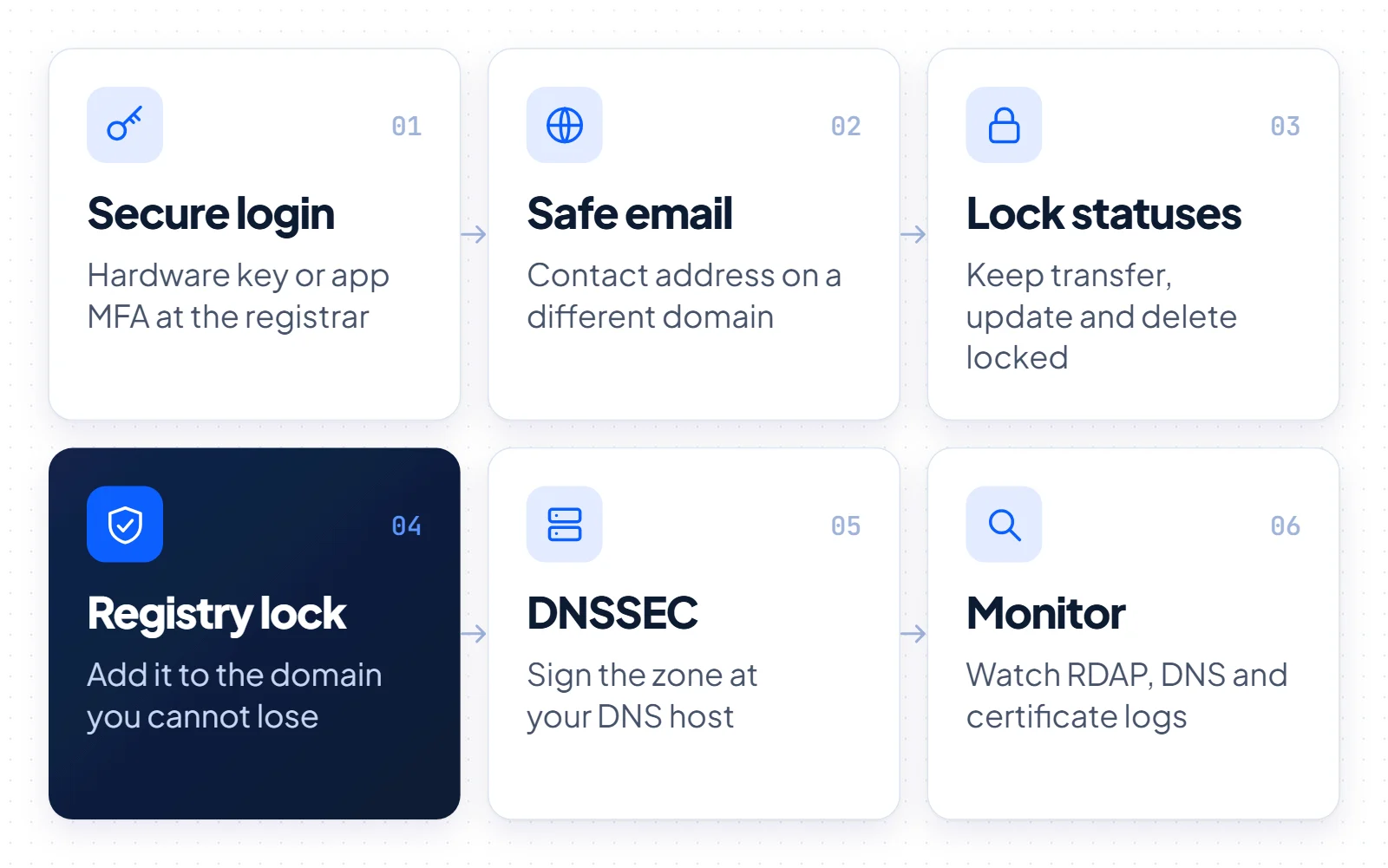
- Secure login. Use a hardware security key or an authenticator app for MFA at your registrar and DNS host. Give access only to people who need it.
- Safe email. Put the registrar contact address on a different domain, managed separately from the one it protects, as SAC044 advises. Otherwise one hijack hands the attacker the reset emails for the rest.
- Lock statuses. Keep transfer, update and delete locked at the registrar, and check the three client statuses after every change.
- Registry lock. For the domain you cannot lose, ask your registrar for the registry’s lock service. Talos recommended it after Sea Turtle. A stolen password cannot pass the registry’s phone check.
- DNSSEC. Sign the zone at your DNS host and publish the DS record through your registrar. Validating resolvers then reject forged answers, though DNSSEC cannot help once the registration is stolen.
- Monitor. Watch the RDAP record, DNS records and Certificate Transparency logs. CISA ED 19-01 told agencies to check those logs “for certificates issued that they did not request.”
Steps 1 to 3 cost nothing at most registrars. Step 4 costs a fee and slows legitimate changes, and Register.si says plainly that a locked domain is safer but much less flexible. For a core brand domain, that trade is usually worth it.
What to do if your domain is hijacked
If your domain is hijacked, contact your registrar first, then escalate. Every hour gives the attacker more time to move the name again or read mail sent to it.
- Registrar and abuse contact. ICANN tells victims to “contact the registrar immediately for assistance.” Section 3.18 of the 2013 Registrar Accreditation Agreement requires registrars to keep an abuse contact and to investigate reports promptly. They must also keep a separate law enforcement contact, monitored 24 hours a day, seven days a week.
- Emergency contact. If the name has moved, your registrar can use the Transfer Emergency Action Contact (TEAC). Under the current ICANN Transfer Policy, the other registrar must respond within 4 hours. A revised policy adopted on June 7, 2026, would extend that window to 24 hours once implemented, but ICANN had set no effective date as of October 23, 2026.
- ICANN complaint. You can file an Unauthorized Transfer Complaint, but “ICANN does not have contractual authority to require a registrar to transfer a domain name back.”
- Transfer dispute. Only registrars can file under the Transfer Dispute Resolution Policy (TDRP), within 12 months of the alleged violation.
- Courts and police. In Kremen v. Cohen (9th Cir. 2003), the court treated a domain name as intangible property and held that Network Solutions could be liable for handing sex.com to a forger.
For a .si domain, contact your registrar and Register.si at once. Under Article 6.4.3 of the Register.si General Terms, only a final court ruling or an ARDS decision can move a domain to a new holder against the current holder’s will. ARDS is the alternative dispute resolution procedure for .si.
Is domain hijacking illegal?
In many jurisdictions, prosecutors can charge domain hijacking under laws on theft, fraud or unauthorized computer access. In 2011, New Jersey sent Daniel Goncalves to state prison for five years for stealing P2P.com, on charges including theft by deception and computer theft. The state called it the first known conviction for domain name theft.
Which step to take first
A founder buying a premium name should move it into their own registrar account, then lock it the same day. Our guide to buying a domain that is already taken covers the purchase, and how EPP codes work covers the transfer. A company already on .ai or .com should check its RDAP record today. If only client statuses show, it sits with 25 of the 30 AI domains we checked, and a registry lock is the next request to its registrar.