A ccTLD (country code top-level domain) is a two-letter domain extension reserved for a country or territory, such as .us, .uk or .si. Most codes come straight from the ISO 3166-1 alpha-2 list. IANA delegates each ccTLD to a local manager, and that manager, not ICANN, sets the rules for who can register names.
The term “cctld” draws about 6,800 searches a month worldwide (Ahrefs, October 2026). Two Google changes have also confused site owners: the retired International Targeting report in Search Console, and the April 2025 move of Google’s own country search domains to google.com. This guide covers the definition, real examples, the gTLD comparison, SEO effects and how to choose.
What is a ccTLD?
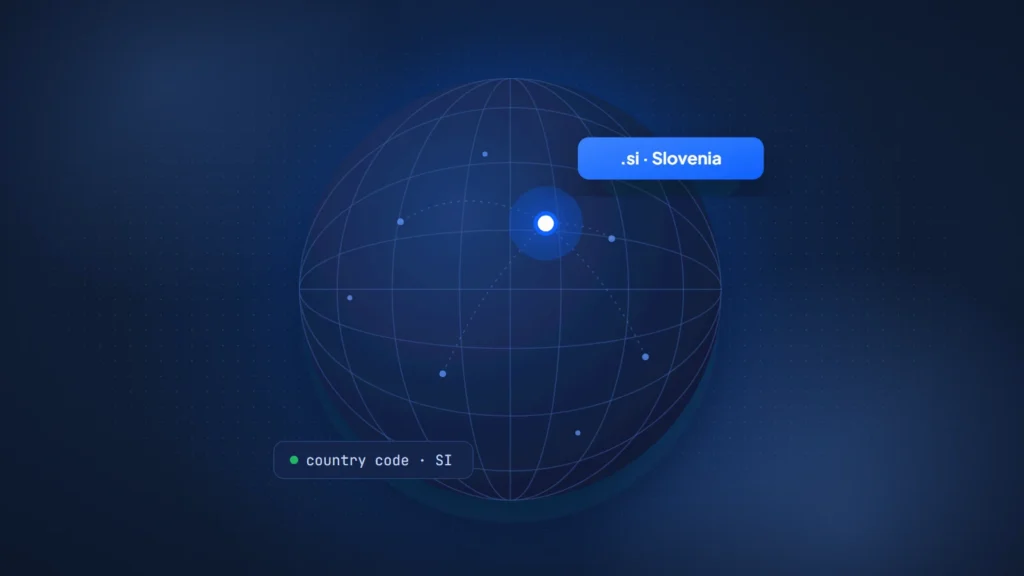
A ccTLD is a top-level domain assigned to a country or territory, normally matching its two-letter ISO 3166-1 alpha-2 code. Slovenia’s code is SI, so its ccTLD is .si. Germany’s code is DE, so it uses .de.
The rule goes back to RFC 1591, published in 1994, which tied country domains to the two-letter codes in ISO 3166. The same document makes clear that IANA does not decide what is or is not a country. It relies on the ISO standard instead, a position ICANN repeated in 2024.
A few exceptions exist. Under IANA’s rules for qualifying top-level domain strings, .uk is “grandfathered” because it was delegated as an exceptionally reserved code before 2000. The older .gb code is listed by IANA as a reserved domain and is not open for registration. The .eu code counts as an “exceptionally reserved” ISO code, which makes it a regional ccTLD. Even .su, the code of the former Soviet Union, is still delegated.
Not every ccTLD uses Latin letters. Internationalized ccTLDs (IDN ccTLDs) use local scripts, and the country behind each one must stay listed in ISO 3166-1. In total there are more than 300 ccTLDs. By our count of IANA’s root zone database on October 5, 2026, about 309 ccTLDs are delegated, 61 of them internationalized (IDN). This is our own tally, not an official IANA figure.
ccTLD examples
Familiar ccTLD examples include .us for the United States, .uk for the United Kingdom and .si for Slovenia. Others, such as .ai, .io and .co, are used worldwide as brand extensions, and Google treats them as generic.
| ccTLD | Country or territory | Manager (per IANA) | Who can register | How Google treats it |
|---|---|---|---|---|
| .us | United States | Registry Services, LLC | US nexus required | Country signal (US) |
| .uk | United Kingdom | Nominet UK | See registry rules | Country signal (UK) |
| .eu | European Union (regional) | EURid vzw | Citizens, residents and organizations of the EU, Iceland, Liechtenstein and Norway | Generic (regional) |
| .si | Slovenia | ARNES (runs Register.si) | Anyone, natural or legal person | Country signal (Slovenia) |
| .ai | Anguilla | Government of Anguilla | See registry rules | Generic |
| .io | British Indian Ocean Territory | Internet Computer Bureau Limited | See registry rules | Generic |
| .co | Colombia | MinTIC (Colombia) | See registry rules | Generic |
| .tv | Tuvalu | Tuvalu government ministry | See registry rules | Generic |
| .me | Montenegro | Government of Montenegro | See registry rules | Generic |
Eligibility rules vary widely. The usTLD Nexus policy limits .us to US citizens, permanent residents and people whose primary home is in the US, and to US organizations. Foreign entities with a bona fide presence in the US are eligible too. The .eu domain is open to citizens of EU countries, Iceland, Liechtenstein and Norway, wherever they live. Residents and organizations established in those countries can also register. Slovenia’s .si has no citizenship or residency limit. Under the Register.si general terms, any natural or legal person can register a name, first come, first served, for 1 to 5 years.
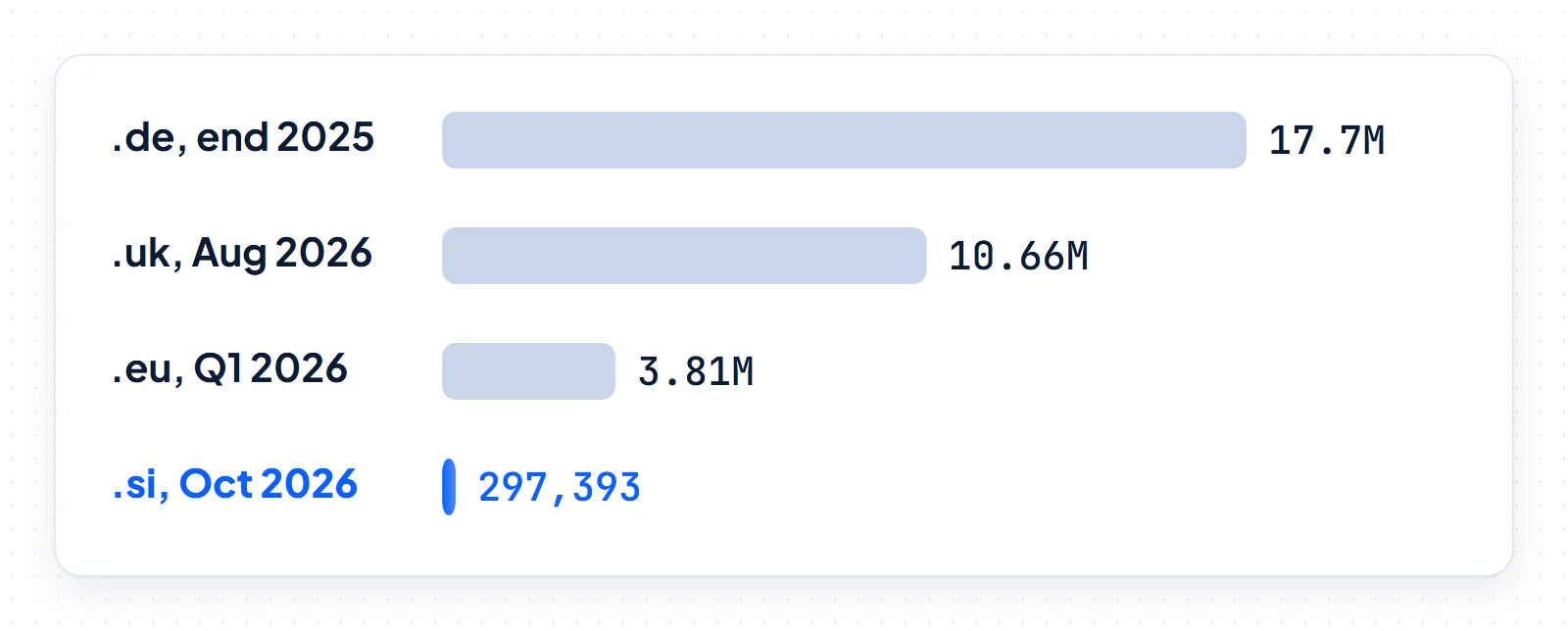
Size varies just as much. DENIC reported around 17.7 million .de domains at the end of 2025. Nominet counted about 10.66 million .uk names at the end of August 2026, and EURid reported 3,810,119 .eu names at the end of Q1 2026. Register.si listed 297,393 .si domains on October 5, 2026.
ccTLD vs gTLD: what actually differs
The core difference between a ccTLD and a gTLD is who writes the rules. Generic TLDs such as .com and .org follow ICANN policy and agreements, while each ccTLD follows rules set by its local manager under national oversight.
ICANN states that it has no contract authority to take compliance action against ccTLD operators. For ccTLDs, registration rules, registrar accreditation and Whois are handled by governance mechanisms within each country. That is why eligibility, pricing and dispute rules differ from one ccTLD to the next.
Disputes show the gap clearly. The UDRP is the standard dispute policy across all gTLDs, while each ccTLD sets its own. For .si, the procedure is ARDS, run by Register.si. On January 14, 2026, WIPO said it now provides dispute resolution services to 87 ccTLDs.
| Aspect | ccTLD | gTLD |
|---|---|---|
| Who sets policy | Local manager, under national governance | ICANN policy, applied by registries and accredited registrars |
| Contract with ICANN | ICANN has no contract authority for compliance | Registries and registrars work under ICANN agreements |
| Eligibility | Set per ccTLD: open (.si), nexus (.us) or regional (.eu) | Open to anyone in .com, .net and .org; some newer gTLDs set limits |
| Dispute policy | Local policy (.si uses ARDS); WIPO serves 87 ccTLDs | UDRP in all gTLDs |
| Google treatment | Country signal, except about 20 treated as generic | Generic, no country signal |
| Examples | .us, .uk, .de, .si | .com, .org, .net |
Who runs a ccTLD
A ccTLD is run by a designated manager to which IANA delegates the domain, usually a national registry, government body or research network. IANA keeps the root zone records, but it does not run ccTLD registries or write their registration policies.
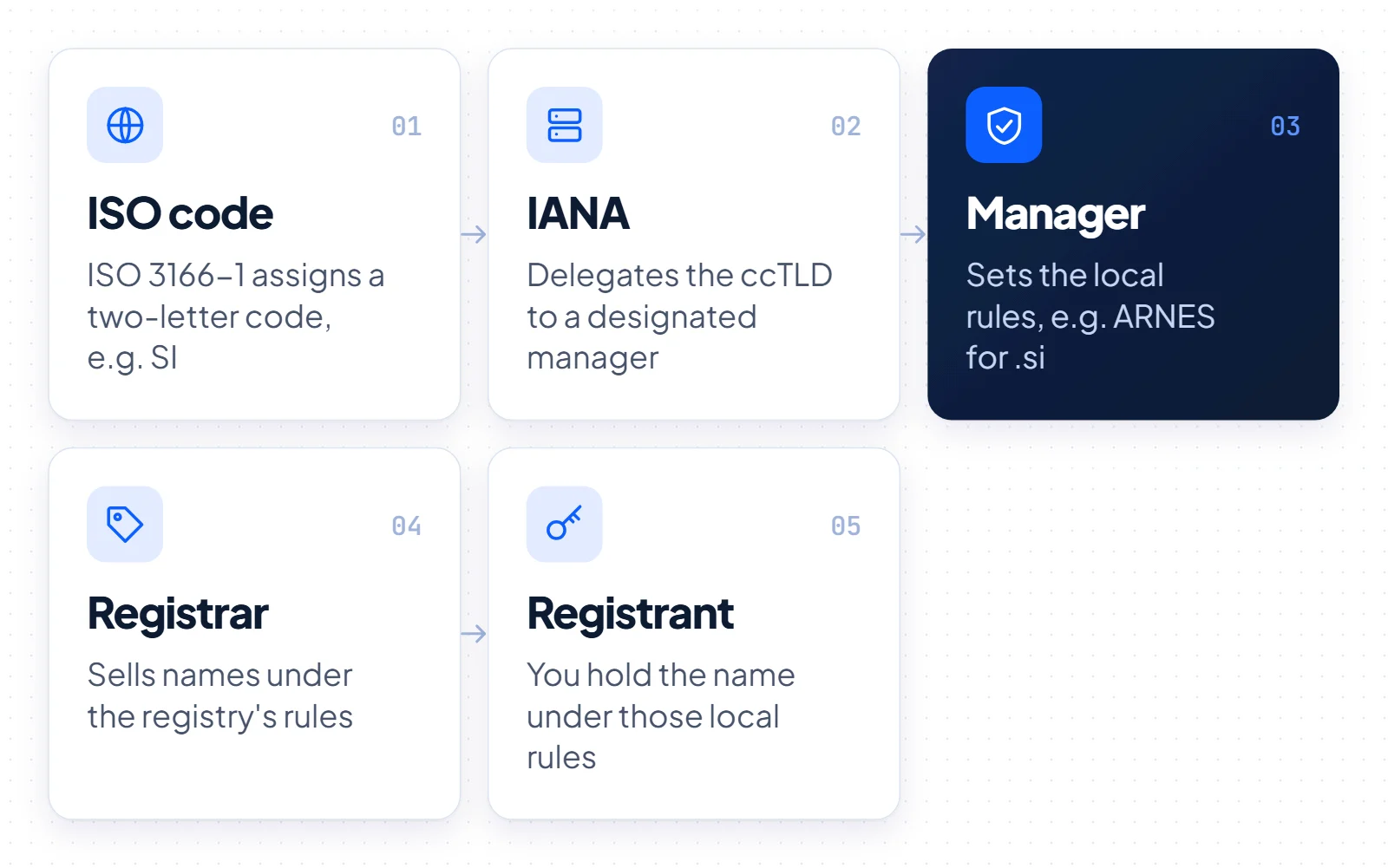
ISO 3166-1 assigns the two-letter code, and IANA delegates the matching top-level domain to a designated manager. The manager, or registry, sets policy and runs the domain database. Accredited registrars sell names to the public, and the registrant holds each name for a fixed term and renews it.
RFC 1591 describes the manager as a “trustee” for both the nation and the global Internet community. In practice, the trustee takes different forms. IANA lists ARNES, the Academic and Research Network of Slovenia, as the manager of .si, and ARNES runs the Register.si registry. Register.si calls April 1, 1992, the date of IANA registration, the birthday of .si. On October 5, 2026, it listed 93 .si registrars.
Elsewhere, governments hold the role themselves. The Government of Anguilla manages .ai, and the Government of Montenegro manages .me. Managers can join ICANN’s country code policy body, the ccNSO, but membership is voluntary and any member may withdraw at any time.
ccTLDs and SEO: how Google treats them
Google treats most ccTLDs as a strong signal that a site is meant for one country. About 20 ccTLDs, including .ai, .io, .co, .tv and .me, are handled like gTLDs, so they carry no country signal.
Google’s guide to multi-regional and multilingual sites, last updated December 10, 2025, lists the generic-treated ccTLDs: .ad, .ai, .as, .bz, .cc, .cd, .co, .dj, .fm, .io, .la, .me, .ms, .nu, .sc, .sr, .su, .tv, .tk and .ws. Google says users and site owners often see these as more generic than country-targeted. It also treats the regional .eu and .asia as generic. The list can change, so check the page before you commit.
For every other ccTLD, Google lists clear geotargeting as the first advantage, and server location does not matter. Among the trade-offs, a ccTLD can target only one country, and some registries have strict eligibility rules.
The ccTLD is also one of the few explicit site-wide country signals left. Google deprecated the International Targeting report in Search Console and says country targeting is no longer supported. It announced the change in August 2022. Hreflang tags still work, alongside on-page signals.
What the 2025 google.com redirect changed
On April 15, 2025, Google announced it would redirect traffic from its own country search domains, such as google.co.uk, to google.com. Google explained that since 2017 everyone has received the same local results whatever domain they use, and said the change would not affect how Search works. The change concerns Google’s own search front ends only. It does not change how Google treats websites on ccTLDs.
What this means for .si
The .si extension is not on Google’s generic list, so Google reads a .si domain as a signal for Slovenia. That helps a site aimed at Slovenia and works against one aimed at the world. Teams that want a .si brand usually pick one of three setups:
- Run the main site on .si when Slovenia is the core market.
- Use the .si name as a short brand address that redirects to a generic main site.
- Accept the Slovenian signal and build global reach with content, links and hreflang.
Our complete guide to the .si domain covers each setup in more detail.
Why startups use ccTLDs as brands
Startups choose ccTLDs like .ai, .io and .co because short, meaningful names are still available there, and the extension can become part of the brand. Google treats these particular ccTLDs as generic, so they work for global sites.
Anguilla’s .ai reads as artificial intelligence, which made it the default extension for many AI companies. Our guide to .ai domains covers prices and rules. The British Indian Ocean Territory’s .io is widely used by tech companies. Extensions such as .tv and .me work as words on their own, and some ccTLDs complete a word as a domain hack.
.si is Slovenia’s country-code domain. For AI companies it reads as SuperIntelligence. That reading is our framing, not an official meaning, and it comes with the Slovenian country signal described above. Short names add to the appeal. The buysidomains.si portfolio lists 10 .si names at fixed aftermarket asking prices from €900 to €12,000 (October 2026), including the 3-letter mkr.si. Our guide to short domain names covers 3- and 4-letter names in more depth.
The risks of building on a ccTLD
A ccTLD brand depends on a registry you do not control. The local manager can change eligibility, pricing or renewal terms, and renewal prices differ between registries and registrars, so check them before you build. Nexus rules like those of .us can also exclude owners without a local connection.
The .io case shows the deeper risk. ICANN relies on ISO 3166-1 to decide which ccTLDs exist. Plans to hand the Chagos Archipelago to Mauritius raised the question of whether the IO code would leave that list. In a November 14, 2024 post, ICANN explained that if IO is removed, its retirement policy applies: a five-year window begins, which might be extended in some circumstances. The UK and Mauritius signed the treaty on May 22, 2025. As of October 2026, the treaty has not taken effect and .io remains delegated.
How to choose: ccTLD, gTLD or both
Choose a ccTLD when one country is your market, a gTLD or a ccTLD that Google treats as generic when your audience is global, and both when brand protection matters. A country-signal ccTLD targets only one country.
Local business
Use your country’s ccTLD as the main domain. It gives Google and customers a clear country signal, and server location does not matter. Check the registry’s eligibility rules first, especially for nexus-based ccTLDs like .us.
Global startup or AI founder
Put the main site on .com or on a ccTLD Google treats as generic, such as .ai or .io. If you want a .si name for its SuperIntelligence reading, use it as a short brand address that redirects, or accept the Slovenian signal with open eyes. If your ideal name is already registered, read how to buy a domain that is already taken.
Brand protection or domain investor
Register your brand in the ccTLDs of the markets you sell in, and redirect them to the main site. Read each registry’s rules and renewal terms before buying. Aftermarket prices for ccTLD names vary widely, and no extension guarantees that a name will gain value.