The agentic web is the part of the internet where AI agents, not only people, find services, read pages and complete tasks for a user. It runs on a few open protocols, such as MCP and A2A, and on plain files that sit on a domain. That last part is why your domain still matters.
Two dates set the scene. In August 2026, Google’s Agent2Agent protocol joined the Agentic AI Foundation, the Linux Foundation fund that has hosted Anthropic’s Model Context Protocol since December 2025. On October 7, 2026, ICANN published 13 applications for a new .agent extension. As of October 22, 2026, no .agent name can be registered.
What is the agentic web?
The agentic web is the phase of the internet in which AI agents act for people: they search, compare offers, fill in forms, call tools and hand work to other agents. The authors of the July 2025 paper Agentic Web: Weaving the Next Web with AI Agents describe it as “a new phase of the internet defined by autonomous, goal-driven interactions.” No standards body owns the term.
Microsoft put the phrase at the center of its Build 2025 conference. In a blog post on May 19, 2025, the company’s Frank X. Shaw described “an open agentic web, where AI agents make decisions and perform tasks on behalf of users or organizations.” Read it as one company’s vision rather than a specification.
Agentic means able to get results with autonomy, according to Merriam-Webster, and the sense is now used mostly for AI. Plain ChatGPT chat, which answers questions, is not agentic because it does not act on its own. OpenAI’s ChatGPT agent, launched on July 17, 2025, is agentic: according to OpenAI’s release notes, it runs its own virtual browser, opens sites and fills in forms.
AI search and the agentic web overlap, but they are not the same thing. In AI search, a model reads your page and writes an answer, which is the subject of our review of generative engine optimization research. In the agentic web, the model also takes the next step: it books, buys, files a form or asks another agent to do it.
The protocols behind the agentic web
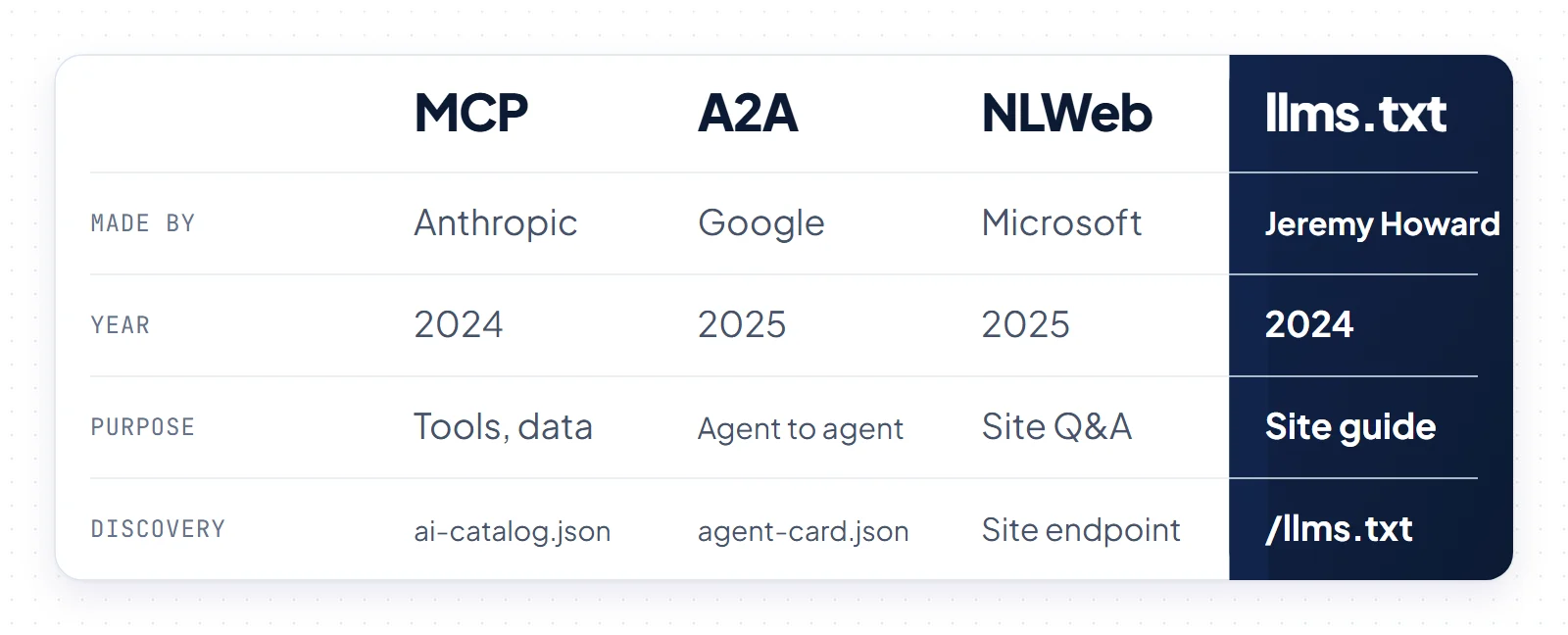
Three open protocols carry most of the agentic web as of October 22, 2026. Anthropic’s Model Context Protocol (MCP, November 2024) connects an AI model to tools and data. Google’s Agent2Agent protocol (A2A, April 2025) lets agents find and talk to each other. Microsoft’s NLWeb (May 2025) gives a website a natural-language endpoint that is also an MCP server.
Anthropic introduced MCP on November 25, 2024 as an open standard for “secure, two-way connections” between data sources and AI tools. Google announced A2A on April 9, 2025, with more than 50 partners at launch, and gave it to the Linux Foundation on June 23, 2025. NLWeb came from R.V. Guha, the creator of RSS, RDF and Schema.org, and Microsoft’s NLWeb announcement says the company believes NLWeb can play “a similar role to HTML in the emerging agentic web.”
MCP and A2A now share one neutral home. The Linux Foundation formed the Agentic AI Foundation on December 9, 2025, with MCP as a founding project next to Block’s goose and OpenAI’s AGENTS.md. A2A joined the same foundation in August 2026, and its project blog says more than 150 organizations back it.
Two lighter pieces sit beside the big three. Jeremy Howard proposed llms.txt on September 3, 2024: a Markdown file at the root of a site that points language models to the pages worth reading. It is a proposal, not a standard. WebMCP, which Chrome previewed on February 10, 2026, lets a web page offer tools to a browser agent from inside the page.
| Protocol | Made by, year | What it connects | Where it lives on a domain | Status, October 22, 2026 |
|---|---|---|---|---|
| MCP | Anthropic, 2024 | Agent to tools and data | A server URL; optional /.well-known/ai-catalog.json | Open spec, hosted by the Agentic AI Foundation |
| A2A | Google, 2025 | Agent to agent | /.well-known/agent-card.json | Spec version 1.0.0, hosted by the Agentic AI Foundation |
| NLWeb | Microsoft, 2025 | Website to agent, in plain language | An endpoint on the site that is also an MCP server | Open-source project |
| WebMCP | Google and Microsoft, 2025 | Web page to browser agent | A JavaScript API inside the page | Origin trial in Chrome 149 |
| llms.txt | Jeremy Howard, 2024 | Site content to language models | /llms.txt | Community proposal |
Why domains still matter for AI agents
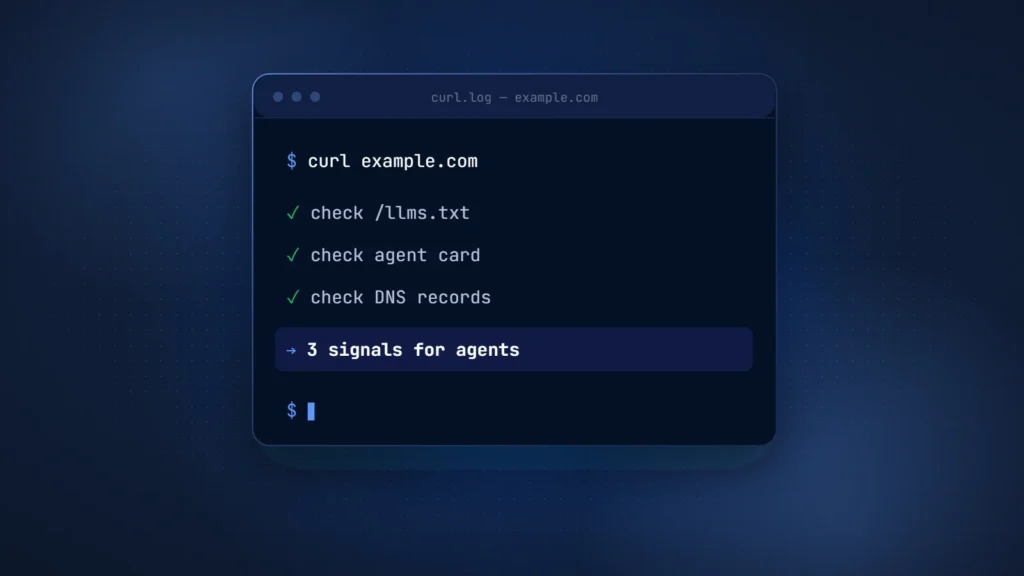
Agent discovery still runs on domain names. An A2A agent publishes its Agent Card at https://{domain}/.well-known/agent-card.json, a path IANA has listed as a permanent registration since August 1, 2025. The official MCP Registry can tie a server’s name to the publisher’s domain and verify ownership through a DNS TXT record or a /.well-known file on that same domain.
The A2A specification names the agent card path directly and says cards should be served over HTTPS. A card can also carry a JWS signature, so a client can check that the card was not altered and comes from the claimed provider. Older A2A versions used agent.json; the current version 1.0.0 uses agent-card.json.
The MCP Registry makes the link even plainer. Under its domain authentication rules, a company at example.com publishes servers under the reverse-DNS name com.example. To prove it, the company adds a TXT record on its apex domain or a file at /.well-known/mcp-registry-auth, each holding the company’s public key. The registry trusts whoever controls the domain.
MCP’s core specification has no discovery file. An optional Server Card extension, finalized in October 2026, lets a domain list its MCP servers in an AI Catalog at /.well-known/ai-catalog.json. As of October 22, 2026, though, agents usually reach an MCP server through its URL or a registry. IETF individual drafts go further and propose agent discovery in DNS itself, for example through records under an _agents label. They are drafts, not standards.
The practical result: each of these files and records sits on a domain, so an agent’s identity is only as stable as the domain behind it. If the domain lapses, whoever registers it next controls the paths that agents read.
What the Forbes AI 50 publish for agents
On October 22, 2026, BuySI Domains checked the main websites of all 50 companies on the Forbes AI 50 2026 list for agent-facing files. Of those 50, 30 served a valid llms.txt file, and seven of them also served llms-full.txt. Three served some MCP discovery file, one of them at /.well-known/ai-catalog.json. None served an A2A agent card at /.well-known/agent-card.json. On each of these checks, a bot challenge blocked two sites, three different sites in all.
The method was simple and can be repeated. A script requested seven paths on each main domain in two passes 40 seconds apart, and both passes gave the same counts. A file counted only if it returned real content: a JSON agent card with a name and skills or capabilities, or an llms.txt that opens with a Markdown heading. A path that sent back the homepage counted as missing.
We checked main domains only, not docs or developer subdomains, so the counts are a floor. Paths behind a Cloudflare challenge count as unknown, not as missing.
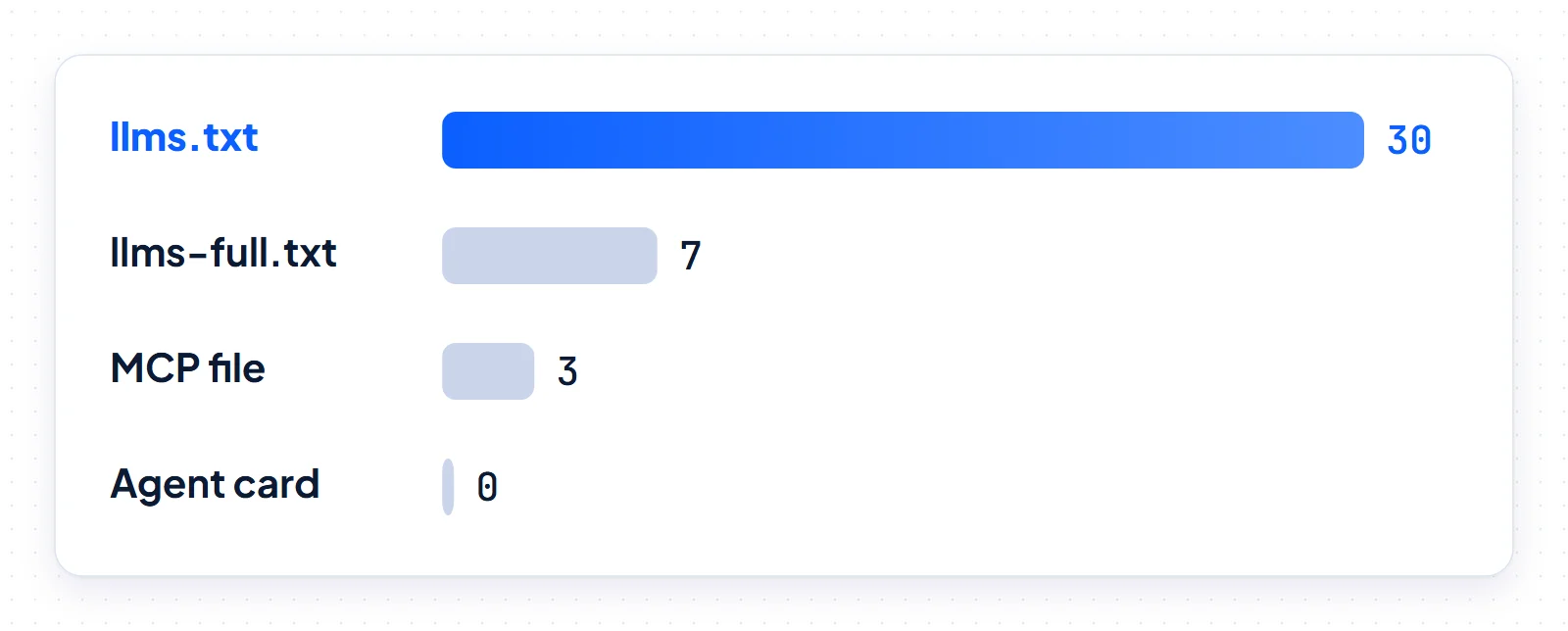
Effort explains much of the spread. An llms.txt file is a single text file that needs no new software, and most of the list publishes one. An agent card only makes sense for a company that runs an A2A agent for the public, and none of these 50 publish one at the root of their main domain. This check shows who publishes llms.txt, not which AI systems read it. Our guide to LLM optimization covers what is known about how brands get into AI answers.
.agent is years away; .si works today
ICANN’s 2026 new gTLD round drew 13 applications for .agent, according to the data ICANN published with its October 7, 2026 reveal. Applicants include OpenAI, Meta and Charleston Road Registry, Google’s registry company. ICANN has set no launch date for .agent, and nothing under .agent can be registered as of October 22, 2026.
The .agent extension is years from launch, and ICANN’s own schedule shows why. According to the ICANN reveal announcement of October 7, 2026, String Confirmation Day is November 17, 2026. The comment and objection window runs to March 16, 2027, and string evaluation is expected to take about 180 days. With 13 applicants for one string, .agent must also go through contention resolution, and only one applicant can run it.
Identity Digital, a registry operator, estimated in February 2026 that the first uncontested new extensions could launch in late 2027 or early 2028. Contested strings fall outside that estimate. Our overview of the 2026 new gTLD round covers the process and the other AI strings in it. Names sold as .agent today on alternative roots are not ICANN domains.
.si is Slovenia’s country-code domain. For AI companies it reads as SuperIntelligence. That reading is our framing, not an official meaning. Unlike .agent, .si is live. Clause 2.7 of the Register.si general terms defines a holder as “a natural or legal person who registers a domain name” under those terms, with no residency condition stated.
Every file in this article, whether an agent card, an llms.txt file or an MCP Registry TXT record, works on any domain you control and needs only DNS and HTTPS. A short .si name such as essai.si, which carries both “AI” and “SI”, can host them the day it resolves. BuySI Domains lists essai.si for sale. For the rules and setup, see the complete .si domain guide, and for the naming side, whether .si suits an AI startup.
What to do on your domain now
For most sites, the agentic web calls for a few small, reversible steps on a domain you already own. The order below runs from cheapest to most involved.
- Publish llms.txt if you have docs or product pages. It is one Markdown file at /llms.txt. Treat it as a low-cost proposal, not a ranking factor.
- Add an agent card only if you run an A2A agent. Serve it at /.well-known/agent-card.json over HTTPS, and sign it if your tooling supports JWS.
- Claim your MCP namespace if you ship an MCP server. The MCP Registry checks a DNS TXT record or a /.well-known/mcp-registry-auth file on your domain.
- Treat the domain as infrastructure. Turn on auto-renew, lock transfers at the registrar and give DNS access to at least two people.
- Watch .agent, do not wait for it. The next ICANN milestone is String Confirmation Day on November 17, 2026. Skip .agent offers that sit outside ICANN.
A startup naming an agent product today can launch on any live extension, publish its files there and decide on .agent if and when it opens. A company that already ships an MCP server or an A2A agent has the most to gain from steps 2 and 3, because both tie its agent to the domain it already owns.