A .org domain is one of the internet’s original top-level domains, dating to 1985 and meant for “organizations.” Anyone can get one. Public Interest Registry (PIR), the nonprofit that has run .org since 2003, calls it “open and unrestricted.” Registration needs no proof of nonprofit status and no eligibility check, just a registrar account and the annual fee.
The timing makes it worth a fresh look. On June 1, 2026, the .org wholesale (registry) price rose from $9.93 to $11.00, its first increase since 2016, according to Domain Name Wire. A week later, PIR CEO Jon Nevett said .org had passed 12 million registrations. Among AI research and safety groups, .org is still the default address: in our check on November 19, 2026, 17 of 33 used it for their main site.
What is a .org domain?
A .org domain is a generic top-level domain (gTLD) and one of the original extensions of the internet, established in 1985. Its meaning is literal: RFC 920, published in October 1984, defines ORG as “Organization.” The first .org name, mitre.org, was registered by the MITRE Corporation on July 10, 1985. The IANA root zone database lists Public Interest Registry as the manager of .org.
Network Solutions ran .org in its early years. Since January 1, 2003, PIR has been the registry operator, with Identity Digital (formerly Afilias) as the technical provider behind it. It kept Identity Digital in that role after a tender in 2023. The registry keeps the master list of names; registrars sell them. For the wider picture of how gTLDs and country codes differ, see our guide to domain extensions.
RFC 920 set a broad definition from the start. It says nothing about charities or tax status, so the nonprofit image came later, from the name and the groups that chose it.
Who can register a .org domain
Anyone can register a .org domain. The PIR FAQ states that .org is “an open and unrestricted domain” and that anyone may register and use .org names. There is no check for charity status, tax filings or a mission statement. You buy a .org name the same way you buy any other domain: through a registrar, which sets its own retail price and renewal terms.
Pricing works in two layers: PIR sells names to registrars at a wholesale price, and in its own words it “does not determine the fees that registrars charge their customers.” The wholesale (registry) price has been $11.00 since June 1, 2026, up from $9.93, according to Domain Name Wire. The same report quoted a PIR spokesperson saying PIR “has no further plans to increase prices at this time.” Retail prices vary from one registrar to the next, so compare renewal prices rather than first-year offers.
If you need an extension that does prove nonprofit status, PIR offers an alternative. It launched .ngo and .ong in 2015, and both require NGO eligibility. Those two verify the registrant. A .org name does not.
Does .org still signal trust?
A .org domain does not verify who runs a website. Public Interest Registry (PIR), the .org registry operator, describes .org as open and unrestricted, so a .org site can belong to a charity, a company or an individual. PIR’s anti-abuse metrics page, accessed on November 19, 2026, showed 6,640 domains reported so far in 2026 and 3,929 suspensions, equal to 0.032% of .org domains under management. These are PIR’s own figures, not an independent audit.
Phishing accounted for 5,306 of PIR’s reports. A .org address alone is no evidence of good intent, so the useful check is the organization behind the name.
The stronger technical argument is security at the registry. PIR says .org was “the first open generic Top-Level Domain” to sign its zone file with DNSSEC, which it did on June 2, 2009. A signed zone lets resolvers verify answers about .org names. Each owner still has to enable DNSSEC for their own domain, and many skip that step. Our explainer on how DNSSEC signing protects domain lookups covers the setup.
Search engines do not reward the extension either. In a 2015 post, Google’s John Mueller wrote that its systems treat new gTLDs “like other gTLDs (like .com and .org).” He added that keywords in a TLD give no advantage or disadvantage in search.
Who runs .org: PIR, ISOC and the sale that never closed
Public Interest Registry (PIR) runs .org. It is a 501(c)(3) nonprofit that the Internet Society (ISOC) created in 2002 to manage the domain. PIR took over as registry operator on January 1, 2003, and about 2.6 million .org domains moved to its system that year. ISOC appoints PIR’s board. In June 2026, PIR CEO Jon Nevett said PIR contributes nearly 60% of the proceeds from each .org registration to ISOC.
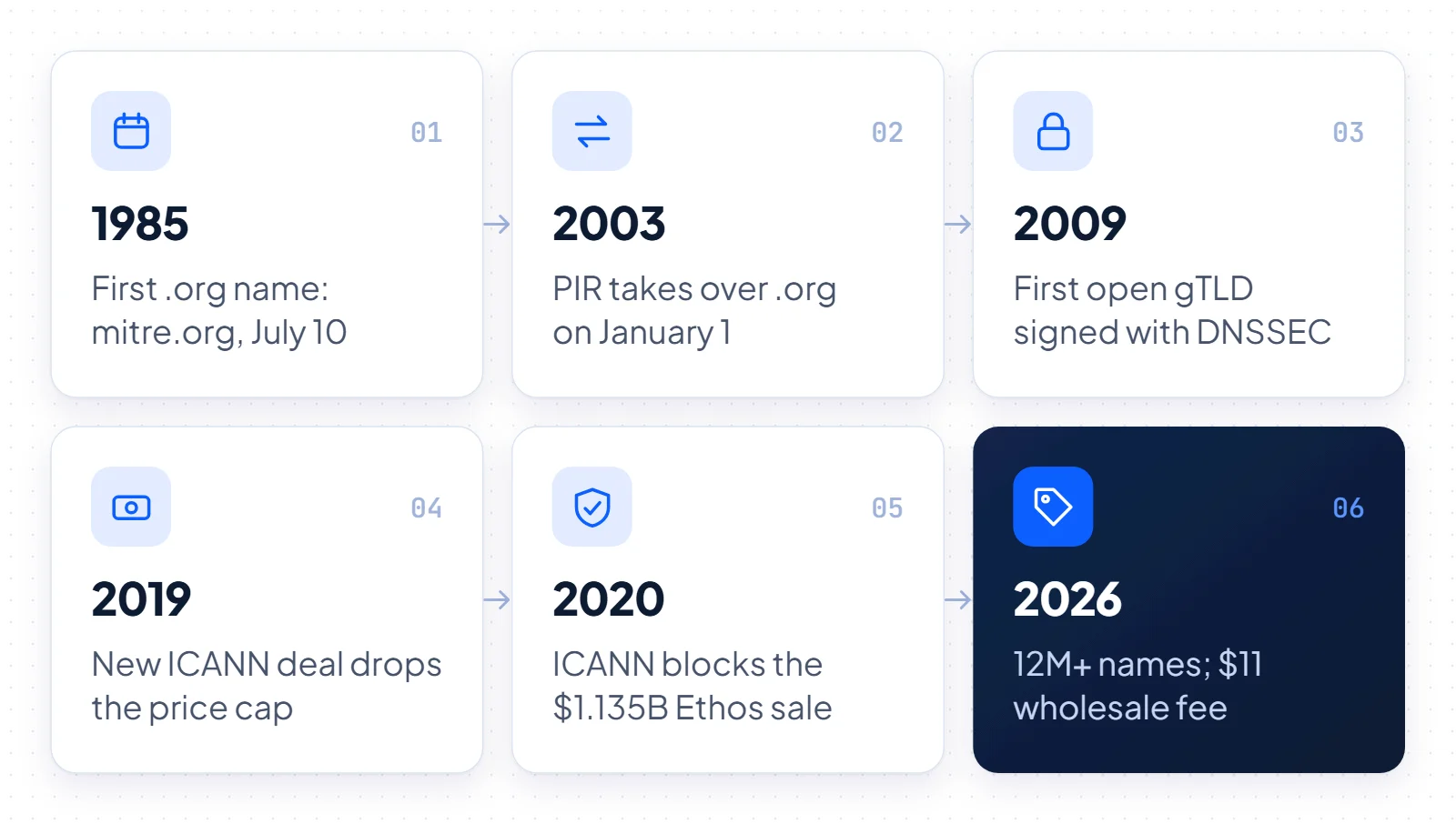
That structure came under pressure in 2019, first over price. The 2013 .org registry agreement capped the registry fee and limited increases to 10% a year. When ICANN renewed the agreement on June 30, 2019, it removed “the price cap provisions,” according to the ICANN public comment record on the renewal. ICANN said protections for existing registrants would remain in place.
The Internet Society tried to sell Public Interest Registry, the .org operator, in 2019, and ICANN blocked the sale. On November 13, 2019, ISOC announced that Ethos Capital would acquire PIR. ISOC CEO Andrew Sullivan disclosed the price, $1.135 billion, as The Register reported on December 3, 2019. On April 30, 2020, the ICANN board withheld consent for the change of control of PIR, citing “unacceptable uncertainty” and a $360 million debt instrument tied to the sale.
The price caps did not come back. An Independent Review Process panel issued its final declaration in Namecheap v. ICANN on December 23, 2022, and on November 10, 2024, the ICANN Board decided to keep the 2019 .org and .info agreements without price controls. Even without a cap, PIR did not raise its wholesale price from 2016 until June 2026. For registrants, that is a steady record, but there is no contractual ceiling on future renewals.
Where AI research and safety organizations actually live
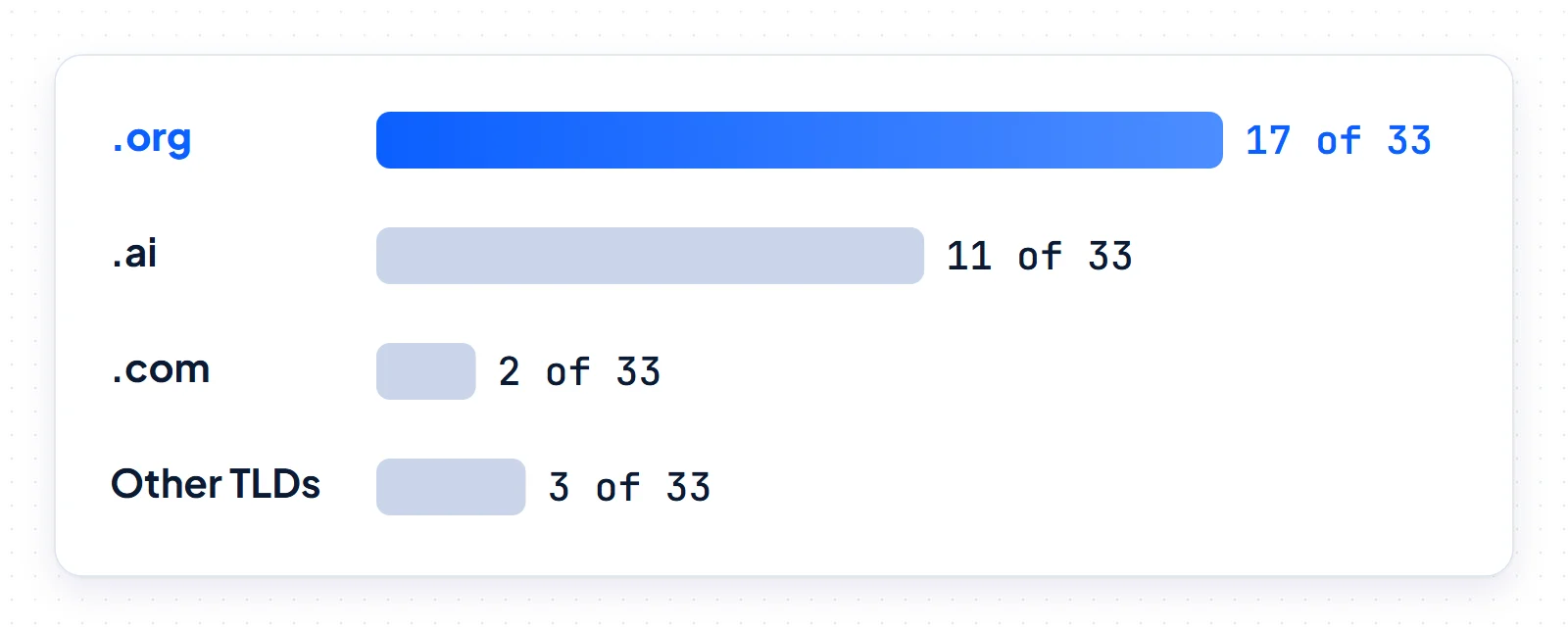
More than half of the well-known AI research and safety groups in our sample use .org. BuySI Domains checked the live main websites of 33 AI research, safety and policy organizations on November 19, 2026, following every redirect to the final address. Of the 33, 17 end on .org, 11 on .ai and 2 on .com. The remaining 3 use .info, .quebec and .institute.
The sample is hand-picked, not random. It covers well-known nonprofits, research collectives and policy groups, such as intelligence.org (MIRI), futureoflife.org, metr.org, epoch.ai, far.ai and lesswrong.com. It leaves out companies, universities’ own .edu sites and government bodies. Read it as a picture of the field’s best-known names, not a census. We fetched each site over HTTPS, looked up DS records through Cloudflare’s DNS-over-HTTPS resolver and queried RDAP at PIR.
| Final TLD of main site | Organizations (of 33) | With DNSSEC (DS record) |
|---|---|---|
| .org | 17 | 8 |
| .ai | 11 | 2 |
| .com and other (.info, .quebec, .institute) | 5 | 1 |
| Total | 33 | 11 |
Some groups have moved their address. The controlai.com domain now redirects to controlai.org, and ai-futures.org redirects to aifutures.org. Not every move favors .org: aiobjectives.org forwards to ai.objectives.institute.
DNSSEC is rarer than the 2009 head start of the .org zone suggests. Only 11 of the 33 organizations publish a DS record for their domain: 8 of the 17 on .org and 2 of the 11 on .ai. The .org, .ai and .com zones are all signed, so the gap sits with domain owners and their DNS providers.
The matching .org names, which we call .org twins, mostly point elsewhere. For the 16 organizations whose main site is not on .org, the .org name with the same label is registered in all 16 cases, according to RDAP at PIR. Only 3 of those 16 redirect to the organization’s main site: pauseai.org, lesswrong.org and vectorinstitute.org. The remaining 13 lead to other websites (mozilla.org, for example, is the site of the parent Mozilla rather than mozilla.ai), parked or registrar pages, or no website at all.
.org vs .com vs .ai vs .si for AI research groups
.si is Slovenia’s country-code domain. For AI companies it reads as SuperIntelligence. That reading is our framing, not an official meaning. The table compares the four on facts from IANA, the registries, Google and our check, plus one row of opinion.
| .org | .com | .ai | .si | |
|---|---|---|---|---|
| Type | gTLD, established 1985 | gTLD | ccTLD (Anguilla) | ccTLD (Slovenia) |
| Manager listed by IANA | Public Interest Registry | VeriSign Global Registry Services | Government of Anguilla | ARNES, run as Register.si |
| Zone signed with DNSSEC | Yes, since June 2, 2009 | Yes (DS in root, our check) | Yes (DS in root, our check) | Yes, since December 1, 2011 |
| How Google treats it | Generic | Generic | Generic (on Google’s list of ccTLDs treated as generic) | Country-targeted (not on that list) |
| Main sites in our 33-organization sample | 17 | 2 | 11 | 0 |
| What it signals (our view) | Mission, research, public interest | Business default | AI product or company | Slovenia; for AI, SuperIntelligence |
For a commercial AI product, .com and .ai are the usual picks; our guide to choosing an .ai domain covers that decision. For a research group or nonprofit, the real comparison is .org against a name with a meaning of its own.
.org domains and .si domains differ in one practical way for search. .org is a gTLD that Google does not tie to any country. .si is a country-code TLD that Google treats as targeted to Slovenia, because .si is not on Google’s list of ccTLDs handled as generic. Google says that list may change. Both are open to registrants worldwide: Register.si accepts any natural or legal person, with no nationality or residency requirement.
The .si registry has a research pedigree. IANA lists ARNES, the Academic and Research Network of Slovenia, as its manager. Register.si deployed DNSSEC for .si on December 1, 2011, and completed the chain of trust on December 24, 2011. Our guide to the .si domain explains how registration works.
Most of these labels are already registered on .si. When we checked the labels of the 33 main sites through Register.si RDAP, 21 of the 33 were taken. We report only that count, because we do not know who holds those names. None of the 33 organizations uses .si for its main site.
The case for .si is meaning. A lab or nonprofit that studies artificial superintelligence can make the SI reading part of its name, much as AI startups use .ai. A name like essai.si shows the idea: essai is French for an attempt or an essay, and the label ends in “ai.” BuySI Domains lists essai.si for sale. We sell .si names, so weigh our view with that in mind.
How to choose your extension
Choose by audience first, then protect the names around your choice.
- Pick .org if you are a nonprofit, research collective, open-source project or standards body, and your readers expect a mission rather than a product. It is generic in Google, signed at the registry and the norm in AI safety, with 17 of the 33 groups we checked.
- Pick .com if you sell to businesses or consumers and want the default commercial address.
- Pick .ai if you are an AI company with a product, and you want the extension to say so. Google treats it as generic.
- Pick .si if you are a research group or nonprofit working on advanced AI and want the SI reading in your name. Accept that Google treats it as country-targeted, and pair it with a .org twin.
Whatever you pick, register the .org twin and redirect it. Our check found that the same-label .org name was registered for all 16 non-.org organizations, yet only 3 pointed to the real site. A 301 redirect from the twin to your main domain keeps donors, journalists and search engines from landing on someone else’s page. Do the same for any old address you leave behind.
Then set up the basics. Turn on auto-renew, compare the renewal price at your registrar against the $11.00 wholesale (registry) price, and enable DNSSEC for your own domain. Only 8 of the 17 .org sites in our sample had done that last step.