A .tech domain is a generic top-level domain for technology brands, run by Radix Technologies Inc. and open to anyone in the world. The registry sets standard registration and renewal at $49 a year before promotions. The catch is premium names: some registry tiers renew at their premium price every year, not at $49.
The extension is bigger than it was a year ago: ICANN’s monthly registry report for July 2026 counts 590,473 .tech domains, up about 10.8% from 532,821 a year earlier. Radix says .tech also led its premium sales in the first half of 2026. To see how .tech holds up in practice, we checked 20 well-known .tech brands and the DNS security of the zone. We also counted how many common AI words are already registered in .tech. All checks ran on November 13, 2026.
What is a .tech domain?
A .tech domain is any web address that ends in .tech. Technology brands of all sizes use it, from developer tools and databases to hardware makers and events. It is one of the new generic top-level domains from ICANN’s 2012 new gTLD round. The IANA root zone database lists Radix Technologies Inc. as the manager and Tucows as the technical contact. ICANN’s registry agreement for .tech is a base, non-sponsored contract dated January 30, 2015.
Control of .tech has changed hands several times. On October 9, 2014, Radix announced that an arrangement with Dot Tech LLC gave it the rights to run .tech. The zone was delegated to Dot Tech LLC in March 2015. Early Access opened on July 29, 2015, and general availability followed on August 5, 2015. IANA’s transfer history then shows three later moves: to Personals TLD Inc. on February 1, 2021, to Radix FZC on August 26, 2021, and to Radix Technologies Inc. on February 7, 2024.
Radix, founded in 2012, also runs .online, .site, .store, .space, .website, .host, .press, .fun and .uno, and says it manages about 10 million domains. In August 2025 it announced that those domains would move from Team Internet (CentralNic) to Tucows Registry. That fits the Tucows technical contact in the IANA record.
| .tech at a glance | Detail |
|---|---|
| Type | New generic TLD (base, non-sponsored) |
| Registry operator | Radix Technologies Inc. (IANA) |
| Delegated | March 2015 |
| General availability | August 5, 2015 |
| Who can register | Anyone, no eligibility restrictions |
| Registration term | 1–10 years |
| Standard price (registry) | $49 registration, $49 renewal per year, before promotions |
| Size | 590,473 domains (ICANN, July 2026) |
| DNSSEC | Signed (checked November 13, 2026) |
| HSTS preload | No |
| Grace period after expiry | Roughly 30–36 days |
Who can register a .tech domain
Anyone can: the registry’s .tech guide says “anyone in the world can register a .tech domain name” and that there are no eligibility restrictions. You do not need a company, a local address or a tech product.
Registration terms run from 1 to 10 years. The usual dispute rules apply: UDRP and URS cover trademark claims, and Radix’s acceptable use policy applies to every name. Students have an inexpensive entry point, since the GitHub Student Developer Pack includes one standard .tech domain free for 1 year.
If a name lapses, there is a grace period before redemption. The registry’s own pages give two figures, 36 days and about 30 days, so plan on roughly 30–36 days and confirm the exact window with your registrar.
What a .tech domain costs: promo, renewal and premium tiers
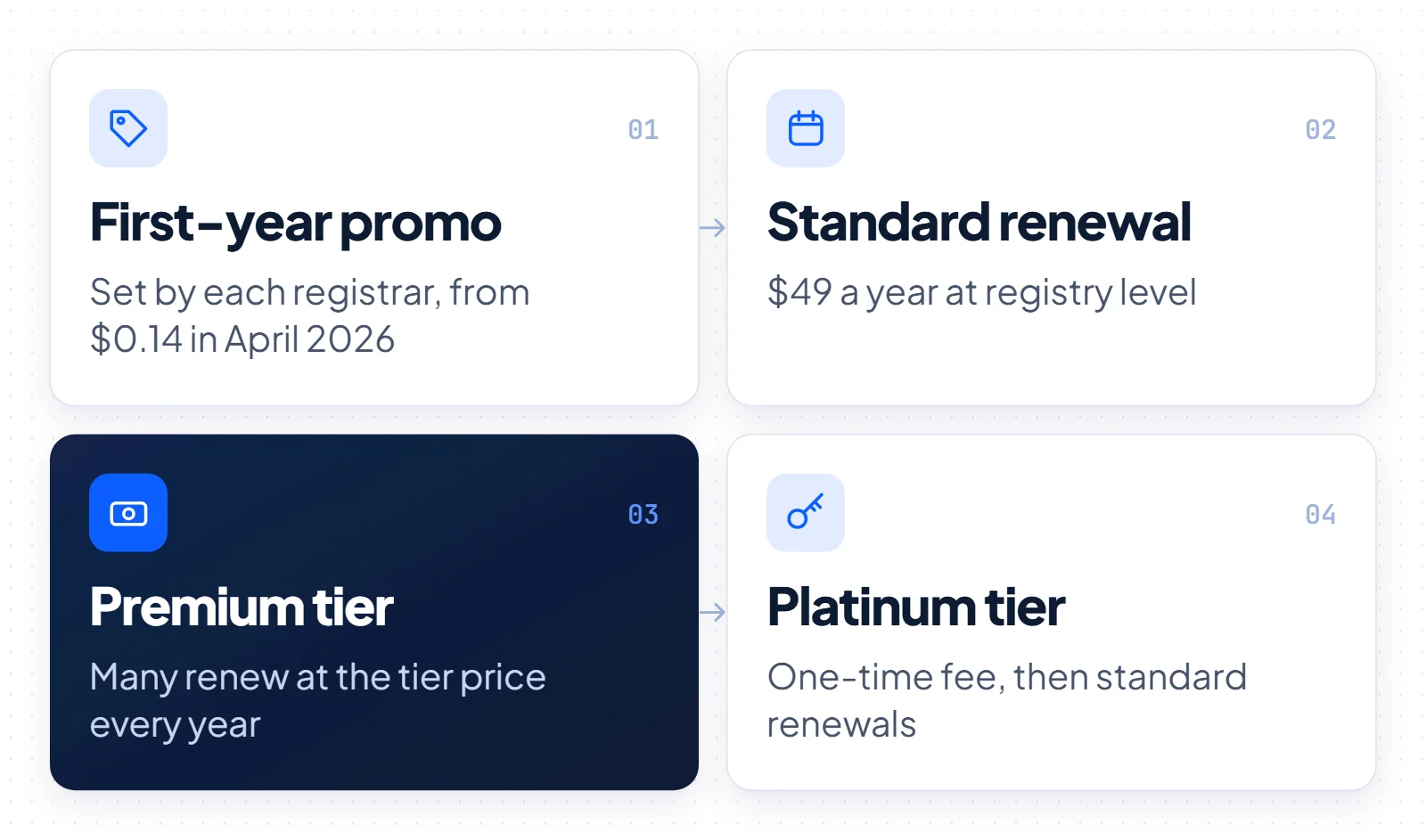
A .tech domain has three price layers. The first-year promo is set by each registrar and can be close to zero. The standard renewal is $49 a year at registry level. Registry premium names sit in pricing tiers, and many of them renew at the premium price every year.
The registry’s guide, updated June 10, 2026, gives $49 for standard registration and $49 for standard renewal before promotions. It also lists first-year offers seen in April 2026 at four registrar partners, from $0.14 to $6.99. A third-party price tracker lists renewals from about $45 to $87. Budget for the renewal, not the promo. Our guide to domain renewal costs shows how to compare multi-year totals.
Premium names work differently. Radix’s registry policies say each pricing tier “may carry a specific price for registration, transfer, redemption and renewal.” Radix also reserves the right to move available names between tiers. Its H2 2022 premiums report said premiums sold through registrars renew at the same price as the first year. Domain Name Wire calls this a “high-high” model: a premium price at registration and again at every renewal.
There is one exception: in its H2 2023 premiums report, Radix said Platinum domains carry the classic model of a one-time fee with standard renewals. The tier therefore decides the long-term cost. Before you buy a premium .tech name, ask the registrar which tier it sits in and what it will cost to renew, and get the answer in writing.
Buyers do pay these prices. According to Domain Name Wire on July 22, 2026, Radix reported 4,424 premium registrations across its TLDs in the first half of 2026. The .tech extension led with 1,229, up from 600 in the first half of 2025. Of those registrations across all Radix TLDs, 112 were priced at $5,000 a year, 37 at $10,000 a year and 2 at $25,000 a year.
Who uses .tech: 20 brands we checked
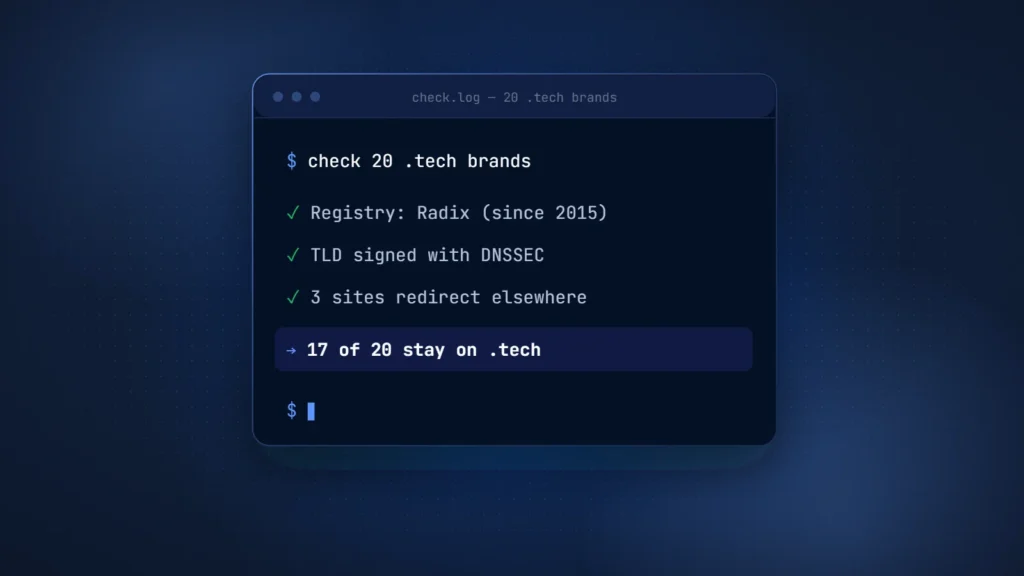
Of 20 well-known .tech brands checked by BuySI Domains on November 13, 2026, 17 keep .tech as their final URL. Three leave: neon.tech redirects to neon.com, mosaic.tech redirects to hibob.com after HiBob acquired Mosaic in 2025, and insight.tech redirects to an Intel corporate address. The same 20 labels are registered in .com (20 of 20), .ai (19 of 20) and .si (19 of 20).
The full sample was nothing.tech, ces.tech, 1x.tech, hex.tech, insight.tech, turso.tech, tldr.tech, ipfs.tech, alice.tech, neon.tech, decentro.tech, aurora.tech, zeta.tech, escape.tech, mosaic.tech, shadow.tech, makers.tech, iqm.tech, jhipster.tech and rabbit.tech. Most appear on the registry’s site or in Radix and trade-press reports, so the sample leans toward success stories.
Brands move in both directions. Neon now sends visitors to a .com it owns, while IQM moved from MeetIQM.com to IQM.tech, Domain Name Wire reported in July 2026. Since all 20 .tech brand labels in our sample are also registered in .com, that overlap has a cost. Some visitors will type the .com out of habit, and some email can go to the wrong place.
Is .tech safe, and does Google rank .tech domains lower?
A .tech domain is a legitimate generic TLD with no entry in the top-20 abuse tables we checked. Interisle’s Cybercrime Information Center and Spamhaus left .tech out of their top-20 lists for reporting periods between May 2024 and September 2026. The .tech zone is also signed with DNSSEC.
Google does not rank .tech domains lower. In a post on the Google Search Central blog on July 21, 2015, John Mueller wrote: “Overall, our systems treat new gTLDs like other gTLDs (like .com and .org).” He added that keywords in a TLD give no advantage or disadvantage in search. The flip side is that a .tech ending will not help you rank for technology terms. Content, links and site quality do that work.
The abuse data, in more detail: Interisle’s Cybercrime Information Center does not list .tech in any top-20 phishing table for May 2024–April 2025 or May 2025–April 2026. Spamhaus also leaves .tech out of its top-20 tables for April–September 2025 and October 2025–March 2026. Its April–September 2026 update, published October 15, 2026, does not name .tech either. That report counted 3.37 million malicious or suspicious listings, up 56.6%, led by .com at 724,149 and .top at 627,907.
Absence from a top-20 list does not indicate zero abuse. Sister Radix TLDs .online and .site do appear in Spamhaus’s top-20 gTLD abuse tables for October 2025–March 2026 and April–September 2026. A shared registry does not mean a shared reputation.
On the technical side, our DNS-over-HTTPS lookup on November 13, 2026, found validated DS records for .tech, as it did for .ai, .com and .si. Unlike .dev, though, .tech is not on the HSTS preload list as a whole TLD, so browsers do not force HTTPS on every .tech name. You need to configure HTTPS and redirects yourself and, if you want it, your own HSTS preload entry.
The bigger risk is the history of an individual name. A used .tech domain may carry spam, malware or a penalty from a previous owner, so check the domain history before you buy.
.tech vs .com vs .ai vs .si for an AI startup
The four extensions send different signals and come with different terms. .si is Slovenia’s country-code domain. For AI companies it reads as SuperIntelligence. That reading is our framing, not an official meaning.
| Factor | .tech | .com | .ai | .si |
|---|---|---|---|---|
| Type | New gTLD (2015) | Legacy gTLD | ccTLD of Anguilla | ccTLD of Slovenia |
| Operator or registry | Radix Technologies Inc. | Verisign | Anguilla’s ccTLD manager | Register.si |
| Who can register | Anyone, no restrictions | Open to the public | Check registrar terms | Open to registrants worldwide |
| Standard renewal basis | $49 per year (registry standard) | Set by each registrar | Set by each registrar | Set by each registrar |
| Premium renewal risk | Some tiers renew at premium price | Check each name | Check each name | Check each name |
| How Google treats it | Like .com and .org | Generic | Generic (ccTLD exception) | Geotargeted to Slovenia |
| Reads as | Technology | The default | Artificial intelligence | SuperIntelligence (our framing) |
Google’s documentation for multi-regional sites lists .ai among the country codes it treats as generic. .si is not on that list, so Google geotargets .si to Slovenia. That matters for a global search strategy, but it matters less for a brand that grows through direct traffic, links and AI answers. Our .ai domain guide covers the Anguilla side in detail.
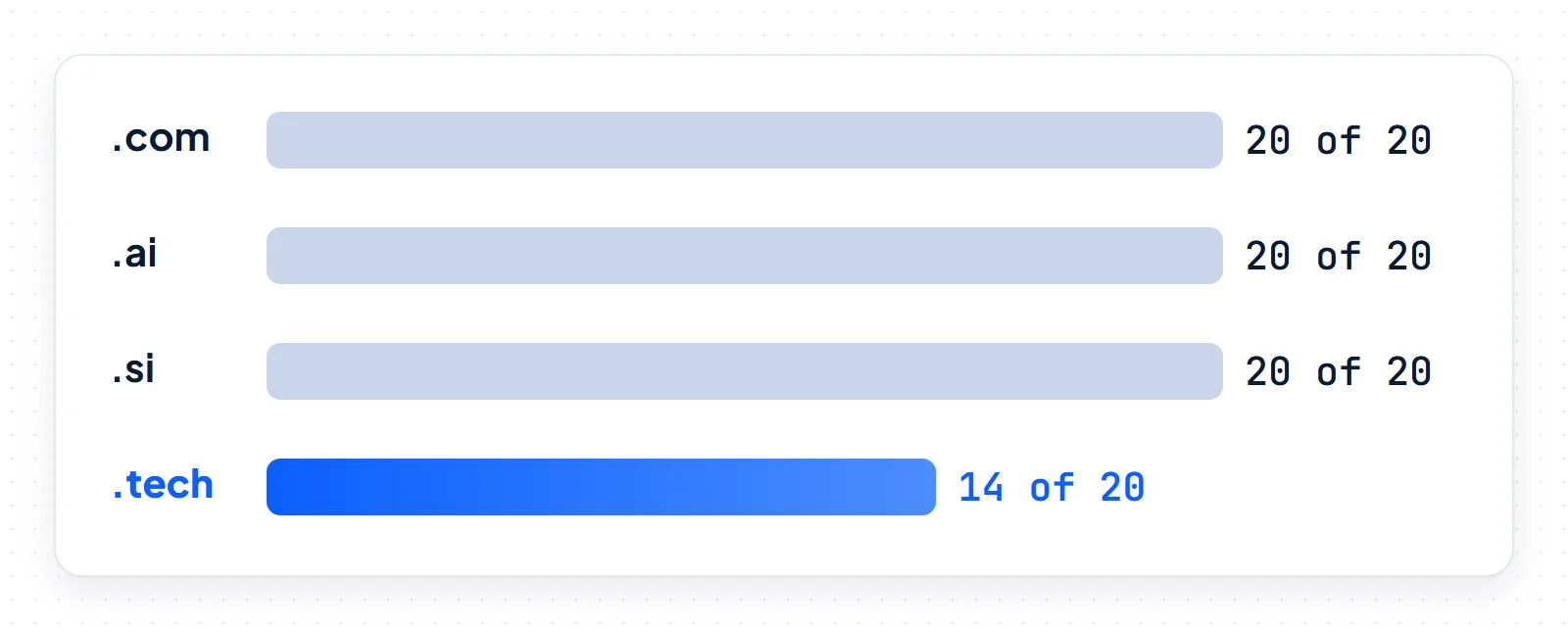
Name supply differs sharply. On November 13, 2026, we ran RDAP lookups for 20 common AI and tech words, such as agent, neural, model and vector. All 20 were registered in .com, .ai and .si, against 14 in .tech. The six with no .tech record were robot, vision, cloud, data, token and cyber, and they also returned NXDOMAIN in DNS.
A missing record does not make a word cheap. RDAP does not show whether a name is reserved or premium-priced, so a word that looks free may still sit in a high pricing tier. Check the price at a registrar first: 14 of 20 words had a .tech record, against 20 of 20 in .com, .ai and .si.
For a lab that works on artificial superintelligence (ASI), the .si reading fits the mission. For infrastructure firms that sell in Slovenia, the geotargeting can help, and a descriptive name does the explaining. A name such as netserver.si reads as hosting or GPU cloud at a glance. BuySI Domains lists netserver.si for sale.
Which extension fits your startup
Pick the extension that matches your buyers and your budget over 10 years, not the first-year price.
- Choose .tech if you build developer tools, hardware or infrastructure and want a short, exact name. Accept that someone else will likely hold the .com. Pick a standard-tier name, or get the premium renewal price in writing before you pay.
- Choose .com if you sell to a mainstream audience, cannot afford misrouted email and can buy the exact name.
- Choose .ai if AI is the product itself and you want a global signal that Google treats as generic.
- Choose .si if you want a short AI brand with the SuperIntelligence reading, or if you sell in Slovenia, where geotargeting works for you.
- Combine them if you can. Build on one extension and redirect the others, as Neon does with neon.tech.
Before you register any .tech name, check three things: its pricing tier, its renewal price and its history. Those three answers tell you more about the real cost than any promo banner.