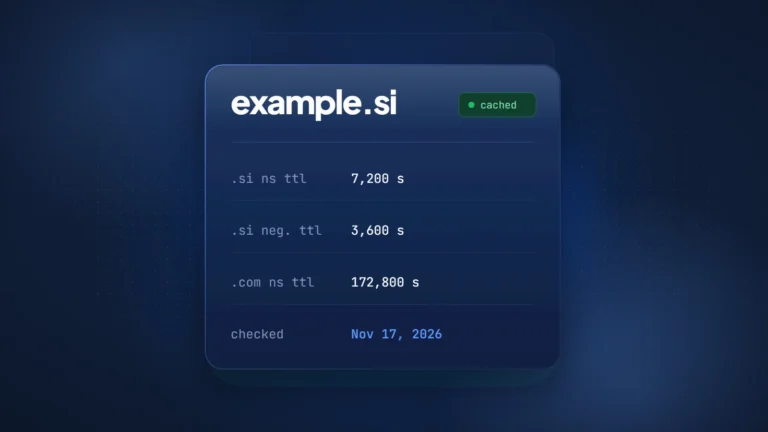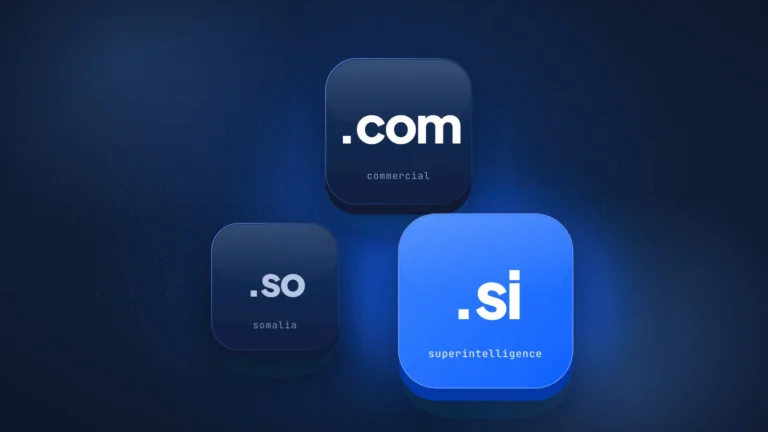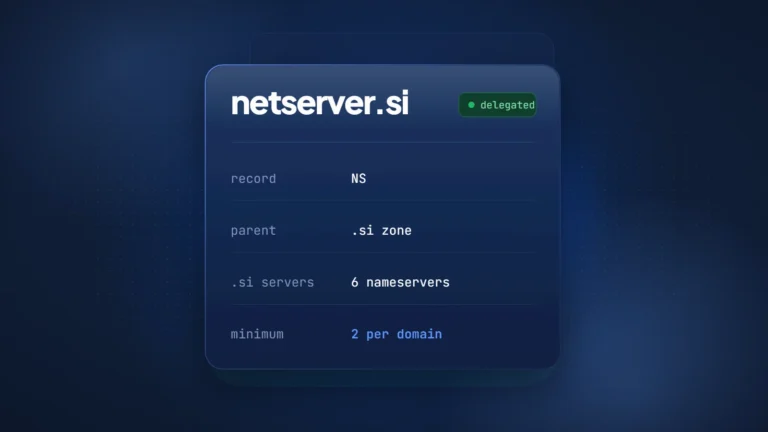
Domain extensions are the letters after the last dot in a web address, such as .com, .org or .si. Each one is a top-level domain (TLD) delegated in the DNS root zone, which IANA manages. IANA’s list held 1,437 domain extensions as of October 19, 2026, and 151 of them are internationalized labels written in characters beyond basic A–Z.
The choice carries more weight in 2026 than it did a few years ago. Verisign’s Domain Name Industry Brief for Q2 2026 counted 401.6 million registrations across all TLDs on June 30, 2026, up 8.1% year over year. ICANN’s 2026 application round then drew 1,663 applications for new extensions. A wider choice helps, but it also makes it easier to pick an extension that works against your brand.
What is a domain extension?
A domain extension is the top-level domain of a web address: in buysidomains.si, it is .si. “Domain extension” and “TLD” mean the same thing.
Every extension sits in a hierarchy. At the top is the DNS root zone, which IANA maintains and publishes in its Root Zone Database. Each TLD in that database is delegated to a manager, usually called the registry, which runs the extension and sets its rules. Registrars sell names to the public and pass the registrations to the registry.
Take .si as an example. IANA lists the Academic and Research Network of Slovenia (ARNES) as the manager of .si, and the registry operates as Register.si. According to Register.si, .si was registered with IANA on April 1, 1992.
Types of domain extensions
IANA’s Root Zone Database sorts all 1,437 domain extensions into three active types: 1,127 generic TLDs, 309 country-code TLDs and one special-use TLD, .arpa (IANA, October 20, 2026). There is no official list of “7 types” of domains. Guides that count more split the generic group into legacy, restricted, new and brand TLDs, and treat internationalized (IDN) extensions as a group of their own.
The finer groups of domain extensions are more useful in practice, because they predict who can register a name.
| Type | What it is | Examples | Who can register |
|---|---|---|---|
| Legacy generic (gTLD) | The original open generic extensions, in use long before the 2012 round | .com, .net, .org | Anyone, through a registrar |
| Restricted generic | Generic in name, limited to defined institutions | .gov, .edu | .gov: US-based government organizations (managed by CISA). .edu: accredited US postsecondary institutions (managed by EDUCAUSE) |
| New gTLD | Generic extensions added through ICANN’s 2012 round, with more coming from the 2026 round | .xyz, .top, .london | Set by each registry; many are open to anyone |
| Brand TLD | A generic TLD run by a company for its own brand | .google, .bmw, .apple | The brand owner or a company it controls, which IANA lists as the manager (for .google, Google’s Charleston Road Registry) |
| Country code (ccTLD) | A two-letter extension tied to a country or territory | .si, .de, .us, .ca | Set by each registry: .si accepts any natural or legal person, .us requires a US nexus, .ca requires Canadian presence |
| Repurposed ccTLD | A ccTLD marketed and used worldwide for what its letters spell | .ai, .io, .co, .tv, .me | Set by each country’s registry manager |
| Internationalized (IDN) | Generic or country-code extensions in characters beyond A–Z; 151 of 1,437 TLDs | .рф, .中国 | Depends on the registry behind the extension |
| Special use | Reserved for internet infrastructure | .arpa | No public registration; managed by the Internet Architecture Board |
Brand TLDs count as generic in IANA’s database, with the company as manager: .bmw is run by Bayerische Motoren Werke AG and .apple by Apple Inc. Repurposed ccTLDs remain country codes on paper, even when used as global brands. For how country-code registries are run, see our explainer on how country-code domains work.
How many domain extensions are there?
IANA’s TLD list contained 1,437 domain extensions in its version of October 19, 2026. The count changes as extensions are added or retired, so a figure without a date is probably out of date.
Most of today’s generic extensions come from ICANN’s 2012 program. That program received 1,930 applications and had produced 1,241 delegated gTLDs as of August 31, 2026, a cumulative figure that does not subtract later terminations. Applicants withdrew another 653 applications.
ICANN’s 2026 new gTLD round drew 1,663 applications between April 30 and August 12, 2026, and 1,616 of them were proceeding on September 22, 2026. ICANN then published 1,615 applications on Reveal Day, October 7, 2026, including 333 for brand TLDs. String Confirmation Day is November 17, 2026.
Some applications will drop out through withdrawal, contention or rejection, and approved TLDs launch on their own schedules. The count of 1,437 will not jump by 1,615 at once. Our overview of ICANN’s 2026 new gTLD round covers the process and the timeline.
The most common domain extensions
Verisign’s Domain Name Industry Brief (DNIB) publishes registration totals every quarter. The Q2 2026 edition shows .com far ahead, with country codes as a group close behind.
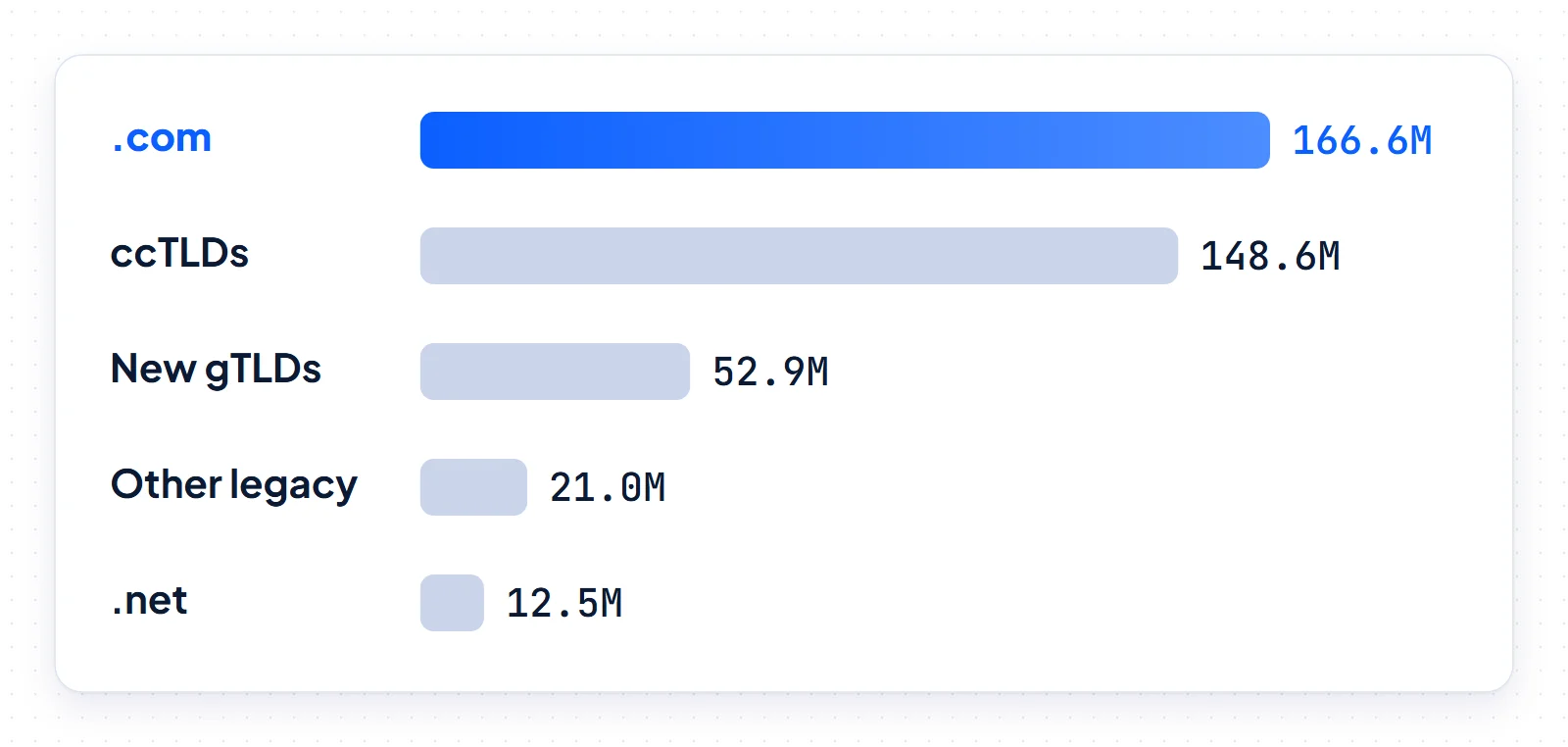
.com holds about 41.5% of all domain name registrations: 166.6 million of 401.6 million on June 30, 2026, according to Verisign’s Domain Name Industry Brief for Q2 2026. Country-code TLDs together account for 148.6 million registrations and new gTLDs for 52.9 million (13.2% of the total). Other legacy gTLDs hold 21.0 million and .net 12.5 million. The common claim that .com is “nearly half” of all domains overstates its share.
The top 10 mixes legacy gTLDs, large national ccTLDs and two new gTLDs.
| Rank | Extension | Type | Registrations (millions) | Share of all registrations |
|---|---|---|---|---|
| 1 | .com | Legacy gTLD | 166.6 | 41.5% |
| 2 | .cn | ccTLD (China) | 20.9 | 5.2% |
| 3 | .de | ccTLD (Germany) | 18.0 | 4.5% |
| 4 | .net | Legacy gTLD | 12.5 | 3.1% |
| 5 | .org | Legacy gTLD | 12.0 | 3.0% |
| 6 | .uk | ccTLD (United Kingdom) | 10.5 | 2.6% |
| 7 | .xyz | New gTLD | 8.5 | 2.1% |
| 8 | .ru | ccTLD (Russia) | 6.9 | 1.7% |
| 9 | .top | New gTLD | 6.5 | 1.6% |
| 10 | .nl | ccTLD (Netherlands) | 6.1 | 1.5% |
Source: Verisign DNIB, data as of June 30, 2026. Shares calculated by BuySI Domains against 401.6 million total registrations.
Country codes are concentrated: the 10 largest ccTLDs hold 57.2% of all ccTLD registrations. New gTLDs are the fastest-growing group, up 34.0% year over year, while ccTLDs grew 3.6%.
Volume is not the same as commitment. DNIB also reports renewal rates: 75.2% for .com and .net (preliminary), 67.2% for other legacy gTLDs and 31.0% for new gTLDs. A low rate means more names lapse when they come up for renewal. That makes renewal rates a better quality signal than raw counts: an extension whose registrants keep their names is one people build businesses on.
Country codes used as global brands: .ai, .io, .co, .tv, .me and .si
Some country-code extensions now work as generic brands because their two letters mean something in English. The government of Anguilla manages .ai, and Internet Computer Bureau Limited manages .io, the code for the British Indian Ocean Territory. Colombia’s MinTIC manages .co, while .tv belongs to Tuvalu and .me to Montenegro.
Google treats 20 country-code TLDs as generic, including .ai, .io, .co, .me and .tv, according to its Search Central documentation (page updated December 10, 2025). Slovenia’s .si is not among those 20, so Google reads a .si domain as a ccTLD with a geographic signal pointing to Slovenia, while it handles an .ai or .io domain like .com. The documentation adds that the list may change.
.si is Slovenia’s country-code domain. For AI companies it reads as SuperIntelligence. That reading is a branding choice, not an official meaning, and it does not change the geographic signal to Slovenia. Our guide to the .si domain covers its rules and history, and our guide to the .ai domain covers the extension most AI startups compare it with.
We pulled monthly search volume for three extension queries from Ahrefs in October 2026.
| Query | US monthly searches | Global monthly searches | Date checked |
|---|---|---|---|
| .io domain | 3,600 | 13,000 | October 5, 2026 |
| .ai domain | 2,200 | 11,000 | October 20, 2026 |
| .si domain | 600 | 4,200 | October 20, 2026 |
Source: Ahrefs, October 2026.
For “.si domain”, only 600 of 4,200 global monthly searches come from the US, which puts most of that interest elsewhere. All three queries are searches for the extension itself: read them as awareness, not adoption.
Do domain extensions affect SEO?
Domain extensions affect SEO mainly through geotargeting, not ranking strength. Google’s Search Central guidance on multi-regional sites calls a ccTLD a strong signal to users and search engines that a site is meant for a specific country. The same page adds that Google handles any TLD that ICANN does not list as a country code as a gTLD.
That gives three cases. A gTLD such as .com or .xyz carries no country signal, so it suits a site aimed at several markets. A ccTLD on Google’s generic list, such as .io or .ai, behaves the same way. A standard ccTLD, such as .de or .si, tells Google the site targets that country: useful for a local business, and a factor a global brand has to plan around.
The words in an extension carry no ranking weight either. In a 2015 post on new top-level domains, Google said keywords in a TLD give no advantage or disadvantage in search. The same post says .BRAND TLDs get no more weight than other gTLDs, and that city TLDs such as .london count as gTLDs. Google now marks that post as possibly outdated, so read it as background rather than current documentation. For the country-code side in more depth, read our guide on how ccTLDs affect SEO.
Registration rules and prices differ by extension
Who can register depends on the registry, and the rules range from fully open to strictly limited. Many generic extensions accept anyone through a registrar. Others tie eligibility to an institution, like .gov and .edu, or to a country:
- .us requires a US nexus: a US citizen, permanent resident or person domiciled in the US, an organization formed in the US, or a foreign entity with a bona fide presence in the United States.
- .ca applies CIRA’s Canadian Presence Requirements, which cover, for example, Canadian citizens of the age of majority and permanent residents.
.si is open. Register.si’s General Terms and Conditions define the domain holder as a natural or legal person who registers a name under those terms. They set no nationality or residency condition, and applications go only through a registrar. A .si name can be 2–63 characters long, using A–Z, 0–9, the hyphen and IDN letters (roža.si is the registry’s own example). Registrars register or renew a .si name for one to five years at a time.
Prices vary by extension too, and they work in layers. The registry sets a wholesale price and registrars add a margin, which is why the same extension costs different amounts at different registrars. First-year and renewal prices often differ, so compare renewal prices, not first-year offers. Some registries also place specific names in premium tiers, and a name someone already owns sells at the price the owner sets.
How to choose a domain extension
Choose the extension by audience first and meaning second. Price and availability matter, but they should decide between options that already fit, not set the shortlist.
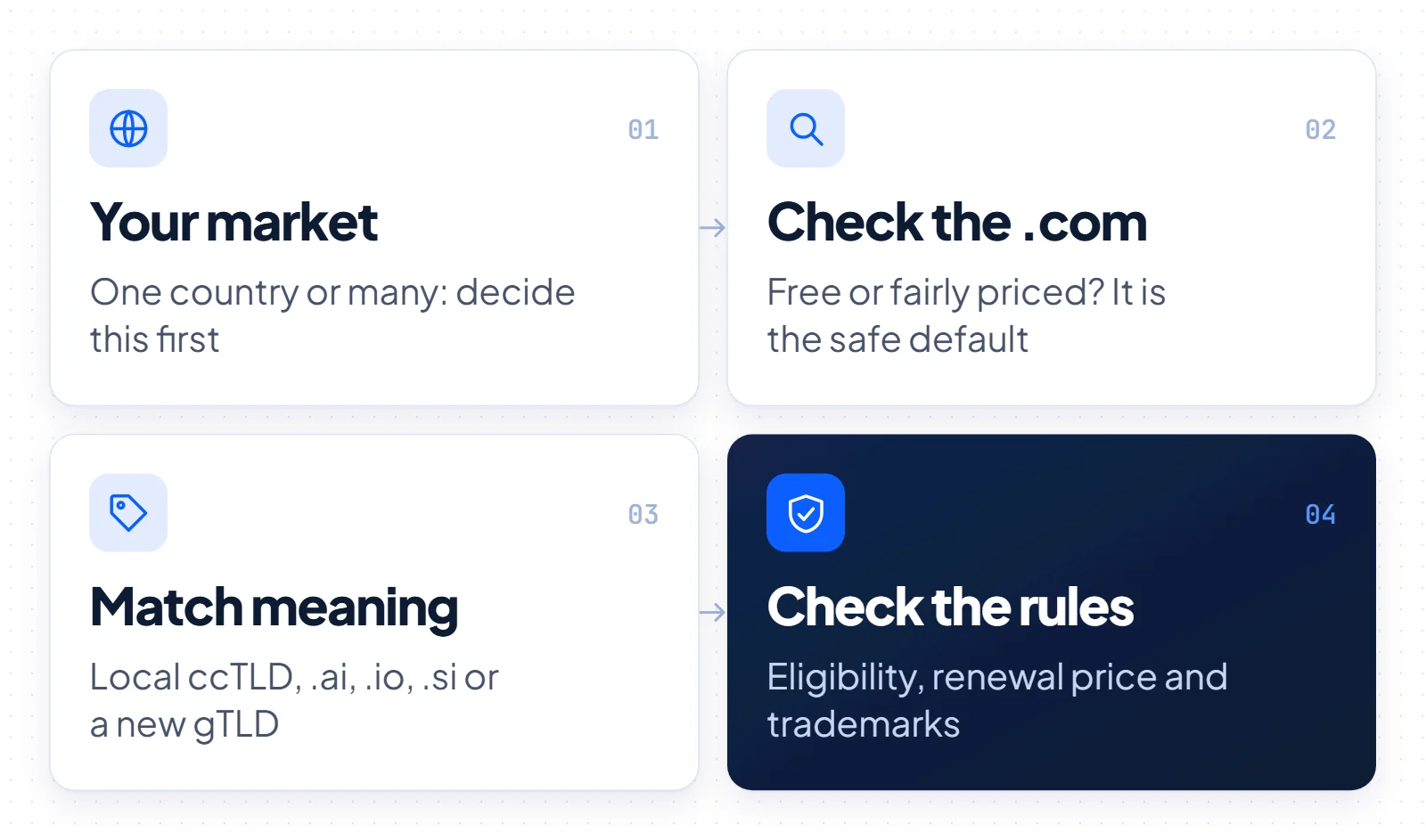
- Define where your customers are: one country, or many.
- Check the .com. If it is free or reasonably priced, it is the safe default.
- Match the extension to what you do, from a local ccTLD to .ai, .io, .si or a new gTLD.
- Check rules, renewals and trademarks before you commit.
Pick .com if you sell across markets and expect people to type your name from memory or hear it spoken. It holds about 41.5% of registrations, and .com and .net together renew at 75.2%. Nobody has to be told a .com is a real address. The cost is availability: short, clear .com names are rarely unregistered, and an aftermarket purchase can cost more than an early-stage company should spend on a name.
Pick your local ccTLD if most of your customers are in one country. Google reads it as a signal for that country, and a Slovenian business on .si or a German one on .de gets the clearest local signal available.
Pick a repurposed ccTLD if you build software or AI and want a short, on-theme name. Both .ai and .io are on Google’s generic list, so they carry no country signal. .si works as an AI-flavored alternative through the SuperIntelligence reading. Google still classes it as Slovenia’s ccTLD, though, and a global company should accept that signal knowingly. A name such as essai.si, a .si name that contains “ai”, shows the idea. It is listed at a fixed price on its page.
Pick a new gTLD when the extension finishes the name, like a studio on .design or a city guide on .london, and you plan to keep it for years. New gTLDs renew at 31.0%, which suggests many of these names are short-term bets. If yours is meant to last, check the renewal price before you register.
If the .com of your chosen name is taken, register the obvious variants your customers are likely to type. Read the renewal terms for every name you buy, premium ones in particular. Then run a trademark search in each market you plan to sell in: an available domain does not mean an available name. If the .com belongs to an active business in your field, change the name, not just the extension.