Yes, a .si domain can rank outside Slovenia. Google treats .si as a country signal for Slovenia, but that does not prevent international visibility. The useful question for a superintelligence brand is whether the name, audience and growth strategy justify that geographic association.
A founder may choose .si because the letters fit a superintelligence identity. Google still classifies the extension as Slovenia’s country-code top-level domain, or ccTLD. Understanding those two meanings helps you choose a domain without assuming that a branding advantage automatically becomes a search advantage.
This guide explains the current Google guidance, examines early data from our English-language .si site and gives you a practical way to assess your own results. Disclosure: BuySI Domains sells .si domains. Our recommendations distinguish branding preferences from documented search behavior.
What does ccTLD SEO mean for a superintelligence brand?
ccTLD SEO concerns how a country-code domain affects a site’s geographic relevance and international search strategy. For a business developing AI tools, publishing research or covering superintelligence, domain choice brings together three separate decisions:
- Brand meaning: does the name communicate something useful and memorable to your intended audience?
- Search geography: does the extension carry a country association that fits your target market?
- Evidence and expertise: what will the site publish that gives people a reason to trust, visit and reference it?
A .si address can support a deliberate superintelligence identity. It does not establish that a company has developed superintelligence, demonstrate research expertise or earn authority on that subject by itself. Those claims need to be supported by the work published on the site.
For registration rules and ownership details, see our guide to the .si domain. Here, the focus is whether that choice fits an international search strategy.
How Google treats .si, .ai and .com
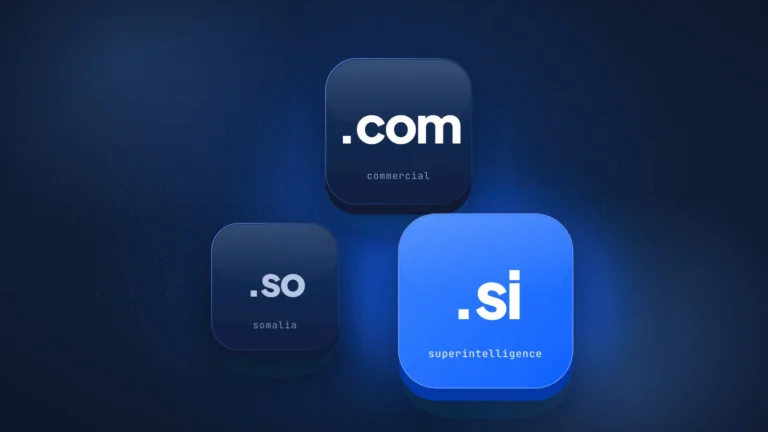
Google’s international-site documentation identifies country-code domains as strong geographic signals. It also lists exceptions: some ccTLDs are treated as generic because their use is perceived as broader than their country of origin.
| Extension | Domain type | Google’s geographic treatment | Implication for your brand |
|---|---|---|---|
| .si | Slovenia’s ccTLD | Country-associated | Weigh the Slovenia association alongside your intended superintelligence branding. |
| .ai | Anguilla’s ccTLD | Treated as generic | An option for an AI identity without an Anguilla country signal from the extension. |
| .com | Generic TLD | Generic | An option when you want a name that is independent of a particular country or AI label. |
Generic treatment is not a promise of higher rankings. It removes the country association attached to the extension; the site still has to earn visibility for its pages.
Which ccTLDs does Google treat as generic?
The reviewed Google list contains 20: .ad, .ai, .as, .bz, .cc, .cd, .co, .dj, .fm, .io, .la, .me, .ms, .nu, .sc, .sr, .su, .tk, .tv and .ws. .si is absent. Google also lists .eu and .asia as generic regional domains. Check the current list before making a purchase, because classifications can change.
Google’s July 2023 SEO office-hours transcript directly confirms that .ai has been treated as generic since early June 2023. That change is documented; a future change for .si should not be assumed in a domain-buying decision.
Country signals and hreflang: what you can influence
Google’s international guidance also identifies local links, relevant business details and regional page annotations as audience signals. It determines a page’s language from its visible content. Server location can contribute information, but it is not definitive; geographic meta tags such as geo.position are ignored.
For an English-language superintelligence publication, the practical starting point is clear English content that serves its intended readers. If your business offers products in specific markets, show accurate availability, pricing and contact information where useful. A .si site should not invent a foreign address or present a business presence it does not have.
Search Console no longer provides a country-targeting setting
Google retired Search Console’s country-targeting feature in 2022. Its deprecation notice confirms that the setting is no longer supported and that hreflang remains supported. There is no Search Console switch that changes .si into a generic extension or assigns it a different country.
Use hreflang when you have alternate versions
hreflang helps Google choose between language or regional versions of equivalent content. It is useful when, for example, you offer an English research page and a Slovenian translation, or separate US and UK versions of a product page. It is not a general ranking boost for an English page.
- One English version: you do not need to create extra regional pages or hreflang tags just to reach international readers.
- Several equivalent versions: identify each version, including itself, and make the references reciprocal.
- A fallback page: consider
x-defaultfor users whose language or region is not otherwise matched. It is optional. - Implementation: choose HTML annotations, HTTP headers or a sitemap. Google treats the methods as equivalent.
Follow Google’s localized-versions documentation. Hreflang describes relationships between pages; it does not reclassify the domain.
Our .si case study: international visibility, with limits
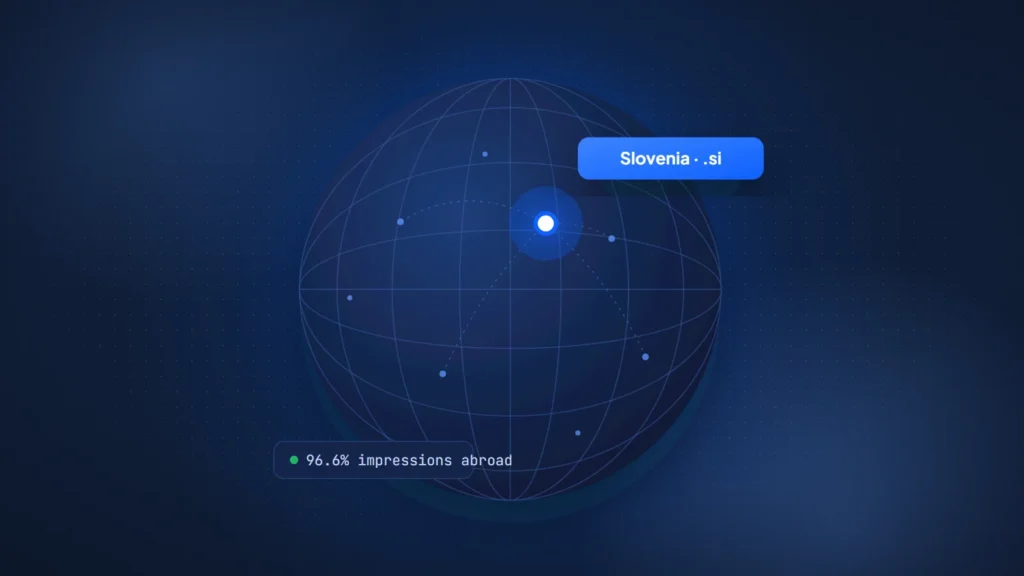
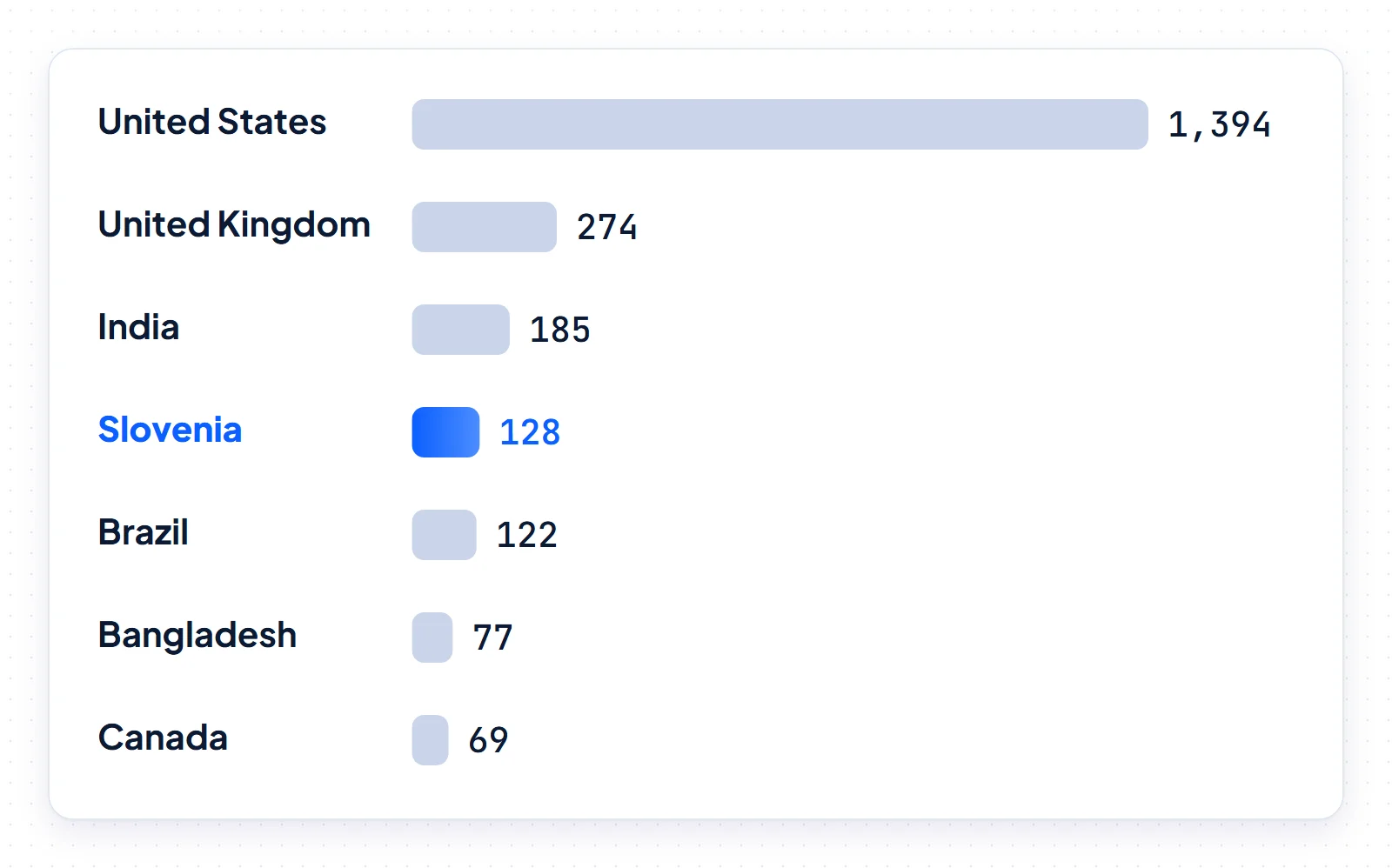
BuySI Domains publishes English-language content about superintelligence, AI naming and domain strategy on a .si domain. Our reported Search Console snapshot for September 21–October 19, 2026 contains 3,720 impressions and 24 clicks. Of those impressions, 3,592 came from outside Slovenia: 96.6%.
That percentage shows that the site appeared in international search results. It does not establish strong traffic, qualified demand or an advantage over a comparable site on .com or .ai. The snapshot’s overall click-through rate was approximately 0.65%.
| Country | Impressions | Share of total | Average position |
|---|---|---|---|
| United States | 1,394 | 37.5% | 34.1 |
| United Kingdom | 274 | 7.4% | 51.7 |
| India | 185 | 5.0% | 7.3 |
| Slovenia | 128 | 3.4% | 7.3 |
| Brazil | 122 | 3.3% | 9.1 |
| Bangladesh | 77 | 2.1% | 7.7 |
| Canada | 69 | 1.9% | 21.4 |
| All other countries | 1,471 | 39.5% | Not reported |
| Total | 3,720 | 100% | Not reported |
What this snapshot can and cannot show
The study covers one young site over a short period. The published summary does not include a raw export, the complete filter configuration or query-level observations, so readers cannot independently reproduce it from this page. The date range also includes publication day. Google’s Performance report guidance notes that the newest data can be preliminary.
The central limitation is the comparison itself. Country averages can contain different pages, queries and devices. The US average of 34.1 and Slovenia’s 7.3 therefore do not measure a country-domain penalty. India also averaged 7.3, which further cautions against explaining the differences through .si alone.
There is no equivalent .com or .ai control site in this dataset. The supported conclusion is narrower: this English-language .si site received impressions outside Slovenia. The size of any effect caused by the extension remains unknown.
How to evaluate international SEO on your own .si site
Before attributing weak performance to a domain, compare the pages and searches that matter to your business. For a superintelligence publication, a visit to a technical explainer may have a different purpose from a visit to a domain sales page.
- Choose the business outcome. Define whether you need research readership, newsletter subscriptions, product trials or qualified enquiries.
- Record a reproducible baseline. Save the property, date range, search type, filters and export time. Use complete comparison periods where possible.
- Separate branded and non-branded searches. Someone searching your company name has a different intent from someone asking a general question about superintelligence.
- Compare like with like. Examine the same page and query across countries, with the same device and search type. Treat very small samples cautiously.
- Review trends, not one position. Follow impressions, clicks and CTR over several comparable periods. Connect those visits to outcomes in your analytics.
- Keep a change log. Record new content, major edits, technical fixes and relevant links so that domain choice does not become the default explanation for every fluctuation.
Google documents these controls in its Search Console Performance report guide. A careful comparison improves diagnosis, although it still does not isolate the causal effect of the domain extension.
Build a superintelligence resource worth discovering
For a site built around superintelligence, a useful editorial strategy connects questions that the same readers actually need answered. Domain strategy belongs in that resource when it helps founders choose and operate a credible identity. Each article should still have a clear job of its own.
- Explain the subject: establish what you mean by superintelligence and distinguish it from adjacent concepts such as AGI and ASI.
- Help readers assess claims: separate demonstrated capabilities, research goals, company statements and forecasts. Link to original evidence where available.
- Support practical decisions: connect a discussion of superintelligence domains to naming, audience fit and the search implications examined here.
- Add your own evidence: publish documented tests, interviews or datasets with enough context for readers to assess the conclusion.
This is an editorial approach to building expertise, not a claim that a particular number of articles unlocks a ranking benefit. Repeating “superintelligence” across unrelated posts does little to help the reader. Contextual links should lead to a useful next question rather than send every page to every other page.
Google’s helpful-content guidance emphasizes original value, clear authorship and evidence of experience or expertise. For this subject, that means making it easy to identify who wrote an assessment, what supports it and where uncertainty remains.
Does .si offer an advantage in AI answers?
The extension alone is not evidence that a source deserves to be cited about superintelligence. Google’s guidance for generative AI search emphasizes useful original content and established SEO practices; it does not prescribe a special domain extension or AI-specific schema.
Provide clear explanations, accessible evidence and accurate source attribution so readers can assess your work. Those qualities make the resource more useful, but they do not guarantee an AI citation. Other answer services have their own systems. Our guide to generative engine optimization examines that wider question.
When should a superintelligence brand choose .si?
Our recommendation is to assess the complete name and business plan. A geographic signal is a real consideration, but this article’s data does not quantify how much it would affect your site.
| Your situation | Approach to consider | Reason |
|---|---|---|
| You are launching an international site with no established domain. | Compare a suitable .com or a generic-treated ccTLD such as .ai with your preferred .si name. | A generic option avoids an extension-level country association, while the name itself still needs to fit your audience and budget. |
| The .si name is central to your superintelligence identity. | Consider .si as the main domain after testing whether intended users understand and remember it. | The branding benefit may justify the geographic trade-off. |
| Slovenia is an important target market. | Include .si in your main-domain shortlist. | The country association fits that part of your audience. |
| Your existing .si site already attracts relevant international visitors. | Improve and measure the existing site before considering a migration. | Established pages, links and user recognition deserve consideration alongside the extension. |
| You want the .si name alongside an existing primary brand. | Use it as a secondary address with an appropriate redirect. | You can retain the name without maintaining a duplicate content site. |
For a new company, our AI startup domain guide considers the broader naming decision. If you already have a site, review the work involved in a domain migration before moving it. If .si will be a secondary address, follow the domain redirect guide.
A sensible next step is to write down your target audience, main acquisition channel and preferred name, then assess the domain against those requirements. For an existing .si site, start with the comparable Search Console measurements above. For a new superintelligence brand, test the name with intended users before treating its meaning as an established advantage.
Frequently asked questions
Can a .si domain rank in the United States?
Yes. Our reported .si snapshot includes US impressions, although its average US position does not establish strong performance. The results show visibility outside Slovenia; they do not measure how the same site would perform on another extension.
Does using .si make a site an authority on superintelligence?
No. You can use the letters as part of a superintelligence brand, but subject expertise must come from the site’s work, evidence and accountable authorship. The name does not substantiate a technical claim about an AI system.
Is .ai better than .si for international SEO?
.ai has generic treatment in Google Search, while .si remains associated with Slovenia. That makes .ai worth considering for a new international brand, but it does not guarantee that a particular .ai website will outperform a .si website.
Do I need hreflang for a single English-language .si site?
Not simply to reach readers abroad. Hreflang is useful when you have equivalent language or regional versions. It is not a setting that removes the geographic association of .si.
Should I move an existing .si site to .com?
Not on the basis of its extension alone. Evaluate relevant traffic, conversions, query-level performance, brand recognition and the cost of moving. The international impression share in this article is not enough evidence either to require or to rule out a migration.
Does FAQ markup improve inclusion in AI answers?
There is no guarantee. FAQs can help readers when they answer useful questions, but Google’s generative AI guidance does not require special schema. Google also discontinued FAQ rich results in May 2026; keep the questions for their usefulness, not an expected expanded search display.
Sources and editorial accountability
Published by: BuySI Domains Editorial Team. Sources reviewed: October 19, 2026. Official documentation supports the search guidance; the case-study figures are publisher-reported observations. Recommendations about naming and domain selection are editorial judgments.
- Google Search Central: Managing multi-regional and multilingual sites — country signals and the generic-treated ccTLD list.
- Google SEO office hours, July 2023 — direct confirmation of .ai’s generic treatment from early June 2023.
- Google Search Console Help: International Targeting report deprecation — removal of the country-targeting setting.
- Google Search Central: Localized versions of your page — hreflang, reciprocal references and optional fallback annotations.
- Google Search Console Help: Performance report — metrics, filters, exports and preliminary data.
- Google Search Central: Creating helpful, reliable, people-first content — original value, evidence and accurate authorship.
- Google Search Central: Optimizing for generative AI features — official guidance on content and technical practices.
- Google Search Central documentation updates — May 8 and June 15, 2026 entries on the retirement of FAQ rich results.
For questions or corrections about this article’s data, contact hello@buysidomains.si.