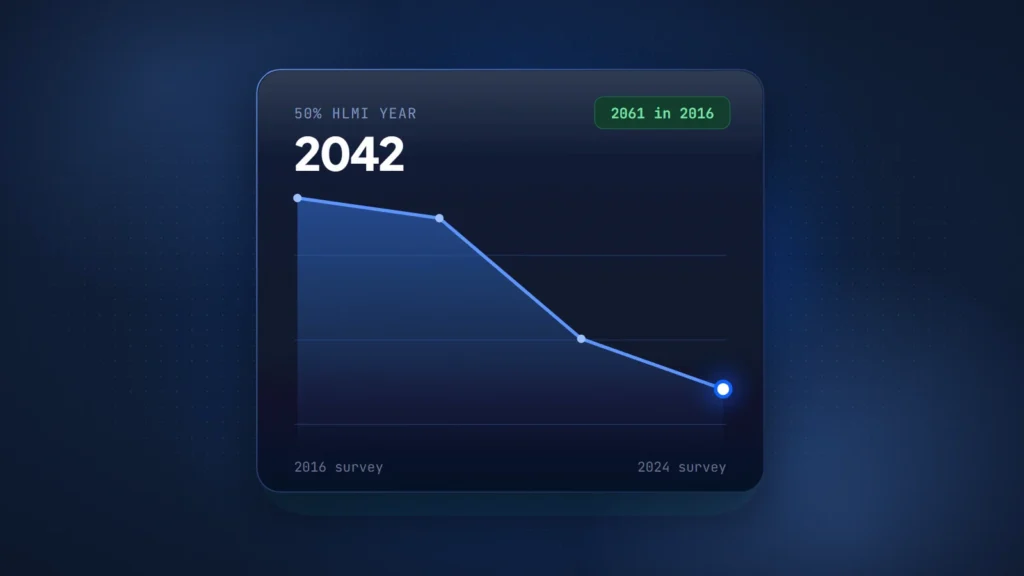
There is no consensus AGI timeline. In the 2024 AI Impacts survey of 1,580 AI researchers, published in September 2026, the aggregate forecast gave high-level machine intelligence a 50% chance of arriving by 2042. The survey uses that term for unaided machines that can do every task better and more cheaply than human workers.
Some AI lab leaders point to 2026 or 2027, while Google DeepMind’s Demis Hassabis spoke in March 2025 of 5 to 10 years. Survey and platform forecasts have moved earlier since 2016.
Search data shows which forecast readers check most. On October 5, 2026, Ahrefs estimated about 350 US and 900 global monthly searches for “agi timeline”. The phrase “ai 2027” drew about 450 US and 10,000 global monthly searches. That scenario draws far more searches than the general question, though its authors have revised their dates more than once. This guide puts the main forecasts side by side and explains why they differ.
The AGI timeline in one table
Published AGI forecasts range from 2026 to the 2040s, depending on who makes them and how they define AGI. The table lists dated forecasts from lab leaders, surveyed researchers, forecasting platforms and skeptics.
| Who | Forecast | When said | Source |
|---|---|---|---|
| Sam Altman, OpenAI | Said OpenAI is “not quite yet” at AGI; TIME reports he expects an internal system he would call AGI by the end of 2026 | August 26, 2026 | TIME interview |
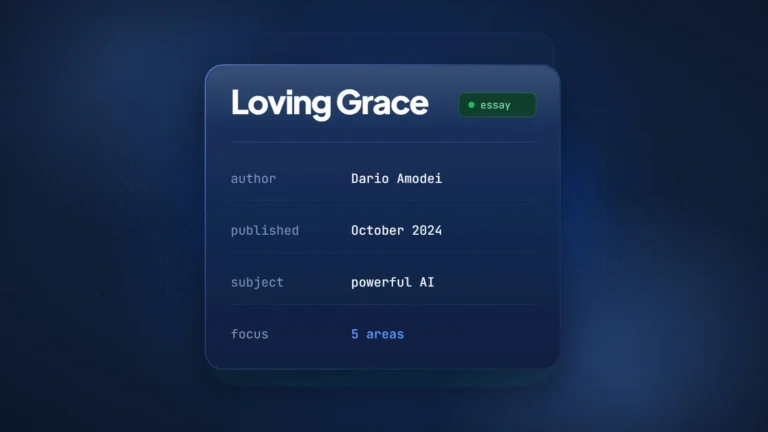
| Dario Amodei, Anthropic | Powerful AI “could come as early as 2026”, though it could also take much longer | October 2024 | “Machines of Loving Grace” essay |
| Anthropic | Powerful AI systems expected in “late 2026 or early 2027” | March 6, 2025 | Recommendations to the White House OSTP |
| Demis Hassabis, Google DeepMind | Movement toward AGI over the next 5 to 10 years | March 17, 2025 | As reported by NBC News |
| AI researchers (ESPAI 2024, 1,580 respondents) | 10% chance of high-level machine intelligence by 2027, 50% by 2042 | Surveyed December 2024, published September 2026 | AI Impacts |
| Metaculus forecasters | First general AI system: January 21, 2031 (snapshot, changes daily) | Read October 5, 2026 | Metaculus question 5121 |
| Daniel Kokotajlo, AI 2027 co-author | Median for Top-Expert-Dominating AI: November 2028 | August 16, 2026 | AI Futures Project blog |
| Eli Lifland, AI 2027 co-author | Median for Top-Expert-Dominating AI: July 2032 | August 16, 2026 | AI Futures Project blog |
| AAAI survey respondents | 76% of 475 say scaling current approaches is unlikely or very unlikely to yield AGI | March 2025 | AAAI 2025 Presidential Panel report |
| Gary Marcus | Bet that AI will not do 8 of 10 specified tasks by the end of 2027 | December 30, 2024 | Marcus on Substack |
Read the table as a spread of views, not a vote. Lab leaders give the nearest dates, and the survey’s aggregate forecast sits further out. Metaculus figures change daily, so the date shown is a snapshot from October 5, 2026.
Why AGI forecasts moved earlier
AGI forecasts moved earlier with each new survey and forecasting round, in the same years that training compute for frontier models grew fast. In AI Impacts’ expert surveys, the year with a 50% chance of high-level machine intelligence fell from 2061 in the 2016 survey to 2042 in the 2024 survey.
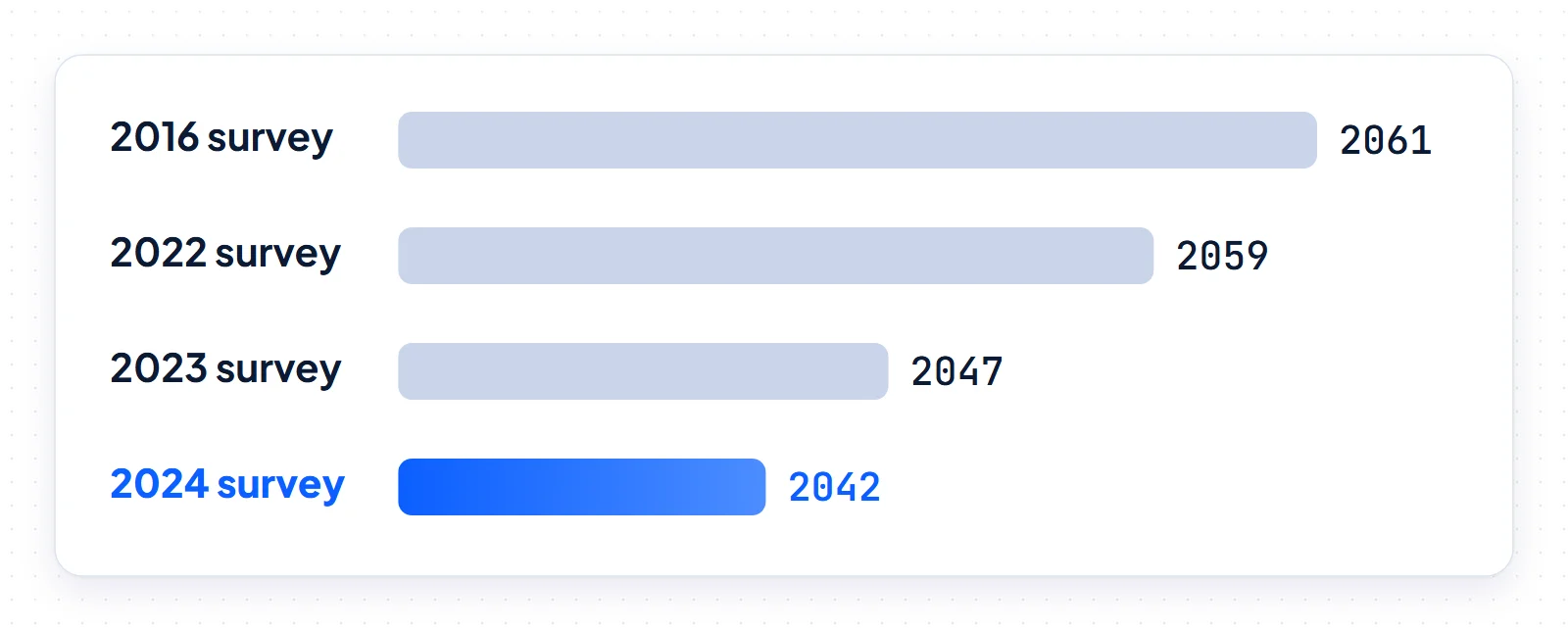
The full series of 50% years is 2061 (2016 survey), 2059 (2022), 2047 (2023) and 2042 (2024). In the authors’ words, over eight years “the forecast horizon shrank from 45 years out to 18” in the mean aggregate forecast. The largest single step came between the 2022 and 2023 surveys, a drop of 12 years.
Two caveats keep the trend in proportion. The same respondents still place full automation of all occupations much later: 2098 for the 50% mark in the 2024 survey. The 2024 survey also had a 10% response rate, so it reflects the researchers who chose to answer.
Hardware scaling is the other measurable trend. Epoch AI estimates that training compute for frontier language models has grown about 5x per year since 2020, with a 90% confidence interval of 4x to 6x. Training costs rose about 3.5x per year over the same period. These are measured trends, not forecasts. They ran alongside the shift in AGI dates without proving its cause.
Forecasting platforms moved in the same overall direction. On Metaculus, approximate chart readings of the forecast history for the first general AI system show community estimates in the 2050s in late 2021. By late 2022, they were in the early 2040s. On October 5, 2026, the community estimate was January 21, 2031, from about 1,900 forecasters.
The AI 2027 scenario and how its authors revised it
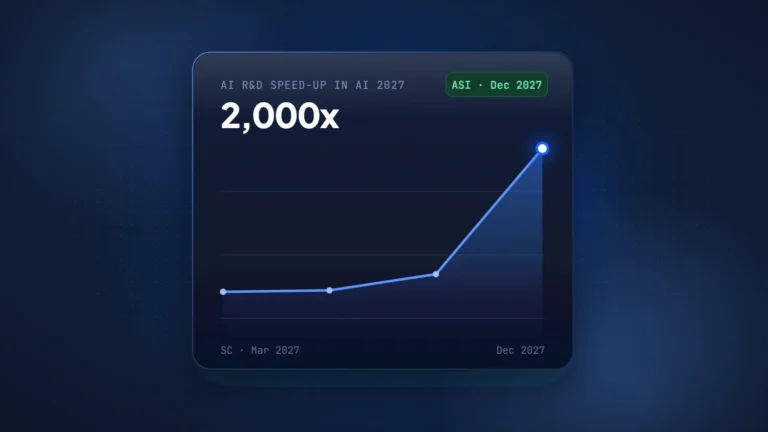
AI 2027 is a scenario published on April 3, 2025, in which AI goes from a superhuman coder in March 2027 to artificial superintelligence in December 2027. Its authors have since said 2027 was their most likely year, not their median, and have since moved their forecasts both later and earlier.
The AI 2027 scenario has five authors, including Daniel Kokotajlo and Eli Lifland, who publish updates through the AI Futures Project. Its milestones were a superhuman coder in March 2027, a superhuman AI researcher in August 2027, a superintelligent AI researcher in November 2027 and ASI in December 2027. A note added on November 22, 2025 says 2027 was their “modal (most likely) year at the time of publication” and that their medians were somewhat longer.
A modal year is the single most likely year. A median is the year by which the forecaster puts the odds at 50%, so with a long tail of later outcomes it falls after the mode.
Their updates so far:
- December 31, 2025: a new AI Futures Model predicted full coding automation about 3 to 5 years later than their previous model.
- January 27, 2026: a clarification post said “it has never been the case that we were confident AGI would arrive in 2027”, and gave Kokotajlo’s AGI median as December 2030 and Lifland’s as about 2035.
- April 2, 2026: the Q1 2026 timelines update moved toward shorter timelines. Kokotajlo’s median for an Automated Coder went from late 2029 to mid 2028. Lifland’s went from early 2032 to mid 2030. Medians for Top-Expert-Dominating AI moved about 1.5 years sooner.
- August 16, 2026: Kokotajlo’s median for Top-Expert-Dominating AI was November 2028 and Lifland’s was July 2032. The post estimated that reality was moving at roughly 70% to 90% of the scenario’s speed.
Reports that stopped at the late-2025 revision, saying the authors had pushed AGI back, missed the April 2026 move in the other direction.
The 2026 debate: capability versus adoption
Much of the 2026 debate mixes two clocks: when AI systems reach AGI-level capability, and how fast the economy adopts them. Sam Altman’s remarks in August 2026 touched both and are easy to misread as contradictory.
In a TIME interview published on August 26, 2026, Altman said OpenAI was “not quite yet” at AGI. TIME also reported that he expects OpenAI to have an internal system he would call AGI by the end of the year. That line is TIME’s paraphrase, not a direct quote.
A day earlier, on August 25, 2026, The Next Web reported Altman’s comments on David Senra’s podcast that “we’ve all been too ambitious on timelines” for economic change. He pointed to economic inertia, so he was talking about adoption speed, not about when AGI arrives. Capability and economic impact are different questions, even when one person speaks to both in the same week.
Why the definition of AGI changes the date
Different definitions of AGI produce different dates, sometimes decades apart within the same survey. Two forecasts are only comparable if they measure the same thing.
The AI Impacts survey shows the gap clearly. It defines high-level machine intelligence as the point “when unaided machines can accomplish every task better and more cheaply than human workers”. It defines full automation of labor as the point “when all occupations are fully automatable”. In the 2024 survey, the 50% years were 2042 and 2098, 56 years apart.
Organizations use their own bars. The OpenAI Charter defines AGI as “highly autonomous systems that outperform humans at most economically valuable work”, which is an economic test. Anthropic talks about “powerful AI”, and the AI Futures Project uses milestones such as an Automated Coder and Top-Expert-Dominating AI. Google DeepMind’s “Levels of AGI” paper from November 2023 rates systems on depth of performance and breadth of generality instead of drawing one line.
Forecasting questions show the same effect. On October 5, 2026, the Metaculus community estimate for “weakly general” AI being publicly known was September 1, 2027. Its estimate for the first general AI system was January 21, 2031. Both are snapshots, but the gap of more than three years comes from the question’s definition.
Definitions have also carried contract consequences. Under Microsoft’s October 28, 2025 agreement with OpenAI, once OpenAI declared AGI, “that declaration will now be verified by an independent expert panel”, according to Microsoft. An amended agreement announced on April 27, 2026 made OpenAI’s revenue-share payments to Microsoft continue through 2030 “independent of OpenAI’s technology progress”. Microsoft also keeps a license to OpenAI’s models and products through 2032, now non-exclusive.
What AGI skeptics say
Skeptics doubt that scaling today’s methods will produce AGI soon, and most respondents to one large AI community survey agree. In the AAAI 2025 Presidential Panel report, 76% of 475 survey respondents said “scaling up current AI approaches” is unlikely or very unlikely to yield AGI.
The report, published in March 2025, came from a panel of 24 experts plus a community survey. It gives no date, but it questions whether more scale alone will be enough.
Individual skeptics have also made the case in public. On December 30, 2024, Gary Marcus published a bet with Miles Brundage that AI will not do 8 of 10 specified tasks by the end of 2027. Yann LeCun said “it’s going to take years before we can get everything here to work, if not a decade” in October 2024, as reported by TechCrunch. He was discussing world models, which he sees as key to human-level AI.
What comes after AGI
Artificial superintelligence (ASI) is the milestone most often discussed after AGI, meaning AI that far exceeds human ability across most domains. The AI 2027 authors place ASI four months to a year after their earlier milestones.
In the AI 2027 scenario, ASI arrives in December 2027, nine months after the superhuman coder. In the August 2026 update, Kokotajlo’s median for ASI was March 2029, four months after his median for Top-Expert-Dominating AI. Lifland’s ASI median was July 2033, a year after his median for Top-Expert-Dominating AI.
Our comparison of AGI and ASI explains how the two terms differ. Our guide to what superintelligence is covers the history of the idea and the main risks researchers raise. Some companies already name superintelligence, not AGI, as the goal, as Safe Superintelligence does in its name.
How to read an AGI prediction
Before comparing two AGI dates, check five things in order: the definition, the source and its incentives, the type of estimate, the date it was made and the track record. Many apparent contradictions disappear at one of these steps.
- Definition used. Check whether the forecast is about high-level machine intelligence, full automation of work, OpenAI’s economic definition or a milestone such as an Automated Coder. In the 2024 AI Impacts survey, two definitions gave 2042 and 2098.
- Who says it and their incentives. A lab chief, an anonymous survey respondent and a forecaster with a public bet have different stakes in the answer. Contract terms can add another layer, as the AGI provisions in the Microsoft and OpenAI agreements of 2025 and 2026 showed.
- Median or modal. A median is the 50% year, while a modal year is the single most likely year and can come earlier. AI 2027 used 2027 as a modal year, not a median.
- Date of the forecast. AGI forecasts age quickly. The AI 2027 authors moved later in December 2025 and earlier in April 2026, and Metaculus figures change daily.
- Track record. Look at how the source revised past forecasts and in which direction. Metaculus publishes its forecast history, and AI Impacts has run its survey four times since 2016.
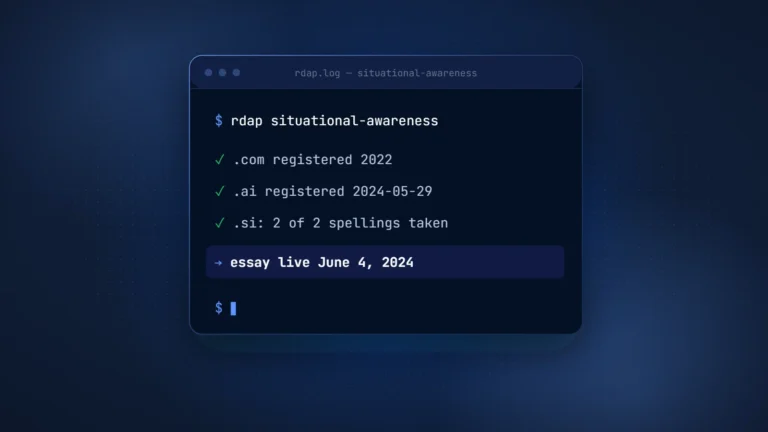
The vocabulary of this debate already reaches company names. Since September 29, 2026, US federal agencies write “SI” where they used to write “AI”. .si is Slovenia’s country-code domain. For AI companies it reads as SuperIntelligence. Our overview of superintelligence domains compares how labs and startups name themselves.