A domain lease lets you use a domain name that someone else still holds, in exchange for monthly or yearly payments. Lease-to-own adds a purchase: the registration moves to you only after the last installment. Buying outright makes you the holder as soon as the transfer completes, so a brand that plans to stay is usually better off buying.
Payment plans are now a standard way to buy aftermarket names. GoDaddy’s annual report for 2025, signed February 24, 2026, lists lease-to-own next to offers and “buy now” as a purchase route. Escrow.com reported $395 million in domain investment through its platform in 2025, up 5.6% (March 4, 2026). No primary source says what share of deals are leases.
What is a domain lease?
A domain lease is a contract in which the registrant of a domain name lets another party use it for a fee. The registration stays with the registrant or a holding agent. In a pure lease, or rental, the name returns to the owner when the term ends. In a lease-to-own deal, the buyer pays installments and receives the registration only after the final payment.
The term “domain lease” gets about 150 searches a month in the US and 200 worldwide, and “lease to own domain” another 40 in the US (Ahrefs, October 17, 2026). Most ranking pages serve owners renting out idle names. This guide takes the buyer’s side.
Can you own a domain or only rent?
You can hold the right to use a domain name, but you cannot own the name outright. A domain registration runs for a fixed period and must be renewed, so what a buyer holds is a renewable right. The person or entity that holds it is the registrant, which ICANN calls the Registered Name Holder. In a lease, that registrant is the seller or a custodian, not the lessee.
ICANN’s registrant FAQ notes that paying for a registration does not make you the registrant if a developer registered the name with their own details. Register.si’s General Terms (November 15, 2024) grant a .si holder “the limited, transferable, renewable and exclusive right to use” the name for the registration period. Buying makes you that holder. Leasing, in either form, leaves the role with the seller or an escrow agent.
Domain lease vs lease-to-own vs buying outright
Buying outright, lease-to-own and a pure domain lease differ on one question: whose name is on the registration while you pay. With an outright purchase through escrow, the buyer becomes the holder when the transfer completes. With lease-to-own, the seller or a custodian stays the registrant until the last installment. With a pure lease, the buyer never becomes the registrant.
| Terms as published, October 17, 2026 | Buy outright | Lease-to-own | Pure lease (rental) |
|---|---|---|---|
| Holder during the term | Buyer, once transfer completes | Seller or custodian until the final payment | Seller, throughout |
| DNS control | Full, after transfer | Varies: DNS only, or changes via support or a fee | Set by the contract |
| On a missed payment | Not applicable, paid up front | Name returns to the seller after any cure period | Use ends, name stays with the owner |
| Payments refunded on default | Not applicable | None under Spaceship terms; GoDaddy refunds nothing on cancellation | Not applicable |
| Total cost (USD or EUR) | Price plus escrow fee | Price plus financing: 10–30% service fees (GoDaddy, terms over 12 months) or Escrow.com holding fees | Rent for as long as you use it, nothing kept |
| Fit for a startup building a brand | Long-term brand | Workable if cash is tight and terms are clear | Campaigns, tests, landing pages |
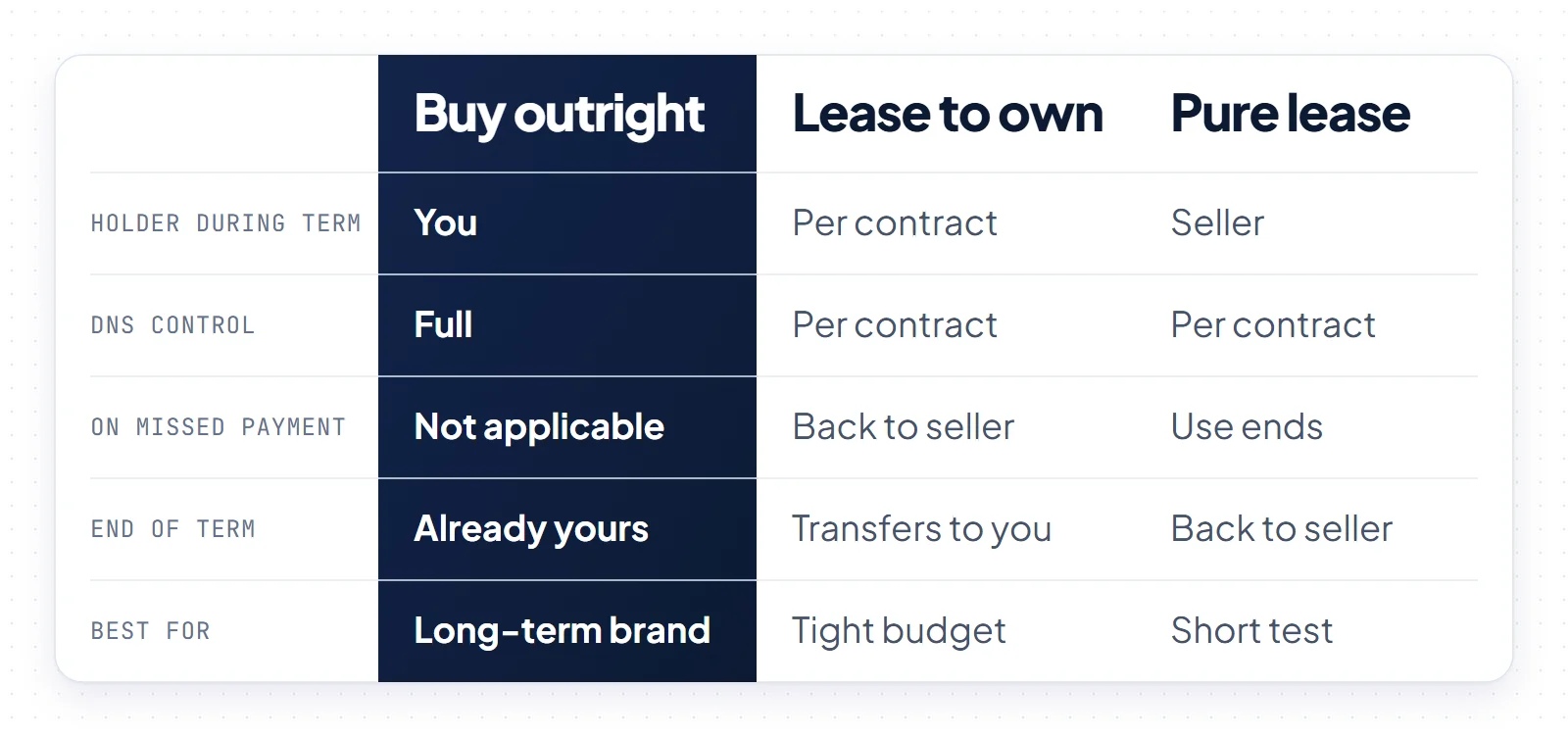
Lease-to-own terms vary most. Spaceship’s marketplace agreement (last updated October 3, 2025) lists the platform as a custodial registrant, keeps the seller as beneficial owner and gives the buyer no registrant-level control during the term. GoDaddy’s help page limits lease-to-own buyers to DNS settings until the domain is paid in full. Read the DNS clause before you point company email at the name.
How lease-to-own works through Escrow.com
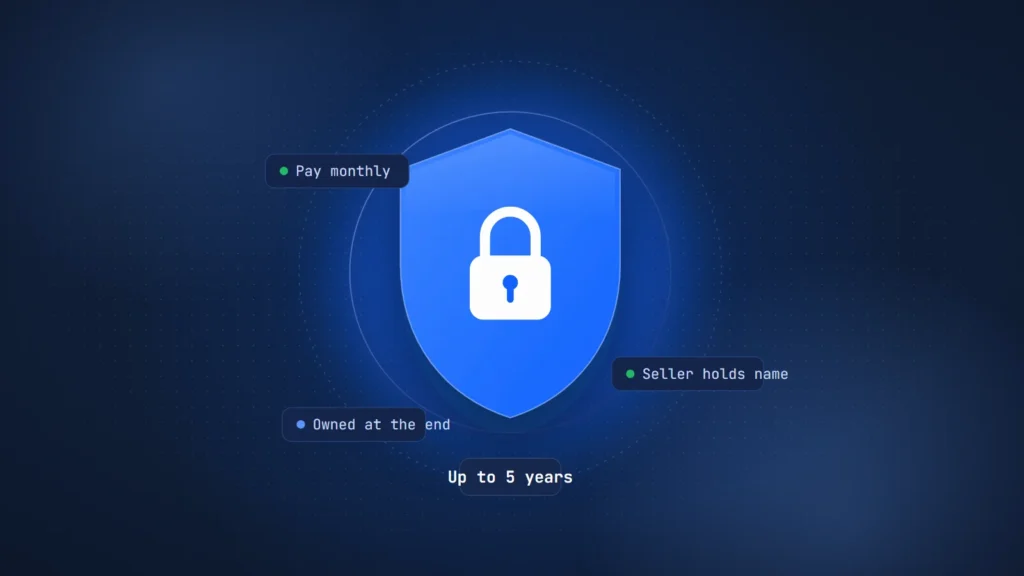
Escrow.com’s Domain Name Holding service is the neutral form of lease-to-own. It holds the domain in its own account while the buyer pays on an agreed schedule of 3 months to 5 years, and releases it to the buyer only after the final payment. The service works like a standard domain escrow transaction spread over months.
Escrow.com’s Domain Name Holding service runs in four steps:
- Buyer and seller agree on price, term and payment schedule, then sign Escrow.com’s Domain Holding Agreement. The term runs from 3 months to 5 years, with one domain per transaction.
- After the first payment, the seller transfers the domain to Escrow.com’s account. Once it is locked there, the first payment goes to the seller.
- Escrow.com collects each scheduled payment from the buyer and sends it to the seller.
- After the final payment, the domain moves to an account for the buyer. In a lease-only deal, it returns to the seller at the end of the term.
Escrow.com states two holding-fee formulas. Lease with Purchase is “(0.01% of the domain value OR minimum of $100) x holding period in months”. Lease Only is “(0.02% of the domain value OR minimum of $200) x holding period in months”. When a purchase is involved, the holding fee is charged on top of the standard escrow fee.
Changes cost extra: $250 for a payment schedule change and $85 for each DNS administrative change. Escrow.com does not say whether the buyer manages DNS directly, but the $85 fee suggests changes run through Escrow.com. Ask for a written quote before you sign.
If the buyer stops paying, the seller notifies Escrow.com, which follows the holding instructions both parties agreed. Its FAQ on missed payments says that if the buyer does not remedy the payment, the domain returns to the seller and the transaction is canceled.
How much does it cost to rent a domain for a year?
The cost of renting a domain for a year depends on which rental you mean. A normal registration is already a yearly right. For .si domains, Register.si charges registrars a €10 registry fee per year before VAT, and registrars set their own retail price on top. Leasing someone else’s premium name has no standard price. The owner sets the rent, and intermediaries add fees, such as Escrow.com’s lease-only holding fee with a stated minimum of $200 a month.
Over time, leasing costs more. A NameSilo blog post (June 18, 2025) compares selling a name for $10,000 with leasing it at $250 a month. Over 4 years, the owner collects $12,000 and still holds the domain. For the lessee, that is $2,000 more than the sale price and nothing to keep.
Lease-to-own adds financing. GoDaddy’s help page lists no service fee for terms of 2–12 months, 10% for 13–24 months, 20% for 25–36 months and 30% for 37–60 months. On a $10,000 name paid over 5 years, the 30% tier brings the total to $13,000 (our arithmetic). Asking prices for premium domain names already reflect scarcity, and financing sits on top.
Risks of building a brand on a leased domain
The main risk of a domain lease is that everything built on the name depends on a registration the lessee does not hold. Spaceship’s lease-to-own terms refund nothing when a buyer cancels or defaults. GoDaddy’s help page says a buyer who cancels or terminates the lease forfeits all payments. In both cases, the name goes back to the seller. The company email, the website and the search rankings attached to the name go with it.
- Sunk payments. Spaceship’s agreement gives a buyer 7 days to cure a missed payment, then all rights end with no refund. At GoDaddy, a buyer who cancels forfeits every payment made.
- Email and website. Mail and web traffic follow the domain’s DNS. Whoever controls the registration decides where those records point.
- Search visibility. Google’s site-move guidance (updated August 20, 2026) says to keep redirects “generally at least 1 year” after a move. A lessee who defaults no longer controls the old domain, so they cannot set up those redirects.
- Disputes. For generic domains, ICANN’s UDRP rules define the respondent as the holder of the registration, so a trademark complaint during a lease goes to the seller or custodian.
- Use limits. Spaceship’s terms bar buyers from granting third-party rights in the domain and from black-hat SEO during the term.
Leasing a .si domain: what Register.si recognizes
A .si domain can be leased under a private contract, but the registry only sees the listed holder. .si is Slovenia’s country-code domain. For AI companies it reads as SuperIntelligence. Founders abroad looking at premium .si names in 2026 may be offered leases instead of sales.
Register.si recognizes only the domain holder listed in its registry database and states that it “is not authorized to rule on who is entitled to the domain name.” A registrar makes a change of .si holder only after both the current and the new holder confirm it. The new holder’s details are verified as for a new registration. Register.si’s General Terms of November 15, 2024 do not address leasing.
The registry’s note on holder data adds that a domain user cannot renew the name without the cooperation of the listed holder. Register.si publishes holder data, the technical contact and the registrar for company holders; for individuals, only the contact email. In a lease of a company-held .si, a public lookup therefore shows the seller or custodian, not the business using the name (our reading of the policy).
In an example from a Register.si column on .si ownership, a web developer registered a company’s .si name with his own details. Years later the company’s email and website stopped working, and the developer asked for a thousand euros for a “domain name renewal”. The registry could not rule, and the company faced a possible court case. A .si lessee is in the same position. Disputes over .si names run through Register.si’s alternative dispute resolution (ARDS), not UDRP, against the listed holder.
Packaged lease-to-own programs rarely cover .si: GoDaddy’s help page excludes “most country code top-level domains (ccTLDs)”, without naming .si. Escrow.com accepts transactions in all TLDs, but no Escrow.com page confirms holding a .si name in a payment plan, so ask first. At the registry, a transfer to a new holder costs €0 and registration terms run 1–5 years. The .si domain guide covers registrars and rules.
Disclosure: buysidomains.si sells .si names at fixed prices through Escrow.com and does not offer leases. Each name in the portfolio has a fixed aftermarket asking price on its listing page, for example the three-letter mkr.si. Each sale ends with the buyer as the holder.
Lease or buy: how to decide
Buy outright if the name will carry your company, email and product for years. You pay once and become the holder when the transfer completes. The guides to buying a domain that is already taken and to transferring a domain cover each step.
Consider lease-to-own if the price is beyond this year’s budget, the seller will not sell outright and the contract passes the checklist below. A neutral holder such as Escrow.com beats a seller keeping the name in their own account. Use a pure lease only for something you can leave without cost: a campaign, a test market or a landing page.
Before signing a domain lease or lease-to-own contract, get these terms in writing:
- Who is the registrant during the term, and what WHOIS will show.
- Who controls DNS and MX records, and how fast changes happen.
- The cure period for a missed payment, and what happens to payments made.
- Early payoff rights, renewal costs, and what happens if the seller sells, closes or lets the name expire.
- For a .si name: which registrar makes the holder change, and when both parties confirm it.
A startup that cannot get clear answers is better served by a name it can buy outright today.