Short domain names are domains with very few characters before the extension, and Wix defines them as a single word of around eight characters or fewer. The scarce end is 1–4 characters: a 2013 check found every 4-letter .com registered, so most buyers now turn to the aftermarket or to alternative extensions.
Keyword data from Ahrefs, October 2026, shows about 400 monthly searches worldwide for “short domain names,” including 200 in the US. The phrases “3 letter domain names” and “4 letter domain names” each draw about 150 worldwide. Length is only one part of the picture, though. Research on listening and recall suggests that whether people can pronounce and spell a name correctly can matter as much as how short it is.
What counts as a short domain name?
A short domain name is a domain whose label, the part before the extension, contains very few characters. There is no formal cutoff. Wix draws the line at a single word of around eight characters or fewer. The scarcest part of the market, and the focus of this article, is names of 1–4 characters. Short domain names are defined by scarcity, not by technical limits, because the DNS allows labels of up to 63 characters.
The technical rules come from RFC 1035, the core DNS specification, which caps each label at 63 octets and a complete name at 255 octets. Its preferred name syntax, which hostnames follow, says a label must start with a letter, end with a letter or digit, and contain only letters, digits and hyphens in between. RFC 1123 later relaxed the first restriction for hostnames, so a label may also begin with a digit.
Registry policy and earlier buyers, not the protocol, make short names rare. A registry can reserve certain lengths, set a minimum or release reserved names years later. The useful question is which lengths are scarce in the extension you want, not which lengths the DNS permits.
How many short domain names exist?
Short domain names come from a small, fixed pool. With the 26 letters a–z, there are 26 one-letter labels, 676 two-letter labels, 17,576 three-letter labels (LLL) and 456,976 four-letter labels (LLLL), by our calculation. Only 11,025 of those four-letter strings follow a consonant-vowel-consonant-vowel (CVCV) pattern, based on 21 consonants and 5 vowels.
| Length and pattern | Combinations, letters a–z only (names) | Combinations, letters and digits 0–9 (names) |
|---|---|---|
| 1 character | 26 | 36 |
| 2 characters | 676 | 1,296 |
| 3 characters (LLL) | 17,576 | 46,656 |
| 4 characters (LLLL) | 456,976 | 1,679,616 |
| 4 characters, CVCV | 11,025 | Not applicable (letters only) |
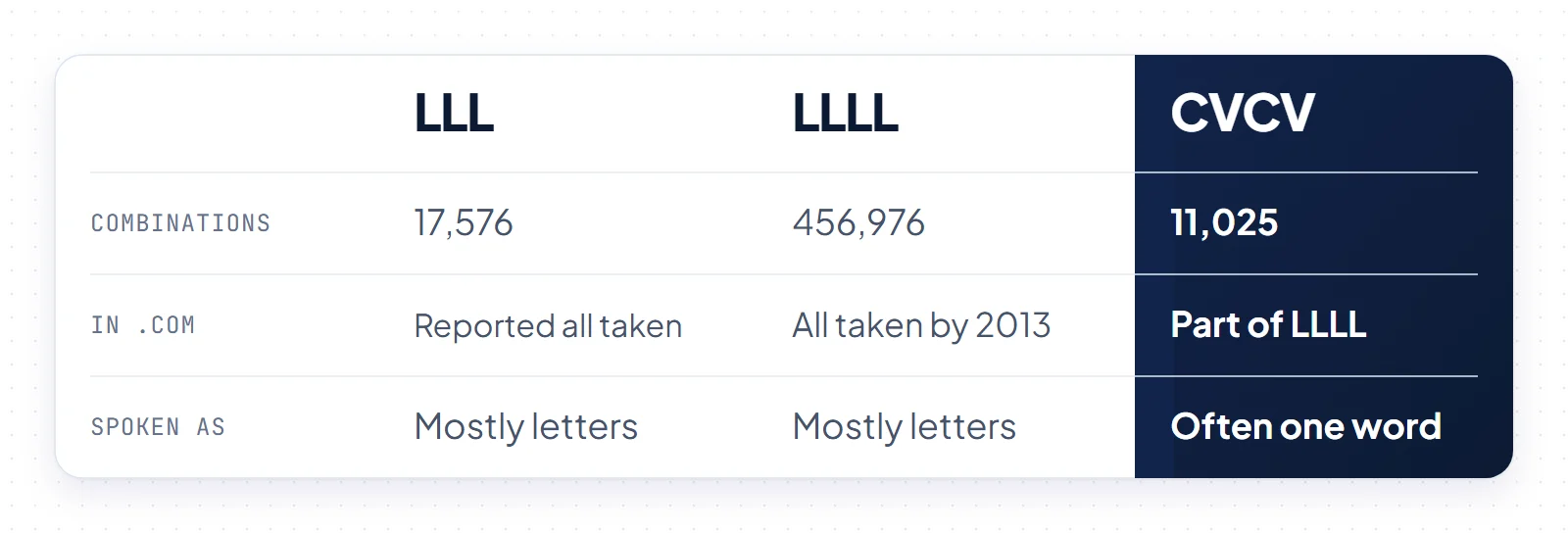
The table reflects our own calculation: 26 raised to the power of the length for letters, and 36 raised to the power of the length once digits are allowed. Hyphens add more strings from three characters up, since they can appear inside a label but not at either end. By our calculation, they add 94,608 four-character combinations to the letters-and-digits column. Still, a hyphen rarely improves a four-character brand.
The CVCV row matters most for branding. It covers about 2.4% of all LLLL strings, and these are the four-letter names people tend to read as one word rather than spell out letter by letter.
Are any 3-letter or 4-letter .com domains left?
No 4-letter .com domain was available to register by 2013. That year, WhoAPI checked all 456,976 LLLL .com combinations and reported that not one remained unregistered, as Slate covered at the time. Trade analyses describe the 17,576 three-letter .com names as taken even earlier. In practice, three- and four-letter .com names now change hands almost entirely on the aftermarket.
The 2013 result is a snapshot. Individual names can expire and drop, and we have not seen a more recent complete survey of the LLLL space. Treat any claim that a four-letter .com is “available” with caution, and confirm it yourself at a registrar before you plan around it.
Registration does not mean active use. In 2016, a guest analysis published by Domain Name Wire estimated that 43.2% of the 17,576 LLL .com names were developed and used by end users. By that estimate, most three-letter .com names were not in active end-user use at the time.
If you want 3 letter domain names or 4 letter domain names in .com, plan for a private purchase rather than a registration fee. If you want a short name at a standard registration price, consider newer extensions and country codes, which the final section covers.
Is there a 1-letter domain?
One-letter domains exist, but buyers can obtain very few of them. The .com Registry Agreement reserves single-character names. A 2017 request from Verisign to ICANN lists q.com, x.com and z.com as the only ones registered before that restriction. Under the new gTLD Registry Agreement, single-character names do not have to stay reserved, so some newer extensions allow them.
The same Verisign request to ICANN proposed to release one additional name, o.com, through an auction with proceeds going to nonprofit organizations. ICANN’s Board approved the plan in March 2019. The auction has still not taken place: as of October 2026, the .com registry’s own record lists o.com as reserved by IANA.
Two-character names follow a separate track. In new gTLDs, ICANN authorized the release of non-letter/letter two-character labels from December 1, 2014, and of letter/letter labels from December 13, 2016. For letter/letter labels, the release comes with ICANN-defined measures to avoid confusion with the corresponding country codes.
Country-code registries set their own minimum lengths. DENIC allows .de names of a single character. The Register.si General Terms set a minimum of two characters for .si, so no one-letter .si name, including č.si, can exist.
What short domain names cost
Reported sales of short .com names range from $162,000 for FSM.com (2021) to $70,000,000 for AI.com (sold 2025, disclosed 2026), according to Domain Name Wire and DNJournal. Short domain names have no list price on the aftermarket, and the largest deals are outliers rather than typical prices.
| Domain | Length (characters) | Reported price (USD) | Year reported |
|---|---|---|---|
| AI.com | 2 | $70,000,000 | Sold 2025, disclosed 2026 |
| Chat.com | 4 | $15,500,000 | 2023 |
| Icon.com | 4 | $12,000,000 | 2025 |
| Z.com | 1 | $6,784,000 | 2015 |
| FTA.com | 3 | $400,000 | 2021 |
| FSM.com | 3 | $162,000 | 2021 |
The top four rows come from the DNJournal list of the top 20 reported cash domain sales. DNJournal reported in February 2026 that the AI.com deal, completed in April 2025 with the owners of Crypto.com, was more than double the previous record. That record was $30 million, paid for Voice.com in 2019. OpenAI later acquired Chat.com, as Domain Name Wire reported in November 2024. The two LLL sales come from Domain Name Wire reports in 2021.
These figures describe the very top of the market. Most of the names are dictionary words or one- and two-character .com names, which few startups actually need. The 2021 LLL sales give a closer sense of the three-letter tier, but even those prices depend on the specific letters, the buyer and the timing. No past sale predicts what a particular name will fetch, and none of this is a forecast of future value.
Short is not the same as memorable
Shorter domain names are not always easier to remember or type. AFNIC, the registry behind .fr, published a listening study with 30 participants in 2018. Participants transcribed regular words of five or more letters with fewer faults than short words of three or four letters. The lesson for naming is that a pronounceable, regularly spelled name can outperform a random string, even a shorter one.
The AFNIC listening study is small, but older memory research points in the same direction, with a caveat. In 1975, Baddeley, Thomson and Buchanan found that memory span decreases as words take longer to pronounce. That research concerns words in short-term memory, not domains, so it is only an analogy. Still, it suggests that spoken length matters more than letter count, since four letters read out individually can take longer to say than a five-letter word.
Pronounceability also appears in financial markets. Alter and Oppenheimer reported in 2006 that shares with pronounceable ticker codes outperformed those with unpronounceable codes after one day of trading. The difference did not reach significance beyond the first day, so the effect is narrow. It also concerns how fluent a name feels rather than how short it is.
The radio test
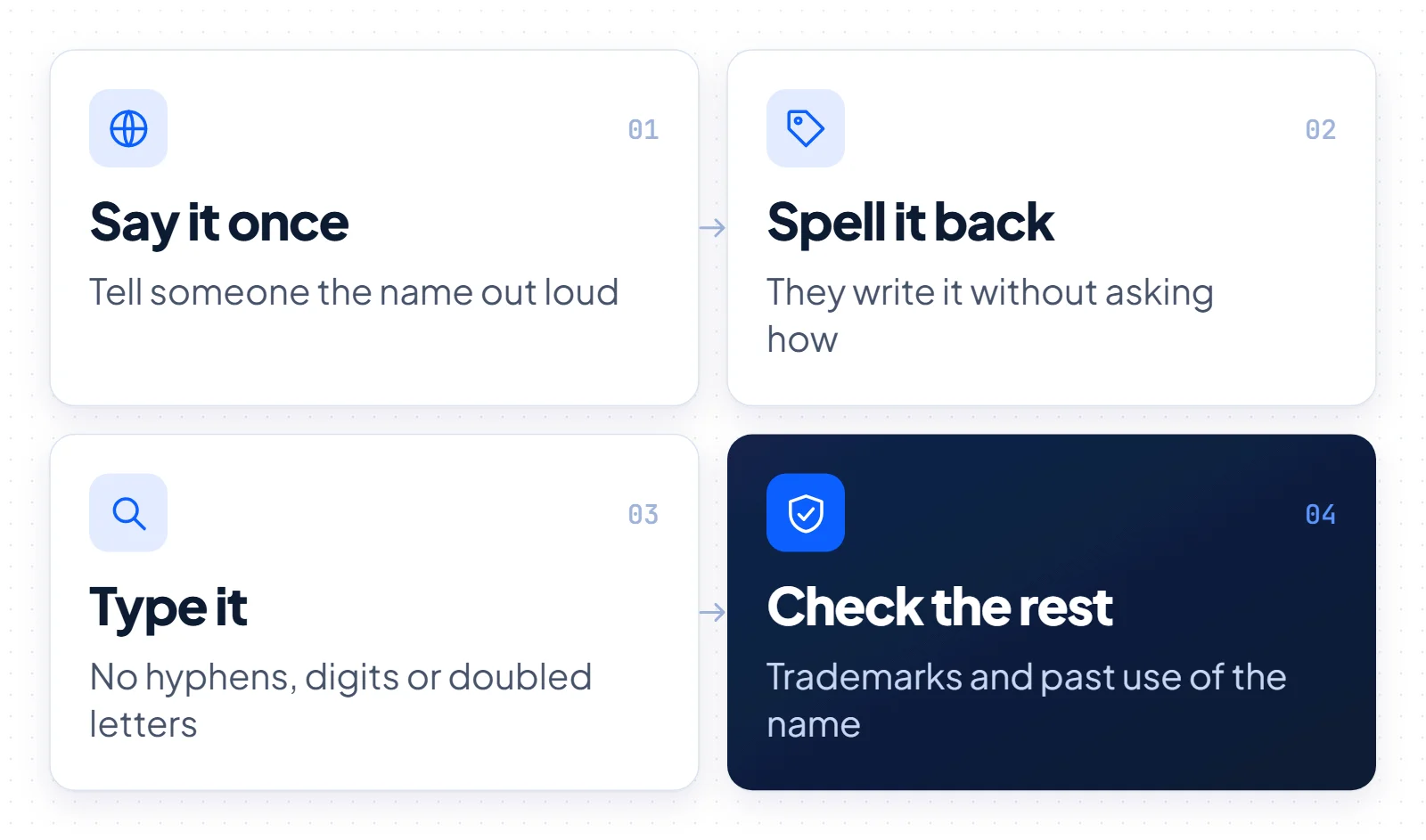
A practical way to apply this research is to test a name the way people will usually encounter it: out loud, with no spelling visible.
- Say it once. Read the name aloud to someone who has not seen it.
- Spell it back. Ask them to spell it, and note every letter they change.
- Type it. A few minutes later, have them type it into a browser from memory.
- Check the rest. Search trademarks and the domain’s history before you commit.
Acronyms frequently fail the second step when letters sound similar, such as m and n or f and s. A CVCV name or a short dictionary word tends to pass more easily, because listeners process it as a single unit.
Short names outside .com
Short domain names available to register or for sale are easier to find outside .com, because country-code and new generic extensions operate with their own rules and their own supply. The trade-off is that the extension now carries part of the meaning.
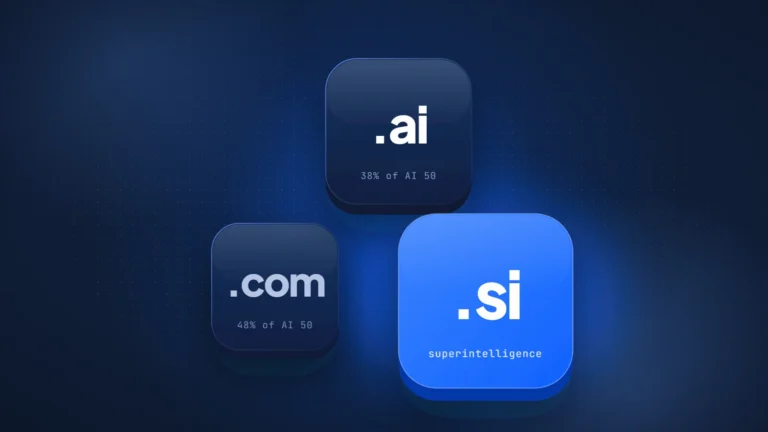
.si is Slovenia’s country-code domain. For AI companies it reads as SuperIntelligence. The reading is informal, not official, but it gives a short .si name a second layer that a random letter string lacks. Register.si allows .si labels from 2 to 63 characters, so three- and four-letter .si names are valid. Our guide to the .si domain explains the extension in more detail.
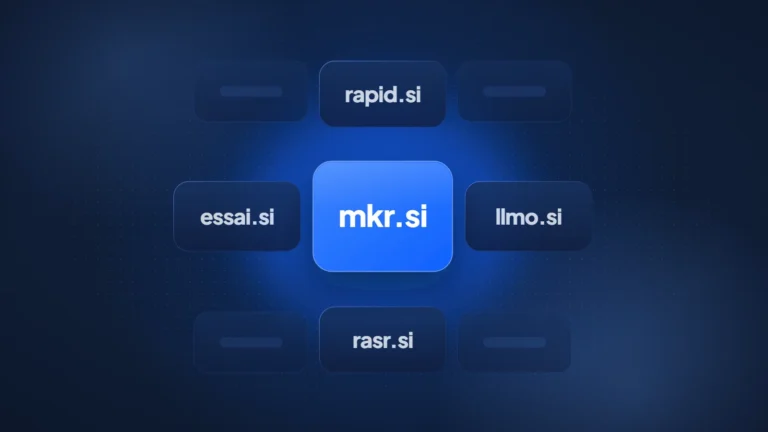
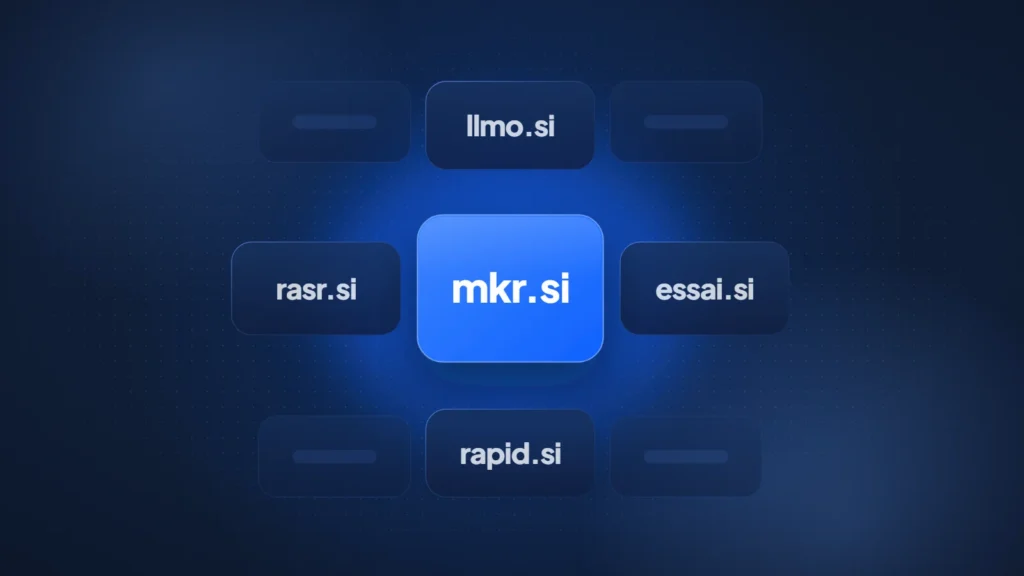
For scale, here are three short .si names from our own portfolio, with fixed asking prices as of October 2026. They are the three-letter mkr.si at €4,500, the four-letter llmo.si at €2,000 and the four-letter rasr.si at €1,500. These are asking prices, not sales, and they are not comparable with the reported .com sales above.
How to decide
Length is one input, not the goal. Use the following criteria to decide where your naming budget should go.
- Pay for 3 or 4 letters when the letters already are your brand, such as an acronym your customers use, or when people will mostly see and type the name rather than hear it.
- Choose a longer, pronounceable name when word of mouth, podcasts or sales calls drive growth. A word of five to eight letters that passes the radio test can beat a four-letter string that fails it.
- Pick the extension before the length. A short .com means an aftermarket negotiation. A short country-code or new gTLD name may cost less, but availability depends on that registry’s rules.
- Set a budget based on your own use, not on headline sales. Record prices tell you what one buyer paid once, not what your name is worth.
Whatever the extension, run each shortlisted name through the radio test before you commit. If .si is on your list, you can find short domain names on the market in our list of .si domains for sale. It shows which short labels are available and at what asking price.