Leopold Aschenbrenner is a German-born former OpenAI researcher best known for Situational Awareness: The Decade Ahead, an essay published June 4, 2024. It argues that AGI by 2027 is plausible and superintelligence could follow by the end of the decade. He then launched Situational Awareness LP, an AI hedge fund that sold most of its public stocks in July 2026.
Both halves of that record face a test in 2026. One of the essay’s earliest checkable benchmarks, a training cluster of about 1 gigawatt by 2026, can now be compared with public trackers. This profile treats the forecast and the fund separately, and dates every check to October 30, 2026.
Who is Leopold Aschenbrenner
Aschenbrenner was born in Germany in the early 2000s. He enrolled at Columbia University at 15, and in 2021, at 19, he graduated as valedictorian in economics and mathematics-statistics. Fortune reported that he won an Emergent Ventures grant at 17 and that Tyler Cowen called him an “economics prodigy.”
His early career ran through effective-altruism circles. He did research on economic growth at Oxford’s Global Priorities Institute, according to his blog. In February 2022 he joined the FTX Future Fund, a grant-making team that included William MacAskill. That work ended when FTX collapsed in November 2022.
In 2023 he joined OpenAI’s Superalignment team, co-led by Jan Leike and Ilya Sutskever. The team studied how to keep AI systems smarter than humans under control, a branch of AI alignment research. His blog lists two outputs dated December 14, 2023: the “Weak-to-strong generalization” paper and Superalignment Fast Grants, a $10 million grant program.
OpenAI dismissed him in April 2024. The Information reported that the company fired him and Pavel Izmailov for alleged leaking, and TechCrunch later summarized OpenAI’s reason as an “improper disclosure of internal information.” The Superalignment team itself ended about a month later, after Leike and Sutskever left OpenAI.
On the Dwarkesh Podcast on June 4, 2024, Aschenbrenner said the “leak” was a brainstorming document on preparedness, safety and security that he shared with three external researchers for feedback. He said he had earlier shared a security memo with board members and was told that this memo turned a warning into a firing.
OpenAI rejects that link. A spokeswoman, Liz Bourgeois, told The New York Times in July 2024: “We appreciate the concerns Leopold raised while at OpenAI, and this did not lead to his separation.”
Situational Awareness in plain English
Situational Awareness: The Decade Ahead runs to about 165 pages and is dedicated to Ilya Sutskever. It has five chapters, and the first two make the forecast. Chapter III covers four challenges: the trillion-dollar cluster, lab security, superalignment and “The Free World Must Prevail.” Chapter IV is “The Project,” and Chapter V offers parting thoughts.
The method is counting orders of magnitude, or OOMs, where each OOM is a tenfold gain in effective compute. Aschenbrenner stacks three sources: physical compute growing about half an OOM a year, better algorithms, and “unhobbling,” his term for removing limits that hold today’s models back. From that count, the first chapter, From GPT-4 to AGI, concludes: “AGI by 2027 is strikingly plausible.”
Leopold Aschenbrenner’s Situational Awareness argues for superintelligence in four steps. First, scaling compute and algorithms produces AGI around 2027. Second, AGI systems can do the work of AI researchers and engineers. Third, as the intelligence explosion chapter puts it, “Hundreds of millions of AGIs could automate AI research, compressing a decade of algorithmic progress (5+ OOMs) into ≤1 year.” Fourth, that compressed progress yields superintelligence by the end of the decade.
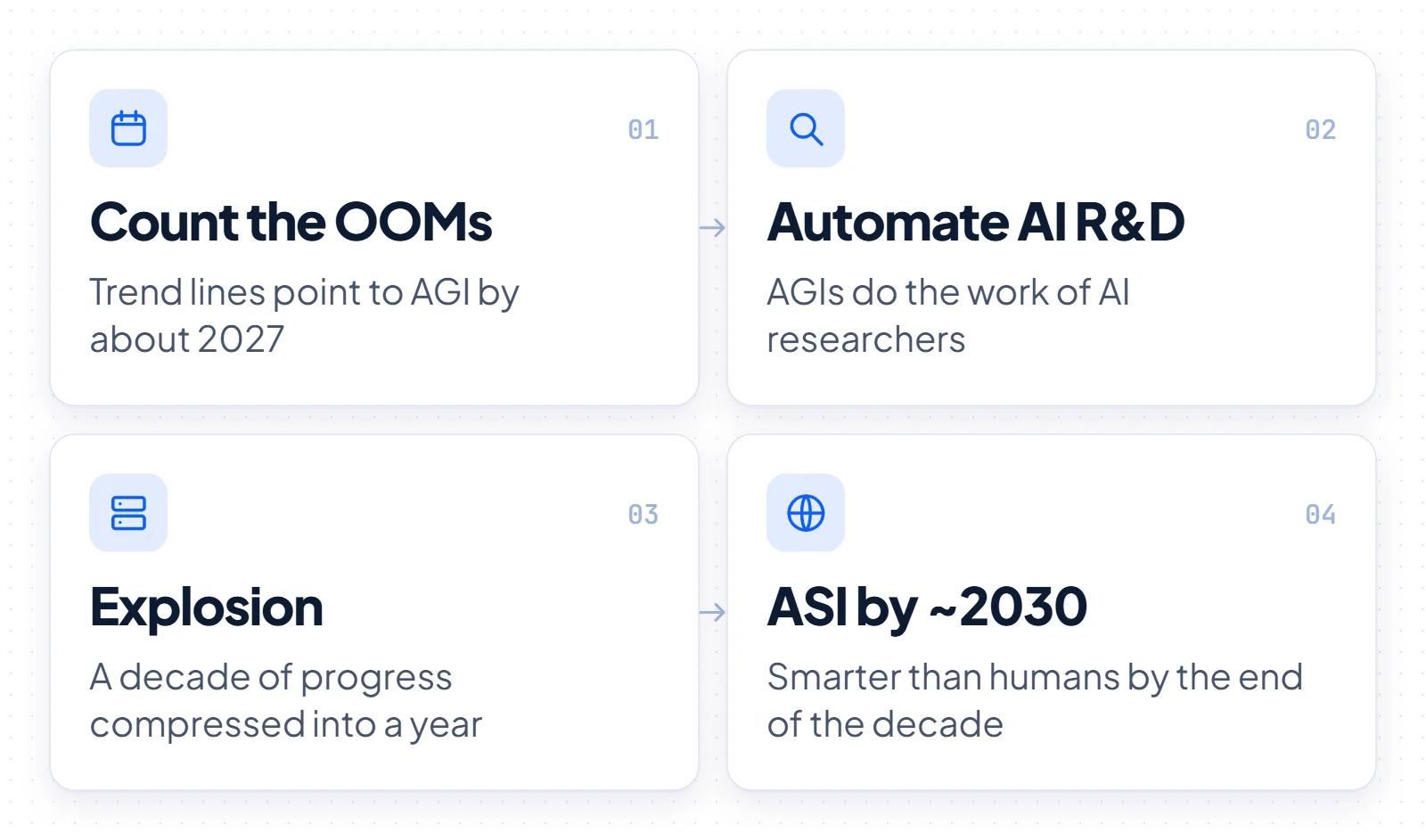
Step three is a form of recursive self-improvement: AI systems doing the research that builds their successors. The end point is artificial superintelligence (ASI), and the essay’s introduction states it without hedging: “we will have superintelligence, in the true sense of the word.”
On hardware, Chapter IIIa projects training clusters of about 1 gigawatt in 2026 and 10 gigawatts in 2028. A single 2030 cluster would cost more than $1 trillion and draw about 100 gigawatts, which his table puts above 20% of US electricity production.
Situational Awareness LP: from essay to hedge fund
Situational Awareness LP is the investment firm Aschenbrenner announced on the same day as the essay, and it launched in mid-2024. On the Dwarkesh Podcast he put the thesis in one line: “This investment firm is going to just be betting on AGI.” His blog names anchor investments from Patrick Collison, John Collison, Nat Friedman and Daniel Gross, and TechCrunch lists Jane Street among early backers.
The portfolio followed the essay’s view that power and compute, not model labs, are the bottlenecks. Fortune reported holdings in power companies, chipmakers and bitcoin miners that host AI data centers, and put assets above $1.5 billion in October 2025. The Wall Street Journal reported more than $20 billion in June 2026.
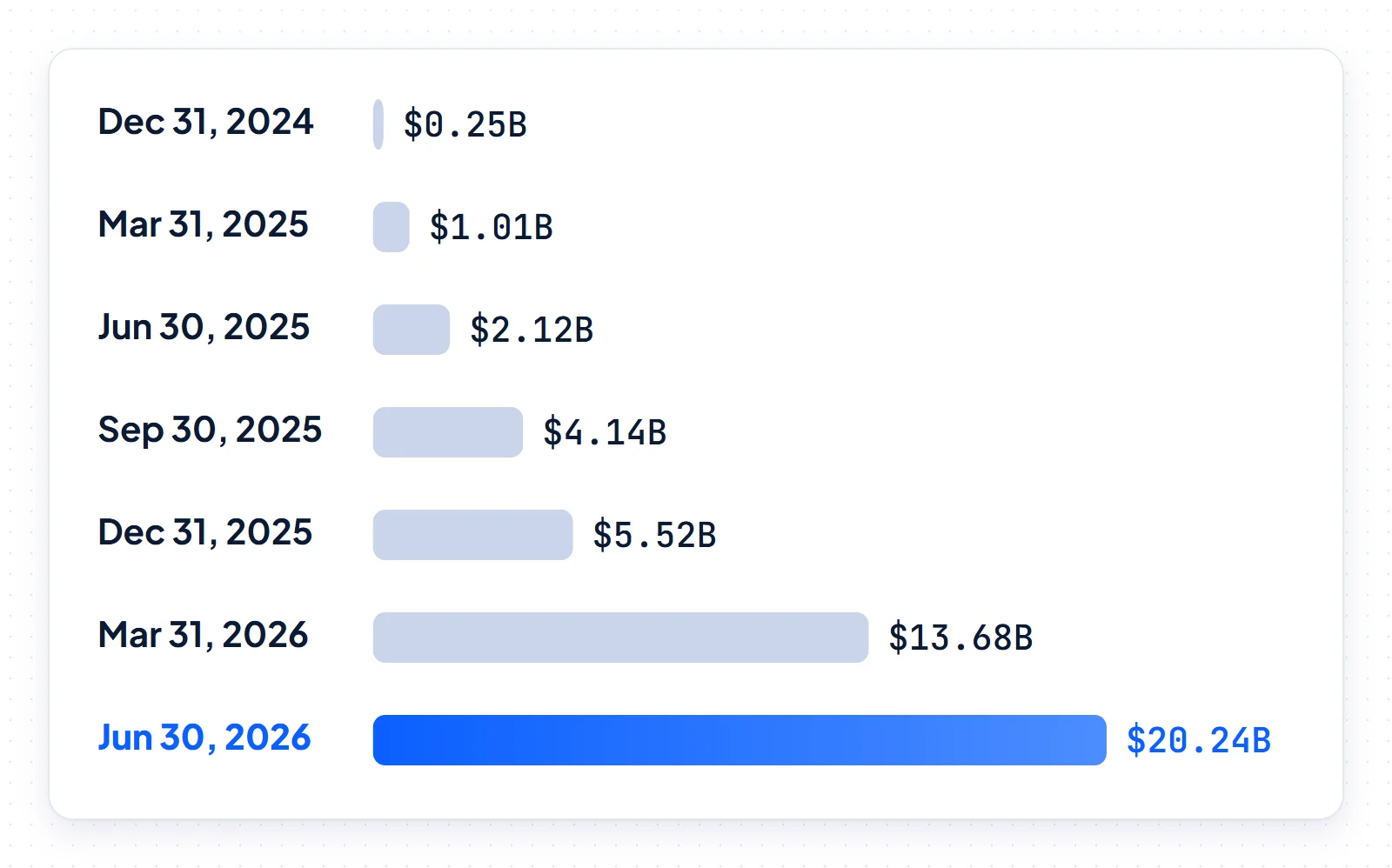
The fund’s quarterly 13F filings with the SEC are the most detailed public record, and we compiled all seven. At June 30, 2026, the two largest lines were Sandisk and Micron, at about $5.67 billion and $5.57 billion.
| Period end | Filed | Positions | Reported 13F value |
|---|---|---|---|
| December 31, 2024 | February 12, 2025 | 6 | $255 million |
| March 31, 2025 | May 14, 2025 | 12 | $1.01 billion |
| June 30, 2025 | August 14, 2025 | 9 | $2.12 billion |
| September 30, 2025 | November 14, 2025 | 28 | $4.14 billion |
| December 31, 2025 | February 11, 2026 | 29 | $5.52 billion |
| March 31, 2026 | May 18, 2026 | 42 | $13.68 billion |
| June 30, 2026 | August 14, 2026 | 26 | $20.24 billion |
Compiled by BuySI Domains from SEC EDGAR filings for CIK 2045724, checked October 30, 2026. Filings: the SEC EDGAR 13F index for Situational Awareness LP.
Situational Awareness LP’s reported 13F value rose from about $255 million at the end of 2024 to about $20.24 billion at June 30, 2026, according to its SEC filings. The 13F value is not assets under management. A 13F lists mainly long positions and listed options in US-listed securities. It leaves out short stock positions and private stakes such as Anthropic, and borrowed money can lift it above the fund’s own capital.
The July 2026 unwind of the Situational Awareness fund
In late July 2026 the fund sold most of its public stock portfolio. CNBC reported that steep losses forced it to unwind its public positions, and The Wall Street Journal reported that Citadel bought the majority of the portfolio. According to TechCrunch, SK Hynix, Sandisk, Bloom Energy and Nebius each fell more than 30% over the month.
Borrowed money made the fall larger. CNBC reported that borrowing lifted the fund’s positions to as much as 400% of its capital, and that a short position in software stocks moved against it. It also reported margin calls from the fund’s prime brokers. Bloomberg described a 24-hour race to salvage the positions as nervous banks demanded more collateral.
Situational Awareness LP’s reported size differs by outlet and by what each figure measures. Its assets reportedly fell from as much as $45 billion (CNBC) to about $10 billion (Bloomberg) after the Citadel sale. Other outlets gave lower peaks: The New York Times put it above $30 billion, while reports in Bloomberg and the Financial Times put assets near $20 billion to $24 billion before the selloff. Aswath Damodaran estimated the loss of principal at more than 43% over the weeks before the July 29, 2026 liquidation.
The fund did not shut down. In a letter to investors on July 31, 2026, Aschenbrenner wrote: “We took the steps that were necessary to fight another day.” According to TechCrunch, the fund kept its private stakes: Anthropic, a holding Bloomberg put at about $5 billion, plus MatX and Fluidstack.
The New York Times reported in late August 2026 that the SEC had subpoenaed Goldman Sachs, JPMorgan, Citigroup and Bank of America for records on trade timing and lender communications. The inquiry is at an early stage, nobody has alleged wrongdoing, and the SEC declined to comment. The fund said it would “cooperate to the fullest extent with any regulatory request.”
CNBC reported on September 11, 2026, that the fund was active in options on AMD, CoreWeave and a memory ETF. On October 29, 2026, Bloomberg reported that it was pitching investors on a Fluidstack fundraise at a valuation of about $40 billion, a report a Fluidstack co-founder disputed.
What the essay predicted, and the status on October 30, 2026
Most of the essay’s large claims point to 2027 or later, so they cannot be scored yet. A few earlier markers can. The table sets each claim beside what public sources show, and “Open” means the date has not arrived or no primary source settles it.
| Essay claim | Target | Status as of October 30, 2026 | Source |
|---|---|---|---|
| Training cluster of about 1 GW, roughly Hoover Dam scale | 2026 | Largest tracked site at about 1,037 MW of current IT power (Anthropic and Amazon, New Carlisle) | Epoch AI, updated October 29, 2026 |
| Cluster of about 10 GW costing hundreds of billions | 2028 | Stargate announced January 21, 2025 at $500 billion over four years; a 10 GW commitment was added in September 2025; largest planned single site about 2.26 GW | OpenAI; Epoch AI |
| Total AI investment above $1 trillion a year | 2027 | Open | Not yet checkable |
| AGI plausible | 2027 | Open | Not yet checkable |
| Labs secured against state actors | Near term | Partial: Anthropic’s ASL-3 security standard (May 2025) targets most attackers, by its own description; the September 2026 White House accord adds cybersecurity controls | Anthropic; Nextgov |
| Some form of US government AGI project | 2027 or 2028 | Open. No government-run AGI project; the Genesis Mission (EO 14363, November 2025) is a DOE AI-for-science effort, and EO 14434 (September 2026) covers terminology | White House; Nextgov |
| Superintelligence | By 2030 | Open | Not yet checkable |
On the record so far, the 2026 hardware marker roughly matches Epoch AI’s figures, while the policy forecasts have not appeared in the form he described. For a second, more detailed timeline of the same years, compare this table with our breakdown of the AI 2027 scenario.
Critics and OpenAI’s response
Gary Marcus replied the day after publication. In his June 5, 2024 post “AGI by 2027?”, he targeted the chart behind the OOM count: “The double Y-axis makes no sense, and presupposes its own conclusion.”
Aswath Damodaran, who writes the Musings on Markets blog, judged the fund rather than the forecast. In his August 10, 2026 post-mortem on the fund, he wrote that pairing a macro story about AI winning with as much debt as possible “creates a time bomb.” He framed the episode as a lesson about conviction, concentration and borrowed money.
OpenAI has also disputed the essay’s picture of the lab. In July 2024 it told The New York Times that it shares his commitment to building safe AGI. Then it added: “we disagree with many of the claims he has since made about our work.”
The domains behind the essay
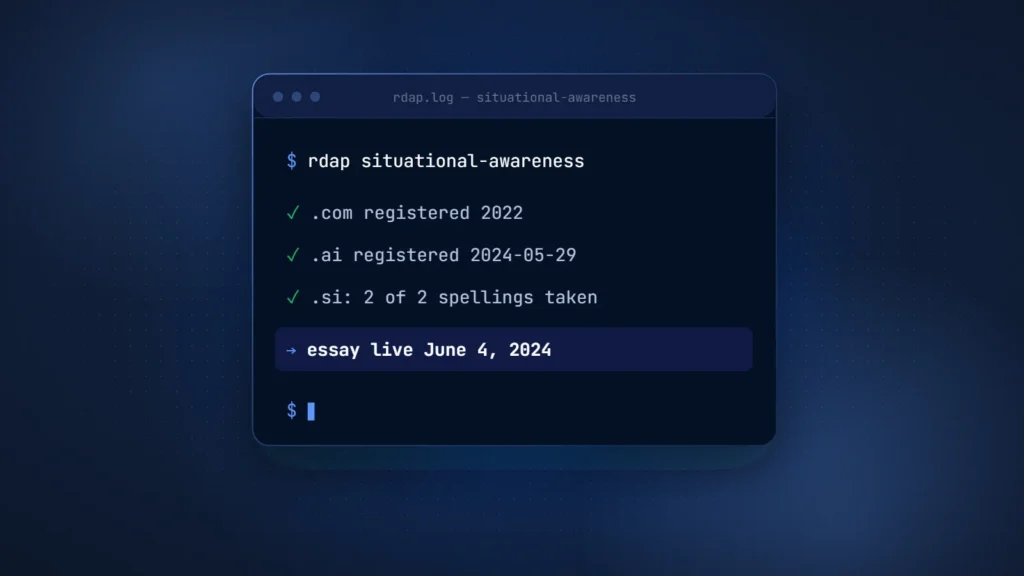
Leopold Aschenbrenner’s essay launched on situational-awareness.ai, a domain registered on May 29, 2024, six days before it went live on June 4, 2024. That date comes from RDAP data checked by BuySI Domains on October 30, 2026. Both .com spellings, situationalawareness.com and situational-awareness.com, date from earlier registrations in 2007 and 2022. The unhyphenated situationalawareness.ai followed on October 8, 2024, about four months after launch.
.si is Slovenia’s country-code domain. For AI companies it reads as SuperIntelligence. Both .si spellings we checked (with and without the hyphen) were already registered, and both registrations date from 2026.
| Domain | Registered | Timing against the essay |
|---|---|---|
| situationalawareness.com | June 30, 2007 | About 17 years before |
| forourposterity.com (his blog) | October 26, 2020 | About 3.5 years before |
| situational-awareness.com | July 10, 2022 | About two years before |
| situational-awareness.ai (essay home) | May 29, 2024 | Six days before |
| situationalawareness.ai | October 8, 2024 | About four months after |
| .si spellings, with and without the hyphen (2 checked) | Both in 2026 | After |
RDAP lookups by BuySI Domains, October 30, 2026. The .si row is an aggregate only.
The word at the center of his essay is superintelligence. On September 29, 2026, Executive Order 14434 asked US agencies to use “Super Intelligence” or “SI” instead of “AI” in non-statutory communications, as Nextgov reported on the order. The order concerns federal wording, not domains, but it puts the same two letters before a wider audience.
The practical lesson is about sequence: a launch date makes a name public, and spellings free the day before can be gone weeks later. Short names that echo a theme deserve the same early check. One example is essai.si: the French word “essai” means essay or attempt, and the name ends in the letters ai and sits on .si. BuySI Domains lists essai.si for sale.
How to read Aschenbrenner, and what founders can take from it
Read the essay as a set of dated claims, not a single bet. The 2026 hardware marker can be checked now. The hinge claim, that models can do an AI researcher’s work by 2027, comes due next year, and every later step in the chain depends on it. When it does, test it against the text of Chapter I rather than against summaries.
Keep the fund and the forecast apart. The July 2026 unwind turned on borrowed money and concentrated positions, the factors Damodaran singles out, while the essay’s key dates are 2027 and 2030. When you see a dollar figure, ask what it measures: a 13F snapshot, a reported peak or assets after a sale.
For founders, the useful part of this story is the domain record. Before announcing, run the check we ran: look up each spelling on .com, .ai and .si, with and without hyphens, and register the ones you need. Only then publish the name.