Ilya Sutskever is a computer scientist who co-created AlexNet, co-founded OpenAI and served as its chief scientist, and now leads Safe Superintelligence Inc. (SSI). In a message on ssi.inc dated July 3, 2025, he wrote that he is “now formally CEO of SSI.” The company has one stated goal: a safe superintelligence.
His profile matters again in 2026. On July 27, 2026, NVIDIA and SSI announced a long-term partnership meant to raise SSI’s compute by an order of magnitude. Yet as of October 22, 2026, SSI’s own updates page lists no model, paper or product, and several institutional profiles still describe him as OpenAI’s chief scientist.
Ilya Sutskever timeline: key dates
The table below lists the main dates of his career, drawn from primary sources: university and company announcements, papers, court coverage and his own posts. BuySI Domains compiled it on October 22, 2026.
| Date | Event | Source |
|---|---|---|
| 2005 | Honours BSc in mathematics, University of Toronto | University of Toronto News |
| 2012 | AlexNet wins ILSVRC-2012 with a 15.3% top-5 error | ImageNet official results |
| March 12, 2013 | Google acquires DNNresearch (Krizhevsky, Sutskever, Hinton) | University of Toronto News |
| 2013 | PhD thesis “Training Recurrent Neural Networks,” advised by Geoffrey Hinton | University of Toronto thesis record |
| September 10, 2014 | Seq2seq paper with Oriol Vinyals and Quoc Le posted | arXiv 1409.3215 |
| December 11, 2015 | OpenAI launches with Sutskever as research director | OpenAI announcement |
| July 5, 2023 | Co-leads the new Superalignment team with Jan Leike | OpenAI announcement |
| November 17, 2023 | OpenAI board, including Sutskever, removes Sam Altman as CEO | OpenAI announcement |
| November 29, 2023 | OpenAI confirms Altman’s return; Sutskever leaves the board | OpenAI announcement |
| May 14, 2024 | Announces he is leaving OpenAI | His X post, reported by Bloomberg |
| June 19, 2024 | Co-founds SSI with Daniel Gross and Daniel Levy | ssi.inc |
| July 3, 2025 | Becomes formally CEO of SSI | ssi.inc/updates |
| May 11, 2026 | Testifies in federal court in Oakland | Reuters |
| July 27, 2026 | SSI and NVIDIA announce a long-term partnership | NVIDIA newsroom |
Early research: Toronto, AlexNet and seq2seq
Sutskever’s reputation rests on a run of papers from 2012 to 2014 that helped make deep learning the default approach in AI. According to the University of Toronto, he was born in Russia, raised in Israel and moved to Canada as a teenager. He studied mathematics at Toronto, then earned a PhD in computer science under Geoffrey Hinton.
AlexNet is the 2012 convolutional neural network that Ilya Sutskever co-authored with Alex Krizhevsky and Geoffrey Hinton. Their team, SuperVision, won the ImageNet challenge (ILSVRC-2012) with a top-5 error of 15.3%, against 26.2% for the next team, according to the official results. The network had 60 million parameters and five convolutional layers.
The three researchers had formed a company, DNNresearch, and Google bought it; the university announced the deal on March 12, 2013. Sutskever joined Google Brain as a research scientist. His thesis that year, “Training Recurrent Neural Networks,” dealt with the sequence models that came next.
In September 2014, Sutskever, Oriol Vinyals and Quoc Le posted “Sequence to Sequence Learning with Neural Networks.” Its LSTM encoder and decoder scored 34.8 BLEU on English-to-French translation, ahead of a phrase-based system at 33.3. NeurIPS gave the paper its 2024 Test of Time award and called it “the cornerstone work that set the encoder-decoder architecture.”
Hinton later shared the 2018 ACM Turing Award with Yann LeCun and Yoshua Bengio, the trio often called the fathers of deep learning. Sutskever is Hinton’s former doctoral student, not one of the three.
OpenAI co-founder and chief scientist (2015–2024)
OpenAI launched on December 11, 2015, and its announcement named Sutskever as research director, “one of the world experts in machine learning.” He later became chief scientist. TIME credits him with overseeing the research that led to ChatGPT and with starting the work that produced o1, OpenAI’s first reasoning model. Papers from those years, including GPT-3, CLIP and the GPT-4 technical report, list him among many co-authors.
Superalignment
On July 5, 2023, OpenAI announced a Superalignment team co-led by Sutskever and Jan Leike. OpenAI pledged 20% of the compute it had secured to date and set a four-year goal to solve the core technical challenges of superintelligence alignment. The post called superintelligence “the most impactful technology humanity has ever invented.” Our explainer on AI alignment and why it is hard covers the research problem itself.
The November 2023 board episode
On November 17, 2023, the OpenAI board, which included chief scientist Ilya Sutskever, announced that Sam Altman was leaving as CEO and named Mira Murati interim CEO. The board said Altman had not been “consistently candid” with it. On November 20, Sutskever posted on X: “I deeply regret my participation in the board’s actions.” On November 29, OpenAI confirmed Altman’s return and Sutskever’s exit from the board.
In that November 29 post, Altman wrote that he harbored “zero ill will” toward Sutskever.
On May 11, 2026, Sutskever testified under oath in Elon Musk’s lawsuit against OpenAI. According to Reuters, he said he had considered removing Altman for at least a year before the vote. He also described Altman’s conduct, including pitting executives against one another, as “not conducive to any grand goal.”
On May 18, 2026, a federal jury found that Musk’s claims had been filed too late. This profile reports his testimony and takes no view on the case.
Departure in May 2024
On May 14, 2024, Sutskever announced on X that “after almost a decade” he was leaving OpenAI for a project “very personally meaningful” to him. Jakub Pachocki succeeded him as chief scientist. Jan Leike resigned the same week, and OpenAI told Wired it had folded the Superalignment work into other research.
How many citations does Ilya Sutskever have?
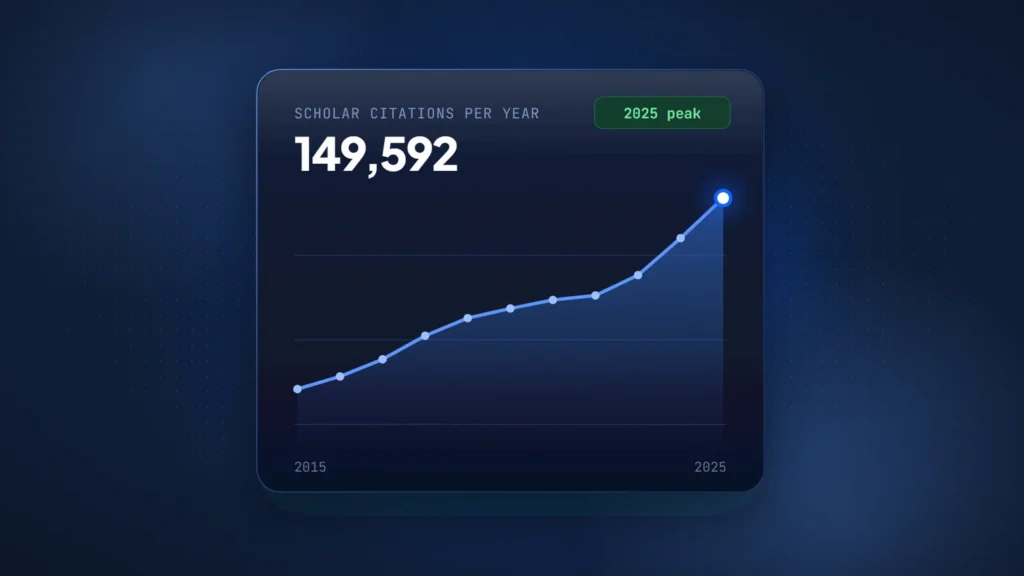
Ilya Sutskever’s Google Scholar profile showed 869,010 citations and an h-index of 111 when BuySI Domains checked it on October 22, 2026. The 2012 AlexNet paper alone accounts for 202,765 citations, or 23.3% of the total. The count is still accelerating: 72.9% of all citations arrived in 2021 or later, and 2025 was his most-cited year, with 149,592.
| Paper (year) | Citations | Authorship |
|---|---|---|
| AlexNet: ImageNet classification with deep CNNs (2012) | 202,765 | 3 authors, with Krizhevsky and Hinton |
| GPT-3: Language models are few-shot learners (2020) | 85,256 | Large OpenAI team |
| CLIP: Learning transferable visual models (2021) | 76,461 | Large OpenAI team |
| Dropout (2014) | 65,762 | 5 authors, including Hinton |
| word2vec: Distributed representations of words (2013) | 52,097 | Co-author, with Tomas Mikolov et al. |
| Top 5 combined | 482,341 | 55.5% of all citations |
Two caveats apply. Several of these are large-team papers, so the counts measure the reach of the work rather than his personal share. The Scholar profile also still lists him as “Co-Founder and Chief Scientist at Safe Superintelligence Inc,” a self-maintained label that has not reflected his CEO title since July 2025.
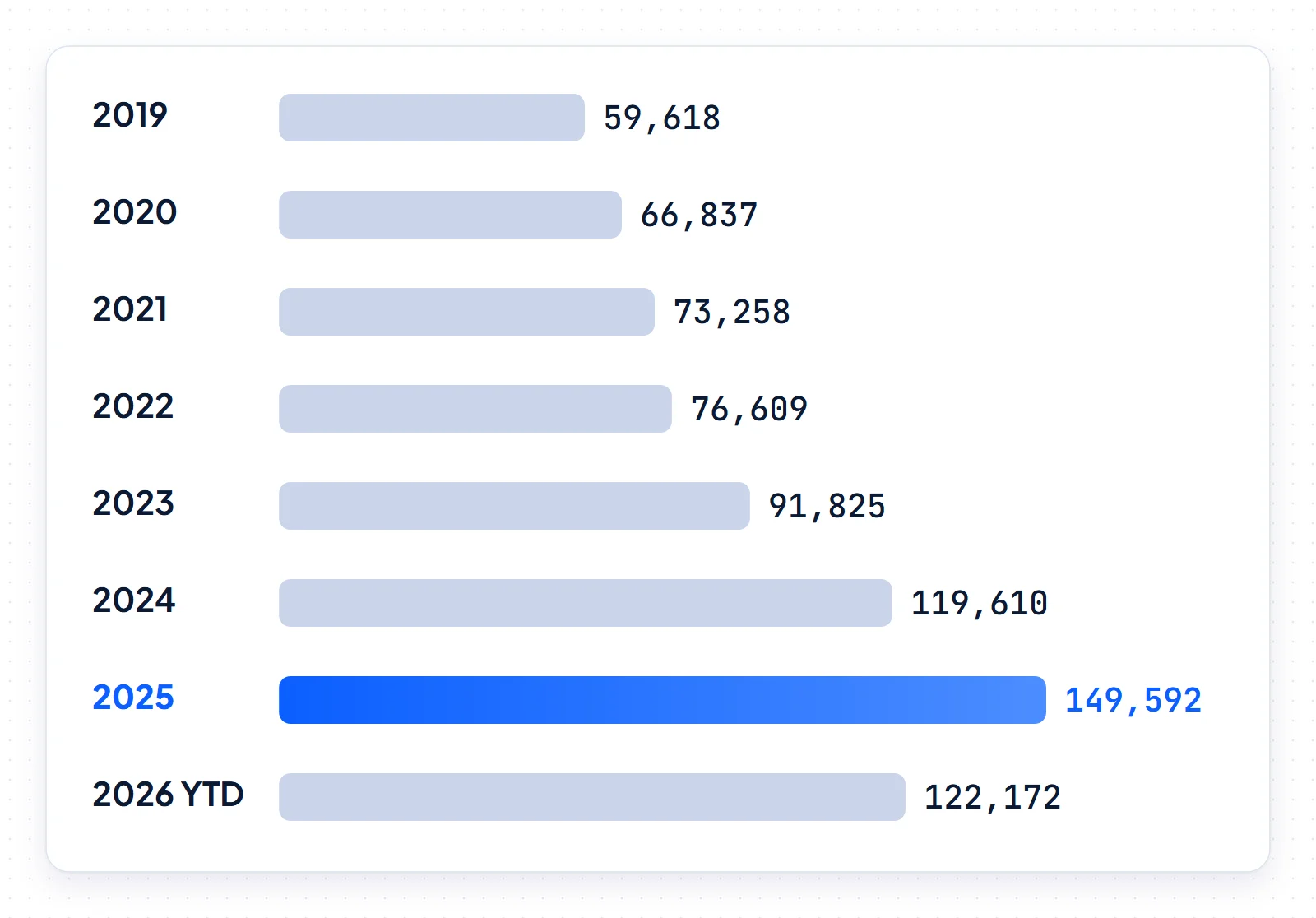
The yearly series shows the same acceleration. Citations rose from 59,618 in 2019 to 149,592 in 2025, and the partial 2026 total reached 122,172 by October 22. Seq2seq alone now has 33,243 citations, up from “more than 27,000” when NeurIPS honored it in November 2024.
What is Ilya Sutskever doing now?
As of October 22, 2026, Ilya Sutskever is co-founder and CEO of Safe Superintelligence Inc. (SSI), a lab with offices in Palo Alto and Tel Aviv. He co-founded it on June 19, 2024, with Daniel Gross and Daniel Levy. After Gross left on June 29, 2025, Sutskever became CEO and Levy became president. SSI has announced no model, paper or product.
SSI calls itself “the world’s first straight-shot SSI lab,” with one goal and one product. Its target is artificial superintelligence, and its homepage says it plans to advance capabilities “while making sure our safety always remains ahead.” In his July 2025 message, Sutskever acknowledged acquisition rumors and wrote: “We have the compute, we have the team, and we know what to do.”
SSI announced a $1 billion raise on September 4, 2024, from investors including a16z, Sequoia and DST Global; Reuters reported a $5 billion valuation. In April 2025, the Financial Times and TechCrunch reported a $2 billion round at a $32 billion valuation, led by Greenoaks. SSI has not confirmed any valuation, and no major outlet has reported a later figure.
On July 27, 2026, NVIDIA and SSI announced a long-term strategic partnership built on NVIDIA’s Vera Rubin platform, with an NVIDIA investment of undisclosed size. Bloomberg and Reuters, citing people briefed on the deal, reported the amount as $5 billion. Sutskever said in the release: “We have research that is worthy of scaling up, and having access to a big NVIDIA computer will let us do so.”
What Sutskever has said about superintelligence
Superintelligence sits at the far end of the usual types of AI, beyond narrow AI and general AI. Sutskever gives few interviews, so his recent views come mainly from two well-documented appearances: his NeurIPS 2024 talk and a 2025 podcast interview.
At his NeurIPS Test of Time talk in Vancouver on December 13, 2024, he said “pre-training as we know it will unquestionably end,” as reported by The Verge. He said “we’ve achieved peak data,” noted that there is only one internet, and called data the fossil fuel of AI. He also said future systems will reason, and that the more a system reasons, the less predictable it becomes.
In an interview on the Dwarkesh Podcast on November 25, 2025, Ilya Sutskever said AI had moved from an “age of scaling” (2020 to 2025) back to an “age of research.” This time, he said, it is research “just with big computers.” Asked when a system could learn as well as a human and then become superhuman, he answered “5 to 20” years. These are his estimates, not SSI commitments.
In the same interview he said that even a straight-shot plan would still involve “a gradual release.” On how SSI will earn money, he said: “Right now, we just focus on the research.” Read together, these remarks describe a bet on new methods rather than ever-larger versions of current models. That reading is ours; SSI has not published its technical approach.
How SSI put superintelligence into a company name
SSI made its goal its brand. Its homepage states: “SSI is our mission, our name, and our entire product roadmap.” RDAP records checked by BuySI Domains on October 22, 2026, show ssi.inc registered on June 14, 2024, five days before the June 19 launch.
That put superintelligence into a company name more than two years before Executive Order 14434. Signed on September 29, 2026, the order directs US federal agencies to use “Super Intelligence” in non-statutory materials, according to the order text published by the White House.
.si is Slovenia’s country-code domain. For AI companies it reads as SuperIntelligence. This is our framing, not an official meaning, but it follows the same instinct SSI acted on: put the goal in the name. Our profile of Safe Superintelligence and its domain choices covers SSI in depth, and our comparison of superintelligence domains used by AI labs sets out the naming options.
For a founder naming a research lab, SSI’s sequence is the practical lesson: settle the name and secure the domain before the announcement. A name such as essai.si fits that use, since “essai” is French for an attempt or trial and the name contains both AI and SI. BuySI Domains lists essai.si for sale.