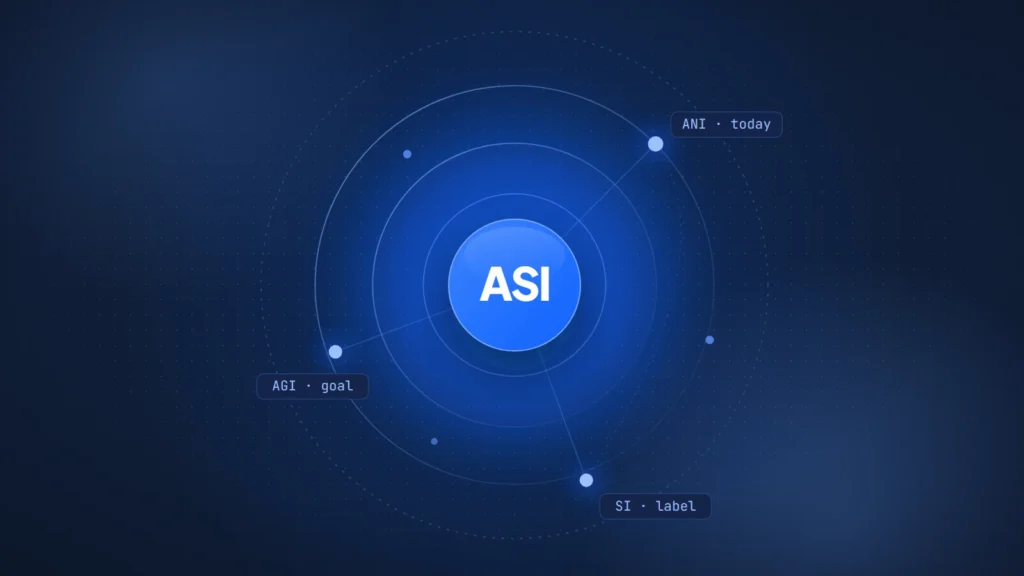
The types of AI fall into two systems. By capability: narrow (ANI), general (AGI) and superintelligence (ASI). By function: reactive machines, limited memory, theory of mind and self-aware AI. Popular lists of “seven types” add the two. As of October 2026, only narrow AI is undisputed: whether today’s chatbots are early AGI depends on the framework, and superintelligence remains hypothetical.
The labels now matter well beyond textbooks. AI labs put them in mission statements and company names, and the EU AI Act made “general-purpose AI model” a legal category. A US executive order signed on September 29, 2026 tells federal agencies to write “Super Intelligence” in place of “Artificial Intelligence”. This guide covers both systems, how they map onto each other, where ChatGPT fits and how the labels turned into names.
Two ways to sort AI, and where “seven types” comes from
Two separate questions sit behind most lists of AI types. The capability system asks how broad and how strong a system is. The functional system asks what a system can remember and what it can represent about others and itself. Three capability tiers plus four functional types make seven, which is why some guides speak of “seven types of AI”. No formal standard defines that combined list.
The two systems also have different origins. The four functional types come from a single essay. Arend Hintze, then an assistant professor at Michigan State University, set them out in The Conversation on November 14, 2016. The three capability tiers have no single author. They are a common convention assembled from terms coined at different times.
Nick Bostrom defined superintelligence in a 1998 paper. Ben Goertzel writes that Shane Legg proposed “artificial general intelligence” around 2002, as the title of a book that Springer published in 2005. Goertzel notes that Mark Gubrud had already used the term in 1997. Legg later co-founded DeepMind and co-wrote the lab’s own Levels of AGI framework. The person who suggested the book title thus helped build one of the best-known scales for that tier.
Types of AI by capability: ANI, AGI and ASI
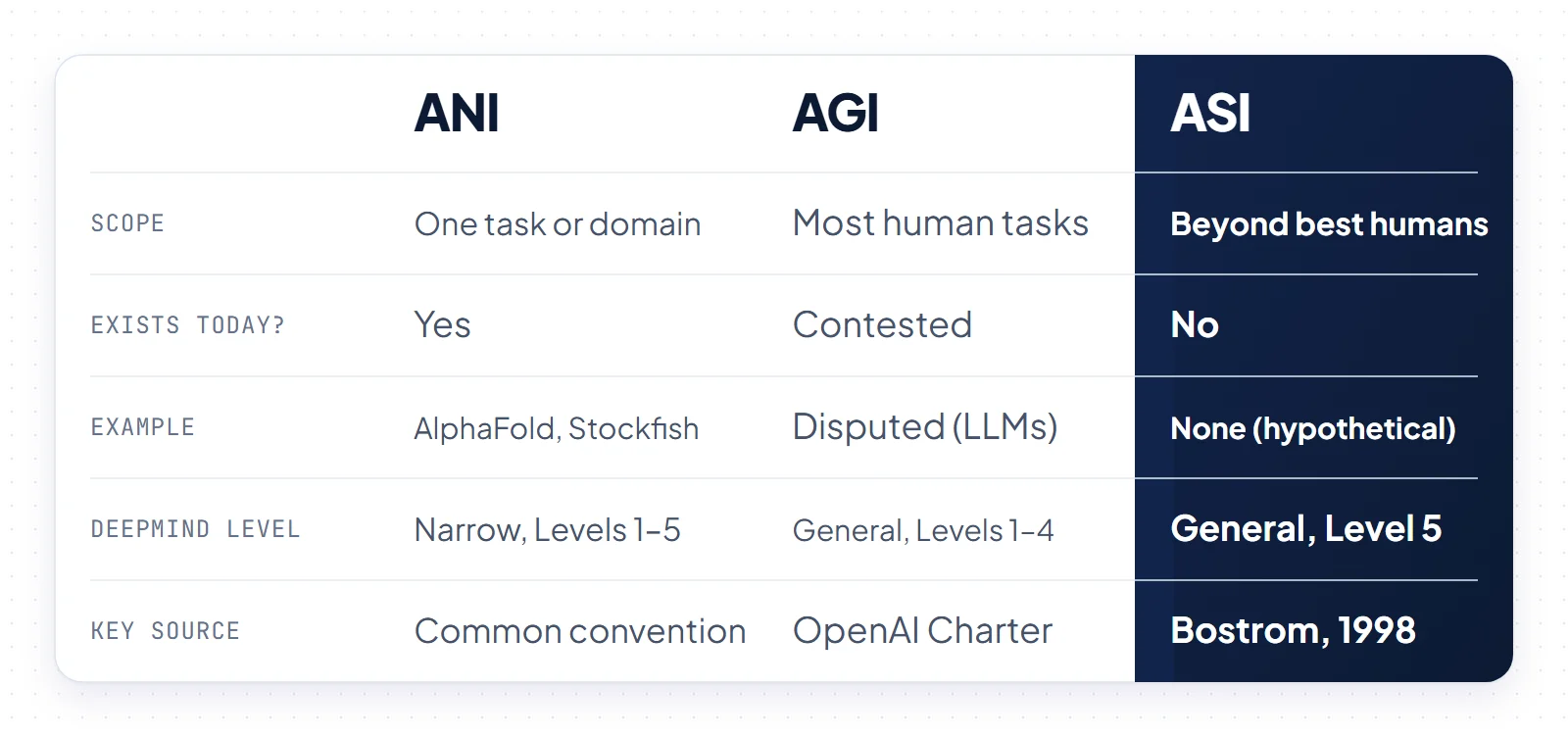
Capability tiers rank AI by breadth and strength. Narrow AI performs one task or a close set of tasks. General AI would match skilled people across most tasks. Superintelligence would exceed the best humans in nearly every field. Google DeepMind’s “Levels of AGI” paper turns this into a grid that crosses performance (Levels 0–5) with breadth (narrow or general).
| Tier | Working definition | Exists today? (October 2026) | Example | Source |
|---|---|---|---|---|
| ANI (narrow) | AI built for one task or a narrow set of tasks | Yes | AlphaFold, AlphaZero, Stockfish | Common convention; DeepMind, Levels of AGI (narrow column) |
| AGI (general) | “Highly autonomous systems that outperform humans at most economically valuable work” | Contested: DeepMind rated 2023 chatbots “Emerging AGI”, its lowest general level, and places OpenAI’s definition near its Level 4 | None confirmed | OpenAI Charter; DeepMind, Levels of AGI |
| ASI (super) | “Much smarter than the best human brains in practically every field” | No: listed as “not yet achieved” | None (hypothetical) | Bostrom, 1998; DeepMind, Levels of AGI |
Artificial narrow intelligence (ANI)
Artificial narrow intelligence (ANI) is AI built for one task or a close set of tasks. It describes most AI in use today, from spam filters and recommendation engines to chess engines and protein-structure prediction. Narrow does not mean weak. In Google DeepMind’s Levels of AGI grid, narrow systems already reach Level 5, “Superhuman”, and AlphaFold, AlphaZero and Stockfish outperform every human at their tasks. What they lack is breadth, since a world-class chess engine cannot write an email or plan a trip.
Artificial general intelligence (AGI)
AGI has no single agreed definition. The OpenAI Charter describes it as “highly autonomous systems that outperform humans at most economically valuable work”. The Levels of AGI paper by Meredith Ringel Morris, Shane Legg and colleagues at Google DeepMind splits general AI into performance levels instead. The paper was first posted on November 4, 2023 and last revised on September 24, 2025. It states that “Competent” AGI, performing at least at the 50th percentile of skilled adults, “has not been achieved by any public systems at the time of writing.”
The gap between general and super AI is its own topic, covered in AGI vs ASI. For named forecasts of when AGI might arrive, see our AGI timeline.
Artificial superintelligence (ASI)
ASI is the top tier and remains hypothetical. Nick Bostrom’s 1998 definition is still the most quoted: an intellect “much smarter than the best human brains in practically every field”. In the DeepMind grid it is Level 5 general AI, marked “not yet achieved”. Our guide to artificial superintelligence (ASI) covers the term in depth.
Types of AI by functionality: Hintze’s four types
The functional system sorts AI by what it can remember and represent. Hintze described four types, ordered from machines that existed in 2016 to machines that remain hypothetical.
- Type I, reactive machines. They respond to the input in front of them and keep no memories. Hintze’s main example is Deep Blue, the chess computer that could identify the pieces on a board and know how each moves. He also placed AlphaGo here, although AlphaGo learned from records of past games, so it fits the type less cleanly.
- Type II, limited memory. These systems “can look into the past” and fold recent observations into their decisions. Hintze noted that self-driving cars already do some of this.
- Type III, theory of mind. Systems that understand that others have thoughts and emotions of their own. Hintze gave no existing example.
- Type IV, self-awareness. Systems that can form representations about themselves. Hintze wrote that we are “probably far from creating machines that are self-aware.”
Hintze’s four types of AI, set out by Arend Hintze in The Conversation on November 14, 2016, form a ladder. Reactive machines and limited-memory systems exist today, while theory-of-mind and self-aware AI have no working examples. Types I and II sit within narrow AI, and Types III and IV would seem to need at least general intelligence. That mapping is our reading, not Hintze’s.
Two cautions apply. The essay was a popular explainer in The Conversation, not a formal standard, and it was written before ChatGPT-era language models. Placing a modern chatbot in one of his four boxes is an interpretation that other writers added later.
What type of AI is ChatGPT?
ChatGPT is a generative AI system built on a large language model, and its type depends on the framework. Many writers call it narrow AI. Google DeepMind’s 2023 Levels of AGI paper lists ChatGPT as Level 1, “Emerging” general AI. The EU AI Act would treat it as a general-purpose AI system built on a general-purpose AI model.
Three frames are in common use, and they disagree.
- The narrow-AI convention. Many explainers call ChatGPT narrow AI because it lacks the full range of human abilities. By function, the same sources usually file it under limited memory, since it uses the context of a conversation. That functional label is a popular-press reading, not Hintze’s.
- Google DeepMind’s Levels of AGI. The paper lists “ChatGPT (OpenAI, 2023)” with Bard, Llama 2 and Gemini at Level 1, “Emerging” general AI. It says that “current frontier language models would therefore be considered a Level 1 General AI”. The examples date from 2023, and the paper does not rate later models.
- The EU AI Act. European law uses a legal category instead of a tier. Article 3(63) of Regulation (EU) 2024/1689 defines a general-purpose AI model as one that “displays significant generality and is capable of competently performing a wide range of distinct tasks”. That describes breadth, not human-level intelligence.
Machine learning, generative AI and agents are techniques, not types
Machine learning, generative AI, large language models and AI agents describe how a system is built or what it does, not where it sits in either classification. A list that puts “generative AI” next to “narrow AI” compares two different things.
- Machine learning is a method: the system learns patterns from data instead of following hand-written rules. Deep learning is a branch of it built on large neural networks.
- Generative AI is an output form: systems that produce new text, images, audio or code.
- Large language models are a model family: generative systems trained on very large amounts of text.
- AI agents are a product form: systems that take actions toward a goal, such as calling tools or completing multi-step tasks.
Each of these can appear at any capability tier. A chess engine and a chatbot can both run on neural networks, yet one is plainly narrow and the other is contested. AI that acts in the world through robots and sensors, covered in our piece on physical AI, is an application area in the same way, not a fifth functional type.
The same logic explains why questions about “the five main AI models” have no authoritative answer. Any count of techniques reflects a choice of grouping, and different textbooks group them differently.
From ANI to ASI: how the labels became names
By October 2026, the word “superintelligence”, the name of the top tier of AI capability, had moved from research papers into company names, mission statements and government text. Safe Superintelligence Inc. (2024), Meta Superintelligence Labs (2025), Microsoft’s MAI Superintelligence Team (2025) and US Executive Order 14434 (2026) all use “superintelligence”, “Super Intelligence” or “SI” in a name or in official wording.
BuySI Domains checked mission pages and live domains on October 20, 2026, to see which label each organization claims and which domain it runs on.
| Organization | Label it uses | Primary domain | Source (date) |
|---|---|---|---|
| Safe Superintelligence Inc. | Superintelligence (“a safe superintelligence”) | ssi.inc | ssi.inc homepage; company announced June 19, 2024 |
| Meta | Superintelligence (Meta Superintelligence Labs) | meta.com | Mark Zuckerberg, “Personal Superintelligence” (July 30, 2025); Meta newsroom on Meta Superintelligence Labs (April 8, 2026) |
| Microsoft AI | “Humanist superintelligence” | microsoft.ai | Mustafa Suleyman, “Towards Humanist Superintelligence” (November 6, 2025) |
| OpenAI | AGI | openai.com | OpenAI About page and Charter |
| Google DeepMind | AGI | deepmind.google | Google DeepMind About page |
| Anthropic | Neither (“advanced AI”) | anthropic.com | Anthropic Company page |
| US government | “Super Intelligence” and “SI” | whitehouse.gov | Executive Order 14434 (September 29, 2026) |
Within this small sample, the check shows two patterns. First, five of the six AI organizations run on non-.ai domains, and the exception, microsoft.ai, is a division site of a company whose main domain is microsoft.com. Other labs not in the table, such as xAI (x.ai) and Mistral AI (mistral.ai), do run on .ai. Google DeepMind’s older deepmind.com address now redirects to deepmind.google.
Second, ssi.inc is the only domain in the table that contains the SI initials: the lab’s SSI abbreviation is the name itself, on a .inc ending.
The US government went furthest. Executive Order 14434, “Inaugurating the Era of Super Intelligence”, signed on September 29, 2026, says agencies “shall use ‘Super Intelligence’ and ‘SI’ in place of ‘Artificial Intelligence’”. We explain the order’s wording and the other readings of the initials in what SI stands for.
.si is Slovenia’s country-code domain. For AI companies it reads as SuperIntelligence. That is a marketing reading, not an official meaning, but it matches the word that SSI, Meta and Microsoft put in their names and that US federal agencies now use for AI in general. Some names hold both layers: essai.si contains “ai” and ends in “si”, so one name covers the field as it is today and the tier those labs name as their goal. BuySI Domains lists essai.si for sale.
How to use the labels
The two systems answer different questions, so pick the one that matches yours and say which one you are using.
- Describing a product: use the capability tiers and default to “narrow” unless you cite a framework that says otherwise. Calling a product AGI without naming whose definition you use invites pushback, because the main definitions disagree.
- Explaining how a system behaves: the functional types help, mostly the first two. Theory of mind and self-awareness remain hypothetical in Hintze’s own terms.
- Compliance work in the EU: use “general-purpose AI model”, the term the AI Act defines, rather than ANI or AGI.
- Naming a company or product: the label in the name signals the tier you claim. “AI” names the field as it stands; “superintelligence” names the top tier, as the labs in the table use it. Since the 2026 executive order, US federal agencies also write “SI” for AI in general, so the initials now carry both readings.
For most writing, one sentence is enough: it names the system, the tier and the framework that assigns it. That habit keeps a pitch deck or a policy memo accurate as the labels spread into company names.