A .so domain is the country-code top-level domain (ccTLD) of Somalia, delegated by IANA on August 28, 1997. IANA’s record names Somalia’s Ministry of Post and Telecommunications as manager and soNIC in Mogadishu as technical contact. Registrars sell .so widely, though sources disagree on who is eligible. Notion used notion.so until it moved to notion.com in early June 2026.
Startups like .so because “so” is short and reads like an English word, and good names were still free. Notion’s move raised a fair question for founders: whether .so is still a sound home once its best-known brand has left. To find out, we checked 20 well-known .so brands on November 9, 2026. Most of them have stayed. Still, the eligibility rules, the registry history and the missing DNSSEC chain deserve a close look before you pick a .so name.
What is a .so domain?
A .so domain is any web address that ends in .so, the two-letter country code of Somalia. According to the IANA root zone database, the delegation dates from August 28, 1997. IANA names the Ministry of Post and Telecommunications as manager, soNIC as technical contact, and shows a record last changed on April 18, 2016.
The early years were quiet. IANA’s 2009 redelegation report says the first delegation went to World Class Domains, a US company whose website told visitors that no .so domains were available. In February 2009 the ICANN Board approved moving the domain to Somalia’s Ministry of Post and Telecommunications.
A relaunch followed in November 2010, with GMO Registry running the back end and launch rules modeled on .co. Public registration opened in 2011. In June 2015 the registry halted new registrations, and on July 8, 2015 it moved from GMO Registry to soNIC, a provider based in Mogadishu. In March 2018, Somalia’s National Communications Authority (NCA) took full control, Xinhua reported. The NCA now calls soNIC the registry operator under its authority, while the IANA record still shows the ministry.
Besides plain .so names, the registry offers about a dozen second-level zones. Open ones include .com.so, .net.so, .org.so and .me.so. The .gov.so and .edu.so zones are restricted, and several zones serve Somalia’s federal states.
Who can register a .so domain?
Sources disagree on eligibility, and you should know that before you buy. Gandi’s .so page limits .so names to people with a “bona fide connection to Somalia”. Wikipedia describes the same limit and ties it to the 2015 registry change. Other registrars tell customers that anyone can register, with no extra documents.
In practice, plenty of foreign startups hold .so names, as our sample below shows. The careful reading is this: registry policy, as registrars summarize it, asks for a Somali connection, yet international registrars sell .so widely. Read your registrar’s .so terms before you build a brand on one, and keep a copy of what you agreed to.
Terms also differ on length. Gandi offers registration terms of 1 to 10 years. A 2015 registrar notice from Ascio said renewals would be limited to one year and that renewal fees would rise. The registry’s own policy page lists a 45-day auto-renew grace period and a 30-day redemption period. Set auto-renew, because a missed renewal on a ccTLD with shifting rules is hard to undo.
Why startups chose .so, and why Notion left
Startups picked .so for a plain reason: short, clean names were still available, and Notion said so itself. Notion’s David Tibbitts explained that many companies were named Notion and that “.so was available” when the team started.
The ending also works as light wordplay. “So” is a common English word, so names like tally.so or plane.so read as a phrase more than a country. That is the logic behind domain hacks that turn the extension into part of the name, from .tv to .me.
Notion’s path from .so to .com is the clearest case study, and the dates tell most of it:
- March 31, 2015: notion.so registered, per the .so registry’s RDAP data.
- April 8, 2020: TheDomains reported that notion.com, registered in October 1997, looked sold and redirected to notion.so.
- February 12, 2021: Notion went offline for hours. TechCrunch reported that Hexonet, which then linked the soNIC registry to registrars, put a temporary hold on the domain after phishing complaints about user pages.
- June 2021: Notion moved public pages to workspace.notion.site addresses and framed it as a branding feature.
- Early June 2026: Notion’s Akshay Kothari posted that the company was “finally shedding the .so” and thanked Somalia on the way out.
People often misread two points. First, the 2021 outage was not Somalia taking the domain back, a myth that still circulates. Second, Notion never gave phishing or blocklists as the reason to leave. The public story is a brand upgrade: reports say the effort to buy notion.com started in 2018 and the price was not disclosed.
The exact switch date is fuzzy. Kothari’s post went up on June 2, 2026, while news reports date the move to June 2, 3 or 5. A Notion developer changelog entry from July 2026 says generated links changed in “early June 2026” and that existing notion.so links still open.
Where 20 .so brands resolve today
Most well-known .so brands have not followed Notion. On November 9, 2026, BuySI Domains requested the home page of 20 recognizable .so tech brands and recorded the final address after all redirects. We took the names from DomainTyper’s list of popular .so sites and left out gambling, spam, google.so and government or school zones. We also checked page titles to spot parked or dead pages.
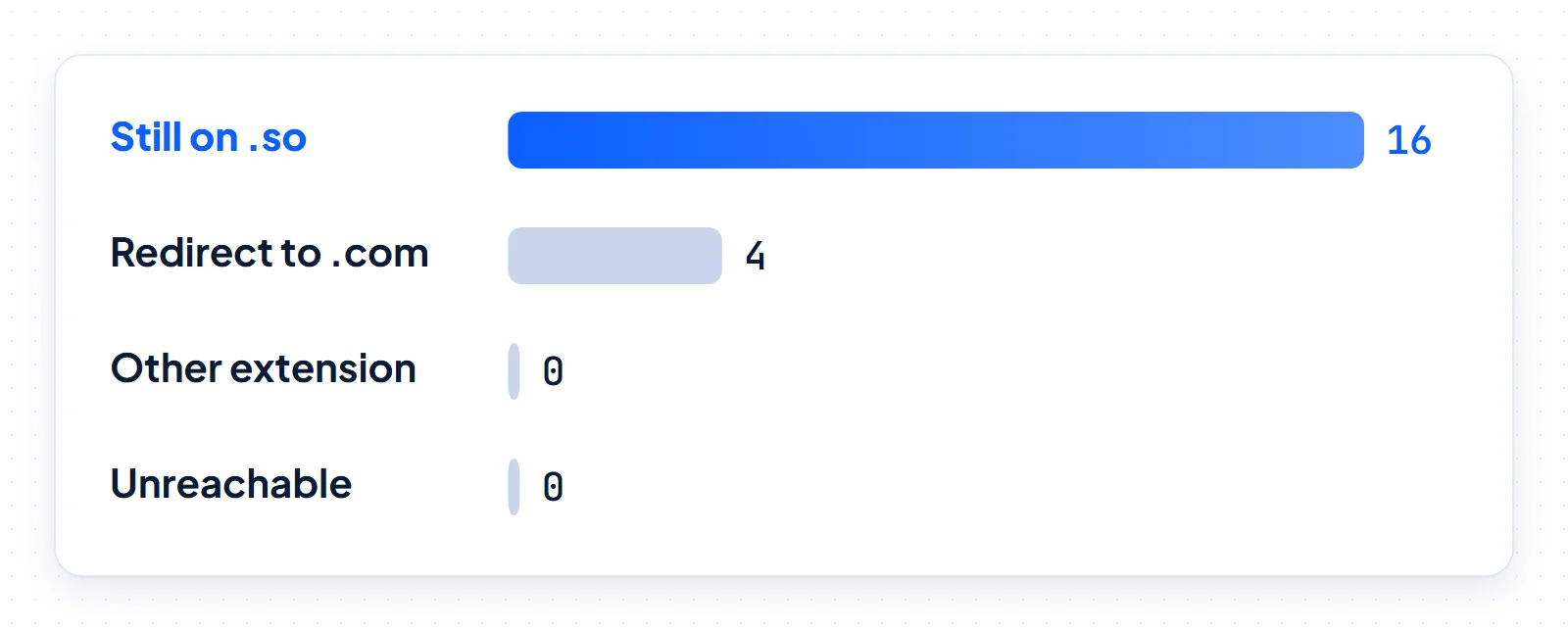
The result: 16 of the 20 still serve their site on .so, and 4 forward to a .com. None redirect to another extension, and none are unreachable or parked. Of those 16, 15 returned a normal page, and birdeye.so stayed on .so behind a bot challenge that we did not bypass.
| .so domain | Final destination (November 9, 2026) | Result |
|---|---|---|
| notion.so | www.notion.com | Redirects to .com |
| cursor.so | cursor.com | Redirects to .com |
| tribe.so | bettermode.com (rebrand) | Redirects to .com |
| opal.so | opalapp.com | Redirects to .com |
| tally.so | tally.so | Serves on .so |
| circle.so | circle.so | Serves on .so |
| orca.so | www.orca.so | Serves on .so |
| cosmos.so | www.cosmos.so | Serves on .so |
| cello.so | cello.so | Serves on .so |
| onekey.so | onekey.so | Serves on .so |
| super.so | super.so | Serves on .so |
| mcp.so | mcp.so | Serves on .so |
| plane.so | plane.so | Serves on .so |
| hiro.so | www.hiro.so | Serves on .so |
| ray.so | ray.so | Serves on .so |
| morgen.so | www.morgen.so | Serves on .so |
| amie.so | amie.so | Serves on .so |
| buildspace.so | buildspace.so | Serves on .so |
| skale.so | skale.so | Serves on .so |
| birdeye.so | birdeye.so (bot challenge, HTTP 403) | Serves on .so |
A few notes keep the numbers honest. Tribe’s redirect comes with a rebrand to Bettermode, so it is not only a domain upgrade. Buildspace.so still responds, but we did not check whether the product is still active. The AI crowd is well represented: mcp.so lists MCP servers, amie.so is an AI note taker, plane.so calls itself AI-native project management, and cello.so describes an AI-powered referral platform.
We also looked up the .si twin of each of the 20 brands through the Register.si RDAP service, reading only the status code. All 20 .si twins are already registered, though we did not check who holds them. Short, brandable names like these are gone in .si as well, so check availability before you plan a .si name.
Risks of building on a .so domain
The main risk with a .so domain is not the country itself but the operator history. Control has passed through four operators or authorities in about two decades, and new registrations froze at least twice, in 2015 and in 2018.
- Registry changes: new registrations stopped on June 9, 2015, during the soNIC handover. A second freeze followed: an OpenSRS notice says new .so registrations and transfers were disabled from April 23, 2018 because of a registry dispute.
- Holds above your registrar: Notion’s 2021 outage shows that a party between registry and registrar can pause a domain, even a famous one.
- No DNSSEC chain: on November 9, 2026, the root zone held no DS record for .so, so resolvers cannot validate .so answers. The registry site says “DNSSEC enabled”, and the zone does publish keys, but the chain of trust is missing.
- Harder lookups: a .so RDAP server answers at rdap.nic.so, yet IANA’s RDAP bootstrap file does not list it, so generic RDAP tools will not find it.
- Filters and compliance: some users report corporate filters blocking .so. In 2024, DomainInvesting relayed one founder’s story: Coinbase compliance asked him about Somali contacts after he used a .so email.
None of this is unique to .so, because country-code extensions always carry political and operational questions. The same pattern shows up with the .io domain and the Chagos agreement, which the UK and Mauritius signed in May 2025. Another example is the .ai extension and its tie to Anguilla. The difference is how stable and well documented each registry is.
.so vs .com vs .si for AI startups
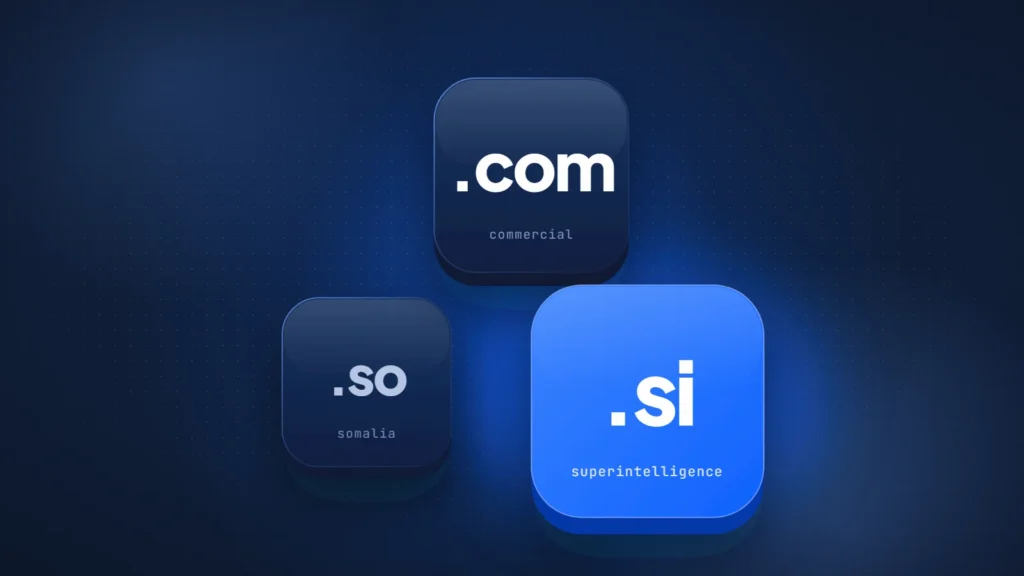
.si is Slovenia’s country-code domain. For AI companies it reads as SuperIntelligence, a playful framing rather than an official meaning. If your product sits close to artificial superintelligence (ASI) research or AI tooling, the ending says something about the product, much as “so” did for Notion’s casual brand.
The .si registry has a calmer history. The IANA entry for .si records a delegation on April 1, 1992, and lists ARNES, the Academic and Research Network of Slovenia, as its manager. ARNES itself dates from a month later, May 1992, and has run the .si registry for decades. The same entry shows a secure delegation, with a DS record in the root.
Eligibility is simpler too. The Register.si general terms set no nationality or residency requirement for holders. Registrars, for their part, must have their seat in the EU or hold ICANN accreditation.
| Feature | .so | .com | .si |
|---|---|---|---|
| Type | Country code (ccTLD) | Generic (gTLD) | Country code (ccTLD) |
| Country | Somalia | None | Slovenia |
| Manager listed by IANA | Ministry of Post and Telecommunications, soNIC as technical contact | VeriSign Global Registry Services, under contract with ICANN | ARNES (Academic and Research Network of Slovenia) |
| In the root since | August 28, 1997 | 1985, one of the original domains | April 1, 1992 |
| Who can register | Disputed: a Somali connection per some registrars, sold widely in practice | Anyone | No nationality or residency requirement in the registry terms |
| Root DNSSEC (November 9, 2026) | Not signed (no DS record) | Signed | Signed (secure delegation) |
| How the ending reads | “So”, as in a casual English word | Company, the default | SuperIntelligence, for AI founders |
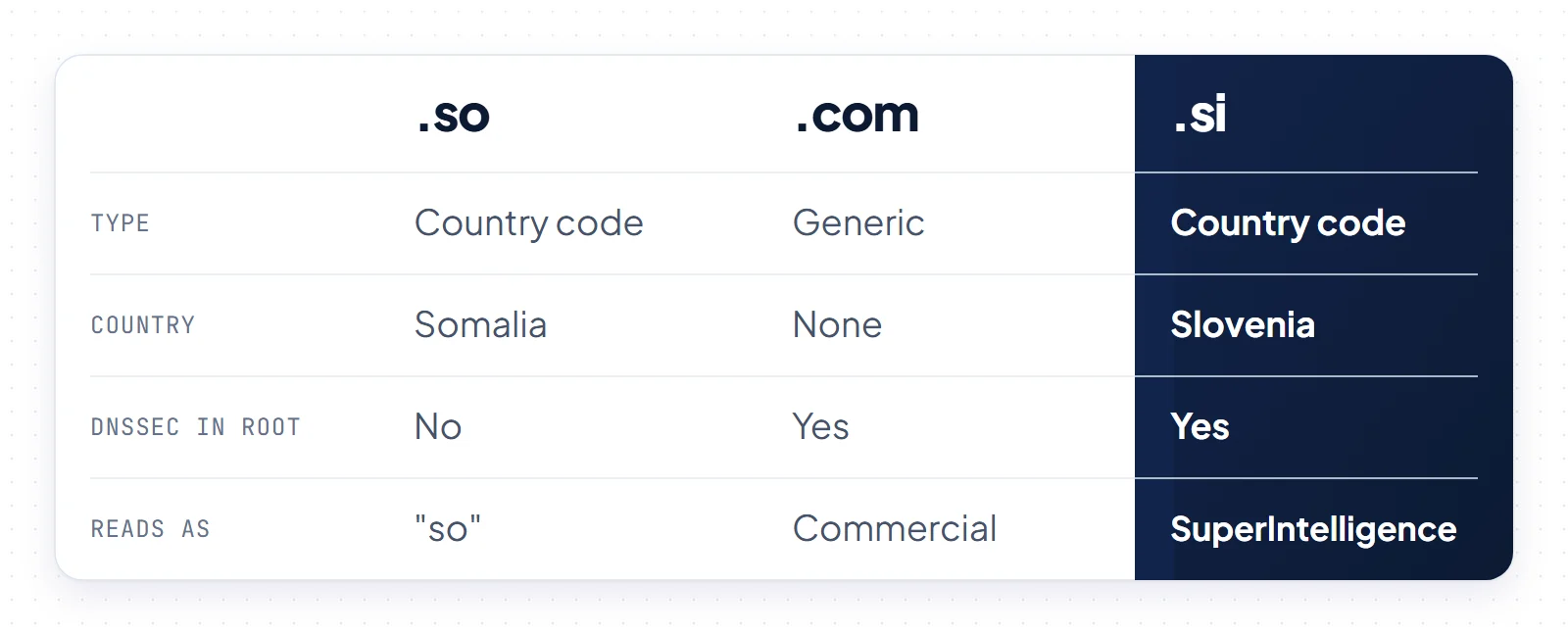
A .si name can do what notion.so did for Notion and turn the ending into part of a word. Take essai.si, one of the names we sell: “essai” is French for attempt or essay, and the name contains both “ai” and “si”. The table above sums up the trade: .com is the safe default, .so is short but uncertain, and .si pairs an EU registry with an AI-friendly reading.
Should you use a .so domain?
Use a .so domain only if you accept the rules gap and the missing DNSSEC chain. It is a fine choice for a side project, a tool or a playful brand, as tally.so and ray.so show. It is a weaker choice for a company that sells to banks, large enterprises or regulated buyers.
If you already run on .so, there is no need to panic or migrate immediately. Turn on auto-renew, keep the registrar contact current, and test your email with the filters your customers use. If you can buy the .com or another strong name later, follow Notion’s playbook: move with redirects and keep the old .so registered so links keep working.
If you are naming an AI product today, compare options side by side. A .com fits a broad brand, .ai signals the category, and .si adds a SuperIntelligence reading on a stable EU registry. Pick the one your buyers will trust and type without a second look.