A .io domain is the country-code domain of the British Indian Ocean Territory, but tech startups adopted it because “IO” reads as input/output. Google treats .io as a generic domain, not a country one. The UK–Mauritius Chagos deal, announced in 2024, raised questions about its future, yet as of October 2026 .io keeps working normally.
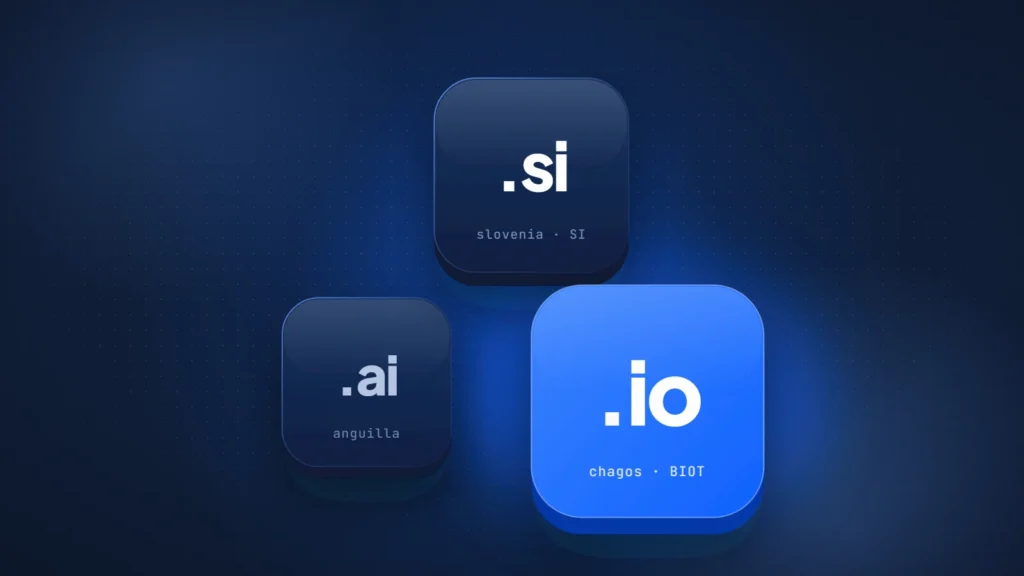
Ahrefs data from October 5, 2026 shows about 3,600 US and 13,000 global monthly searches for “.io domain”. That is more than “.ai domain” at 11,000 and “.si domain” at 3,300 global searches. This guide covers who runs .io, how Google treats it, what the Chagos treaty could change and how to decide.
What .io stands for and who runs it
The .io extension stands for the British Indian Ocean Territory, whose ISO 3166-1 code is IO. IANA lists Internet Computer Bureau Limited as the sponsoring organization and dates the delegation to September 16, 1997.
The IANA root zone record for .io gives the sponsor’s address as care of Sure (Diego Garcia) Limited, on Diego Garcia. The registry website, nic.io, names Internet Computer Bureau Ltd in Orpington, UK, as the operator. It says anyone, anywhere can register a .io name, first come, first served.
Afilias bought Internet Computer Bureau (ICB), which also runs .ac and .sh, in April 2017. The price was $70.17 million in cash, a figure from Afilias’ Irish financial statements reported by Domain Incite in November 2018. Donuts acquired the Afilias registry business in December 2020, and the two companies announced their rebrand as Identity Digital on June 22, 2022.
In October 2024, Identity Digital told The Register that it is “the registry service provider for .io” and would keep supporting the domain’s operation. Domain Incite, citing the registry’s latest financial filing, reported ICB revenue of £31.6 million for 2024 across .io, .ac and .sh. The same report says the vast majority of that business is in .io. Registration prices vary by registrar, and the registry publishes no retail price list.
Why startups use .io domains
Startups use .io because the two letters read as input/output, a basic computing term. Google treats .io as a generic domain, so a .io site can serve a global audience without a local signal. The registry operator, Internet Computer Bureau, lets anyone, anywhere register a .io name, which keeps the extension open to founders in any country.
The registry also pitches .io around the input/output reading. Over time, the extension became common among tech companies, so many founders and engineers read it as a technical signal. A name on .io tells visitors little about location and a lot about the product category.
That appeal has limits. The extension is tied to a territory whose status is changing, and most .io owners have no link to that territory. The rest of this guide explains the actual rules and what to plan for.
Is .io trusted by Google?
Google treats .io like a generic top-level domain, so a .io site gets no geotargeting to the British Indian Ocean Territory. Google lists .io among the country-code domains it handles this way.
Google’s guide to multi-regional and multilingual sites, last updated December 10, 2025, states the rule in one sentence. “Google treats some ccTLDs (such as .tv and .me) as gTLDs, as we’ve found that users and website owners frequently see these more generic than country-targeted,” the guide says. The list that follows has 20 entries, including .io and .ai alongside .co, .me and .tv. Google notes that the list may change.
Slovenia’s .si is not on that list. Google therefore treats .si as a country-code domain for Slovenia. That helps a site aimed at Slovenia, but it sends a local signal for a site with a global audience. Our guide to ccTLDs explains how country signals work for every other extension.
The Chagos question: what changed in 2024–2026
The UK–Mauritius treaty, signed on May 22, 2025, would recognize Mauritius as sovereign over the Chagos Archipelago. That raised the question of whether the IO code, and with it .io, would disappear. As of October 2026, the treaty has not entered into force, and .io operates as before.
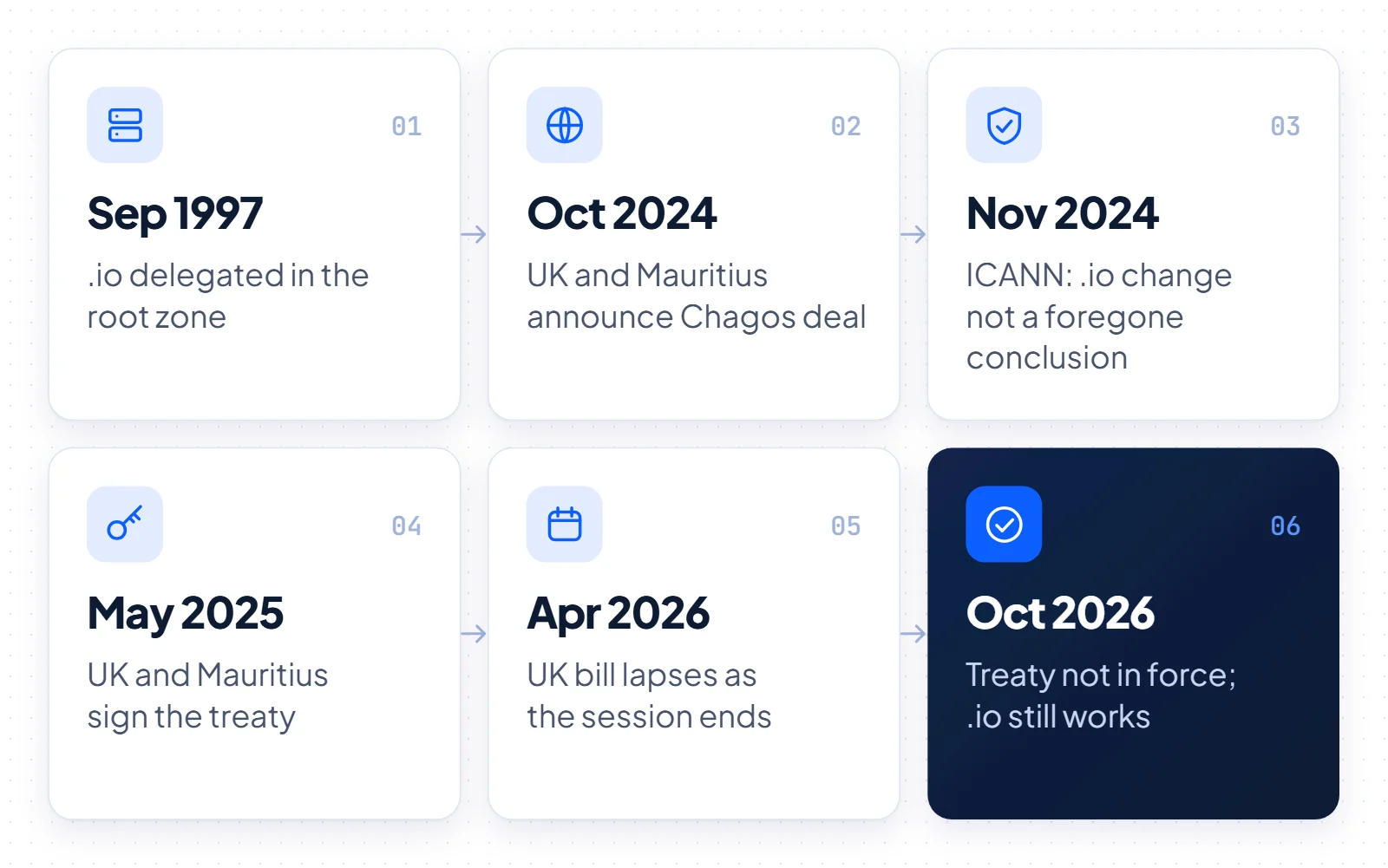
On October 3, 2024, the UK and Mauritius issued a joint statement on the islands. The UK would agree that “Mauritius is sovereign over the Chagos Archipelago, including Diego Garcia,” with a 99-year arrangement for the base. The two governments then signed the UK–Mauritius agreement on May 22, 2025.
The UK implementing bill was the Diego Garcia Military Base and British Indian Ocean Territory Bill. It could not complete its passage before the 2024–26 parliamentary session ended on April 29, 2026. According to Al Jazeera, Prime Minister Andy Burnham said on September 21, 2026, that the UK would work with Mauritius and the US on a way forward. The same October 2, 2026 report says the treaty has not yet entered into force.
| Date | Event | Source |
|---|---|---|
| September 22, 2022 | ICANN Board adopts the ccTLD retirement policy | ICANN |
| October 3, 2024 | UK and Mauritius announce that Mauritius will be sovereign over the Chagos Archipelago | GOV.UK |
| October 10, 2024 | Identity Digital says it will keep supporting .io | The Register |
| November 14, 2024 | ICANN explains how ISO 3166-1 and its retirement policy apply to .io | ICANN |
| May 22, 2025 | UK and Mauritius sign the treaty | GOV.UK |
| April 29, 2026 | 2024–26 session ends; the UK implementing bill falls without completing passage | Al Jazeera |
| September 21, 2026 | UK prime minister says the UK will work with Mauritius and the US on a way forward | Al Jazeera |
| October 2026 | Treaty not in force; .io still delegated and operating | Al Jazeera; IANA |
What happens to .io if the IO code is removed
Under ICANN’s ccTLD retirement policy, the process for .io starts only if the ISO 3166 Maintenance Agency deletes the IO code. A Notice of Removal then opens a phase-out of five years by default and 10 years at most.
The trigger is “the deletion of that corresponding Alpha-2 Code Element from the ISO 3166-1 Standard by the ISO 3166-1 Maintenance Agency,” according to the ccNSO policy. A treaty alone does not start the clock. Members of the ccNSO backed the policy in July 2021, and the ICANN Board adopted it on September 22, 2022.
Within that window, the registry has five years from the notice to phase the domain out. Extensions can add up to five more years, and IANA must remove the ccTLD from the root zone no later than 10 years after the notice.
ICANN addressed .io directly in a November 14, 2024 blog post. Kim Davies, who leads IANA Services, said any removal would open a five-year window that might be extended. “It is not a foregone conclusion that a change in sovereignty will result in a change to the .io domain,” he wrote.
We found no announced change to the IO code as of October 2026. The Register reported in October 2024 that the ISO record had been unchanged since 2018.
How past ccTLD retirements played out
Past ccTLD retirements took years, and the most famous candidate, .su, is still delegated. Every retirement in the table below predates the 2022 policy, so these cases show the pace of past transitions rather than how the current rule will work in practice.
| TLD | Trigger | ISO removal | Retired or status | Source |
|---|---|---|---|---|
| .yu | Yugoslavia split; names moved to .rs and .me | YU replaced by CS, July 2003 | Retired March 30, 2010 | Wikipedia; RNIDS |
| .tp | East Timor became Timor-Leste (.tl) | 2002 | Retired, IANA notice February 28, 2015 | IANA |
| .an | Netherlands Antilles dissolved October 10, 2010 | December 15, 2010 | Retired by 2015 after a phased transition | IANA |
| .um | Not ISO-triggered; largely unused, and its manager gave it up | No ISO change | Removed from the root; IANA record “Not assigned” | IANA |
| .su | Soviet Union dissolved in 1991 | 1992 | Still delegated, October 2026 | IANA; Domain Name Wire |
The .su case is the clearest reminder that retirement is neither automatic nor fast. IANA updated the .su record on August 5, 2026, more than three decades after the Soviet Union ended, and the domain is still delegated. In March 2025, ICANN director Becky Burr said there had been no formal letter kicking off any process, as Domain Incite reported. In April 2025, the ccNSO wrote that the retirement policy does not apply to .su, because SU sits on ISO’s “exceptionally reserved” list, according to Domain Incite.
.io vs .ai vs .si vs .com
The .io, .ai and .com extensions all work as global domains in Google, while .si sends a country signal for Slovenia. The choice comes down to meaning, the names still available and how much policy risk you accept.
| Extension | Country or territory | Google treatment | Typical use |
|---|---|---|---|
| .io | British Indian Ocean Territory | Generic (on Google’s ccTLD list) | Developer tools and tech startups |
| .ai | Anguilla | Generic (on Google’s ccTLD list) | AI companies; reads as artificial intelligence |
| .si | Slovenia | Country signal for Slovenia | Slovenian sites; short brand addresses for AI names |
| .com | None (generic TLD) | Generic | Default for businesses worldwide |
Anguilla’s .ai is the closest alternative for an AI product. It shares the generic treatment in Google and reads as artificial intelligence. Our guide to .ai domains covers its rules and prices.
.si is Slovenia’s country-code domain. For AI companies it reads as SuperIntelligence. That reading is our framing, not an official meaning, and it comes with a Slovenian country signal in Google. One common setup is a short .si brand address that redirects to a main site on a generic extension, as our .si domain guide explains.
The .com extension has no link to any country or territory. That makes it the simplest fallback for any brand, even when the main site lives on another extension.
Should you choose a .io domain?
A .io domain remains a reasonable choice as of October 2026 when the name fits your product and you hold a fallback domain. Under ICANN’s retirement policy, any removal of .io would start only after ISO deletes the IO code and would allow five years by default and 10 years at most. That makes the Chagos question a policy risk to plan for, not an immediate deadline.
If you already run a .io brand
No retirement process has started, and under ICANN’s policy any future one would begin only after an ISO change, with five years by default to move. A rushed migration costs redirects, rebranding and lost links for a risk with no date attached. Secure a fallback name now and keep watching primary sources.
If you are naming a new brand
Start with your risk tolerance. If the brand must last for decades without a planned move, .com, .ai or .si avoids the Chagos question entirely. If the .io name is clearly the best fit, and your team accepts a possible move years from now, choose it. In Google, .io works like any generic domain.
Keep a fallback and a paper trail
- Hold a fallback domain on .com, .ai or .si, and renew it alongside the .io name.
- Write down your registrar, the account owner, the renewal date and the auto-renew setting.
- Know your transfer path: how to remove the registrar lock and request the auth code. Our guide on how to transfer a domain covers each step.
- Keep the brand name, not the extension, at the center of your logo and marketing.
- Follow IANA’s .io record and ICANN announcements rather than registrar marketing.
Prices vary by registrar, so compare renewal terms as well as the first-year price. The decision itself rests on two primary facts: Google treats .io as generic, and no retirement clock has started as of October 2026.