Mustafa Suleyman is the executive vice president and CEO of Microsoft AI, reporting to Satya Nadella, as of November 16, 2026. He co-founded DeepMind in 2010 and Inflection AI in 2022, wrote The Coming Wave, and leads the MAI Superintelligence Team. Since March 2026 he has focused on superintelligence and Microsoft’s own MAI models, not Copilot.
That last detail is where many profiles go out of date. Microsoft’s March 2024 announcement put Copilot, Bing and Edge under him. A March 17, 2026 leadership update moved Copilot to Jacob Andreou. Since then, Suleyman has published a draft code of conduct for Microsoft’s models and warned the industry against building conscious machines. This profile follows his record company by company, then checks which domains each chapter of his career sits on.
Mustafa Suleyman at a glance
The table below keeps to items with a clear primary source. Most details of Suleyman’s early life come from secondary sources. According to Wikipedia, he was born in London in 1984 and studied philosophy and theology at Oxford, leaving without a degree. Wikipedia also lists early work on the Muslim Youth Helpline, a human-rights policy role for London Mayor Ken Livingstone and the consultancy Reos Partners.
| Item | Detail | Source |
|---|---|---|
| Current role | EVP and CEO, Microsoft AI, reporting to Satya Nadella (since March 19, 2024) | Official Microsoft Blog |
| Focus since March 17, 2026 | Superintelligence and MAI models; Copilot led by Jacob Andreou | Official Microsoft Blog |
| Companies co-founded | DeepMind (2010), Inflection AI (2022) | CNBC |
| Book | The Coming Wave, with Michael Bhaskar (Crown, September 5, 2023) | Penguin Random House |
| Honors | CBE, 2019 New Year Honours, “for services to the UK Technology Industry” | The London Gazette |
| Recognition | TIME100 AI, 2023 and 2024 | TIME |
| Other roles | Board of The Economist Group; Senior Fellow, Belfer Center, Harvard Kennedy School | mustafa-suleyman.ai |
| Google Scholar | 31,134 citations, h-index 26, i10-index 39 (checked by BuySI Domains on November 16, 2026) | Google Scholar |
Mustafa Suleyman at DeepMind and why he left Google (2010–2022)
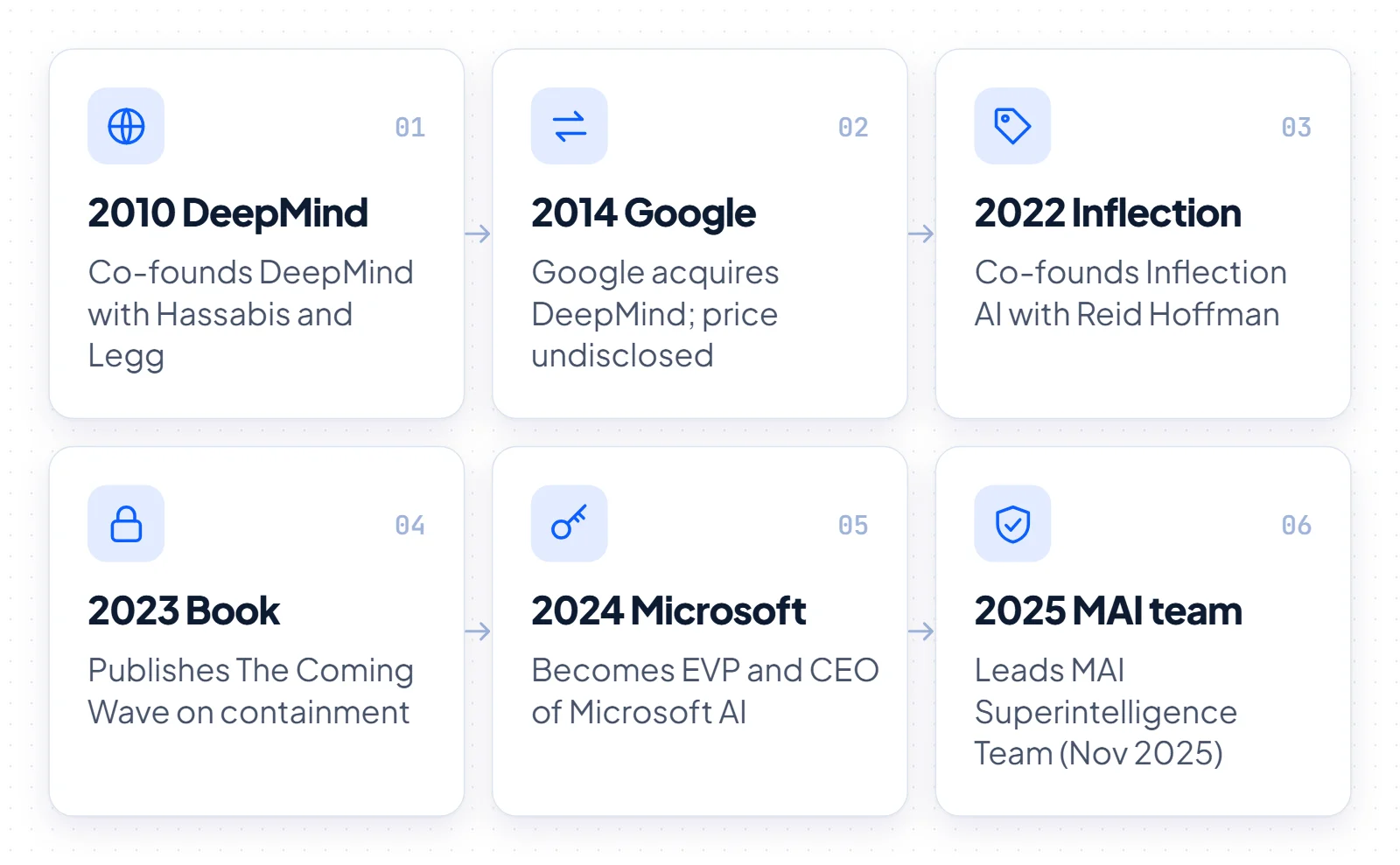
Suleyman co-founded DeepMind in London in 2010 with Demis Hassabis and Shane Legg. His own site says he “led its applied research and commercialisation efforts.” Google bought the company in January 2014. Neither side disclosed the price, and TechCrunch reported it at more than $500 million.
Health work drew the most scrutiny. DeepMind Health launched in February 2016 and built Streams, an app for acute kidney injury. On July 3, 2017, the UK Information Commissioner’s Office (ICO) ruled on a Streams trial at the Royal Free hospital in London.
The ICO found that the Royal Free NHS Foundation Trust failed to comply with data protection law when it shared data on about 1.6 million patients with DeepMind. The ruling was against the Trust, the data controller, not DeepMind, and the ICO issued no fine. Google completed its takeover of DeepMind Health in September 2019.
In August 2019, Bloomberg reported that Suleyman was on leave from DeepMind. He described it himself as a “break to recharge.” In December 2019 he moved to Google as vice president of AI product management and AI policy. In January 2021, CNBC reported that Google and DeepMind had used an external lawyer to look into “concerns that were raised about Mustafa’s management style.”
Suleyman apologized in a statement to CNBC: “I drove people too hard and at times my management style was not constructive.” Neither company published the findings of the review. In January 2022 he left Google to become a venture partner at Greylock, CNBC reported. On a podcast with Reid Hoffman he said, “I really screwed up,” and that he remained sorry for “the hurt that people felt.”
Inflection AI and Pi (2022–2024)
Reid Hoffman, Suleyman and Karén Simonyan announced Inflection AI in March 2022, with Suleyman as CEO and Simonyan as chief scientist. Its chatbot, Pi, short for “personal intelligence,” launched on May 2, 2023, on the web and iOS. In June 2023, TechCrunch reported a $1.3 billion round led by Microsoft, Reid Hoffman, Bill Gates, Eric Schmidt and Nvidia, at a $4 billion valuation. The money was meant for a cluster of 22,000 Nvidia H100 GPUs.
The startup phase ended quickly. On March 19, 2024, Satya Nadella announced that Suleyman would become EVP and CEO of a new Microsoft AI group, with Simonyan as chief scientist. Bloomberg reported that Microsoft agreed to pay Inflection about $650 million, mostly to license its models. Microsoft did not confirm the figure.
Regulators looked closely at the structure. The UK Competition and Markets Authority found that Microsoft had hired “almost all of Inflection’s team” and treated the deal as a merger. It cleared the deal on September 4, 2024, without an in-depth probe. The US Federal Trade Commission opened its own inquiry in 2024, according to the Wall Street Journal and CNBC, and it has not announced an outcome.
The Coming Wave: containment as his core idea
The Coming Wave, Mustafa Suleyman’s September 5, 2023 book with Michael Bhaskar, centers on what it calls the containment problem. Its publisher, Penguin Random House, defines it as “the task of maintaining control over powerful technologies” and calls it “the essential challenge of our age.” The argument moves from “Containment Is Not Possible” to “Containment Must Be Possible” and ends with “Ten Steps Toward Containment.”
That September 5, 2023 date is Crown’s US hardcover. A paperback followed on April 1, 2025, with the new subtitle “AI, Power, and Our Future.” The book was shortlisted for the 2023 Financial Times and Schroders Business Book of the Year. In a review for Issues in Science and Technology, Carl Mitcham and Lukas Fuchs highlight his argument that elites fall into “the pessimism-aversion trap.”
The idea did not stay in the book. Suleyman’s November 2025 post at Microsoft says superintelligence must be contained and aligned “not just once, but constantly, in perpetuity.” The book names the problem, and the 2025 post applies the same test to Microsoft’s own models.
Microsoft AI CEO after the March 2026 reorganization
On March 17, 2026, Microsoft reorganized its AI leadership. Jacob Andreou became EVP, Copilot, reporting to Satya Nadella, and took over the Copilot experience across consumer and commercial. Mustafa Suleyman kept his title as EVP and CEO of Microsoft AI. In his own memo, he said the change would let him “focus all my energy on our Superintelligence efforts.” His stated aim is to deliver “world class models for Microsoft over the next 5 years.”
The move followed a run of in-house work. Microsoft AI released MAI-Voice-1 and MAI-1-preview on August 28, 2025, and the preview model trained on about 15,000 Nvidia H100 GPUs. MAI-Image-1 followed on October 13, 2025. Two weeks later, a new Microsoft-OpenAI agreement stated that “Microsoft can now independently pursue AGI alone or in partnership with third parties.”
At Build on June 2, 2026, Suleyman announced seven MAI models, including MAI-Thinking-1, MAI-Voice-2 and MAI-Code-1-Flash. On October 15, 2026, Microsoft AI said it had finished pre-training MAI Base 2. It describes the model as a mixture-of-experts design with 2.8 trillion total parameters, trained on 16,000 GB200 GPUs for 38 days.
Suleyman still sits on the new Copilot Leadership Team. CNBC reported that he stays involved in the day-to-day running of the wider Microsoft AI group. Microsoft has not spelled out which products he oversees today, so this profile does not list them.
Humanist superintelligence and the MAI Superintelligence Team
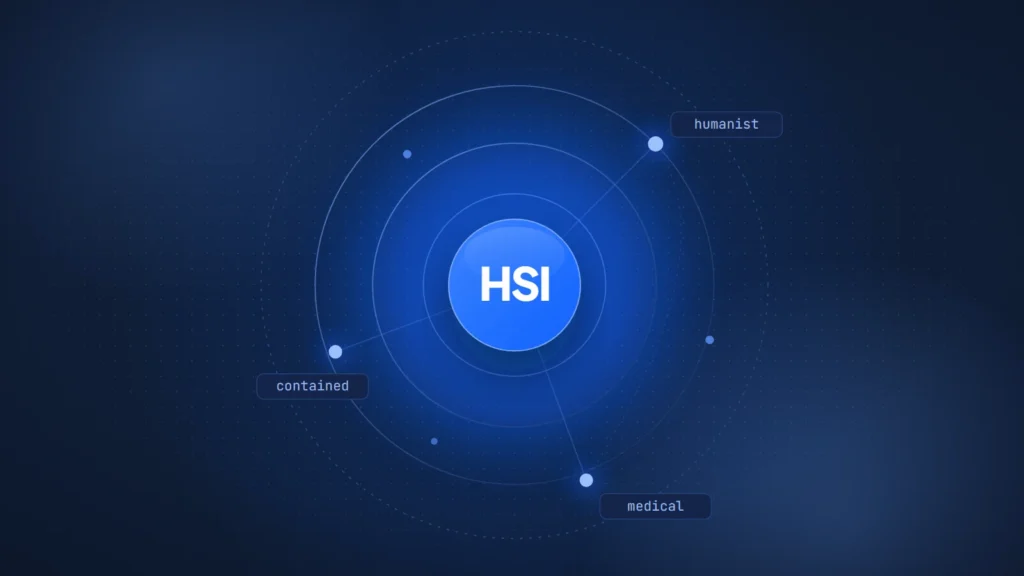
Humanist superintelligence is Mustafa Suleyman’s term for “incredibly advanced AI capabilities that always work for, in service of, people and humanity more generally.” He introduced it on November 6, 2025, when he announced the MAI Superintelligence Team inside Microsoft AI. The launch post rules out “an unbounded and unlimited entity with high degrees of autonomy.” It names three target areas: an AI companion for everyone, medical superintelligence and plentiful clean energy.
Suleyman frames the effort against the idea of a race, writing in the launch post that “we reject narratives about a race to AGI.” Fortune reported that Simonyan would serve as the team’s chief scientist. Later that month, Business Insider reported that Suleyman called fully autonomous superintelligence an “anti-goal.”
Our guide to artificial superintelligence (ASI) covers the wider term. Other labs use their own labels, as our piece on personal superintelligence shows.
Medicine is where Microsoft AI has published test results. In an October 22, 2026 post, the company said its MAI-DxO system was correct on 83% of complex NEJM cases, against 36% for physicians who could consult references. TechCrunch noted the limits: the study compared individual generalists, not specialists or teams, and most of the gain came from the underlying models. Suleyman told TechCrunch, “We’re just true believers.”
Consciousness is the other recurring theme. In an August 2025 essay he wrote that “AI companies shouldn’t claim or encourage the idea that their AIs are conscious.” On September 14, 2026, Microsoft AI opened a six-week public consultation on a draft Humanist AI Code of Conduct. It says MAI models “will never resist human interruption, correction, or shutdown,” and Suleyman called it “a warning shot,” Reuters reported.
On November 1, 2026, he went further in a post on X. According to the Los Angeles Times, he wrote: “If consciousness started to emerge in training, I would call for everyone to stop AI development until we could design out those properties.”
Suleyman’s domain trail: .ai, .google and the .si reading
On November 16, 2026, BuySI Domains checked the six live domains tied to Mustafa Suleyman’s career with RDAP lookups and live HTTPS requests. Four use .ai: inflection.ai, pi.ai, microsoft.ai and his personal site, mustafa-suleyman.ai. The other two are deepmind.google and the-coming-wave.com, the book’s website. The table below also lists deepmind.com and heypi.com. They redirect to deepmind.google and pi.ai, so we do not count them separately.
| Career chapter | Domain | What we found on November 16, 2026 |
|---|---|---|
| DeepMind (2010) | deepmind.com | Registered in 2003; redirects to deepmind.google, created September 7, 2023 |
| Inflection AI (2022) | inflection.ai | Live; the homepage no longer mentions Suleyman |
| Personal site (2022) | mustafa-suleyman.ai | Live; registered August 9, 2022 |
| The Coming Wave (2023) | the-coming-wave.com | Live; registered February 16, 2023, about 7 months before publication |
| Pi (2023) | heypi.com | Launch address in May 2023; now redirects to pi.ai |
| Microsoft AI (2024) | microsoft.ai | Live; hosts his bylined posts and the draft Code of Conduct |
The table leaves out creation dates for inflection.ai, pi.ai and microsoft.ai. They cluster in December 2017, which looks like a registry migration artifact.
The hyphen-free spellings of his name and the book title are not his sites. Someone registered mustafasuleyman.com on October 26, 2024, and it sits on a parking service. The name thecomingwave.com has been registered since 2004 and now hosts an unrelated web design firm.
.si is Slovenia’s country-code domain. For AI companies it reads as SuperIntelligence. That reading is not official, though Microsoft’s own launch post shortens humanist superintelligence to HSI. We also checked the .si equivalents of seven names on his path, from the lab names to his own name and the book title. Six of them are already registered.
That count says nothing about who holds those names, and nothing suggests Suleyman uses or endorses any .si domain. Our note on what the .si ending stands for covers the background. Our guide to choosing an .ai domain explains the trade-offs of the Anguilla ending.
The practical lesson is about product names. Pi and Copilot are short, easy to say aloud and describe a relationship with the user. A name for an AI companion or assistant can follow the same logic, and mind-portal.si is one example in that style. BuySI Domains lists mind-portal.si for sale.
How to read Mustafa Suleyman’s position
Start by separating what he says from how others read it. In his own words, Suleyman wants powerful AI that stays bounded and under human control. He told CNBC on September 18, 2026, that “Regulation is not a nasty, dangerous word.” He has also made near-term timing claims. In February 2026, Fortune reported his view that most tasks done “sitting down at a computer” could be fully automated within “the next year or 18 months.”
Others read the record with more caution. TechCrunch flagged the limits of the medical results. The CMA examined whether hiring Inflection’s staff amounted to a merger. On the 2019 episode, the public record consists of Google’s statement and his own apologies, not the findings of the review.
- Founders building AI assistants: treat the draft Code of Conduct and the 2025 essay as one lab’s written product rules, such as not presenting an AI as conscious.
- Investors and policy readers: follow MAI model releases on microsoft.ai, since his stated focus since March 2026 is models, not Copilot.
- Researchers and writers: cite dated posts from Microsoft and Suleyman himself, not 2024 profiles that still describe him as the head of Copilot.
Two open items are worth watching. In the draft Code’s preface, Microsoft AI says a revised version will guide its model development “in 2027 and beyond.” The FTC inquiry into the Inflection deal has no published outcome yet.