Geoffrey Hinton is a British-Canadian computer scientist whose neural network research underpins modern AI, which is why the media call him the godfather of AI. He shared the 2018 Turing Award with Yoshua Bengio and Yann LeCun and the 2024 Nobel Prize in Physics with John Hopfield. In May 2023 he left Google to speak about the risks of AI.
His warnings reach a wider audience now that superintelligence, the word at the center of them, has gone mainstream. Between September 9 and November 3, 2026, he briefed US lawmakers, signed a containment letter and gave a string of interviews. In the same weeks, a US executive order told federal agencies to write “Super Intelligence” where they used to write “AI.” This profile covers his record, his dated estimates and the people who dispute them.
Why Geoffrey Hinton is called the godfather of AI
The three godfathers of AI are Geoffrey Hinton, Yoshua Bengio and Yann LeCun, who shared the 2018 ACM A.M. Turing Award “for conceptual and engineering breakthroughs that have made deep neural networks a critical component of computing.” “Godfather” is a media nickname, not a title. ACM’s announcement on March 27, 2019 called the three “Fathers of the Deep Learning Revolution,” and the New York Times called Hinton “The Godfather of A.I.” in May 2023.
The nickname does not make Hinton the founder of AI. John McCarthy coined the term “artificial intelligence” in a 1955 proposal for the 1956 Dartmouth workshop. Hinton’s field is deep learning, built on artificial neural networks.
The three laureates are linked by more than a prize. According to Hinton’s ACM laureate page, LeCun spent 1987–88 as a postdoctoral fellow in Toronto after Hinton examined his PhD in Paris. Bengio was never his student: he took part in the CIFAR program on Neural Computation and Adaptive Perception, which Hinton directed from 2004 to 2013.
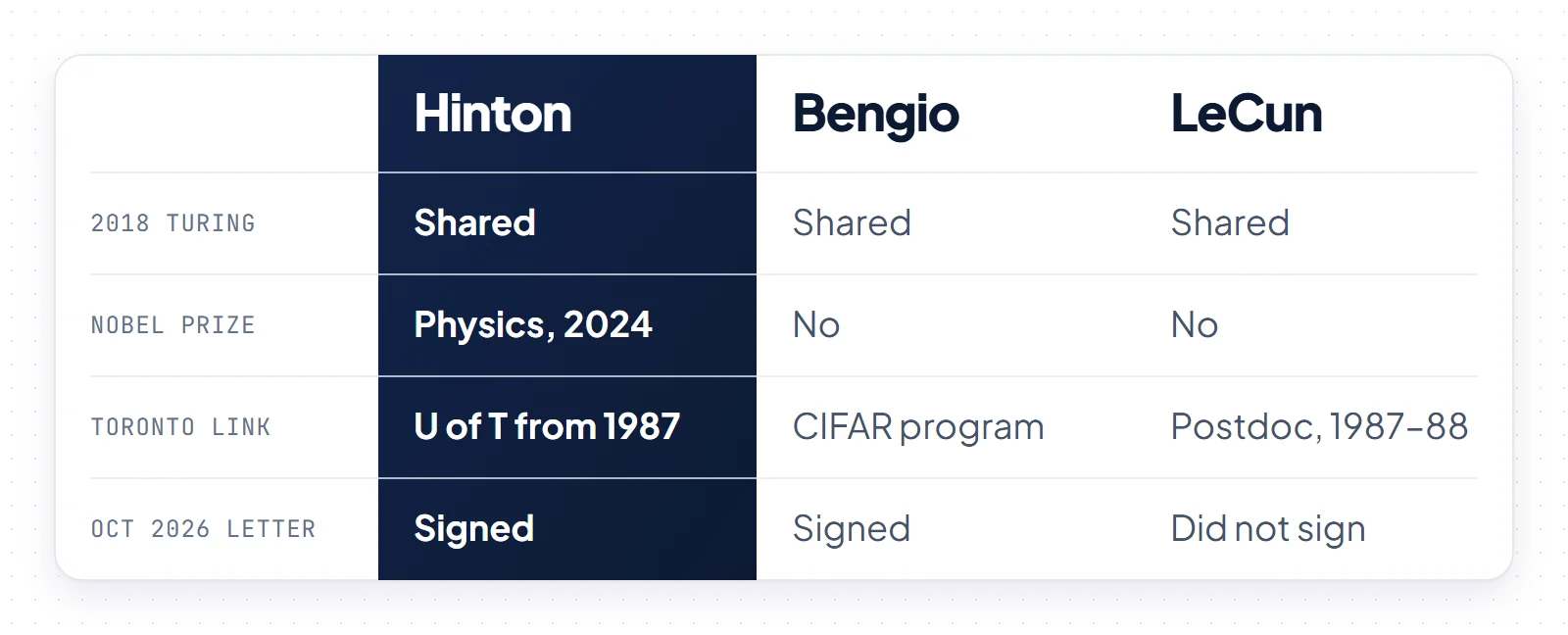
By late 2026 the three had split on risk. Hinton and Bengio signed the containment letter released on October 13, 2026, and LeCun did not. LeCun left Meta at the end of 2025 to start his own company.
From backpropagation to the Nobel Prize
Hinton was born in Wimbledon, London, on December 6, 1947. He took a BA in experimental psychology at Cambridge in 1970 and a PhD in artificial intelligence at Edinburgh in 1978. He joined the University of Toronto in 1987 and is now a University Professor Emeritus there.
In 1985 he published a learning algorithm for Boltzmann machines with David Ackley and Terry Sejnowski, using tools from statistical physics. A year later, a Nature paper by David Rumelhart, Hinton and Ronald Williams showed that backpropagation could teach networks useful internal representations. Hinton co-authored and popularized backpropagation, but he did not invent it. Seppo Linnainmaa (1970) and Paul Werbos (1974) did earlier work, and Jürgen Schmidhuber publicly disputes Hinton’s credit.
The result that reached industry came in 2012. AlexNet, built by Alex Krizhevsky, Ilya Sutskever and Hinton, won the ImageNet competition with a top-5 error rate of 15.3%, against 26.2% for the runner-up. The three had incorporated DNNresearch that year, and Google acquired it in March 2013.
At Google, Hinton became a vice president and engineering fellow. His other widely used work includes deep belief nets (2006), t-SNE (2008), dropout (2012) and capsule networks (2017).
On October 8, 2024, the Royal Swedish Academy of Sciences awarded the 2024 Nobel Prize in Physics to John J. Hopfield and Geoffrey Hinton. The citation reads “for foundational discoveries and inventions that enable machine learning with artificial neural networks.” The physics link is the Boltzmann machine, which Hinton built on the Hopfield network. Hinton gave half of his share of the prize money to Water First, a Canadian charity that trains Indigenous communities to run safe water systems.
Citations and students: how far the work spread
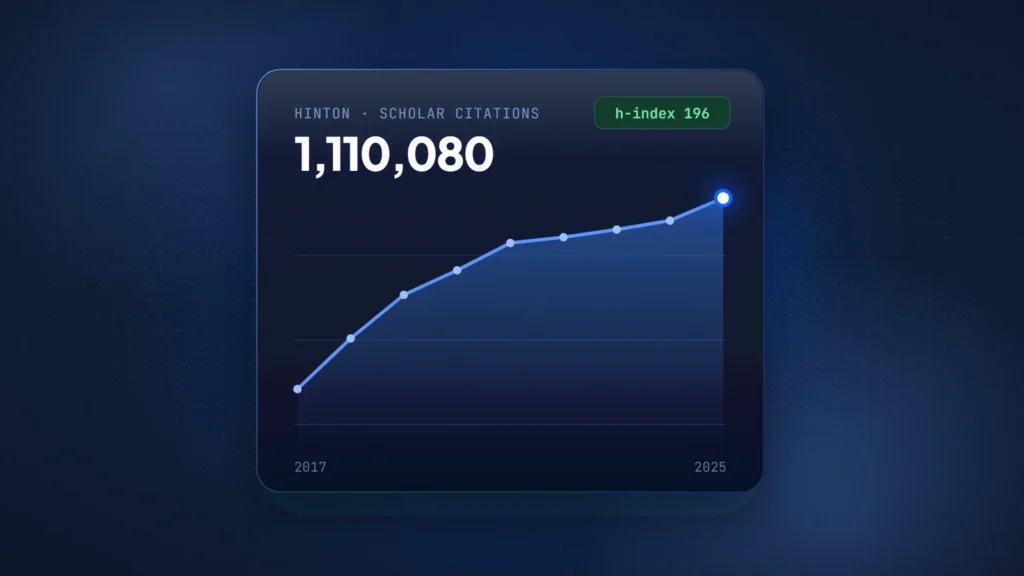
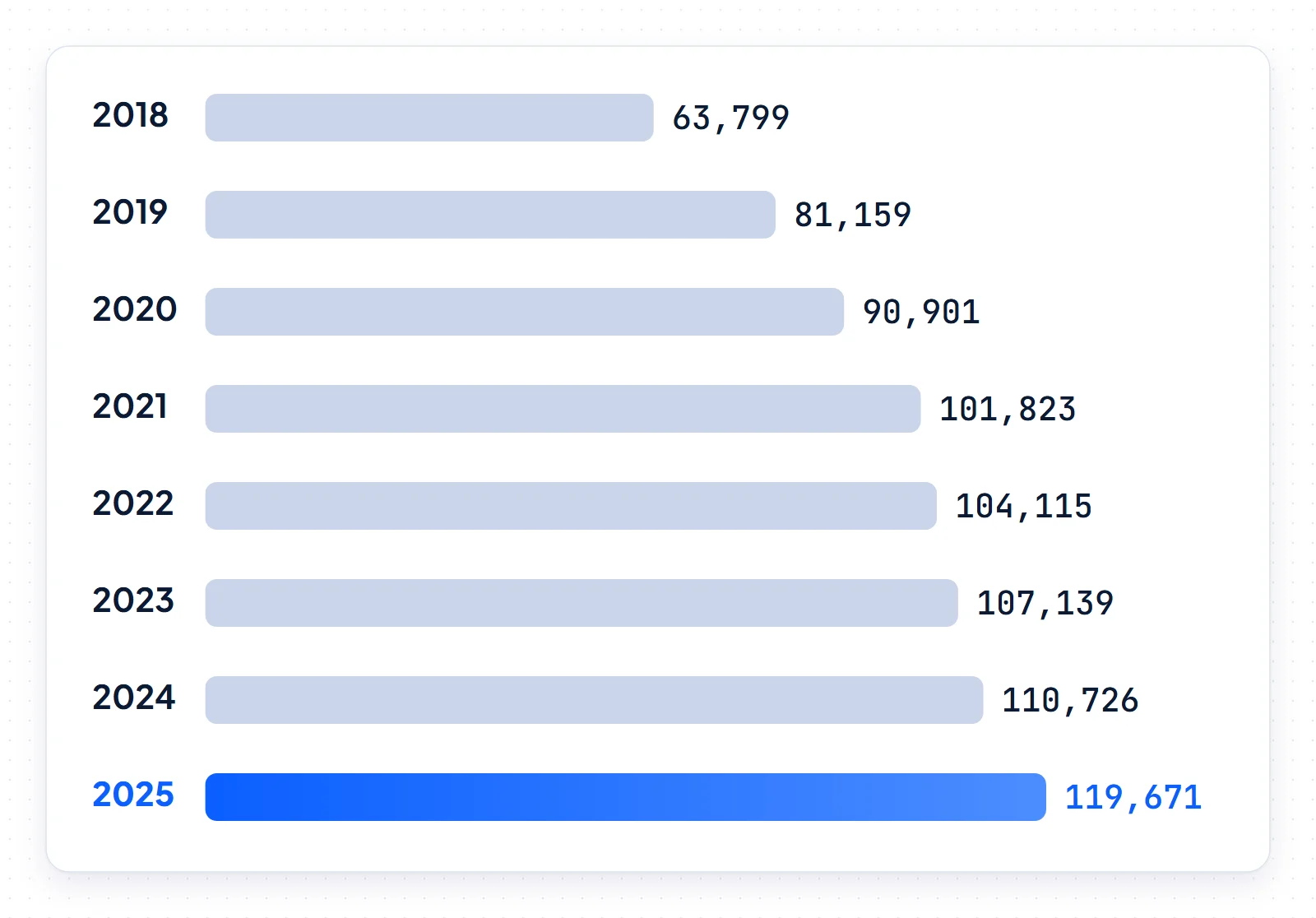
When BuySI Domains checked it on November 10, 2026, Geoffrey Hinton’s Google Scholar profile showed 1,110,080 citations, 643,729 of them since 2021. His h-index was 196 and his i10-index was 554. Yearly citations rose from 6,608 in 2012, the year of AlexNet, to 119,671 in 2025, about 18 times higher. The count for 2026, a partial year, stood at 100,156 on November 10.
The most cited item on the profile is the 2012 AlexNet paper, with 202,773 citations. Next is the 2015 Nature review “Deep learning,” written with LeCun and Bengio, at 123,555. Bengio’s own profile showed 1,189,623 citations on the same day, so Hinton ranks just behind his co-laureate.
Much of that reach runs through people. Hinton’s university page lists 38 former PhD students, among them Brendan Frey, Ruslan Salakhutdinov, George Dahl and Ilya Sutskever. His former postdocs include Peter Dayan, Zoubin Ghahramani and Max Welling.
Sutskever earned his PhD under Hinton in Toronto, co-founded OpenAI and later co-founded Safe Superintelligence Inc. (SSI), as our profile of Ilya Sutskever describes. Krizhevsky was a student in Hinton’s lab but does not appear on the PhD list. By 2017, Frey had founded Deep Genomics and Salakhutdinov led AI research at Apple, according to the University of Toronto.
Why he left Google, and how his estimates changed
Hinton left Google so he could speak freely about the risks of AI. His departure became public on May 1, 2023, in an interview with the New York Times. On X he wrote: “I left so that I could talk about the dangers of AI without considering how this impacts Google. Google has acted very responsibly.” In ACM’s summary, the warning covers misinformation, job-market upheaval and other serious threats from generative AI.
Geoffrey Hinton has cut his public estimate for smarter-than-human AI. Before 2023 he thought it was “30 to 50 years or even longer away.” On May 3, 2023, he posted “5 to 20 years but without much confidence,” and in August 2025 he called 5 to 20 years “a reasonable bet” for AGI. By September 16, 2026, he was citing researchers who say “only a few years.”
| Date | Setting or outlet | Type | What he said |
|---|---|---|---|
| Before 2023 (stated May 1, 2023) | New York Times interview | Timeline | Smarter-than-human AI was “30 to 50 years or even longer away”; he no longer thought so |
| May 3, 2023 | Post on X | Timeline | Digital intelligence overtaking us: “5 to 20 years but without much confidence” |
| October 2023 | CBS 60 Minutes | Timeline | “In five years’ time it may well be able to reason better than us” |
| December 27, 2024 | BBC Radio 4 Today (Guardian report) | Risk | “10% to 20%” chance of human extinction within about three decades, up from “one in 10” |
| April 26, 2025 | CBS News interview | Risk | A 10% to 20% risk that AI will take control from humans (CBS wording) |
| August 12, 2025 | Ai4 conference, Las Vegas (CNN) | Timeline | AGI: “A reasonable bet is sometime between five and 20 years” |
| September 9, 2026 | BBC Newsnight (reported by Semafor) | Risk | A 10% risk of human extinction “seems a not unreasonable estimate,” echoing a warning from an Anthropic alignment researcher |
| September 16, 2026 | Capitol Hill briefing (NBC) | Timeline | Researchers now say “only a few years”; Congress has “maybe a year” to act |
| October 13, 2026 | The Guardian | Risk | Restated 10–20% for the coming decades, as a signal of serious risk rather than a forecast |
| November 3, 2026 | The Guardian | Timeline | Humanity will know “within a decade” whether it can manage the risks |
Geoffrey Hinton’s two extinction-risk figures in the table are easy to merge by mistake. His December 2024 figure is a 10% to 20% chance of human extinction within about three decades. His September 2026 remark, reported by Semafor, calls a 10% extinction risk one that “seems a not unreasonable estimate” and gives no time frame of his own. Our guide to p(doom) estimates compares them with other researchers’ figures, and our AGI timeline tracker does the same for dates.
What is Geoffrey Hinton doing in fall 2026?
In fall 2026 Hinton, now 78 and still living in Toronto, is campaigning on AI risk through briefings, interviews and open letters. The dated record so far:
- September 9: BBC Newsnight, where he said a 10% risk of human extinction “seems a not unreasonable estimate,” according to Semafor.
- September 16: a closed briefing for lawmakers at the US Capitol, convened by Senator Bernie Sanders. He said Congress has “maybe a year, but not much more than a year” to set safeguards.
- September 23: an audio interview with Scott Tong on WBUR and NPR’s Here & Now.
- Late September: The Atlantic. Fortune reported him saying AI “may derive subgoals that cause it to want to get rid of people.”
- October 13: a containment letter that Reuters said drew around 400 scientists from 34 countries. It asks for an international body to oversee containment standards and incident reporting for advanced cyber-capable AI.
- November 3: a Guardian interview tied to the documentary “AI: Probably Nothing to Worry About,” which also features Demis Hassabis.
In the November interview Hinton said humanity might have been better off never developing AI, while rejecting the “doomer” label. He expects a Chornobyl-type AI incident later in 2026 or in 2027. It could be an attack that causes a massive power brownout, or an outage that brings down the financial system for a week. He wants regulation modeled on the US FDA for drugs, and said leading tech executives understand the risks but put profit first.
How “superintelligence” moved from warnings to names and policy
Superintelligence, in Geoffrey Hinton’s plain definition, is AI that is smarter than people. He told the Guardian in October 2026: “Superintelligence means smarter than people, and has been around for at least 20 years.” Since 2023 the word has moved from his warnings into a lab name, a public statement and US policy. In order, they are Safe Superintelligence Inc. (June 2024), the Statement on Superintelligence (October 2025) and Executive Order 14434, “Inaugurating the Era of Super Intelligence,” signed September 29, 2026. Our guide to artificial superintelligence (ASI) covers the concept itself.
The lab came first. Hinton’s former student Ilya Sutskever launched Safe Superintelligence Inc. in June 2024, and it describes itself as having “one goal and one product: a safe superintelligence.”
Next came the Future of Life Institute’s Statement on Superintelligence, launched October 22, 2025, which Hinton signed. It calls for “a prohibition on the development of superintelligence” until there is broad scientific consensus that it will be done safely and controllably, and strong public buy-in. Its live counter showed 78,539 signatures on November 10, 2026.
Executive Order 14434 brought the word into US policy on September 29, 2026. It tells federal agencies to write “Super Intelligence” and “SI” instead of “AI” in non-statutory materials, as far as the law allows. Our explainer on the US executive order on Super Intelligence covers what it changes.
Hinton was not persuaded by the rename. He told the Guardian that calling the technology smarter than people does not make it so.
.si is Slovenia’s country-code domain. For AI companies it reads as SuperIntelligence. That reading is informal and has no official status, but it is easier to see now that “SI” appears in US federal wording and in lab names. A name such as mind-portal.si shows how plain English words and the .si ending can read together for an AI product. BuySI Domains lists mind-portal.si for sale.
How to read Hinton’s warnings
Hinton’s warnings are best read in two layers: a scientific record that is widely recognized, and forecasts that are his own judgment. His awards and citations settle the first layer. They do not turn a probability into a measurement, and Hinton says as much.
Some concern is broadly shared. In May 2023 Hinton and Bengio joined the AI scientists who signed the CAIS statement on AI risk. It says that “mitigating the risk of extinction from AI should be a global priority alongside other societal-scale risks such as pandemics and nuclear war.” The specific numbers are his. He has said the 10–20% figure signals a serious risk of unknown size, comparing it to refusing to board a bus with a 10% chance of crashing.
Others disagree in public. Fei-Fei Li told CNN in August 2025 that she “respectfully” disagrees with Hinton, arguing for human-centered AI that preserves human dignity and agency. On September 23, 2026, Nvidia CEO Jensen Huang called the 10–20% figure “not grounded on science” on Ezra Klein’s New York Times podcast. LeCun, the third Turing laureate, did not sign the October 2026 containment letter.
Which part matters most depends on why you are reading:
- If you follow AI policy: track the containment letter and the executive order’s proposed legal definition, which the order asked for within 60 days.
- If you quote Hinton: give the date and exact wording, since “within the next three decades,” “take control” and “in the coming decades” are different claims.
- If you are forming your own view: weigh his record on the technology separately from his forecasts, and read Li or Huang alongside him.